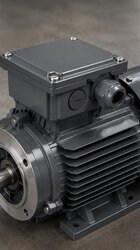
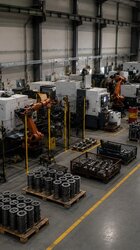
Feed factory and flour mill operators know very well what a motor failure means: when the pellet press motor stops, trucks waiting for dispatch are stuck at the gate; when the roller mill motor fails, the entire passage balance of the mill is disrupted; even a single elevator motor can lock the whole line. Moreover, because these plants run most of the year — often in three shifts — the motors must both be selected correctly and renewed very quickly in the event of failure. This guide addresses, from a buyer's point of view, the power, speed, body and protection criteria to watch when selecting pellet press, raw-material mill (hammer mill), roller mill, elevator, screw conveyor and mixer motors, the bill the wrong choice presents to the operation, and the stock-delivery dimension. As an electric motor manufacturer producing in Turkey since 1979, HEM Motor has supplied motors to the feed and milling sector for many years; it delivers its IE3 and IE4 motors in the 0.55–355 kW range quickly from strong stock in Turkey.
The Motor Map in a Feed Factory: Which Equipment Needs What?
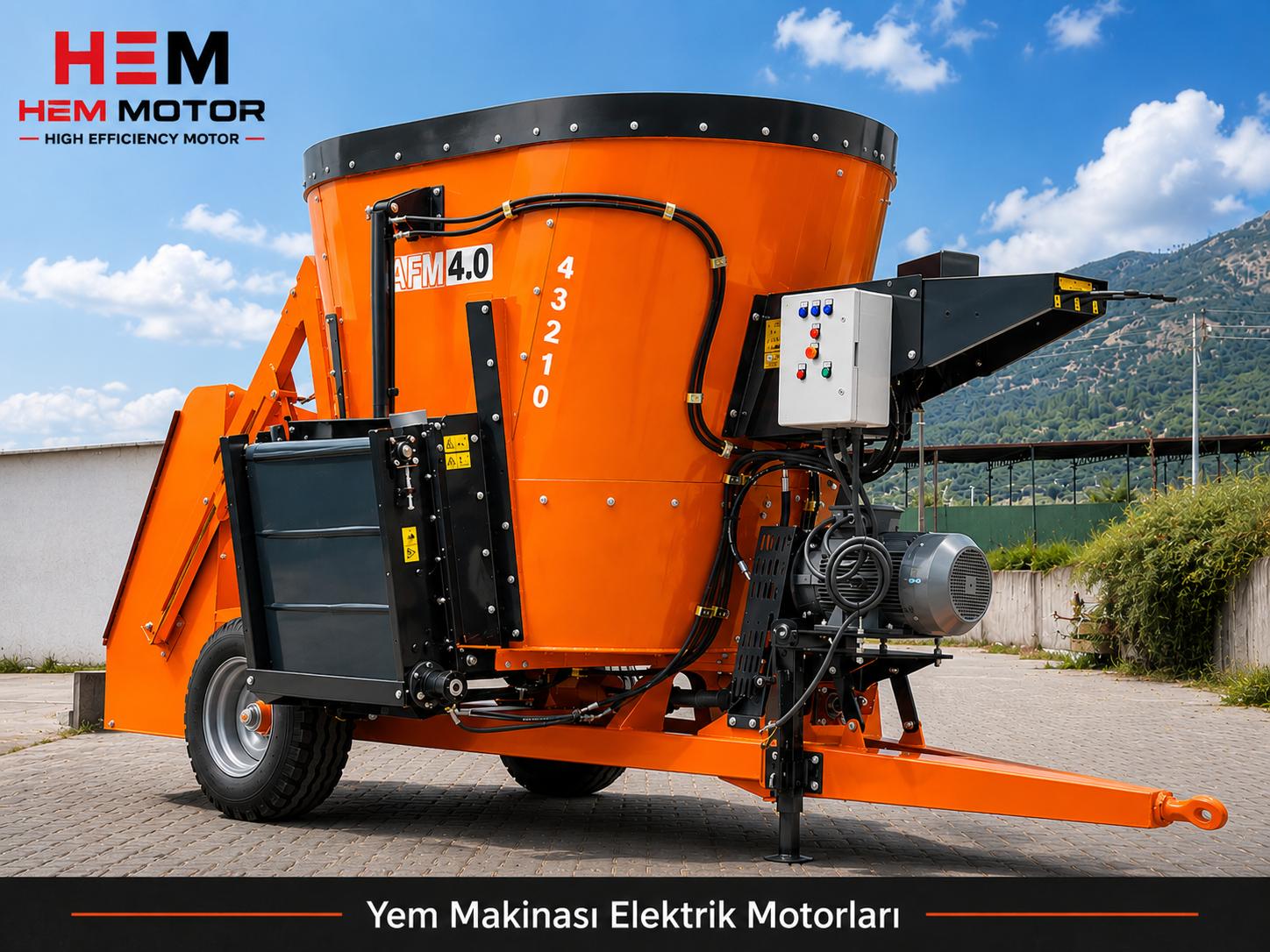
In a medium-scale compound feed factory, 30–50 electric motors run. By power, the pellet press tops the list: depending on capacity, a single large motor between 75 and 250 kW forms the main drive of the press. The second-largest consumer is the hammer mill that grinds raw material: it runs directly coupled in the 55–160 kW range, mostly with 3000 rpm (2-pole) motors. The mixer needs 11–37 kW, the molasses and oil dosing systems 1.5–7.5 kW, and the cooler fans 7.5–30 kW. In the conveying group, elevators are driven by geared motors in the 4–15 kW band and chain conveyors and screws in the 3–11 kW band. On HEM Motor's feed machinery electric motors page you can find options prepared for these equipment groups.
In a flour mill the picture is a little different: the power is distributed across many roller mills. Each roller mill needs a 15–45 kW motor, and in an 8–12 passage mill the total of the roller mill motors exceeds half of the plant power. Sifters (plansifters) are 5.5–15 kW, semolina purifiers 4–11 kW, pneumatic conveying fans 15–55 kW, and elevators and screws in the 3–11 kW band. For options specific to mill applications, you can review our flour mill electric motors page.

The Pellet Press Motor: The Plant's Most Expensive and Most Critical Selection
Three criteria are decisive in pellet press motor selection. The first is the load character: because of the compression resistance between the die and the rollers, the press draws a variable and shock load; when the formula changes (molasses, oily mixes) the resistance rises suddenly. That is why the press motor must have a robust design that can run continuously at its rated power and tolerate short-term overloads. The second is the start-up: the press never starts completely empty; feed left in the die increases the starting resistance. A star-delta or soft starter is standard, and the motor's starting torque must be verified accordingly. The third is the speed: the press drive is done with a belt and pulley, and a 1500 rpm (4-pole) motor is the most common solution. A 160 kW motor on a 30 t/h class press, and 90–110 kW motors on smaller 10–15 t/h presses, are common in the field; the exact value must be confirmed with the press manufacturer's drive table. On a press motor, a cast iron body, IP55 protection and F-class insulation are minimum requirements that should not even be up for negotiation.
Hammer Mill and Roller Mill Motors: The Importance of Speed Selection
Because hammer mills require a high peripheral speed, they generally run directly coupled with a 3000 rpm motor. In this application, rotor balance and bearing quality come to the fore: an unbalanced mill rotor transmits vibration to the motor and low-quality bearings fatigue within a few months. The other point to watch on a mill motor is that the power drawn changes with the screen change: when switching to a finer screen, the motor load rises; therefore the finest-screen scenario should be taken as the basis for power selection. On roller mills the load is more regular but the operation is uninterrupted: because the mill barely stops at all in season, the efficiency class on roller mill motors is directly the operating cost. 1500 rpm, B3 foot-mounted, IE4-class motors have become the standard in new mill projects. Together with the fan and screw motors in the wheat cleaning and conditioning section, you can complete the whole mill inventory from a single source in our high-efficiency electric motors category.
Elevator, Screw and Mixer Motors: The Continuity Group
Elevators are the plant's vertical veins, and the stopping of a single elevator cuts the whole flow. Elevator motors run with a reducer, are chosen at 1500 rpm, and a one-step power margin is left against the possibility of a full start: if the calculation shows 5.5 kW, choosing 7.5 kW is a rule that has paid for itself many times in the field. To guarantee non-reversing operation, elevator drives have a mechanical backstop; the direction of rotation must definitely be confirmed when changing the motor. In screws and chain conveyors, jamming risk determines the power selection; in mixers, the start should always be assumed full and the motor chosen with high starting torque. The real commercial gain in this group is standardisation: a plant that reduces its elevator and screw motors to two or three powers from the same series secures its whole conveying line with a few spare motors. If you are wondering about the reducer side's cost items, our factors affecting worm gear reducer prices article addresses this subject in detail.
Summary Table: Feed and Mill Plant Motor Selection Matrix
| Equipment | Typical Power | Speed | Critical Selection Criterion |
|---|---|---|---|
| Pellet press | 75–250 kW | 1500 rpm | Resistance to shock load, starting torque |
| Hammer mill | 55–160 kW | 3000 rpm | Rotor balance, bearing quality |
| Roller mill | 15–45 kW | 1500 rpm | Efficiency in uninterrupted regime (IE4) |
| Mixer | 11–37 kW | 1500 rpm | Full-start assumption |
| Elevator | 4–15 kW | 1500 rpm | Power margin, direction, reducer match |
| Screw / conveyor | 3–11 kW | 1500 / 1000 rpm | Jamming tolerance |
| Fan / exhauster | 7.5–55 kW | 3000 / 1500 rpm | Continuous regime, vibration |

The Dusty Environment Reality: Protection, Insulation and Maintenance
The common enemy of feed and flour plants is organic dust. Dust blocks the motor cooling fins and raises the winding temperature; every permanent 10-degree temperature rise halves the insulation life. That is why IP55 protection class is a minimum requirement in these plants: it provides full protection against dust and withstands wash-down cleaning. F-class insulation preserves the thermal life even in the elevator-head motors on the roof floor in summer. A cast iron body is advantageous over aluminium for both vibration damping and the ability to clean between the fins without deformation. On the operating side, there are two simple maintenance rules: the fins and fan cover should be cleaned with compressed air every month, and the bearing sounds should be listened to every three months. These two rules measurably extend motor life.
On suction and pneumatic conveying fans, the point to watch is the balance quality of the fan impeller: an unbalanced impeller silently kills the motor bearings. Having the vibration measurement done on fan motors during commissioning and recording the values is a cheap precaution that makes fault diagnosis easier later.
The Bill for the Wrong Choice: Three Real Field Scenarios
The first scenario is undersized power: a feed plant that chooses a 75 kW press motor instead of 90 kW for a 10 t/h capacity runs the motor in constant overload when it switches to a molasses formula in the busy season; the result is a burnt winding in mid-season and days of downtime. The second scenario is the wrong speed: connecting a 1500 rpm motor to a hammer mill and trying to raise the speed with a pulley comes back as belt losses and constant belt failure; a 3000 rpm motor directly is both more efficient and more trouble-free. The third scenario is a supply error: an operation forced to wait weeks for a critical press motor from abroad pays many times the price of the motor in lost production. The common lesson of the three scenarios is this: verify the power and speed selection together with the equipment manufacturer and the motor manufacturer, and for critical motors work with a domestic manufacturer capable of delivery from stock.
A Realistic Example: The Motor List of a 20 t/h Feed Factory
The main motor list of a plant producing 20 tonnes of compound feed per hour roughly takes shape as follows: a 132 kW 1500 rpm heavy-duty motor on the pellet press, a 90 kW 3000 rpm motor on the hammer mill, 22 kW on the mixer, 15 kW on the cooler fan, 4 kW on molasses dosing, motors between 5.5–11 kW on six elevators, 3–7.5 kW motors on eight screws and conveyors, and a total of 30 kW in the suction group. The plant's installed motor power reaches about 400 kW. The purchasing strategy is two-legged: on the press and mill motors, the focus is on technical verification and the IE4 efficiency class; in the conveying group, standardisation is done over a single series and one spare motor each of 7.5 and 5.5 kW is put into stock. This entire list can be shipped from HEM Motor's stocks in Turkey in a single batch; you can find the equivalent of a similar supply planning on the ready-mixed concrete side in our electric motor supply for a concrete batching plant article.

The Information to Prepare Before Requesting a Quote
The way to get an accurate and fast quote is to convey the request completely. The information we ask of our feed and mill customers at the quotation stage is as follows:
- Equipment and capacity: The equipment the motor will connect to (press, roller mill, elevator, etc.) and its hourly capacity.
- Power and speed: The kW value and speed; if unknown, a photo of the existing motor's nameplate closes all questions in one go.
- Connection type: B3 foot-mounted, B5/B14 flange or B35 combined; for motors coupled to a reducer, the flange dimension.
- Operating regime: Number of shifts, daily operating hours and start-up frequency; this determines the service factor and the efficiency recommendation.
- Environment information: Is it a dusty section, an open area, a roof floor; this enters the protection and cooling assessment.
- Lead-time expectation: Planned overhaul or urgent failure; the shipment priority is set accordingly.
Once this information reaches us, our quote comes back to you the same day with stock confirmation and a delivery date. If the list is large, it is enough to send it as an Excel file or a photo; our sales team does the arranging.
Renewing Old Motors: Rewinding or a New Motor?
It is common to work with fifteen- to twenty-year-old motors in mill and feed plants, and the same question comes up at every failure: do we send it for rewinding or buy a new one? The decision should be made by looking at three criteria. The first is efficiency loss: every rewind lowers the motor's efficiency somewhat; on a roller mill motor running three shifts, this loss can reach the price of a new motor within a few years. The second is time and risk: the days spent in the rewinding workshop are lost production, and the life of a rewound motor is uncertain compared with the factory winding. The third is the technology difference: switching from an old class-E or IE1 motor to IE4 means the same job is done with noticeably less electricity. Our practical rule is this: on motors below 15 kW, rewinding is not economical and a new one should be bought directly; at large powers, if the motor age has exceeded ten years and the plant runs intensively, renewal comes out more profitable than rewinding. In renewal decisions, we confirm from our stocks an IE4 equivalent with a body matching the old motor's nameplate exactly.
Stock and Delivery: The Insurance of a Three-Shift Plant
For feed and mill plants, the most critical question in motor supply is not the price but the lead time, because in these plants even an hour of downtime is a measurable loss. The equivalent of HEM Motor being a manufacturer in this sector is clear: in the 0.55–355 kW range, at 3000/1500/1000/750 rpm speeds and in B3/B5/B14/B35 connection types, the majority of motors are ready in the factory stocks in Turkey; for urgent failure requests, same-day cargo or vehicle organisation is done. The warranty process runs without intermediaries, directly with the manufacturer; even years later an exact equivalent motor in the same frame size is supplied. For large motors with special configurations such as a press, production prioritisation is done and a written lead time is given.
Frequently Asked Questions
My pellet press motor trips the thermal frequently; should I size up the motor?
First the cause must be diagnosed: die wear, a fine screen or a formula change can be the source of the load increase. If the load has risen permanently, stepping up one power is correct; however, if the motor's cooling fins are blocked with dust, cleaning may solve it. If you send the nameplate information and the drawn current value, we will clarify together whether sizing up is necessary.
My mill runs three shifts; is the difference of an IE4 motor really noticeable?
Yes, and it is most noticeable precisely in your profile. In operation exceeding 7,000 hours a year, the efficiency difference an IE4 motor provides over IE3 turns into a serious energy saving across the total of the roller mill and fan motors, and typically pays back the price difference in two to three years. In addition, a cooler-running motor offers a longer insulation life in the dusty mill environment.
In an urgent failure, how soon can I receive the motor?
For powers and configurations held in stock, shipment is done on the order day; next-day delivery is possible to most of Turkey. In an emergency, it is enough to send a photo of the existing motor's nameplate by phone; the stock confirmation and shipment plan are clarified in the same call.
Get a Quote
Send us your motor list, your overhaul plan or your urgent failure request for your feed factory or mill; let us make the power, speed and connection verification free of charge, and send a manufacturer price the same day together with stock availability and delivery time. You can reach us by phone at +90 (532) 345 49 86 or create a written request through our contact us page. HEM Motor: manufacturer assurance since 1979, strong Turkey stock and delivery that does not keep your plant waiting.