English
 Türkçe

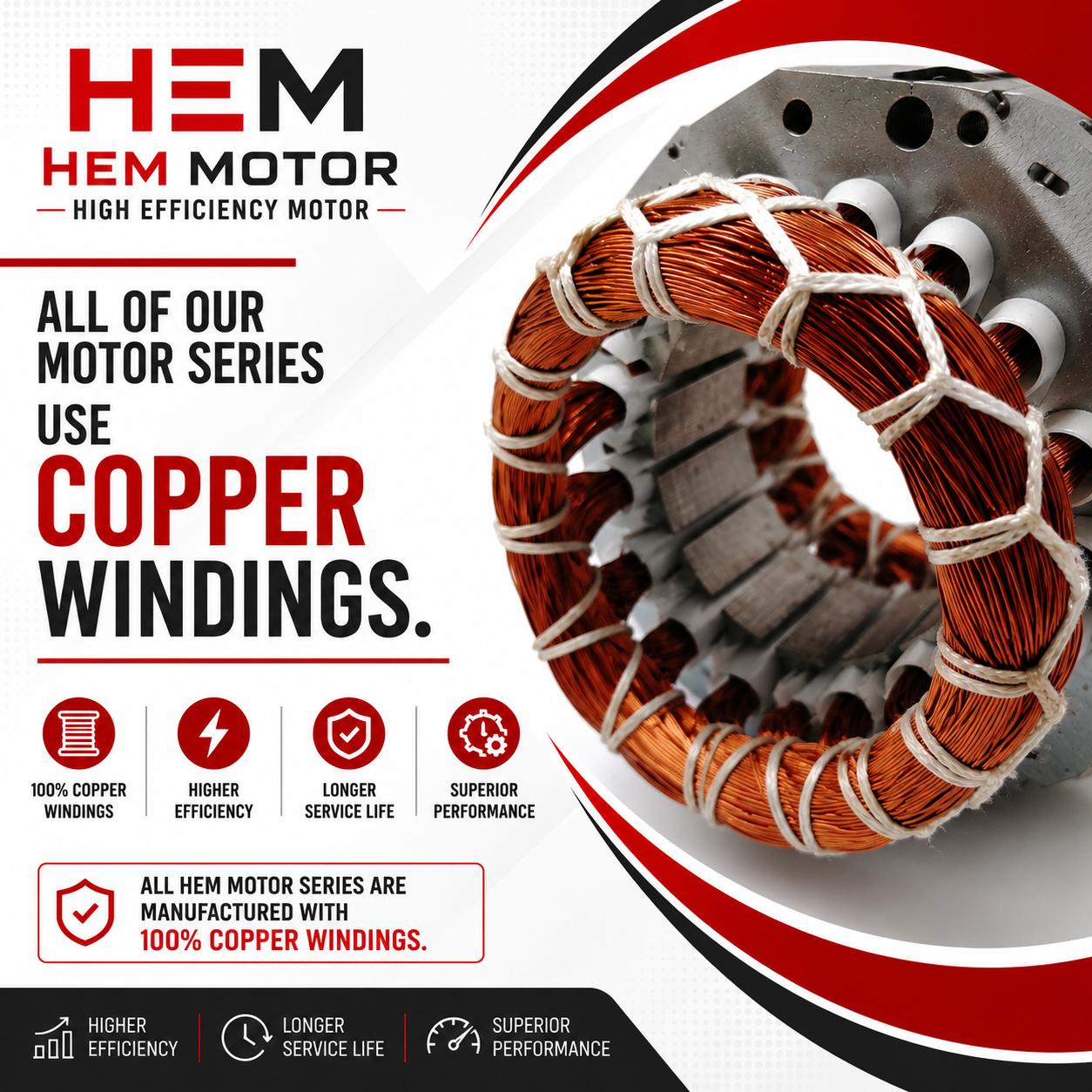

When commissioning an IE4 super premium efficiency motor in a dusty environment, most engineers focus on the efficiency class, winding quality and bearing life; but they rarely look at that simple plastic part at the very back of the motor, the fan cowl. Yet in a flour mill, a sugar factory, a woodworking shop, a feed mill or a grain silo, the motor's cooling fan pushes hundreds of liters of dusty air per second through this cowl. Dust flowing over an insulating plastic cowl generates static electricity through friction. When the charge finds no path to discharge, it accumulates on the cowl surface and at some point discharges as a spark toward the grounded metal body. In an environment with a combustible dust cloud, this small spark means an ignition source. This is exactly why, on IE4 motors, an anti-static / conductive fan cowl is a serious safety option in dusty and explosive dust environments.
In this article we explain why static charge accumulates on a plastic cowl in an IE4 motor, the mechanism of spark and ignition risk, the ATEX dust (Zone 21/22) context, the options of metal versus conductive/anti-static plastic cowl, material surface resistance values and the importance of grounding, and then how to choose the right option. The goal is to run a high-efficiency motor both efficiently and safely in a dusty plant.
Why Does Static Charge Accumulate on a Plastic Cowl?
Static electricity forms when two materials exchange electrons through friction (the triboelectric effect). As the motor fan turns, dust particles passing through the cowl constantly strike and rub against the plastic surface. A standard polypropylene or polyethylene cowl is insulating; there is no conductive path to discharge the charge accumulating on its surface. The charge gradually builds, the surface potential rises, and when it reaches a critical threshold it discharges as a spark toward the nearest grounded metal (motor body, terminal box, machine chassis). Although this discharge energy seems small, it can exceed the minimum ignition energy (MIE) of a combustible dust cloud.
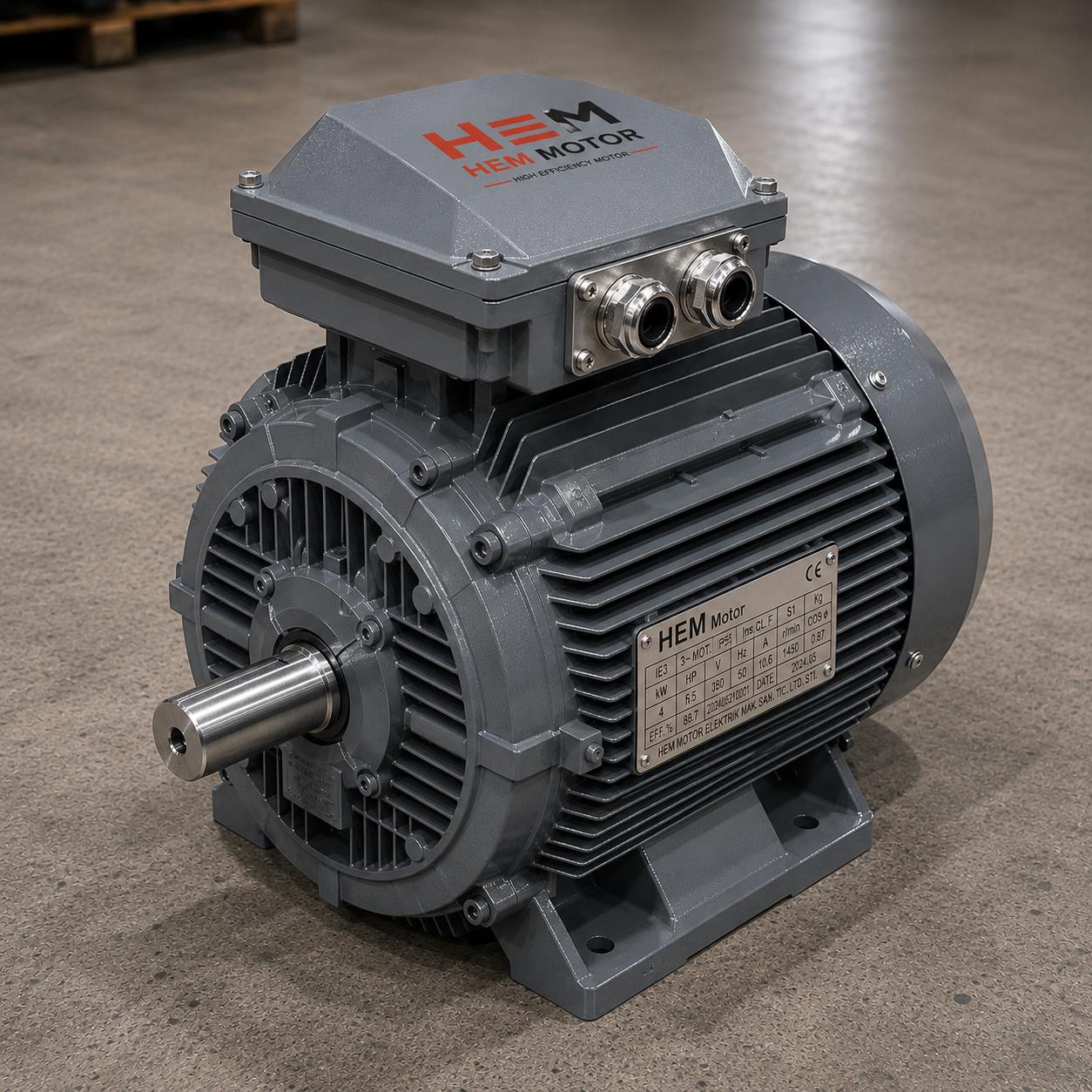
The magnitude of the risk depends on the environment's dust. Flour, starch, sugar dust, wood dust, coal dust, aluminum dust and many organic dusts form an explosive atmosphere when suspended in air at a certain concentration. The ignition energy of these dusts is sometimes in the millijoule range; a static spark can easily supply this. A standard IE3/IE4 motor's plastic cowl causes no problem in normal industry, but in areas classified as an ATEX dust zone (Zone 20/21/22), an insulating plastic cowl is a potential ignition source, and this is where the anti-static/conductive cowl comes in.
ATEX Dust Zones and the Cowl Requirement
Explosive dust environments are divided into zones according to ATEX. The table below summarizes the zone definition and the fan cowl approach.
| Zone | Dust atmosphere status | Recommended cowl |
|---|---|---|
| Dust-free / general industry | No explosive dust | Standard plastic cowl is sufficient |
| Zone 22 | Rare, short-duration dust cloud | Anti-static / conductive cowl or metal |
| Zone 21 | Occasional dust cloud in normal operation | Conductive cowl + grounding or metal, Ex tD |
| Zone 20 | Continuous / long-duration dust cloud | Full ATEX-certified Ex motor solution |
The critical point here is this: a cowl being anti-static or conductive alone does not make the motor an "ATEX motor". For Zone 21/22, the motor must be selected as fully suitable (Ex tD / category 2D-3D); the conductive cowl is only one part of that package. Yet as far as eliminating the static accumulation risk created by an insulating cowl, it is a fundamental and indispensable element.
Metal or Conductive Plastic? Material and Surface Resistance
To prevent static accumulation, the charge building on the cowl surface must be able to flow to ground. There are two ways to achieve this: a fully conductive metal cowl, or a plastic cowl with conductive/anti-static additives. For a material to be considered "static safe", its surface/volume resistance must be below a certain threshold.
| Cowl material | Typical surface resistance | Static behavior |
|---|---|---|
| Standard plastic (PP/PE) | > 10¹² Ω | Insulating, accumulates charge (risky) |
| Anti-static (dissipative) plastic | 10⁶ – 10⁹ Ω | Discharges charge slowly and safely |
| Conductive plastic (carbon-filled) | 10³ – 10⁶ Ω | Discharges charge fast, must be grounded |
| Steel / aluminum cowl | < 10² Ω | Fully conductive, grounded with body |
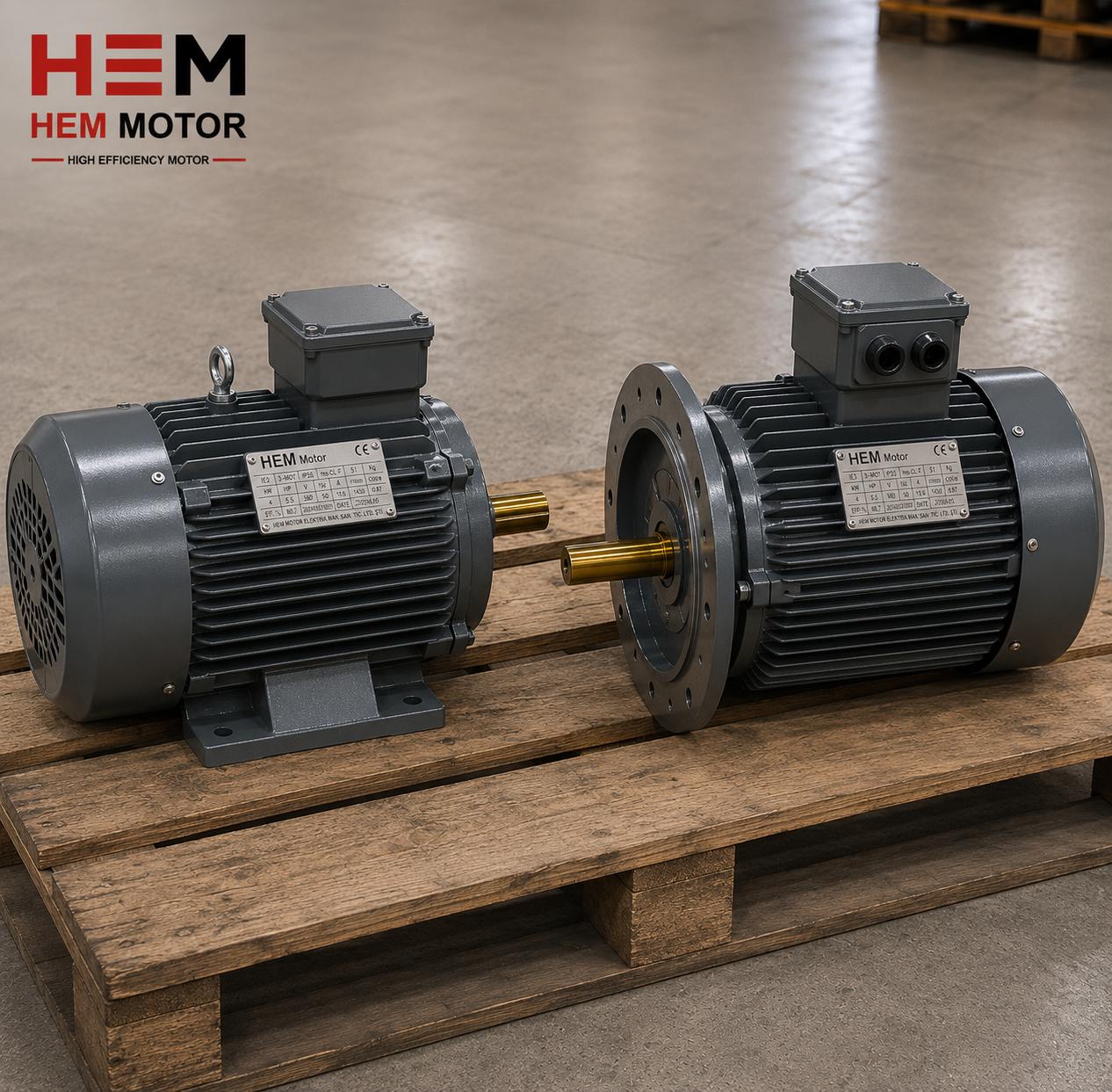
- Metal cowl: The safest and most durable option. When connected conductively to the body, static charge flows directly to ground. It is also advantageous in hot/abrasive environments; weight and cost increase are its only drawbacks.
- Conductive plastic cowl: Plastic made conductive with carbon additive; light, corrosion-resistant and more economical than metal. Used together with a grounding bridge.
- Anti-static (dissipative) plastic: Discharges the charge in a controlled and slow manner; prevents the sudden discharge spark. Sufficient for most Zone 22 applications.
Whatever material is chosen, grounding is vital: if a conductive cowl is not grounded, it still accumulates charge. The cowl must be connected to the motor body, and the body to the plant ground, via a low-resistance path. On IE4 motors fed by a VFD, grounding is also important for bearing current and EMC.
Steps to Choose the Right Option
- Clarify the environment's ATEX dust zone (20/21/22) and dust type.
- If Zone 21/22, request a conductive/anti-static cowl; switch to a full Ex tD motor solution if needed.
- Have the cowl-body-ground continuity resistance measured and documented.
- If there is hot or abrasive dust, consider a metal cowl.
- On VFD supply, plan the grounding and EMC connection together.
For more technical detail on the cooling and fan side of the IE4 motor, see our articles on IE4 motor cooling and fan design and motor fan cowl, protection guard and dust protection. On the explosive environment and grounding side, the guides on when an exproof/ATEX motor is required and motor grounding, EMC and VFD system connection are complementary. For dusty-wet environment protection level, our article on IP65-IP66 protection upgrade will also be useful.
Frequently Asked Questions
Is a conductive cowl required in every dusty environment?
No. In normal industrial environments where the dust is not explosive, a standard plastic cowl is sufficient. A conductive/anti-static cowl is required in areas containing combustible/explosive dust and classified as Zone 21/22 by ATEX. The decision is made according to the dust's ignition energy and the area's zone classification.
Does fitting a conductive cowl make the motor ATEX compliant?
Not on its own. A conductive cowl is an important element that eliminates the static accumulation risk, but ATEX compliance requires the motor as a whole (sealing, surface temperature limit, certification) to suit the relevant category. For Zone 21/22, an Ex tD certified motor must be selected, with the conductive cowl as part of that package.
Is conductive plastic or a metal cowl better?
It depends. A metal cowl is the safest and most durable option, ideal for heavy and abrasive environments, but it is heavier and more costly. Conductive/anti-static plastic is light, corrosion-resistant and economical; with proper grounding it is sufficient for most Zone 22 applications. Ambient temperature, corrosion and zone class determine the choice.
The Triboelectric Effect and the Five Conditions of a Dust Explosion
To understand why a static spark is taken so seriously, you need to know how a dust explosion forms. For a dust explosion, five conditions must be met at the same time; this is called the "explosion pentagon": combustible dust, oxygen in the air, the dust suspended in air at a certain concentration (a dust cloud), a closed/semi-closed environment and an ignition source. Four of these five conditions are already naturally present in a dusty plant; the only missing component is often the ignition source. The discharge of static charge built up on an insulating plastic fan cowl as a spark completes exactly this missing fifth corner and triggers the explosion. That is why static control is the most direct and lowest-cost step in managing dust explosion risk.
The severity of the triboelectric effect depends on the dust type, humidity and fan speed. In dry environments (low relative humidity) static charge accumulates much more easily; so the risk rises in winter in heated, drying plants. Organic dusts (flour, starch, sugar, wood) both charge easily and have low ignition energy. Metallic dusts (aluminum, magnesium) are both conductive and extremely dangerous due to their very low ignition energy. The higher the fan speed, the more dust and friction passes through the cowl; so static accumulation on high-speed 2-pole motors is faster than on low-speed motors.
Risk and Cowl Approach by Dust Type
| Dust type | Ignition energy | Recommended cowl approach |
|---|---|---|
| Inert/non-combustible dust (lime, sand) | None | Standard plastic is sufficient |
| Wood, paper, grain dust | Low-medium | Anti-static / conductive cowl |
| Flour, starch, sugar dust | Low | Conductive cowl + grounding |
| Aluminum, magnesium dust | Very low | Metal cowl + full Ex solution |
Maintenance, Cleaning and Field Verification
Fitting a conductive or anti-static cowl is not a one-time measure; maintaining its effectiveness depends on maintenance. A dust layer accumulating on the cowl surface can form an insulating layer even on a conductive cowl and disrupt the charge discharge path. So in dusty plants the cowl and cooling fins should be cleaned regularly. Likewise, a grounding connection loosening, corroding or breaking over time renders the conductive cowl ineffective. In periodic maintenance, the continuity resistance between cowl-body-ground should be measured and verified.
A simple but effective method for field verification is to measure the resistance from the cowl surface to the plant ground with a low-resistance meter. This value must be below the threshold appropriate for the material's class; otherwise the cowl, even if labeled "conductive", may be accumulating charge in practice. Documenting this measurement at new motor delivery provides objective evidence in a future audit or incident investigation.
Static-Safe Cowl Maintenance Steps
- Periodically clean the dust accumulation on the cowl surface.
- Check the soundness of the grounding bridge and its bolts.
- Measure and record the cowl-body-ground continuity resistance.
- Replace any conductive plastic cowl where you see corrosion or cracks.
- Note that static risk increases when ambient humidity drops (winter, drying).
Does a Conductive Cowl Affect IE4 Efficiency?
A frequently asked and valid concern is whether changing the fan cowl will disrupt the motor's cooling and therefore its efficiency. A well-designed conductive or metal cowl preserves the same aerodynamic profile and the same air guidance as the standard cowl; the only difference is the electrical conductivity of the material. So a static-safe cowl does not lower the IE4 motor's efficiency class. What matters is that the cowl continues to direct the correct air flow to the motor body and cooling fins. When a metal cowl is chosen there is a small weight increase, but cooling performance is the same or even better in some cases, because metal conducts heat better.
That said, to avoid disturbing the cooling balance, a part made specific to the motor and matching the original geometry must be chosen. A cowl fitted carelessly, narrowing the air inlet section or positioned wrongly, can reduce fan efficiency and cause the motor to overheat. So the static-safe cowl should be selected from the manufacturer-approved option list; a factory-shipped, tested solution should be preferred over a later field-made part.
Grounding and Static on a VFD-Fed IE4 Motor
Most IE4 motors are run by a frequency drive (VFD). This makes the static and grounding topic even more important for two separate reasons. First, VFD supply produces high-frequency leakage currents and shaft voltages; the motor needs a low-impedance, large-surface grounding connection for these to discharge safely. The same ground path also carries the static charge built up on the cowl to ground. Second, in the electrical noise environment created by the VFD, static charge built on an insulating cowl can also cause interference and faults in nearby electronic sensors and control circuits. Therefore, in dusty VFD applications, the conductive cowl, grounding and EMC connection should be planned as an integrated package.
The practical rule is: the motor body should be connected to the plant ground with a separate, short and large cross-section conductor; the cowl should be added to the body with a bridge of conductive continuity. Since paint, corrosion or a loose bolt can disrupt this continuity path, contact points should be made over clean metal surfaces.
Summary Decision Logic in Explosive Dust Environments
To turn all this assessment into a quick field decision, a simple logic chain helps: answer in order whether there is combustible dust in the environment, if so which zone it is classified in by ATEX, how low the dust's ignition energy is and how high the fan speed is. As the answers raise the risk, you move from standard plastic to anti-static plastic, from there to conductive plastic and metal, and at the extreme to a full Ex-certified motor solution. This graded approach lets you both avoid unnecessary cost and not ignore real risk.
If you want to supply IE4 motors with the right fan cowl option for your dusty and explosive dust environments, HEM Motor is by your side with its stocked product range and fast delivery advantage. For a solution suited to your environment's zone class, dust type and grounding requirements, contact us and request a quote; let the efficient motor be safe too on the dusty floor.