English
 Türkçe


When buying an IE3 efficient motor we look at the nameplate power, speed and efficiency; yet the critical value that determines how long the motor can withstand a jam, lock or failed start before burning out is often overlooked: the locked-rotor withstand time (tE) and the thermal limit. If the rotor cannot turn for any reason (mechanical jam, overload, single-phasing), the motor draws a locked-rotor current up to 5 to 8 times rated, and because the cooling fan does not turn this current is hardly cooled at all. tE is the time it takes for the winding in this locked condition to reach the temperature permitted by its insulation class; exceed it and the winding insulation is permanently damaged. If the protection relay’s trip class (Class 10/20/30) is not chosen in harmony with this tE value, the motor appears protected on paper but actually burns out. In this article we explain tE, its relation to insulation class, locked-rotor current, trip classes and the correct protection relay setting with concrete tables.
What Is the Locked-Rotor Withstand Time (tE)?
tE is the time it takes, with the motor at rated voltage and hot operating temperature, for the winding temperature to reach the limit of its insulation class when the rotor is suddenly locked. The value is given in seconds and is mandatory on the nameplate of explosive-atmosphere (Ex e) motors in particular, but it is also critical for protection selection in standard IE3 motors. The shorter the tE, the faster the motor burns and the faster the protection must act. The current drawn at locked rotor is an overload regime in which rated torque cannot be produced; for the relationship between starting torque and rated torque, see our article on IE3 motor starting torque, rated torque and DOL.
Typical Causes of a Locked Rotor
- Mechanical jam: bearing failure, foreign object, pump/fan impeller seizing.
- Overload: a counter-torque exceeding the motor’s breakaway torque.
- Single-phasing: phase loss at start, so the motor cannot start.
- Low voltage: because torque falls with the square of voltage, the motor cannot carry the load.
The Relationship Between Insulation Class and tE
The motor’s insulation class (usually F or H in IE3 motors) sets the maximum temperature the winding can withstand. Class F has a 155 °C, Class H a 180 °C limit temperature. At locked rotor, the faster the winding reaches this limit, the shorter the tE. The table below shows insulation class and typical tE values.
| Insulation class | Limit temperature | Typical tE (locked rotor) | Note |
|---|---|---|---|
| B | 130 °C | ~5 - 10 s | Older motors |
| F | 155 °C | ~8 - 20 s | IE3 standard |
| H | 180 °C | ~12 - 30 s | High thermal reserve |
Most IE3 motors use Class F insulation, often with a Class B temperature rise; this means extra thermal reserve at locked rotor. For the insulation class and temperature rise relationship, our article on IE3 motor winding insulation class F-H is detailed. For service factor and overload capacity, see our service factor and overload capacity article.
Locked-Rotor Current (LRA) and the Thermal Limit
At locked rotor the motor draws typically 5–8 times rated current. Because the fan does not turn, this current is hardly cooled and all the heat accumulates in the winding. Because the heat dissipated in the winding rises with current squared, 6 times current means about 36 times the heating power; this is why the limit temperature is reached within seconds to a few tens of seconds. For reducing locked-rotor current (LRA) and starting methods, our article on reducing starting current LRA and starting is helpful.
Protection Relay Trip Class: Class 10, 20, 30
The trip class of thermal overload relays and motor protection breakers sets how long they take to trip at locked-rotor current (7.2 × Ie). This time must be shorter than the motor’s tE; otherwise the motor burns before the protection trips.
| Trip class | Trip time at 7.2 × Ie | Suited to |
|---|---|---|
| Class 10A | 2 - 10 s | Short tE, normal start (pump, fan) |
| Class 10 | 4 - 10 s | Most standard applications |
| Class 20 | 6 - 20 s | Medium inertia, somewhat long start |
| Class 30 | 9 - 30 s | High inertia, very long start (crusher, large fan) |
Golden rule: the relay’s trip time in the chosen class must be shorter than the motor’s tE. In a long-start (high-inertia) application Class 30 is chosen; but the motor’s tE must be greater than this time, otherwise a special long-tE motor for long starts is needed. For breaker setting our motor protection breaker (MPCB) setting, and for thermal selection our thermal relay and fuse selection articles are practical guides. For the most certain protection, a winding-embedded PTC/PT100 temperature protection is recommended; it looks directly at the winding temperature, independent of current.
Correct Protection Selection Steps
- Obtain the motor’s nameplate/catalogue locked-rotor current (LRA, IA/IN) and tE value.
- Determine the run-up time and inertia regime; choose the trip class (10/20/30) accordingly.
- Verify that the chosen class’s trip time is shorter than tE.
- Set the thermal relay exactly to rated current (Ie); choose a phase-loss-sensitive type.
- For critical motors add current-independent thermal protection with a PTC thermistor.
The Link Between tE, Run-Up Time and Inertia
The locked-rotor withstand time (tE) is decisive not only for a jam scenario but also for long-start applications. While a high-inertia load (large fan, crusher rotor, mill) starts, the motor draws a near-locked-rotor current for a long time. If the run-up time approaches tE, the motor reaches its thermal limit at every start and its life shortens fast. So in long-start applications you must ask the maker for a long-start-rated (extended tE) motor; these motors extend tE with a larger rotor bar cross-section and better cooling.
| Application | Run-up time | Required tE | Recommendation |
|---|---|---|---|
| Pump, small fan | < 3 s | Standard tE adequate | Class 10 |
| Medium fan, conveyor | 3 - 10 s | Medium tE | Class 20 |
| Large fan, crusher | 10 - 30 s | Long-tE motor | Class 30 + long tE |
We also covered this topic, where inertia, run-up time and thermal limit are interlinked, in our article on run-up time and inertia moment matching. In applications needing frequent stop-start, because every start accumulates heat, the starts-per-hour limit must be watched alongside tE; our article on starts per hour limit and heating is a guide here.
Frequent Stop-Start (Jogging) and Intermittent Duty Effect
If a motor stops and starts frequently (jogging, inching), accumulated heat cannot fully cool before a new start arrives; this cumulative effect, while not as fast as a locked-rotor event, tires the winding over the long term. In intermittent duty types (S3, S4) the motor’s power and thermal capacity are assessed differently. For frequent stop-start and heating, see our articles on jogging, frequent stop-start, inching and heating in IE3 motors and for intermittent duty S3-S4 intermittent duty cycle percent heating. In these applications a PTC thermistor is the safest protection because it monitors the real winding temperature independent of current.
Service Factor and Overload Capacity
The service factor (SF) shows how much non-continuous overload above rated power the motor can carry; for example a motor with SF 1.15 meets a short-term 15% overload with extra thermal reserve. But the service factor is not a continuous-duty guarantee and does not cover an extreme regime like locked rotor. For service factor and overload capacity, our article on service factor and overload capacity is detailed. Reading the nameplate values correctly (locked-rotor current ratio, SF, insulation class) is the basis of protection selection; our article on reading the nameplate ratings is a guide here.
- Service factor: a short-term overload margin; not a continuous load.
- Locked-rotor current ratio (IA/IN): the basis of protection setting.
- Insulation class (F/H): sets the thermal reserve.
- tE: the critical time limit before burnout.
Protection Setting: MPCB and Thermal Relay Application
To set up locked-rotor protection correctly in practice, a few steps are followed. First the thermal relay or motor protection breaker (MPCB) is set exactly to the motor’s nameplate rated current (Ie); an under-setting causes nuisance trips, an over-setting makes the protection late. Then the trip class is chosen by the motor’s start regime; Class 10 for a normal-start pump-fan, Class 20 for a somewhat long start, Class 30 for a very long start. Finally, it is verified that the chosen class’s trip time at locked-rotor current is shorter than the motor’s tE.
| Step | Action | Note |
|---|---|---|
| 1 | Set thermal/MPCB current to Ie | Read nameplate current correctly |
| 2 | Choose class by start regime | 10/20/30 |
| 3 | Verify trip time < tE | Long-tE motor for long start |
| 4 | Add PTC/PT100 | Current-independent assurance |
For motor protection breaker setting and selection, our article on MPCB setting, selection and current, and for winding temperature protection wiring our PTC/PT100 wiring terminal article are hands-on guides.
Service Life and the Effect of Low Voltage
Frequent repetition of locked-rotor events markedly shortens the motor’s expected service life; each event leaves an irreversible amount of ageing in the winding insulation. Low voltage can also be a hidden cause of locked rotor: because torque falls with the square of voltage, when voltage drops the motor becomes unable to carry the load and locks. So monitoring the grid voltage reduces the locked-rotor risk. For voltage tolerance, see our article on voltage tolerance and grid fluctuation, and for expected life service life and warranty period.
Reading the Nameplate Values: The Basis of Protection Setting
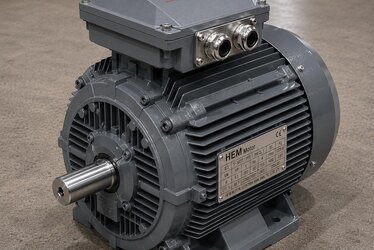
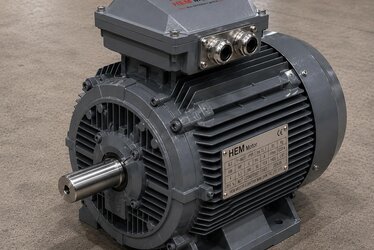
Correct locked-rotor protection starts with reading the nameplate values correctly. The nameplate carries the rated current (Ie), the locked-rotor current ratio (IA/IN, e.g. 7), the insulation class (F/H), the duty type (S1, S3...) and on some motors the tE value. These values directly set the thermal relay current setting, the trip class and the need for a PTC. If the nameplate locked-rotor current ratio is high, the current drawn in the locked condition is also high and the protection must act faster. On motors with a duty type other than S1 (continuous) (S3, S4) the thermal assessment differs.
- Ie (rated current): the base setting value of the thermal relay.
- IA/IN: the locked-rotor current ratio; sets the protection speed.
- Insulation class (F/H): affects thermal reserve and tE.
- Duty type (S1/S3/S4): changes the thermal assessment.
For nameplate and efficiency value reading, our article on nameplate efficiency value and IE code reading, and for rated torque calculation our rated torque calculation (kW-rpm-torque) are references here.
Frequently Asked Questions
What if I cannot find the tE value on the nameplate?
In standard IE3 motors tE is not always on the nameplate; it is requested from the manufacturer’s catalogue or technical document. If unavailable, an estimated thermal limit is set from the insulation class (F/H), locked-rotor current ratio and run-up time, and the protection is set accordingly.
Is a Class 30 relay safer for every motor?
No. Class 30 trips later; it is needed for long-start (high-inertia) motors, but choosing Class 30 on a short-tE motor means the protection may not trip before the motor burns. The trip class is chosen by the motor’s tE and start regime.
Does a PTC thermistor replace tE protection?
The PTC is a very valuable complement because it monitors winding temperature directly; but in a very fast locked-rotor event the heat may reach the thermistor with a delay. The safest solution is to use current-based trip-class protection together with the PTC.
Supply a Correct-tE, Protected IE3 Motor from Stock
A locked rotor is a manageable risk as long as it does not turn into burnout, with the right-tE motor and a matched trip class. Share your application’s start regime and your protection infrastructure; let the HEM Motor team deliver fast, from manufacturer stock, an IE3 motor with the right insulation class, PTC option and correct power-speed, and prepare a tailored quote. Contact us for a safe plant.