English
 Türkçe

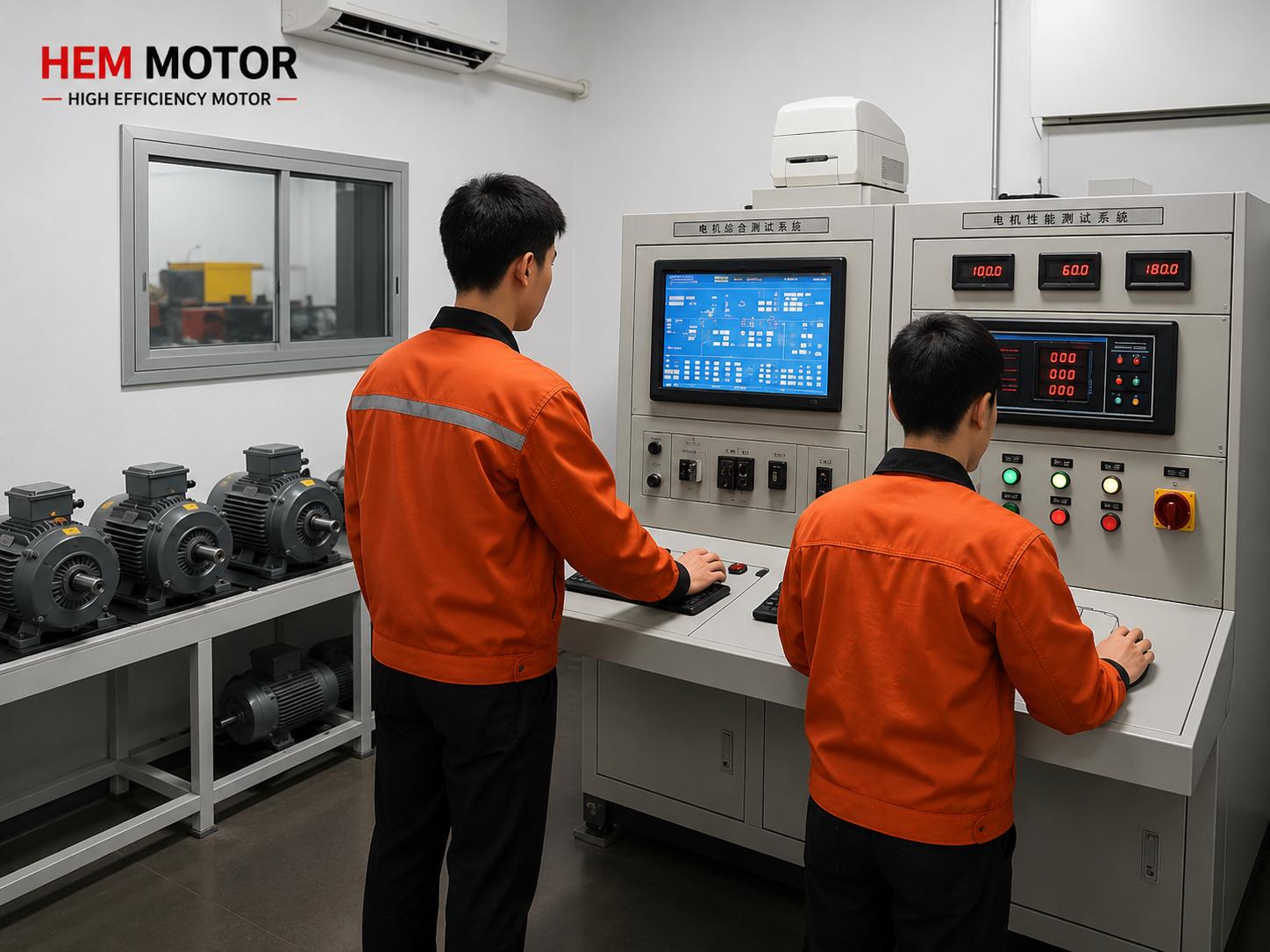

The efficiency of an electric motor depends not only on its efficiency class (IE3, IE4, IE5) but also on the load point at which the motor operates. Even a motor with the highest efficiency class will not deliver the expected savings if it is chosen at the wrong power. In this article we cover the part-load efficiency curve of a high-efficiency motor: how efficiency changes at 25%, 50%, 75% and 100% load, why efficiency is typically highest around 75% load, why efficiency and power factor (cosφ) drop together at low load, and why oversizing eats savings. The article is conceptual; the aim is to explain the decisive role of correct kW selection in energy savings.
What Is Part Load and Why Does It Matter?
If a motor runs at the rated power on its label (full load), it is at 100% load. However, in the field, motors often run not at full load but at a load below what is needed. The ratio of the mechanical power a motor draws to its rated power gives the load factor; if this ratio is 50%, the motor runs at half load. Part load is exactly this operating state below full load.
Part load matters because the motor's efficiency changes with the load factor. In continuously loaded applications, fitting the efficiency to the correct load point translates directly into savings; we covered this logic in detail in our efficiency-load curve in an induction motor article. Running the motor at the correct load is the prerequisite for truly benefiting from the advantage of a high efficiency class.
The Relationship Between Load Factor and Efficiency
A motor's efficiency curve is a curve plotted against the load factor. This curve starts low at very low load, rises as the load increases, reaches a peak and falls slightly towards full load. The shape of this curve is the key to understanding the motor's behaviour at different load points.
An important feature of this curve is that it contains a relatively flat region between 50% and 100%, that is, a wide region where efficiency is high and stable. This is good news in practice: the motor does not have to run at exactly 75%; a motor running in the 50-100% band is generally in the high-efficiency region. The real problem begins when the motor falls below this band, especially below 30%. Therefore the aim of correct kW selection is to place the motor in this wide high-efficiency band. You can review the general features and advantages of the high-efficiency motor family on our high-efficiency motors product page.
The Efficiency Curve: At 25%, 50%, 75%, 100% Load
Examining the part-load efficiency curve of a high-efficiency motor at four points makes the curve's behaviour easier to understand.
100% Load (Full Load)
The nominal efficiency on the label is the full-load value. While the motor runs at rated power, efficiency is high, but on most motors the highest point is not full load but slightly below it. We covered reading the efficiency and IE code on the label correctly in our reading nameplate efficiency and the IE code article.
75% Load: The Peak of Efficiency
In induction motors, efficiency is typically highest around 75% load. The reason is the structure of the losses: some losses are independent of load (iron loss, friction), while others increase with load (copper loss). The sum of these two loss groups reaches the most favourable balance around 75%. We detailed where efficiency losses occur in our efficiency losses in an IE4 motor article.
50% Load: A Slight Drop
At 50% load, efficiency is slightly below the peak but still at an acceptable level. Many applications run in this band, and high-efficiency motors perform well at this point too. However, the drop accelerates as you go below this point.
25% Load: A Marked Drop
At 25% load, efficiency drops markedly. Because the motor runs at a capacity far below the useful work it produces, the proportion of losses increases. This is exactly the region where oversizing is most harmful: a motor chosen far larger than necessary runs constantly in this low-efficiency region.
When we evaluate these four points together, the picture that emerges is clear: a motor's efficiency depends strongly on the load point at which it operates. The same motor that runs at near-perfect efficiency at 75% load can show a much lower efficiency at 25% load. Therefore, to evaluate a motor's real energy performance, it is not enough to look only at the nominal efficiency on the label; you need to know at which load point the motor actually runs. We covered why IE5 synchronous reluctance motors perform better in this respect at part load in our IE5 efficiency curve and part load article; synchronous reluctance technology keeps the efficiency drop at part load more limited than induction.
At Low Load, Efficiency and Power Factor Drop Together
At low load not only efficiency but also the power factor (cosφ) drops. These two drops occur together and adversely affect the total energy performance.
The Drop in Power Factor
An induction motor draws a magnetising current independent of load to create the magnetic field. As the load decreases, the ratio of this magnetising current to the total current increases; consequently the power factor drops. A low power factor means an increase in the reactive power drawn from the grid. We covered reactive draw and power factor correction at part load in our power factor and correction article.
A Double Loss
In an oversized motor both efficiency drops and power factor drops; this is a double loss. The efficiency drop is a direct energy loss, while the power factor drop creates reactive load and a compensation need. Therefore choosing a large motor "just in case" often increases costs, contrary to expectations.
Why Does Oversizing Eat Savings?
Oversizing is choosing a motor at a power far above the real need. Although it is a common habit, it is harmful for energy savings. Understanding the reason reveals the importance of correct kW selection.
Constant Operation in the Low-Load Region
A motor chosen larger than necessary runs constantly at a low load factor. For example, if a 15 kW motor is fitted while the real need is 7.5 kW, the motor runs constantly at about 50% load or below. Because both efficiency and power factor are low in this region, the savings that the high IE class would provide are largely lost. We covered correct power selection through the 7.5 and 11 kW example in our efficiency and load curve in an IE4 motor article.
Wasting the High IE Class
Investing in a high efficiency class such as IE4 or IE5 and then oversizing the motor wastes the investment. This is because the advantage of the high efficiency class appears when the motor runs at the correct load point. We compared the real difference between efficiency classes in our IE5 vs IE4 article. The correct conclusion: choose the correct power first, then determine the appropriate IE class.

How to Select the Correct kW?
For savings to be realised, the motor must be chosen according to the real load demand. Correct kW selection both moves the efficiency to the peak region and keeps the power factor high.
Determining the Real Load Demand
The real power need of the machine the motor will drive should be determined; the "safety margin" should not be exaggerated. A reasonable safety margin is enough; a motor larger than necessary grows the harm, not the margin. If an existing motor is being replaced, measuring the real load in the field with a power analyzer is the soundest method; we covered this measurement in our field verification of label efficiency article.
Optimising with Speed Control
In variable-load applications, speed control with a variable frequency drive (VFD) can keep the motor running close to the correct load point at all times. Especially in applications where the load varies with speed, such as pumps and fans, a VFD carries great savings potential. We examined when a VFD is needed in our variable frequency drive with an induction motor article. We covered why IE5 synchronous reluctance motors are superior at part load in our IE5 efficiency curve and part load article.
Duty Type and Load Profile
The efficiency curve evaluation should be made together with the motor's duty type. On a motor running continuously (S1) the constant load point is decisive, while on intermittent applications the calculation changes. We covered the effect of duty type on selection in our duty type (S1-S6) selection article. If the load profile is constant and high, correct kW selection maximises savings; if the load is variable, optimisation with a VFD comes to the fore.
Oversizing is one of the foremost mistakes made when buying an electric motor; we compiled this and other mistakes in our mistakes made when buying article. Correct power selection is critical both for not enlarging the initial investment unnecessarily and for ensuring energy savings throughout operation.
Frequently Asked Questions
Why is efficiency highest around 75% rather than at full load?
Because the losses in a motor are in two groups: load-independent losses (iron, friction) and load-increasing losses (copper). At low load the proportion of load-independent losses is high; as the load increases this proportion falls but the copper loss rises. The sum of these two effects reaches the most favourable balance typically around 75% load, which is why efficiency peaks there.
Why is choosing a large motor harmful?
A motor chosen larger than necessary runs constantly at a low load factor. In this region both efficiency and power factor drop; consequently the savings that the high efficiency class would provide are largely lost and the reactive load increases. A reasonable safety margin is enough; excessive sizing eats savings.
How do I tell if my existing motor is oversized?
You can start by comparing the current the motor draws with the rated current on the label. If the drawn current is well below the rated current, the motor may be running at low load. For a precise evaluation, the real load factor should be measured with a power analyzer. If the low load factor is constant and marked, replacing it with a correctly sized motor can deliver energy savings.
Get a Quote
If you want to determine the correct kW and efficiency class for your application, assess whether your existing motors are oversized, or plan a transition to a high-efficiency motor, the HEM Motor expert team is at your side. Share your load profile, running hours and application details; let us determine the right solution for your needs together. To get a quote, reach us at +90 (532) 345 49 86 or write to us via our contact page. You can explore our product family on our high-efficiency motors and IE4 electric motors pages, and the full range on our homepage.
Checklist
- Has the real load demand of the machine the motor will drive been determined?
- Was the motor selected so that it falls in the peak region of the efficiency curve (typically ~75%)?
- Was it sized with a reasonable safety margin, without exaggerating the "safety allowance"?
- Were the efficiency and power factor drops at low load taken into account?
- In a variable-load application, was speed control with a VFD evaluated?
- Was oversizing on existing motors checked with a current/power analyzer measurement?