English
 Türkçe

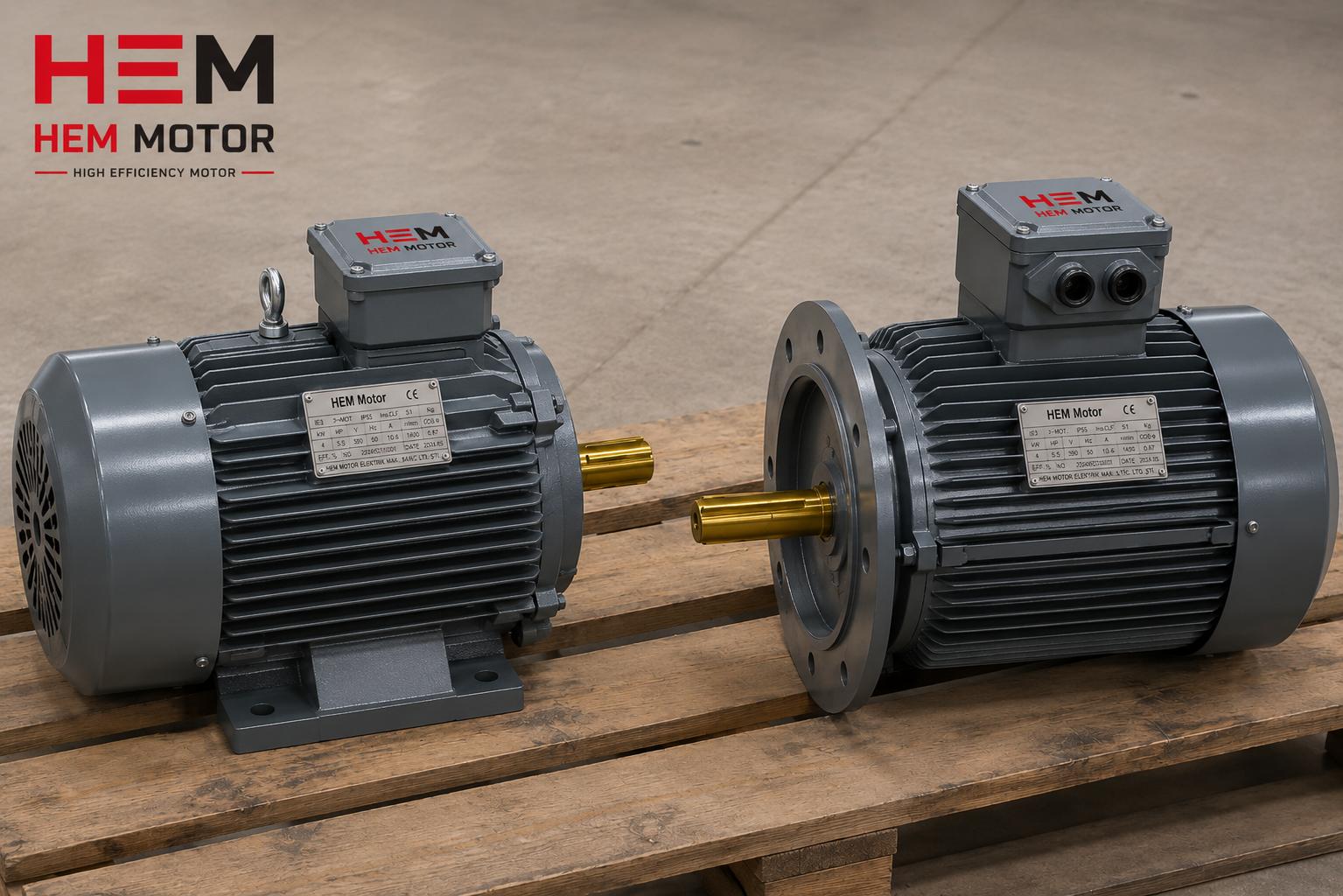

When a machine needs to run at two different speeds, the first solution that comes to mind is a variable frequency drive (VFD). However, if only two fixed speeds are sufficient and the ratio between them is 2:1, there is a much simpler and more economical solution: the Dahlander single-winding two-speed motor. The Dahlander connection makes it possible to obtain two different synchronous speeds from the same motor by changing the number of poles of a single stator winding. For example, speed pairs such as 4-pole/2-pole (1500/3000 rpm) or 8-pole/4-pole (750/1500 rpm) are obtained this way. Without an extra winding or complex electronics, switching between the two speeds is done simply by changing the contactor connection.
The greatest strength of the Dahlander motor is its simplicity; however, choosing the correct connection type for the correct application is critical. This is because the Dahlander connection can be made in three different torque characteristics: constant torque, constant power and quadratic (variable) torque. The wrong connection type causes the motor to run incompatibly with the load, to overheat, or to deliver insufficient torque. As HEM Motor, we supply Dahlander two-speed motors for fan, pump and conveyor applications with the correct pole ratio and connection type. In this article we cover the Dahlander principle, the three connection types, the contactor diagram, which connection suits which load, and the difference from a separate-winding two-speed motor.
The Dahlander Principle: Two Pole Counts from One Winding
The synchronous speed of an asynchronous motor is inversely proportional to the number of poles. If the pole count is halved, the speed doubles. The Dahlander connection changes the number of poles in a 2:1 ratio by changing the internal connection of a single winding. For this reason, Dahlander always gives a 2:1 speed ratio; for example 2/4, 4/8 or 6/12 poles. Intermediate ratios (such as 4/6) cannot be obtained with Dahlander; a separate-winding motor is required for these.
The winding ends are brought out to the motor terminal box as six (sometimes seven) leads. The winding is bridged in one configuration for low speed (high pole count) and in another for high speed (low pole count). This bridging is done automatically via contactors. You can find detailed information on the pole-speed relationship in an asynchronous motor in our article on asynchronous motor pole selection (2, 4, 6 poles).
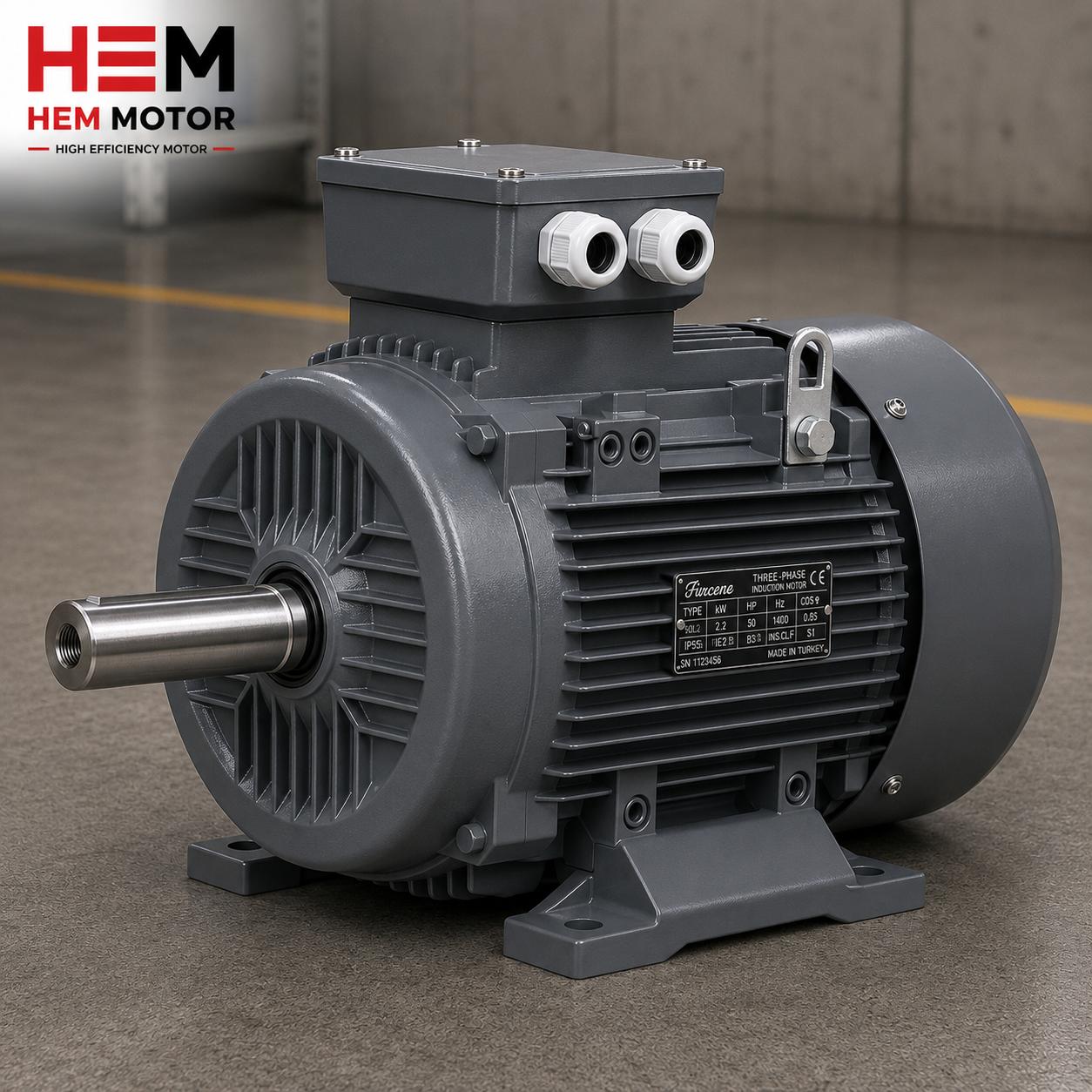
Three Connection Types: Constant Torque, Constant Power and Quadratic Torque
Depending on how the winding is bridged, the Dahlander connection offers three different torque characteristics. Choosing the correct connection type is decisive for the motor to run in harmony with the load and efficiently.
Constant Torque Connection
At both speeds the torque the motor can deliver is approximately the same; power varies proportionally with speed (when speed doubles, power roughly doubles). This connection uses star (Y) bridging at low speed and double star (YY) at high speed. It is preferred in conveyors, transporters and machines that require constant torque.
Constant Power Connection
Power remains approximately the same at both speeds; torque varies inversely with speed (as speed increases, torque decreases). This connection uses double star (YY), sometimes delta-based, at low speed and a different bridging at high speed. It is used in applications requiring constant power, such as machining tools; it is the least common connection in industry.
Quadratic (Variable) Torque Connection
Torque varies with the square of speed and power with the cube of speed. This is exactly the load character of fans and pumps. This connection uses delta (D) bridging at low speed and double star (YY) at high speed. It is the most suitable and most common Dahlander connection for quadratic loads such as fans, pumps and blowers.
Dahlander Connection Type Comparison Table
| Connection Type | Low-Speed Bridging | High-Speed Bridging | Torque Behavior | Power Behavior | Typical Application |
|---|---|---|---|---|---|
| Constant Torque | Star (Y) | Double Star (YY) | ~Equal at both speeds | Increases with speed (~2x) | Conveyor, transporter, hoist |
| Constant Power | Double Star (YY) | Delta-based | Decreases with speed | ~Equal at both speeds | Machining tool |
| Quadratic (Variable) Torque | Delta (D) | Double Star (YY) | With square of speed | With cube of speed | Fan, pump, blower |
As seen, each connection type suits a particular load character. Quadratic torque is the correct choice for fans and pumps, and constant torque for conveyors. If the connection type is chosen incorrectly, the motor draws excessive current at low speed or fails to deliver adequate torque.
Contactor Diagram: How Are the Two Speeds Selected?
The speed of a Dahlander motor is selected with a contactor group. A typical diagram has three contactors:
- K1 (low-speed contactor): Provides the low-speed bridging (e.g. delta or star).
- K2 and K3 (high-speed contactors): Form the double star (YY) bridging for high speed; they short three winding ends and feed supply to the other three.
An important rule: K1 and K2/K3 must not be energized at the same time; otherwise the winding is short-circuited. Therefore electrical and mechanical interlock is essential. In addition, when switching from high to low speed while the motor is still rotating at high speed, making the low-speed connection creates a high current surge; a short delay (time relay) is recommended during the transition.
To limit the starting current, star-delta or soft starter logic does not apply directly in Dahlander; however, you can review similar starting principles in our article on star-delta vs soft starter. The effect of speed and pole count on efficiency is explained in our article on efficiency and pole count in asynchronous motors.
Dahlander or Separate-Winding Two-Speed Motor?
A two-speed motor is produced in two ways: Dahlander (single winding) and separate-winding (two independent windings). Which one you choose depends on the speed ratio and cost.
- Dahlander (single winding): Gives only a 2:1 speed ratio (e.g. 1500/3000, 750/1500). Because it is a single winding it is more compact and usually more economical. Common in fans, pumps and conveyors.
- Separate-winding (two windings): Has a separate winding for each speed; therefore ratios other than 2:1 (e.g. 1000/1500, 750/1000) can also be obtained. It is more flexible but the frame is larger and more costly at the same power.
If your speed ratio is exactly 2:1, Dahlander is the most economical solution. If an intermediate ratio is needed, a separate-winding motor is essential. We detailed in which applications Dahlander two-speed motors are preferred in our article on dual-speed (Dahlander) asynchronous motors.
Correct Dahlander Motor Selection: A Checklist
- Is the ratio between the two speeds exactly 2:1? If not, a separate-winding motor is needed.
- What is the load character? Quadratic for fan/pump, constant torque connection for conveyor.
- The power and torque required at both speeds must be calculated; in particular, sufficient torque at low speed must be verified.
- The contactor group must always have electrical and mechanical interlock.
- The current surge must be limited with a time relay during speed transition.
- The motor thermal protection (PTC/PT100) must be set appropriately for both speeds.
Advantages and Limits of the Dahlander Motor
There are several concrete advantages behind the widespread industrial preference for the Dahlander connection. However, as with every solution, knowing its limits is necessary for a correct decision.
Advantages
- Economical solution: When two fixed speeds are required, a single-winding Dahlander motor plus a contactor group is far more cost-effective than buying a variable frequency drive.
- Robustness and simplicity: Because there is no complex power electronics, it operates reliably in dusty and harsh industrial environments; there is no electronic board to fail.
- Compact structure: Because a single winding is used, it fits into a smaller frame than its separate-winding counterpart at the same power.
- Fast speed change: It is possible to switch between the two speeds instantly via contactor transition; practical in fans and pumps that run at two speeds by process need.
- Grid compatibility: Fed directly from the grid; it does not produce harmonics and requires no additional filter.
Limits
- Only two speeds: If continuously variable speed is needed, Dahlander is not enough; in that case a variable frequency drive should be preferred.
- Fixed 2:1 ratio: Intermediate speed ratios cannot be obtained.
- Starting current: The starting current is high with direct-on-line starting; it requires attention at high powers.
- Speed transition surge: A sudden transition from high to low speed can cause mechanical and electrical stress; it should be softened with a time relay.
For these reasons, Dahlander is an ideal solution for fan, pump, blower and conveyor applications where the need is clearly two fixed speeds. When continuous, stepless speed control is required, a single-speed motor with a variable frequency drive is the correct choice.
Application Examples: Which Speed on Which Machine?
It is useful to explain how a Dahlander two-speed motor is used in practice with a few typical examples:
- Ventilation fans: Under normal conditions it runs quietly and energy-efficiently at low speed; when high airflow is required, it switches to high speed. The quadratic torque connection is used.
- Cooling tower fans: By switching between two speeds according to air temperature, both energy savings and temperature control are achieved.
- Conveyor belts: Low speed during loading, high speed during transport; the constant torque connection is preferred.
- Pump stations: Flow is adjusted with low speed during low demand and high speed during high demand.
- Elevator and hoist drives: Two speeds for approach (deceleration) and normal travel; it provides comfort and precise stopping.
You can find the correct motor selection in low-speed (e.g. 6/8-pole) applications in our article on 6 and 8-pole low-speed asynchronous motor selection. In every application it is necessary to ensure that the torque required at low speed is met by the motor; otherwise the motor cannot handle the load or overheats.
Thermal Protection and Commissioning of the Dahlander Motor
In two-speed motors, thermal protection must be considered separately for each speed. At low speed the motor's cooling fan also turns slowly; therefore heat dissipation decreases. If the load remains the same at low speed, the winding temperature can rise. For this reason:
- The thermal relay must be set according to both speed currents, or two separate thermal relays must be used.
- Monitoring the temperature directly with a PTC thermistor or PT100 sensor placed inside the winding is the safest method.
- If there is prolonged high load at low speed, a forced (external) cooling fan should be considered.
- At commissioning, both speeds and the direction of rotation must be checked separately; the contactor interlock must be tested.
Correct thermal protection directly affects the life of a Dahlander motor. Continuous monitoring of the winding temperature prevents early failure, especially in applications running at high load at low speed.
Frequently Asked Questions
Why does a Dahlander motor give only a 2:1 speed ratio?
The Dahlander connection halves or doubles the number of poles by changing the internal bridging of a single winding. Because the pole count changes by 2:1, the synchronous speed also changes by 2:1. Therefore only exact half/double ratios such as 4/2, 8/4, 12/6 are possible. A separate-winding two-speed motor is required for intermediate ratios such as 4/6.
Which Dahlander connection is correct for fans and pumps?
For applications with a quadratic load character such as fans, pumps and blowers, the quadratic (variable) torque connection is correct. This connection uses delta (D) bridging at low speed and double star (YY) at high speed. Because torque varies with the square of speed and power with the cube, it fits the fan/pump load exactly and no unnecessary current is drawn at low speed.
What happens if the contactors in a Dahlander motor energize at the same time?
If the low-speed and high-speed contactors energize at the same time, the winding is short-circuited and the motor and panel are seriously damaged. For this reason, electrical and mechanical interlock is mandatory in the contactor group. In addition, a short time delay during speed transitions is recommended to prevent a high current surge.
HEM Motor supplies Dahlander single-winding two-speed motors for fan, pump, blower and conveyor applications with the correct pole ratio and connection type. Share the character of your load and the desired speed pair with us; we will determine the connection type suited to your application and provide a quote with manufacturer stock advantage and fast delivery.