English
 Türkçe

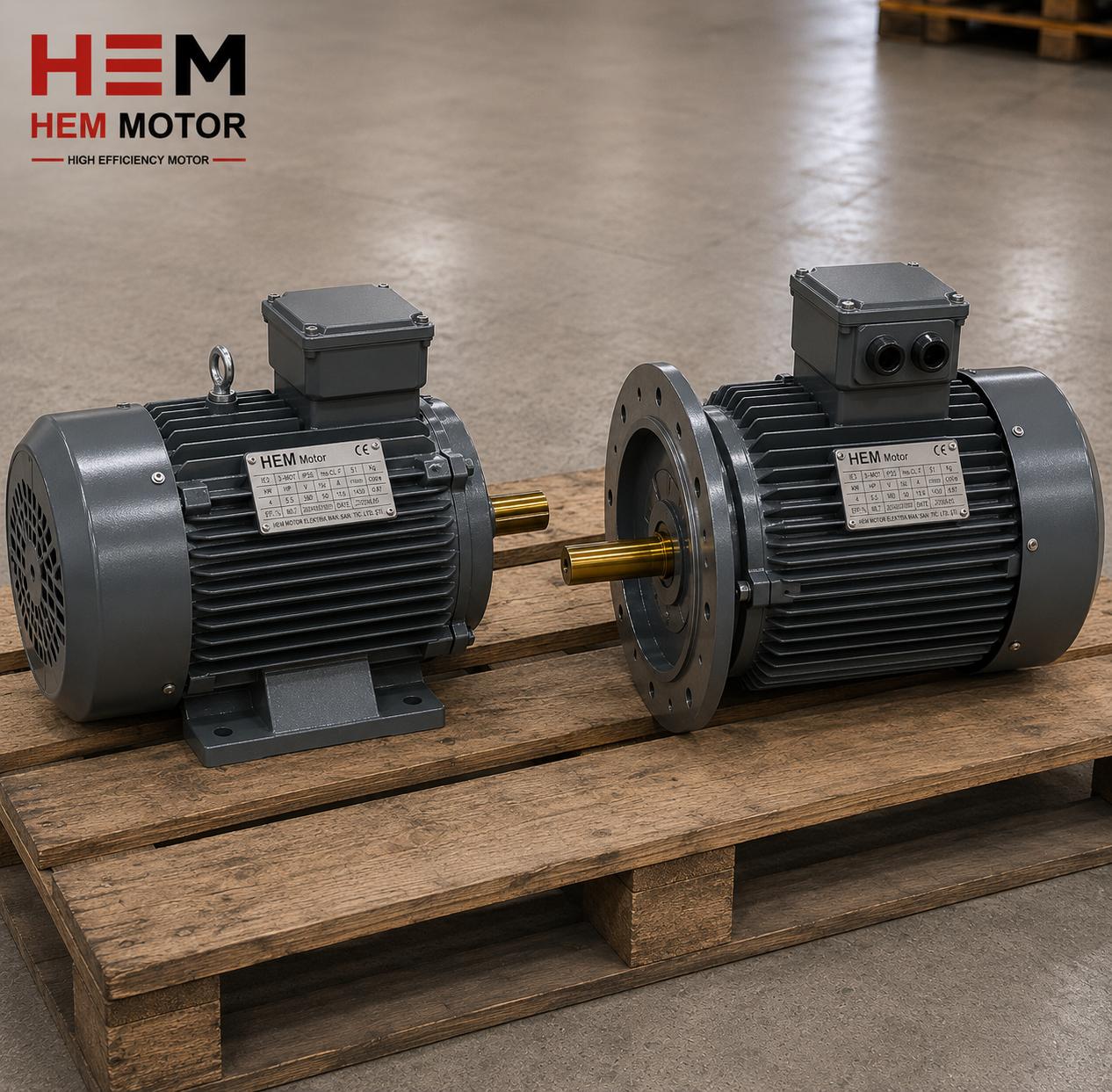

Two-speed (dual-speed) electric motors provide great flexibility in many applications such as fans, pumps, elevators and conveyors by offering two different operating speeds in a single frame. However, "two-speed motor" refers to two completely different technologies: Dahlander (single winding, pole-changing) and separate-winding (two independent windings, two separate windings) motors. The subject of this article, the separate-winding two-speed motor, is a structure in which two completely independent windings are placed inside a single stator. Each winding has its own pole number and therefore its own speed; for example one winding may be 4-pole (1500 rpm) and the other 8-pole (750 rpm). Its most important advantage is that the power and torque values at the two speeds can be selected completely independently of each other. While in a Dahlander there is a fixed ratio (2:1) between the two speeds and interdependent power values, in a separate-winding motor non-2:1 ratios such as 4/6, 6/8, 4/8 and any desired power at each speed can be freely designed. In this article we cover the operating logic of the separate-winding two-speed motor, its difference from Dahlander, terminal and contactor connection, which structure suits which application, and the correct selection step by step.
How Does a Separate-Winding Two-Speed Motor Work?
In an asynchronous motor, speed is determined by the number of poles and the grid frequency. On a 50 Hz grid, synchronous speed is found by dividing 3000 by the number of pole pairs: 2-pole 3000, 4-pole 1500, 6-pole 1000, 8-pole 750 rpm. In a separate-winding motor, two separate windings are placed in the stator; each winding has a different pole number. Only one winding is energized at a time while the other remains idle. When low speed is required, the high-pole winding is engaged; when high speed is required, the low-pole winding is engaged.
The fundamental advantage of this structure is that the two windings can be designed independently of each other. Each winding's conductor cross-section, number of turns and slot fill is optimized for its own speed and power requirement. This way, application-specific characteristics such as high torque at low speed and a different power profile at high speed can be obtained. In a Dahlander motor, because the pole number is doubled by changing the connection of a single winding, the two speeds are always in a 2:1 ratio and the power values are interdependent.
It is also useful to understand the trade-off of this design. Since two complete windings share the same stator slots, each winding occupies only part of the available slot space. As a result, the separate-winding motor is usually built in a somewhat larger frame than a single-speed motor of comparable power, and it costs more because of the additional copper and labor. In return, the designer gains full freedom over the torque and power curve at each speed. For applications where this freedom is essential, such as elevators that need a precise creep speed and a fast travel speed with independent torque, this is a price worth paying. Understanding this balance from the start prevents both oversizing and disappointment with performance.
Another important feature of the separate-winding structure is that the two windings also behave independently in terms of insulation and thermal load. Since each winding is only in circuit at its own speed, the inactive winding does not heat up; this reduces the total thermal load of the motor. However, because both windings are inside the same frame, the heat generated by the active winding is partly conducted to the idle winding as well. For this reason, the duty profile at both speeds (continuous or frequent starting, how long at which speed) must be considered in the sizing.
Separate-Winding or Dahlander? The Basic Difference
The choice between the two technologies depends on the desired speed ratio and the power/torque requirement at each speed. The table below compares the two structures.
| Property | Separate-Winding (Two Windings) | Dahlander (Single Winding) |
|---|---|---|
| Number of windings | Two independent windings | Single winding, pole-changing |
| Speed ratio | Free (4/6, 6/8, 4/8 etc.) | Fixed 2:1 (2/4, 4/8 etc.) |
| Power/torque selection | Independent at each speed | Two speeds interdependent |
| Terminal lead count | 6 leads (2x3) | 6 leads (special bridging) |
| Frame size | Generally larger | More compact |
| Cost | Higher (two windings) | More economical |
| Typical use | Where non-2:1 ratio is needed | Where 2:1 ratio is sufficient |
In short: if your speed ratio is exactly 2:1 and the power at both speeds naturally matches, Dahlander is the more economical solution. But if a non-2:1 ratio such as 6/8 is needed, or independent power/torque design at the two speeds is required, the separate-winding motor is the only option.
Speed and Pole Combinations
| Pole | Synchronous Speed (50 Hz) | Typical Combination | Application |
|---|---|---|---|
| 2-pole | 3000 rpm | 2/4, 2/8 | High-speed fan, pump |
| 4-pole | 1500 rpm | 4/6, 4/8 | General purpose, conveyor |
| 6-pole | 1000 rpm | 6/8 | Fan, elevator |
| 8-pole | 750 rpm | 4/8, 6/8 | Low speed, high torque |
This is exactly where the strength of the separate-winding motor lies: ratios that cannot be obtained with Dahlander, such as 4/6 or 6/8, can be freely designed. For example, in a crane or elevator application, low speed for approach and high speed for travel can both be requested with independent powers.
Terminal and Contactor Connection
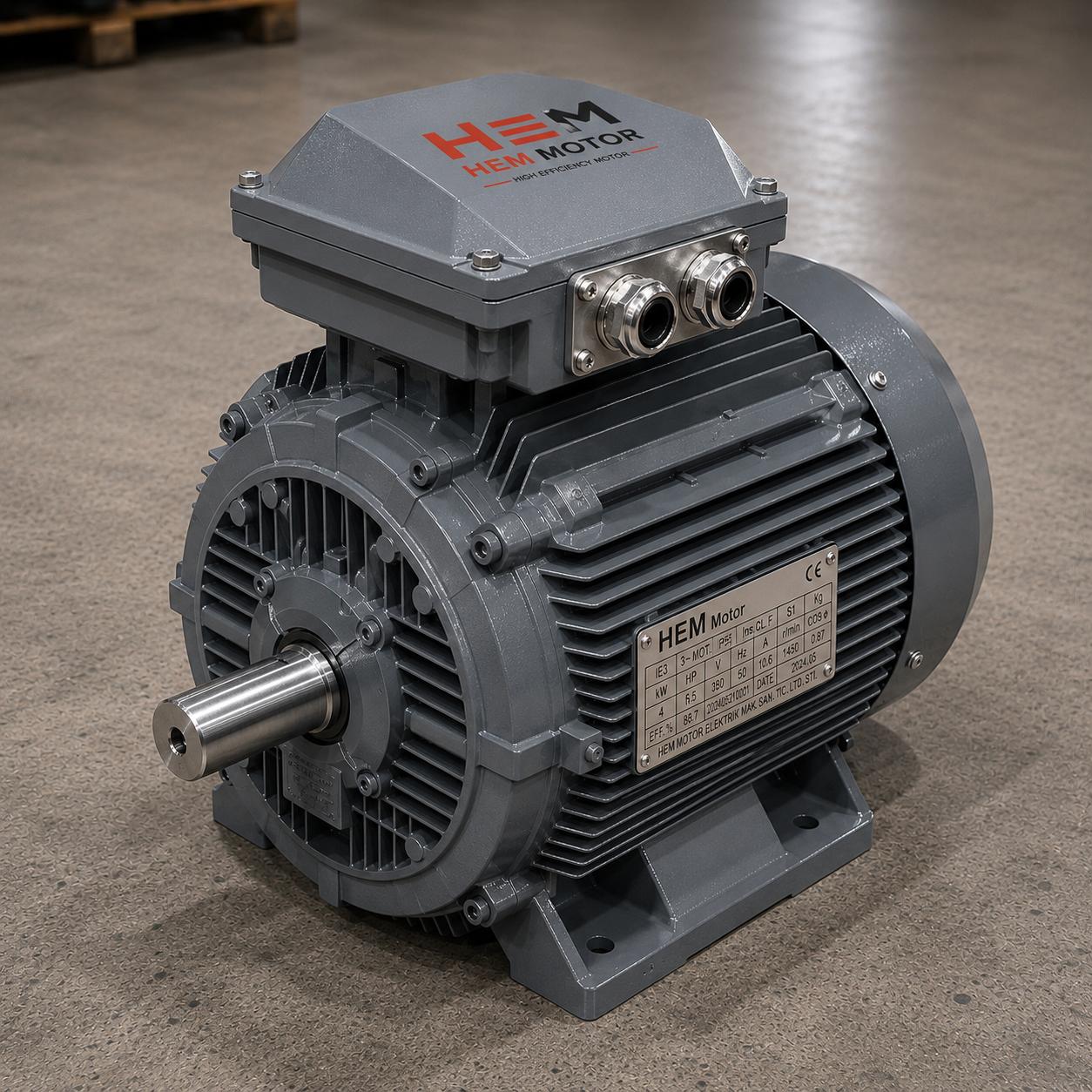
In a separate-winding two-speed motor, there are six leads in the terminal box: three for each winding. Because the two windings are completely independent, the connection is simpler than Dahlander; however, it is essential that the two windings are never energized at the same time in the control circuit. For this reason, two contactors and mutual interlocking are used.
- Low-speed contactor: Energizes the high-pole winding.
- High-speed contactor: Energizes the low-pole winding.
- Mechanical/electrical interlock: Prevents the two contactors from pulling in at the same time.
- Transition timing: A short delay during the change from high to low speed reduces mechanical and electrical stress.
The terminal connection layout and control logic must follow the motor nameplate and connection diagram. For general terminal and voltage connection, our terminal and star-delta connection article is a basic reference. For terminal box orientation and cable entry, see our terminal box orientation selection article.
Which Application Needs a Separate-Winding Two-Speed Motor?
The separate-winding two-speed motor is preferred especially in applications requiring independent power/torque characteristics at two speeds:
- Fan and ventilation: Two separate speeds for summer/winter or high/low airflow; power matching the fan load curve at each speed.
- Pump: Two speeds for different flow/pressure needs; energy saving at low speed.
- Elevator and crane: High speed for travel, low speed for floor approach/precise positioning; independent torque for both.
- Conveyor and handling: Two stages for loading/unloading and normal transport.
- Machine tools: Different speed stages for rough and fine machining.
In these applications, if a non-2:1 speed ratio (such as 6/8) or different power at the two speeds is needed, the separate-winding structure is the correct solution. In modern plants, variable frequency drive (VFD) operation is also an alternative; but when a simple, durable and drive-free two-stage solution is desired, the separate-winding two-speed motor is still a very strong choice.
A point that deserves special attention in fan applications is that the fan load torque changes with speed. The load torque of a centrifugal fan rises with the square of the speed, and its power with the cube of the speed. Therefore the power required at high speed is much greater than at low speed. In a separate-winding motor, the winding at each speed can be matched separately to this fan load curve, so the motor is neither overloaded nor oversized at any speed. In Dahlander, because the two speeds are interdependent, this matching may not always be ideal. This is exactly where the value of the separate-winding structure appears in applications with a quadratic load characteristic such as fans and pumps.
In positioning applications such as elevators and cranes, low speed is used so that the load approaches the floor or target point smoothly and precisely. Here, sufficient and controlled torque is needed at low speed, and fast, efficient travel at high speed. Independent torque design at the two speeds explains why the separate-winding motor is preferred in these applications. Selecting the correct torque class according to load type and inertia also determines the starting and transition behavior.
Steps for the Correct Selection
When selecting a separate-winding two-speed motor, follow these steps:
- Define the two speeds: Clearly define the high and low speeds required by the application.
- Check the speed ratio: Is the ratio exactly 2:1? If not, separate-winding is essential; if so, Dahlander can also be considered.
- Determine the power/torque at each speed: If independent power is needed at the two speeds, separate-winding is chosen.
- Evaluate the duty type: Frequent speed changes, starting frequency and load type affect the motor sizing.
- Control and protection: Two contactors, interlocking and separate thermal protection for each winding must be planned.
Two-Speed Motor, Dahlander and VFD Comparison
There are three basic ways to meet a variable-speed need: the separate-winding two-speed motor, the Dahlander two-speed motor, and a single-speed motor driven by a frequency drive (VFD). The right choice depends on how many speed stages are needed, the speed ratio and the budget.
| Criterion | Separate-Winding | Dahlander | VFD Motor |
|---|---|---|---|
| Speed stages | Two (fixed) | Two (fixed) | Infinitely variable |
| Speed ratio flexibility | Free | Only 2:1 | Fully free |
| Initial investment | Medium | Low | High (drive included) |
| Panel space | Two contactors | Three contactors | Drive + filter |
| EMC measures | Not required | Not required | Required |
| Durability | High (simple) | High (simple) | Depends on drive |
| Best for | Non-2:1 two speeds | 2:1 two speeds | Multi-stage/variable |
As the table shows, if the need is only two distinct speed stages and a drive-free, durable solution is wanted, the separate-winding or Dahlander motor makes more sense. If a continuously changing, multi-stage speed profile is needed, the VFD stands out. In many plants both are used together: a two-speed motor for critical, simple applications; a VFD where process control is required.
You can review the stock and application side of power and speed combinations in our IE3 power and speed stock guide article. For the efficiency and torque balance in low-speed 6 and 8-pole applications, our low-speed 6/8-pole motor article is also useful. For selection by starting torque and load, see our torque classes (Design N/H) article.
Frequently Asked Questions
What is the most practical difference between a separate-winding motor and Dahlander?
The most practical difference is the speed ratio. Dahlander always gives a 2:1 ratio (for example 1500/3000 or 750/1500). The separate-winding motor also provides non-2:1 ratios such as 4/6 (1500/1000), 6/8 (1000/750) and allows independent power design at each speed. If your ratio is not 2:1, the separate-winding motor is mandatory.
What happens if both windings are energized at the same time?
The two windings must never be energized at the same time; otherwise magnetic conflict, overcurrent and winding damage occur. For this reason, mechanical and electrical interlocking between the two contactors is always used in the control circuit. A correctly built control panel completely eliminates this risk.
Is it better to use a frequency drive instead of a two-speed motor?
It depends. A frequency drive offers infinitely variable speed and smooth transition, but requires additional cost, panel space and EMC measures. If only two distinct speed stages are sufficient and a simple, durable, drive-free solution is desired, the separate-winding two-speed motor is a more economical and robust choice. If multi-stage and variable speed are needed, the VFD stands out.
To be sure which pole combination and which two-speed structure (separate-winding or Dahlander) is suitable for your fan, pump, elevator or conveyor application, tell us your speed, power and torque requirements. Let the HEM Motor engineering team determine the correct combination; with our wide stock range and fast delivery advantage, contact us for a correctly optioned order and request a quote.