English
 Türkçe

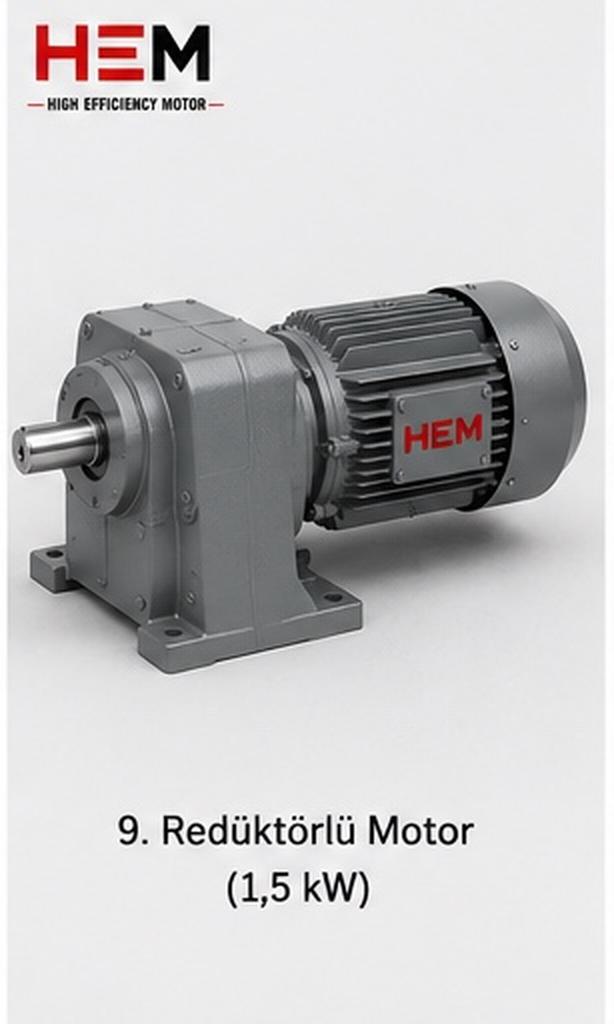

When selecting an electric motor, the two most critical values are power (kW) and speed (rpm). Speed is determined by the number of poles: 2 poles give about 3000 rpm, 4 poles 1500 rpm, and 6 poles a synchronous speed of 1000 rpm. In this article we cover 6-pole 1000 rpm motors, which often stay in the shadow of the 4-pole but are genuinely the right choice for certain jobs. Offering medium speed, higher torque density and smoother running, these motors stand out in specific applications, and HEM Motor explains from a field perspective why, their effect on frame size and efficiency, the most sought kW values, and how to choose the right power-speed combination.
Speed selection is not merely a choice of velocity; at the same power it directly affects the torque the motor produces, its frame size, weight and even its efficiency. At the same kW, as a motor's speed decreases the torque it produces increases, because power is proportional to the product of torque and speed. This simple relationship explains why a 6-pole motor is preferred for certain load types: applications needing high torque at low speed, a soft start and low noise naturally draw the 1000 rpm motor.
Pole Count, Speed and Torque Relationship
In an induction motor, synchronous speed is determined by the line frequency and pole count. On a 50 Hz grid the synchronous speed of a 6-pole motor is 1000 rpm, while the actual load speed is around 960-985 rpm due to slip. Compared with a 4-pole motor of the same power, the 6-pole motor produces higher rated torque at the same kW because its speed is lower. This can reduce or shrink the gearbox requirement for directly driven loads needing high starting torque.
- 2 pole (≈3000 rpm): High speed, low torque; pumps, compressors, high-speed fans.
- 4 pole (≈1500 rpm): The most common speed; general-purpose drives, conveyors, machinery.
- 6 pole (≈1000 rpm): Medium speed, high torque density; mixers, heavy conveyors, large fans.
- 8 pole (≈750 rpm): Low speed, very high torque; special heavy-duty applications.
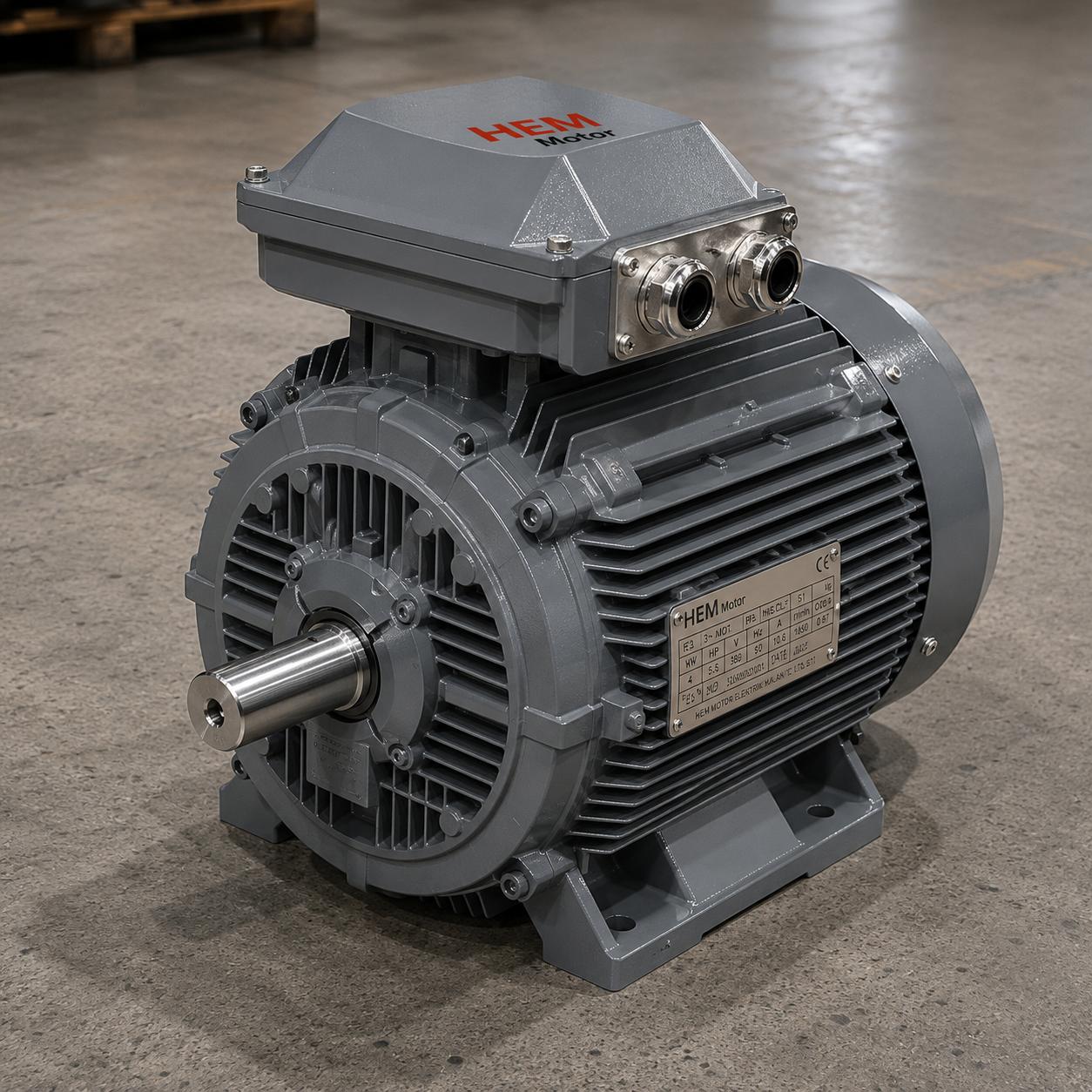
The Torque Density Advantage of the 6-Pole Motor
Torque density is the ratio of the torque a motor produces to its frame size. Because a 6-pole motor produces higher torque at the same kW than its 4-pole equivalent, it can drive high-torque loads with a smaller gearbox ratio. But the other side of the coin is this: at the same kW, a 6-pole motor's frame is usually one or two frame sizes larger than a 4-pole motor. Because to produce the same power at lower speed, the motor needs more magnetic material and a larger rotor-stator volume.
For this reason, choosing a 6-pole motor is always a matter of balance: higher torque and smoother running in exchange for a larger frame, slightly higher weight and usually a slightly higher initial investment. If the application genuinely needs medium speed and high torque, this balance tips in favour of 6 poles. To choose the right power and speed combination, the IE3 power and speed stock guide and the HP-kW matching table provide a practical starting point.
6-Pole (1000 rpm) Motor kW – Torque – Frame Table
| Power (kW) | Approx. Rated Speed | Approx. Rated Torque | Typical Frame (IEC) | Typical Application |
|---|---|---|---|---|
| 1.5 kW | ≈ 960 rpm | ≈ 15 Nm | 100L | Small mixer, feeder |
| 3 kW | ≈ 960 rpm | ≈ 30 Nm | 112M | Conveyor, dosing |
| 5.5 kW | ≈ 965 rpm | ≈ 54 Nm | 132M | Heavy conveyor, mixer |
| 7.5 kW | ≈ 965 rpm | ≈ 74 Nm | 132M | Agitator, fan |
| 11 kW | ≈ 970 rpm | ≈ 108 Nm | 160M | Large fan, pump |
| 15 kW | ≈ 970 rpm | ≈ 148 Nm | 160L | Heavy-duty conveyor |
| 22 kW | ≈ 975 rpm | ≈ 215 Nm | 180L | Large agitator, blower |
| 30 kW | ≈ 980 rpm | ≈ 292 Nm | 200L | Industrial fan, mill |
Values are approximate and vary with manufacturer and efficiency class; exact values are read from the motor nameplate.
In Which Applications Is 6-Pole Preferred?
6-pole 1000 rpm motors stand out in jobs where high torque at medium speed and smooth running add value. Typical applications include:
- Agitators and mixers: Mixing high-viscosity material needs medium speed and high torque.
- Heavy-duty conveyors: The soft start of a loaded belt and high torque demand make 6-pole suitable.
- Large-diameter fans and blowers: A large air flow at low speed runs more quietly and efficiently.
- Low-speed pumps: For certain centrifugal pumps, 1000 rpm gives a better operating point.
- Geared drives: A lower input speed reduces the gearbox stage and tooth load.
In agitator and fan applications, speed selection directly determines performance. For the speed-flow relationship on the pump and fan side, the circulation pump motor selection article is complementary.
6-Pole in Terms of Efficiency and Energy
In terms of efficiency class (IE3, IE4), 6-pole motors are subject to the same requirements. As a general rule, at the same kW the efficiency of low-speed motors may be somewhat lower than high-speed ones, because fixed losses are relatively higher at low speed. However, in the right application, using a 6-pole motor can raise system efficiency by avoiding an unnecessary gearbox stage or pulley-belt loss. What matters is not the motor's efficiency alone but the total system efficiency of the motor-load-transmission trio.
Reading the efficiency value and IE code on the nameplate correctly is essential for a fair comparison. On this, the reading the IE3 motor nameplate article explains kW, speed and efficiency values from a field perspective. Selecting speed and power per the application is decisive for both initial investment and operating cost.
4-Pole or 6-Pole? Decision Criteria
In many applications a 4-pole motor is the right choice; but if the load needs high torque at medium speed, requires a soft start, or you need to relieve the gearbox input, 6-pole stands out. When deciding, you should ask: what speed does the load need? Is high starting torque required? Are there frame size and weight constraints? At which speed is total system efficiency better? The answers to these questions usually clarify the right pole count.
- If the load is direct and needs high torque at medium speed: 6 pole.
- If high speed and low torque are sufficient: 2 or 4 pole.
- If frame and weight are critical and torque need is moderate: 4 pole + gearbox.
- If noise and vibration matter: 6 pole is usually quieter.
The most sought 6-pole powers usually concentrate in the 3, 5.5, 7.5, 11, 15, 22 and 30 kW range. For stock and speed combinations, the speed and pole selection in 18.5 and 22 kW motors and speed, pole and frame selection in 2.2-4 kW motors guides offer a practical comparison.
Using 6-Pole Together with a Gearbox
When a 6-pole motor is used with a gearbox, the motor's already low output speed offers a softer speed to the gearbox input. This means less strain on the gearbox teeth and lower input noise. Especially in high-ratio applications, starting with a 6-pole motor can reduce the number of gearbox stages, improving both efficiency and reliability. For gearbox output speed and torque calculation, the geared motor selection article gives the basic logic.
6-Pole Motor Use by Sector
6-pole motors are preferred for specific duties across many industries. In food and beverage plants, dough kneading, mixing and large extraction fans need medium speed and high torque; in these applications a 6-pole motor provides both smooth running and low noise. In mining and aggregate plants, heavy conveyors and screen drives require high starting torque, so 6-pole motors stand out at these points. In water and wastewater plants, aeration blowers, agitators and low-speed pumps run more stably with a 1000 rpm motor. In cement, ceramics and chemical plants, large fans and mill auxiliary drives similarly need medium speed.
This variety shows that the 6-pole motor is not a single niche product but a genuine performance choice in the right application. What matters is correctly analysing the load's speed and torque characteristics and choosing the motor accordingly. A motor chosen at the wrong speed cannot turn the load efficiently even if it has the right power.
The Basic Logic of Power and Speed Calculation
The right motor selection starts with understanding how much power the load truly needs and at what speed it needs torque. Three variables determine mechanical power: torque, speed, and the power arising from their product. If a load needs a certain torque at a certain speed, the required power is found by multiplying the two. A common mistake when choosing a 6-pole motor is looking only at power and ignoring speed. Yet 2, 4 and 6-pole motors of the same kW offer entirely different torque and speed characteristics; a wrong speed choice can leave the motor unable to turn the load at all, or constantly overloaded.
The path followed in practice is this: first the output speed the load needs is determined, then the torque required at that speed is calculated, then the power is found, and finally the suitable pole count is chosen. If the load turns directly at around 1000 rpm, a 6-pole motor is ideal for direct drive; if a lower speed is needed, a 6-pole motor with a gearbox offers a more balanced starting point. This calculation logic ensures the motor runs efficiently and lasts long.
Starting Torque and Starting Method
The high rated torque of a 6-pole motor also positively affects starting behaviour. For loads needing high starting torque, such as a loaded conveyor or a mixer stirring viscous material, a 6-pole motor breaks away more easily at start. When choosing the starting method, the load's inertia must be considered: for high-inertia large fans and flywheel systems, direct-on-line draws a high starting current, so a soft starter or star-delta may be preferred. However, since torque drops in the star position, this method must be evaluated carefully for loads needing high starting torque. The right starting method protects both the motor and the grid.
- Direct-on-line: The simplest solution at small powers and low inertia.
- Star-delta: Reduces starting current but also reduces torque.
- Soft starter: Provides a soft start and controlled torque.
- Frequency inverter (VFD): Makes speed adjustable and fully controls starting.
Frame Size and Mounting Planning
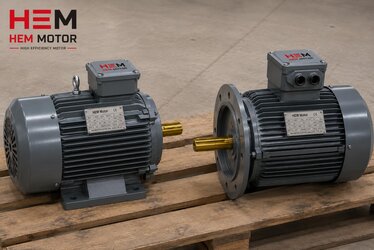
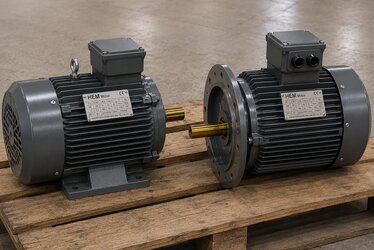
Because a 6-pole motor's frame is larger than a 4-pole motor of the same power, mounting dimensions must be checked carefully when replacing a motor on an existing machine. The foot hole spacing, shaft diameter, shaft length and flange dimensions must fit the machine. Especially when replacing a 4-pole motor with a 6-pole, the larger frame of the new motor means layout and coupling alignment should be re-evaluated. The multi-mount option (B3/B5/B35) provides flexibility here, allowing foot or flange substitution with a single stock code. Correctly matching mounting dimensions saves time and cost in the field.
Frequently Asked Questions
Why does a 6-pole motor have a larger frame at the same power?
To produce the same power at lower speed, the motor must produce higher torque. Higher torque means a larger rotor-stator volume and more magnetic material. Therefore, at the same kW, a 6-pole motor is usually one or two frame sizes larger than its 4-pole equivalent.
Is a 6-pole motor's efficiency lower than a 4-pole?
At the same kW, low-speed motors may have slightly lower efficiency; but in the right application, using 6-pole can raise total system efficiency by eliminating an unnecessary gearbox or belt loss. What matters is the total efficiency of the system, not the motor alone.
At which kW values are 6-pole motors most sought?
Field demand usually concentrates in the 3, 5.5, 7.5, 11, 15, 22 and 30 kW range. Because these powers are common in mixer, heavy conveyor, large fan and low-speed pump applications, they offer the advantage of fast supply from stock.
The 6-pole 1000 rpm motor is a choice that adds value in the right application with its torque density and smooth running. HEM Motor supplies IE3 and IE4 class motors in the most sought 6-pole powers from stock with fast delivery and manufacturer assurance. Share your application's speed, torque and frame needs with us, and request a quote for the right power-speed combination.