English
 Türkçe


Golf courses, large parks, motorway medians, stadium turf and corporate campus landscapes turn yellow and deteriorate within a few hot days without even, pressurised and programmed irrigation. Behind this irrigation there is often an unseen infrastructure: the main pumps that draw water from a pond or well, the booster pumps that keep the line at the required pressure, the inverter-driven pumps feeding the sprinkler and fountain lines, and pivot irrigation systems over large agricultural areas. The common heart of all these systems is the electric motors, mostly working outdoors, in humid conditions and under variable load. This article is written for golf course managers, landscape contractors, municipal and estate technical managers and engineers who build irrigation systems. It summarises which power and speed are needed in pivot, sprinkler line and booster pump applications, why outdoor IP protection and corrosion matter, and how automation with a VFD (variable frequency drive) saves energy, all within a framework of from-stock delivery and fast quoting that clarifies the purchasing decision.
Environment and Load Profile in Irrigation Motor Supply
In irrigation applications there are two main factors that determine motor life: the outdoor conditions in which it works and the load profile it is exposed to. The pump station is mostly located by a pond, under an eave or in a prefabricated cabin; the motor faces sun, rain, dust and humidity. That is why at least IP55 protection is standard for outdoor irrigation motors, and IP65 is preferred at points with direct water splashing and heavy dust. On the load side, irrigation has a variable profile during the day: some zones open and close and the pressure demand fluctuates. The motor must therefore be selected for continuous duty (S1) and variable load.
Irrigation pump supply is a branch of general pump motor supply; knowing the logic of the related applications makes correct selection easier. Our irrigation and agricultural pump motors article, which covers pump motors for fields and greenhouses, and our centrifugal pump motor selection guide, which explains matching flow and head to power, are basic resources in irrigation line design.
Outdoor IP Protection: IP55 and IP65
Irrigation pump motors do not work in an enclosed machine room but in the open field, exposed to seasonal conditions. IP55 protection guards the motor against dust ingress and water jets from any direction and is the practical standard at most points of landscape and golf irrigation. Where the pump station is prone to flooding, washed under pressure or very dusty, IP65 is preferred. Our IP protection class selection (IP55, IP65, IP66) guide, which explains step by step how to choose the IP class by application, is a resource you should keep at hand when writing a specification. Our cooling tower and chiller fan motors article, which covers IP protection in outdoor applications, also sheds light on outdoor motor selection.
Corrosion and Open-Field Protection
Irrigation water may be from a pond, a well or treated grey water; some of these contain lime, sand or light salt. A motor standing in the open field is also exposed to damp soil and constant humidity. That is why a cast iron body and good corrosion protection (cataphoresis primer + durable top coat) guarantee long life in irrigation motors. Our corrosion protection and open-field use in cast iron body motors article is a useful resource when planning the outdoor durability of irrigation station motors.
Motor Selection by Application: Pivot, Sprinkler Line and Booster Pump
Irrigation systems have different working logics, and each calls for a different motor profile. To choose the right motor you must first clarify the application.
Booster Pump Motors
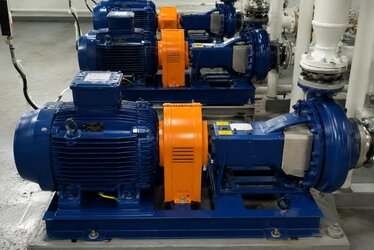
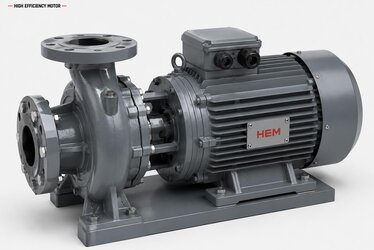
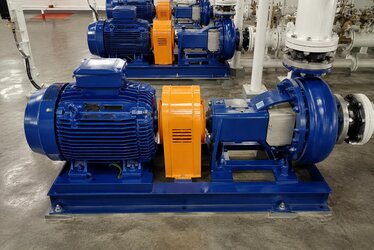
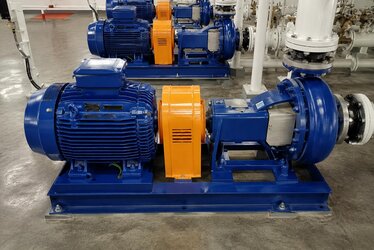
Booster pumps keep the line at the required pressure so that the fountain and sprinkler heads work properly. On golf courses and large landscape areas, a pressurisation station (a system where several pumps run in parallel) is usually built. In this application motors are mostly selected as 2-pole (3000 rpm) for high pressure or 4-pole (1500 rpm) for balanced flow; powers between 2.2 kW and 45 kW are common. IE3/IE4 efficiency class on booster motors running under continuous and variable load noticeably lowers the energy bill. Our booster motor replacement article, which covers selecting a booster motor from its nameplate, is a guide when finding a motor for your existing pressure pump.
Sprinkler and Fountain Line Motors
Sprinkler lines feed the zoned sprinkler heads at a certain pressure and flow. Here the motor must adapt to the variable demand of opening and closing zones, so constant-pressure control with a variable frequency drive (VFD) is very common. The VFD lowers the motor speed when demand drops, keeping the pressure constant and saving energy. Our asynchronous motor with a variable frequency drive (VFD) article, which explains in detail when a VFD is needed and how to select it, is a basic resource for anyone building irrigation automation. Our variable-speed motor selection article, which covers the constant/variable torque distinction, also complements this point.
Pivot Irrigation Motors
Pivot irrigation systems are used over large agricultural areas and wide landscape parcels; sprinklers on arms rotating from a central point water the area regularly. A pivot system has both the main pump motor that pushes the water and the low-speed geared drive motors that move the arms. Because the arm drive motors require high torque and low output speed, they are often used together with a worm gear reducer. Our low-speed (high-pole) motors article, which covers direct drive, helps to choose the right solution on the pivot drive side.
VFD Automation and Energy Efficiency: Lowering the Cost in Irrigation
Because irrigation systems run for long hours, pump motors make up most of the energy cost of landscape and golf facilities. There are two levers here: high-efficiency motor selection and smart control with a VFD. IE3 and IE4 efficiency class motors provide the same flow with less energy and create clear savings in continuously running irrigation pumps. Our IE4 threshold in pumps, fans and compressors article explains in which irrigation application an IE4 motor is justified.
On the VFD side, the saving comes from adapting to variable demand. In a classic system the pump always turns at full speed and the excess pressure is throttled by a valve; this is wasted energy. The VFD lowers the motor speed when demand drops, and because energy consumption falls with the cube of speed under the affinity laws, it provides significant savings. When choosing the right power-speed combination, buying an oversized motor is also wrong, because a motor running at low load loses efficiency. Our motor power calculation article, which explains the required kW for pump and fan loads step by step, helps with correct sizing. Our at what load to run a motor article also sheds light on the sizing decision.
Starting and Multi-Pump Coordination
In pressurisation stations several pumps run in parallel and come online in turn as demand rises. With direct-on-line (DOL) starting, large pump motors draw a high starting current; this stresses the grid and creates problems with frequent starting. That is why star-delta or soft starter starting is preferred at medium and large powers. Our star-delta or soft starter article, which explains in detail how to choose the starting method, is a useful resource for those building multi-pump stations. In VFD systems the starting is already soft, so a separate starter is not needed; this is one of the advantages of a VFD.
Outdoor Storage, Season and Commissioning
Irrigation is a seasonal job; in winter the pumps are usually out of service and the motors stand idle for a long time. In a non-salty but humid coastal or pond environment, moisture settles on the winding of an idle motor. Before commissioning at the start of the season, an insulation resistance (megger) test must be done and the drain plugs checked. Our electric motor storage and long-term standstill article, which covers moisture and bearing management in motors kept for a long time, offers a practical checklist for seasonally running irrigation systems. To avoid losing hours during a mid-season failure, keeping a spare motor stock in critical booster pump powers is also a wise precaution.
Supply by Facility Type: Golf, Park, Stadium and Median
The type of facility and the irrigation layout directly determine the motor package. On golf courses the area is very wide and the fairway, green and rough zones require different pressure and flow; here a multi-pump pressurisation station and constant-pressure control with a VFD are usually built. In stadiums and sports fields the area is relatively small but the irrigation is intense and time-sensitive; high flow is needed in a short window before a match, so powerful booster pumps are preferred. In park, median and estate landscaping the area is fragmented and many zones are watered in rotation; here medium-power, single or twin-pump solutions with a VFD are common.
The common point in every facility type is the correct definition of the motor's nameplate data: power (kW), speed (rpm), frame size (IEC frame), mounting type (B3/B5/B35) and shaft diameter. When this information is conveyed together with the required IP class and outdoor corrosion protection, both an exact mechanical match is achieved and a motor with the correct package is allocated from stock. Matching correctly from the nameplate when replacing an existing booster pump motor avoids the wrong product and delays. Our boiler room and circulation pump motors article, which covers pump motor supply in circulation applications, is a related resource in building and facility irrigation infrastructure. When selecting the right power and mounting type, the compatibility of flanged connections with the pump body must also be considered, so you can review mounting type selection on our electric motor mounting types page.
Frequently Asked Questions
Which IP protection class is needed in a golf course irrigation pump motor?
At least IP55 protection is standard for irrigation pump motors working in the open field; this guards the motor against dust ingress and water jets from any direction. Where the pump station is prone to flooding, washed under pressure or very dusty, IP65 is preferred. Clarifying the right class according to the station's location and the conditions it is exposed to is the first thing to do at the quotation stage.
Is a VFD (variable frequency drive) mandatory for an irrigation system?
A VFD is not mandatory, but it provides a great advantage especially in zoned sprinkler lines and variable-demand pressurisation systems. The VFD lowers the motor speed when demand drops, keeps the pressure constant and, under the affinity laws, creates clear energy savings; it also reduces mechanical load by providing soft starting. In simple single-pump systems with constant flow, solutions without a VFD may also make sense; the decision is determined by system size and demand variability.
What kind of motor is needed in a pivot irrigation system?
Pivot systems have two types of motor: the main pump motor that pushes the water and the low-speed geared drive motors that move the arms. While the pump motor is selected by flow and pressure, the arm drive motors require high torque and low output speed and are therefore usually supplied together with a worm gear reducer. To clarify your need, it is best to request a quote by sharing the number of pivot arms, the irrigation area and the required flow.
Get a Quote
For your golf course, park, stadium and corporate landscape irrigation systems, we supply booster pump, sprinkler line and pivot irrigation motors with outdoor IP protection and VFD-compatible solutions, from stock and with fast delivery. Share your application, flow-pressure requirement and nameplate data and let us offer a price with the most suitable solution. Reach us now via our contact page or request a quote on +90 (532) 345 49 86.