English
 Türkçe

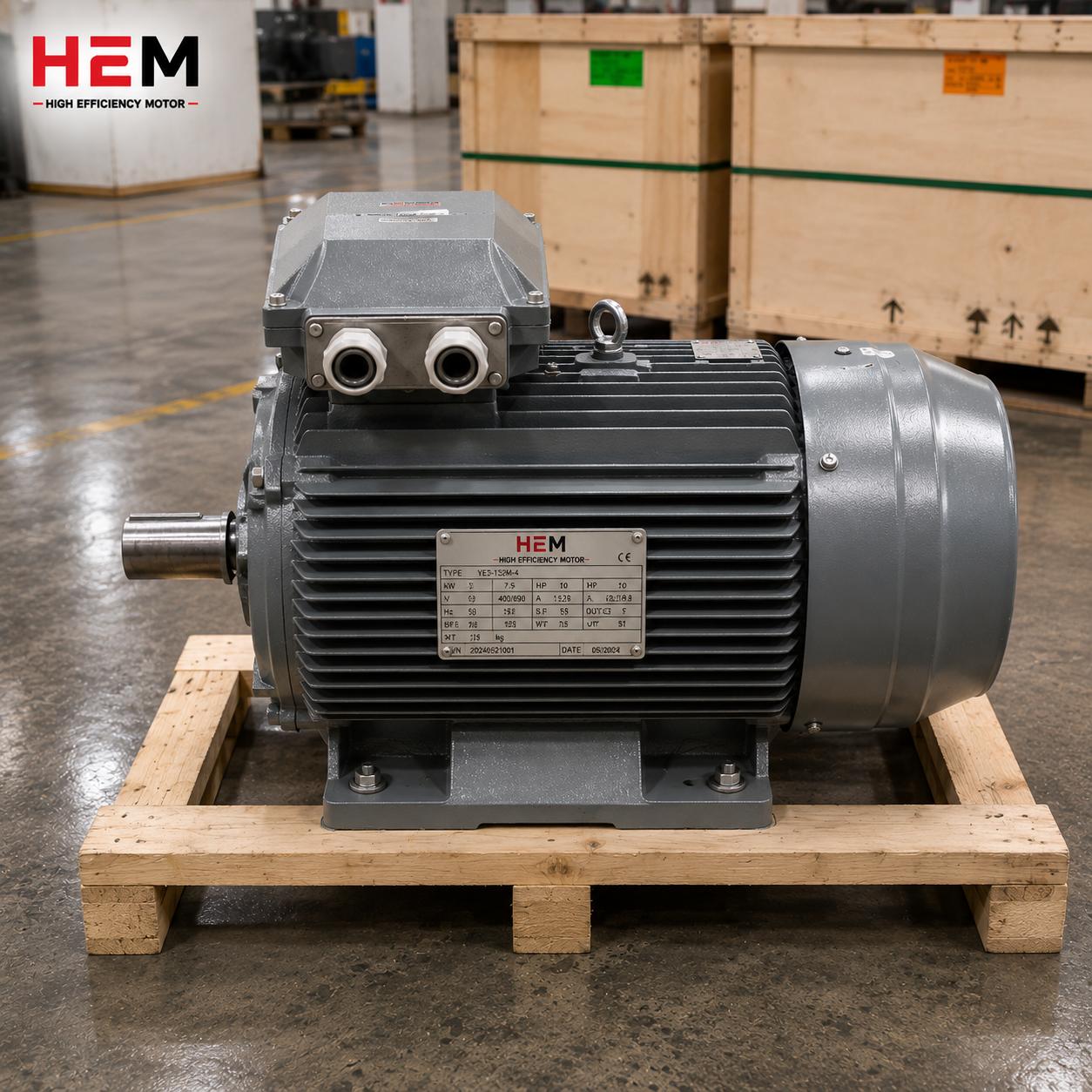

Motors in the 560 kW and 630 kW class sit at the upper limit of the low-voltage induction motor world. At these ratings you are no longer making an ordinary purchase but managing a supply project: the frame reaches huge dimensions around 355 and 400, the motor weight is measured in tons, the starting current is high enough to strain the grid, and the delivery time is expressed in weeks. A single wrongly chosen parameter can delay a plant's main drive by months. At HEM Motor, this article examines the 2- and 4-pole speed options of 560 kW and 630 kW motors, the frame-weight relationship, large-power starting methods, cooling and transport requirements, and correct lead-time/supply planning from an engineering perspective. The goal is to help you buy this top-class motor right the first time.
Where Are 560 kW and 630 kW Used?
This power class appears as large centrifugal pumps, main supply fans and exhausters, screw and centrifugal compressors, crusher and mill drives, and main-line motors in heavy industry such as paper, cement and steel. What these applications share is continuous, high-load operation, which makes efficiency, reliability and a guaranteed lead time more critical than price. A low-voltage 560/630 kW motor sits just below the threshold for switching to a medium-voltage motor, so it requires careful planning on the panel, cable and starting side. Because the rated current at this power reaches hundreds of amperes, cable cross-section, busbar sizing and protection coordination are also an integral part of the project.
- 2 pole (~3000 rpm): Centrifugal compressors and large fans requiring high speed.
- 4 pole (~1500 rpm): Large pumps, mills and general heavy drives; the most common choice.
- 6 pole (~1000 rpm): Low-speed, high-torque applications (limited, special request).
Application-Based Power and Speed Selection
560 and 630 kW motors appear with different speed and frame requirements across sectors. The right choice depends not only on power but also on the torque-speed characteristic of the driven machine. Below are the typical uses of this power class and the selection logic:
- Cement and mining mills: High inertia and high starting torque; 4 or 6 pole, liquid-resistance or VFD starting.
- Large water pumps and pumping stations: 4 pole common; soft start/stop against water hammer with a soft-starter or VFD.
- Centrifugal compressors and large fans: 2 pole high speed; cooling and vibration control are critical.
- Paper and textile main drives: VFD and encoder feedback for precise speed control.
- Steel rolling mills and fan groups: Heavy load, high reliability and a spare-motor strategy.
What these applications share is that the motor is the lifeblood of the plant. So in the selection, not only power but also speed, frame, cooling, starting and lead time must be evaluated together. A wrong pole count or insufficient cooling can cause the motor to fail in its first year and lead to large production losses.
Power, Pole, Speed, Frame and Weight Table
In 560 and 630 kW motors the frame size changes with the pole count. 2-pole motors usually concentrate in the 355 frame, while high-power 4-pole units move up to the 400 frame. Because weight directly affects crane capacity and foundation design, it should be clarified before ordering. The table below summarizes typical approximate values; exact figures are confirmed by the production type.
| Power | Pole | Synchronous Speed | Typical Frame (IEC) | Approx. Weight |
|---|---|---|---|---|
| 560 kW | 2 | 3000 rpm | 355 | ~2900-3300 kg |
| 560 kW | 4 | 1500 rpm | 355 / 400 | ~3300-3900 kg |
| 630 kW | 2 | 3000 rpm | 355 | ~3100-3600 kg |
| 630 kW | 4 | 1500 rpm | 400 | ~3700-4400 kg |
| 630 kW | 6 | 1000 rpm | 400 / 450 | ~4300-5000 kg |
Large-Power Starting: Soft-Starter or VFD?
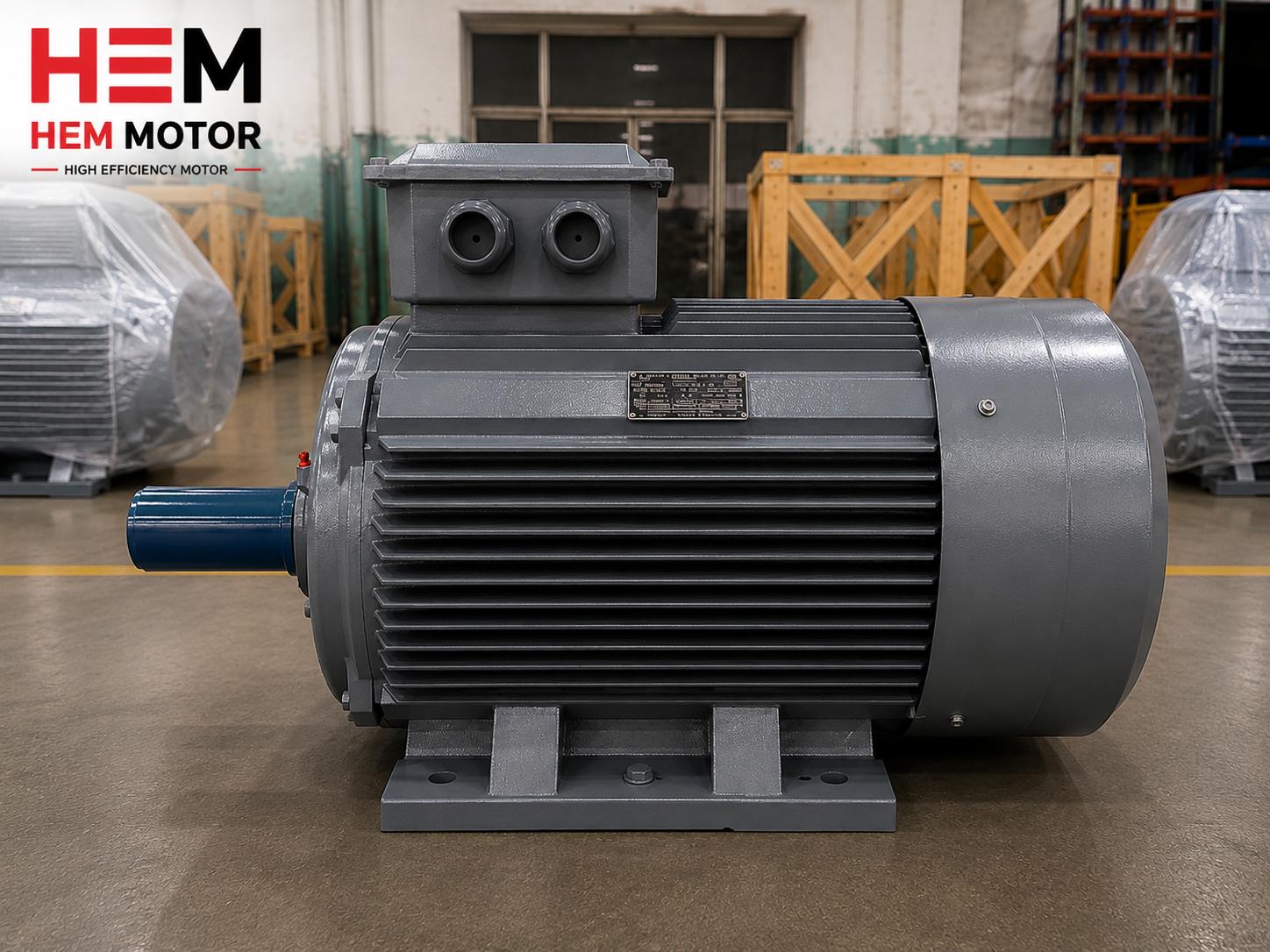
Direct-on-line (DOL) starting is practically impossible on 560/630 kW motors because the starting current reaches 6-7 times the rated current, causing severe voltage dips on the grid, mechanical shock and coupling stress. At this power there are two main solutions: the soft-starter and the variable frequency drive (VFD). The choice depends on whether the application needs speed control. On high-inertia mill and crusher drives, liquid-resistance (electrolytic) starters are still preferred because they ramp up the starting torque smoothly and minimize the grid shock.
| Method | Starting Current | Speed Control | Suitable Application |
|---|---|---|---|
| Soft-starter | ~3-4 × In | None | Fixed-speed pump, fan, compressor |
| VFD | ≤ 1.5 × In | Full | Flow/speed controlled, energy saving |
| Liquid-resistance starter | Low, smooth | None | High-inertia mill/crusher |
When a VFD is chosen, at this power the harmonics it produces and long-cable effects cannot be ignored. A line reactor, a dV/dt or sine filter and a correct shielded-cable connection protect the motor winding insulation and grid power quality. When a soft-starter is chosen, a bypass contactor engages after starting to protect the thyristors from heating and to avoid efficiency loss. Whichever method is chosen, the number of starts (starts per hour) and the inertia must be compatible with the motor's thermal capacity; otherwise the winding is thermally stressed.
Cooling: Managing Heat at 560/630 kW
At this power the loss heat the motor produces is measured in kilowatts and, if not removed correctly, the winding life shortens rapidly. Standard surface-cooled (IC411) motors are sufficient in most applications; however, if continuous operation at low speed with a VFD is required, the motor's own fan cannot move enough air, so an external forced (separately driven) cooling fan (IC416) is needed. Water-jacket (IC71W) or air-water heat-exchanger cooling is preferred in plants with high ambient temperature or heavy dust. The cooling air inlet and outlet path must be kept clear, and the motor fins should be cleaned periodically; a dust-covered frame significantly reduces heat dissipation.
- IC411: Standard solution for grid-fed, fixed-speed applications.
- IC416: Mandatory for VFD operation over a wide speed range and continuous torque at low speed.
- Air-water heat exchanger: High ambient temperature, enclosed and dusty environments.
- For thermal protection, PT100 winding sensors and bearing temperature sensors are standard at this power.
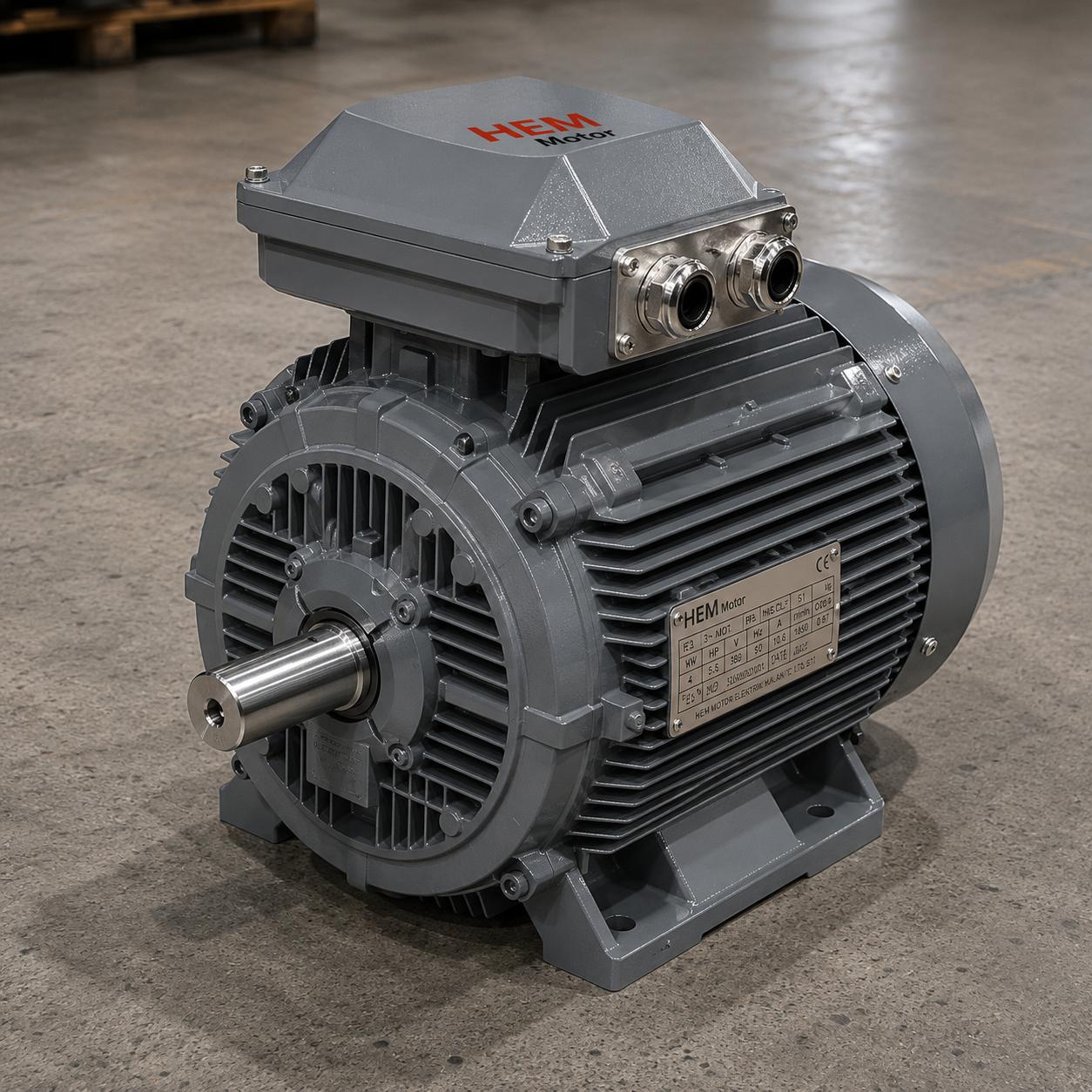
Weight, Transport and Installation Planning
Moving and placing a motor of 3.5-5 tons is a logistics operation in its own right. Lifting eyebolts must be selected for the full motor weight, and crane capacity and sling angles must be calculated. The foundation must be designed to handle dynamic load and vibration; alignment should be done with a laser. During transport the motor bearings are secured against long-haul vibration with a shaft transport lock. At this power, installation errors are very costly, so foundation, coupling and alignment work should be done by experienced teams.
- Measure door, elevator and passage widths along the route into the site in advance.
- Crane capacity should be at least 1.25 times the motor weight.
- Foundation bolts and vibration mounts must be selected for the motor type.
- If long storage is required, plan moisture protection (space heater) and bearing lubrication.
Lead Time and Supply Planning: Don't Delay the Project
560/630 kW motors are not always on the shelf; at this power, lead-time management is the heart of the project. A good supply plan means finalizing the motor selection early, evaluating frame and speed alternatives, and defining the spare/critical motor strategy in advance. At HEM Motor, with manufacturer stock and a fast supply network, we make lead times predictable for these top-class motors. Since a delay on a plant's main motor can halt the entire production, correct planning comes before cost.
- Lock the motor ratings (power, speed, voltage, IP, mounting, frame) early; late changes extend the lead time.
- Plan the starting method (soft-starter/VFD) together with the motor; the winding type is chosen accordingly.
- For critical plants, define a spare-motor or fast-supply guarantee strategy.
- Synchronize the transport and installation window with the production/delivery schedule.
Efficiency, Energy Cost and Return on Investment
When a motor like 560/630 kW runs thousands of hours a year, the purchase price becomes small next to the total cost of ownership; the real cost is energy. The few-point difference between a high-efficiency motor and a lower-efficiency one turns into tens of thousands of kilowatt-hours of loss per year at this power. That is why, in this power class, IE3 and, where possible, higher-efficiency motors should be preferred; efficiency should be treated not as a mere label value but as a parameter that directly affects the operating budget.
In VFD applications energy saving doubles: the motor efficiency is high and the pump/fan flow is reduced to the need, avoiding unnecessary consumption. On centrifugal pumps and fans, reducing the flow yields very large energy savings because of the cubic law; for example, lowering the speed by twenty percent can cut the power demand by more than half. So in variable-load applications a VFD offers a double benefit, both for starting and for savings. When deciding on the investment, the right approach is to calculate over five or ten years of energy cost, not the purchase price of the motor.
- On a continuously running large motor, the efficiency difference quickly overshadows the purchase cost.
- Flow control with a VFD under variable load provides large savings thanks to the cubic law.
- Power factor correction (compensation) reduces grid penalties and losses at this power.
- Correct sizing; an oversized motor runs inefficiently at low load.
Frame, Torque and Mechanical Compatibility
In this power class, frame selection concerns not only electrical power but also the mechanical connection and torque transmission. The shaft, coupling and bearing of a 400-frame motor are dimensioned to transmit high torque safely. The shaft diameter, key size, flange bore and foot-hole spacing must match the driven machine exactly; otherwise a special adapter or new foundation is needed in the field. Especially when replacing an old motor with a new one, confirming the frame and mounting dimensions exactly prevents lead-time loss.
- Shaft diameter and key size must match the coupling and driven machine.
- Mounting type (B3/B5/B35) and flange dimensions must fit the existing foundation.
- Bearing type must be selected for axial and radial load; reinforced bearings under high inertia.
- Vibration class and balance quality matter on precision drives.
Checklist for Correct Procurement
When making the purchasing decision in this power class, all of the following items must be clarified. A missing item comes back as a field mismatch or a lost lead time:
- Power and pole/speed (2 or 4), according to the application torque and speed need.
- Frame (355/400) and mounting type (B3 foot, B5/B35 flange), shaft diameter and key.
- Voltage and frequency (400/690 V, 50/60 Hz), star-delta connection suitability.
- Protection class (IP55 and above), cooling type (IC411/IC416), thermal sensors.
- Starting method and drive compatibility (inverter-duty winding, filter requirement).
- Weight, lifting points, transport and installation logistics.
Frequently Asked Questions
Should I choose 2-pole or 4-pole at 560/630 kW?
The speed the application requires is decisive. Applications such as centrifugal compressors and high-speed fans need 2 pole (3000 rpm); large pumps, mills and general heavy drives run with 4 pole (1500 rpm). 4 pole is the most common and balanced choice.
Should low voltage or medium voltage be preferred at this power?
560/630 kW is in the threshold zone between low voltage (400/690 V) and medium voltage. Cable current, panel size and existing infrastructure are decisive. Most plants still prefer low voltage at this power; at higher powers medium voltage becomes economical.
Why can the delivery time be long?
Motors at this power involve large frames, special windings and sometimes customer-specific options. Stock status, cooling and mounting options affect the lead time. Early ordering and a clear technical specification make the delivery time predictable. In addition, options such as special voltage, special paint/protection class and ATEX explosion-proof can extend the lead time, so these requests should be clarified from the very start.
Should I keep a spare motor at this power?
In critical plants where a production stop is unacceptable, a spare motor or fast-supply guarantee is essential. In a main-motor failure, the weeks-long supply of a new motor drops to hours with a spare. The cost of a spare motor is small next to the potential production loss; therefore, on critical lines a sparing strategy should always be evaluated.
Conclusion and Supply
560 kW and 630 kW motors, when chosen correctly, are investments that run a plant's main drive safely for years; chosen wrongly, they cause expensive surprises in both lead time and cost. Clarifying power-speed, frame-weight, starting, cooling and transport up front is the key to buying this top-class motor right the first time. At HEM Motor we offer fast supply from manufacturer stock, engineering support and application-specific sizing. Reach us with your project's power, speed, mounting and starting details; let us choose the right 560/630 kW motor together and prepare a tailored quote for you.
Related guides: 355 kW Asynchronous Motor 2/4 Pole Supply, 132 kW High Power Supply Plan, Low Voltage vs Medium Voltage Threshold, Starting Current (LRA) Reduction and Starting and Cooling Methods IC411/IC416.