English
 Türkçe


Whether imported or domestically sourced, the first question to ask when buying an IE3 electric motor is: "Is the efficiency truly IE3, and are there documents to prove it?" The marking "IE3" on the nameplate alone is not enough; behind that class there must be a CE marking, a Declaration of Conformity (DoC), and MEPS (Minimum Energy Performance Standard) / Ecodesign compliance records for efficiency. In this article we explain step by step how to check CE and DoC on IE3 motors, which directives apply, and which documents to request during import customs clearance and procurement tenders. At HEM Motor, every motor we supply comes with this complete documentation chain.
What Does the CE Marking Mean on an IE3 Motor?
The CE marking is a conformity mark by which the manufacturer declares, on its own responsibility, that the product complies with the relevant EU technical legislation (directives). It is not a quality award; it means "this product meets the essential safety and performance requirements of the relevant directives." For electric motors, the CE marking arises at the intersection of several directives. The presence of CE on the nameplate shows that the manufacturer has assumed responsibility for all of them.
An important point: a motor that does not meet the efficiency (MEPS) requirement can no longer carry the CE marking. So the presence of CE is, indirectly, an indication that the motor meets the applicable minimum efficiency threshold (IE3 for most ratings). An IE2 motor cannot be placed on the EU market with CE even if used together with a variable speed drive.
Directives Relevant to an IE3 Motor
- Low Voltage Directive (LVD): Electrical safety of motors supplied between 50-1000 V AC. Nearly all IE3 three-phase motors fall under this.
- EMC (Electromagnetic Compatibility) Directive: The motor must not emit electromagnetic interference and must be immune to external interference. The effect is limited for direct-on-line (DOL) standard induction motors but becomes important in drive-fed applications.
- Ecodesign / Energy-related Products (ErP) regulation: The regulation setting the minimum efficiency performance (MEPS). This is the legal basis of the IE3 requirement.
What Is a Declaration of Conformity (DoC) and What Must It Contain?
The Declaration of Conformity is the signed document in which the manufacturer or its authorised representative in the EU formally declares that the product conforms to the relevant directives. If the CE marking is the "visible face," the DoC is the "written commitment" behind it. In procurement and import processes, the DoC is the document that should actually be requested. A complete DoC should contain:
- Name and address of the manufacturer / authorised representative
- Description of the product (motor type, frame size, serial/batch reference)
- List of directives on which the declaration is based (LVD, EMC, Ecodesign)
- Harmonised standards applied (e.g. the EN/IEC 60034 series)
- Signature, date, and title of the signing official
The information on the DoC must match the nameplate data (type, frame, rated values). A mismatch between the nameplate and the description in the declaration is the first risk to spot.
Documenting the Efficiency Class: The IEC 60034 Series
Determining and labelling the efficiency class is based on standards. IEC 60034-30-1 defines the efficiency classes (IE1-IE4); IEC 60034-2-1 specifies how efficiency is measured (the test method). The reliability of the efficiency value on the IE3 nameplate depends on it having been measured according to this test method. For a detailed look at how efficiency is measured and documented, see our article on IE3 motor efficiency measurement and the IEC 60034-2-1 test method.
Document Check on Imported Motors
The documentation chain is especially critical for an imported IE3 motor, because a lack of documents causes both legal and commercial problems at customs and during resale. What to check during import:
- Physical presence of CE marking: Must be legible and permanent on the nameplate and/or body.
- Original DoC: On manufacturer letterhead, wet or electronically signed, traceable to the batch/type.
- Test/efficiency report: Measurement data supporting IE3 efficiency must be available on request.
- Nameplate-declaration consistency: kW, speed, voltage, efficiency, and IE class on the plate must match the DoC.
- Origin and brand traceability: Brand and place of manufacture supported by documentation.
We compared the commercial and documentation differences between imported motors and domestic stock supply in our article on imported motor vs domestic from stock. What to check during packaging and acceptance inspection at delivery is covered in IE3 motor incoming acceptance inspection.
MEPS / Ecodesign: Which Class Is Required at Which Rating?
Minimum energy performance thresholds are set according to the motor power and number of poles. The general framework is: within a certain power range, direct-on-line three-phase motors must be at least IE3; at smaller ratings IE2 is acceptable; and at larger power-pole combinations an IE4 threshold has come into effect. You can find the history of these thresholds and which motor is mandatory from which date in our articles on the IE3 and IE4 efficiency mandate and the IE3 efficiency class mandate power table. Whether old IE2 stock still makes sense is assessed in IE3 vs IE2 motor.
For facilities selling to multiple countries or exporting, 50/60 Hz and different voltage compatibility also matter on the documentation side; we covered this in IE3 motor multi-voltage and 50/60 Hz compatibility.
Requesting Documents in Tenders and Procurement
In corporate purchases and tenders, clearly writing the document requirement into the motor specification prevents later disputes. The specification should include:
- "Motors shall be CE marked and a Declaration of Conformity (DoC) shall be provided with delivery."
- "The efficiency class shall be at least IE3; the nameplate efficiency shall be measured according to IEC 60034-2-1."
- "Nameplate data shall exactly match the description in the declaration."
- "An efficiency/test report shall be presented on request."
What information you need to provide when requesting a quote is in our article on information to provide when requesting an electric motor quote, and the line items in a proforma quote are in reading a proforma quote. For correct replacement based on the shaft and frame table when selecting an IE3 motor, our article on the IE3 motor shaft and frame table is a useful guide.
Data to Verify on the Nameplate
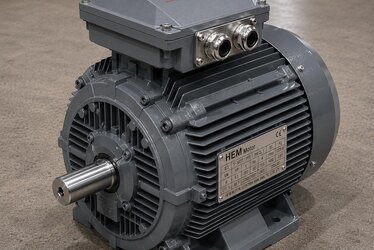
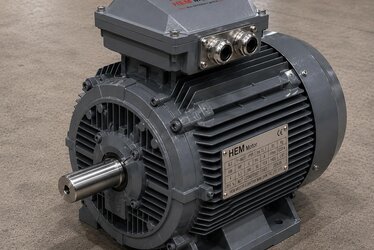
The step that completes the CE and DoC check is reading the consistency of the data on the motor nameplate. On an IE3 motor, the nameplate should carry at least the following information, and it should match the description in the declaration:
- Rated power (kW) and rated speed (rpm): These two values are critical because the efficiency class threshold depends on power and number of poles.
- Efficiency value and IE class: The nameplate should clearly show both the percentage efficiency (e.g. at full load) and the "IE3" marking.
- Voltage/frequency and connection: Such as 230/400V 50 Hz; export motors may also carry 60 Hz values.
- Rated current and power factor (cosφ): Needed for field verification and protection selection.
- Protection class (IP), insulation class, and duty type: Evidence of suitability for the environment and operating regime.
Consistency between the nameplate efficiency value and the actual efficiency is the practical indicator that the motor is truly in the IE3 class. For this reason, attaching a photo of the nameplate to the quote and delivery file is good practice in corporate purchases. Selecting the IP protection class according to the environment should also be evaluated separately, because the wrong protection class causes the motor to fail early regardless of documentary conformity.
Risks and Cost of Missing Documents
A gap in the documentation chain is not just a bureaucratic formality; it creates concrete commercial and operational risks:
- Customs and market-placement risk: Without CE and DoC, the motor cannot legally be sold in the EU and aligned markets; there is a risk of it being stuck at import.
- Tender disqualification: In a purchase whose specification requires documents, a supplier unable to provide the declaration is eliminated or the delivery is rejected.
- Warranty and liability gap: With an undocumented motor it becomes difficult to trace manufacturer liability; finding a responsible party in case of failure becomes hard.
- Efficiency commitment not met: If a motor bought on an energy-saving calculation is not actually IE3, the payback period and operating cost calculations break down.
For this reason, the document check should be carried out together with the physical inspection of the motor (packaging, damage, nameplate). When working with the right supplier, this chain is established from the start and there are no later surprises.
Additional Document Notes for Drive-Fed (VSD) Applications
If the motor will run on a frequency converter (VSD/drive), the documentation assessment is not limited to the motor alone. In that case, both the motor and the drive are expected to have their own declarations of conformity, and the complete drive system (motor + drive + cabling) must be installed in an EMC-compliant way. The Ecodesign regulation has also introduced a minimum efficiency requirement for drives within a certain power range; therefore the question "the motor is IE3, but is the drive compliant?" should also be asked. We covered the soft starter and drive compatibility of an IE3 motor running on a drive in IE3 motor soft starter compatibility. This holistic view safeguards both legal conformity and real energy efficiency.
Frequently Asked Questions
The nameplate says IE3 but there is no DoC; is that a problem?
Yes, it is a serious gap. A nameplate statement alone does not replace a binding document. In import, tender, and warranty processes the Declaration of Conformity (DoC) is requested. For a motor without a DoC, the efficiency class and directive conformity cannot be proven, which creates both legal and commercial risk.
Does the CE marking guarantee the motor is IE3?
It is a strong indirect indicator. Because of the applicable Ecodesign regulation, a motor in the relevant power range cannot be placed on the market with CE without meeting the minimum efficiency class (IE3 for most ratings). Still, for definite confirmation, the DoC and the IE class on the nameplate should be checked together.
How does the EMC directive concern a standard induction motor?
For standard induction motors started direct-on-line, electromagnetic impact is limited and usually no issue arises at motor level. However, if the motor runs on a frequency converter (drive), conformity of the complete system including the drive and cabling becomes important from an EMC standpoint.
Get a Quote for a Properly Documented IE3 Motor
At HEM Motor, we supply IE3 electric motors with CE marking and a Declaration of Conformity (DoC), with nameplate-declaration consistency ensured. If you need documented and verified IE3 motor supply for your import, tender, or investment project, get in touch. For more content, visit our homepage and browse our other blog posts for different sector applications.
Get a Quote: Call us at +90 (532) 345 49 86 or reach us through our contact page.
Pre-Purchase Document Checklist
- Is the CE marking on the nameplate legible and permanent?
- Is a signed Declaration of Conformity (DoC) on manufacturer letterhead delivered?
- Are the LVD, EMC, and Ecodesign directives listed in the DoC?
- Is the efficiency class at least IE3 and clearly stated on the nameplate?
- Do the type/frame/rated values on the nameplate exactly match the declaration?
- Can IEC 60034-2-1 efficiency/test data be provided on request?
- If imported, are origin and brand traceability supported by documents?
- Is the document requirement clearly written into the tender specification?