English
 Türkçe

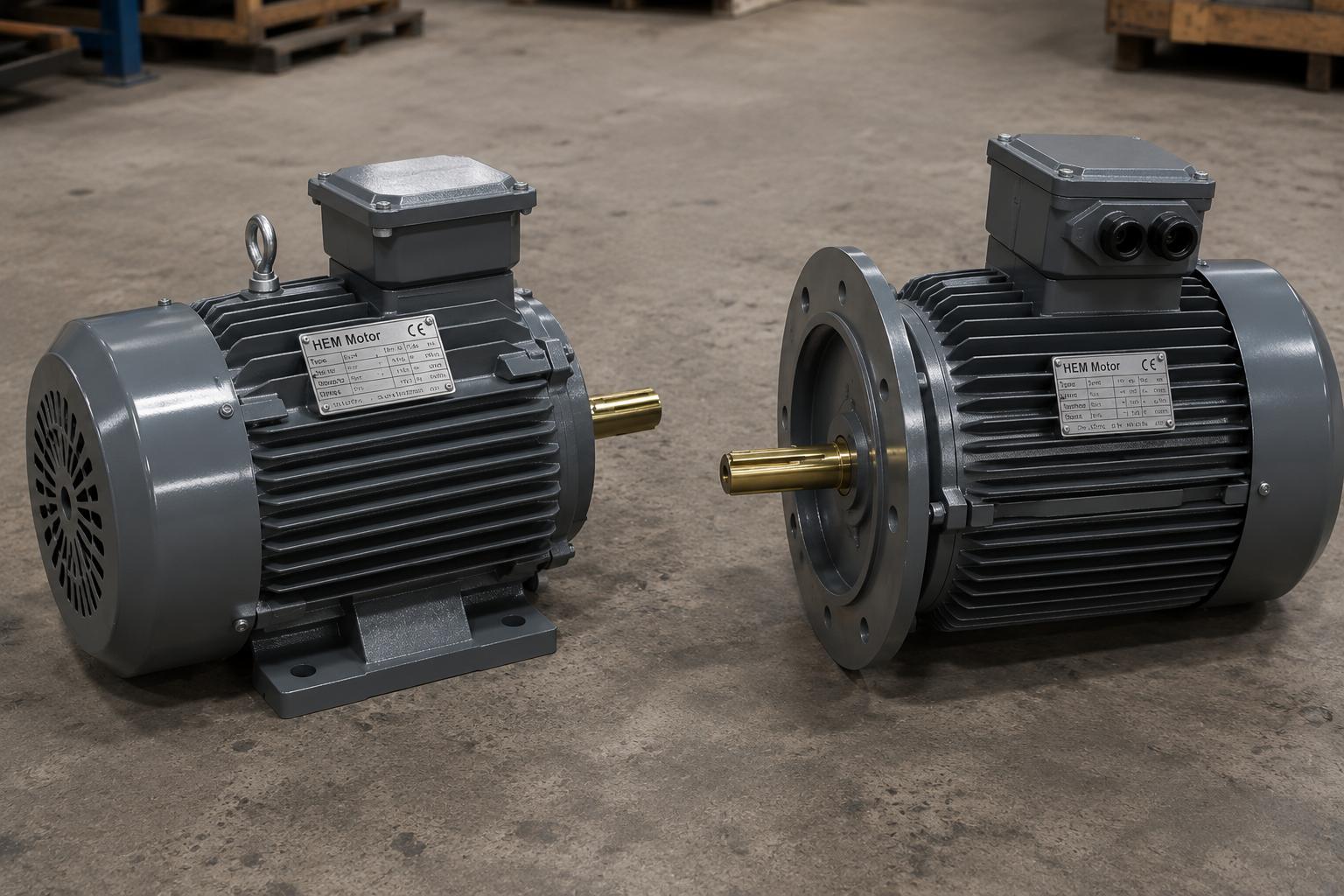

When you buy a cast iron frame electric motor, the first things on your mind are usually power, speed and frame size. Yet in many heavy-duty applications the decisive detail hides at the back of the motor: the double shaft extension. A standard motor delivers torque only from the drive end (DE); but when you need to mount an external cooling fan, a second drive element, an encoder or a pump coupling, the shaft end on the non-drive end (NDE) becomes essential. A double shaft extension (2DE) lets you take torque from both ends of the motor, and if it is not coded correctly the motor shipped from stock simply will not fit your application.
In this article we look, from a practitioner's point of view, at what a double shaft extension is on cast iron motors, why the cast iron frame is an ideal base for this option, how to choose shaft diameter and key, the balancing class, bearing arrangement, the order code and the right selection steps. The goal is to help you define the rear shaft end correctly from the start when you request a motor from HEM Motor stock or custom build. A wrongly defined rear shaft end is usually noticed only after the motor arrives on site, causing both time and cost loss; that is why clarifying the mechanical expectations at both ends before ordering matters so much.
What Is a Double Shaft Extension and Why Is Cast Iron an Advantage?
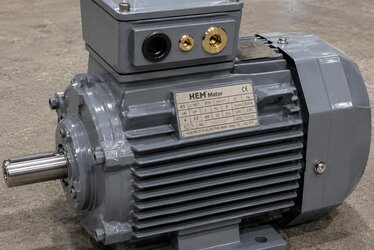
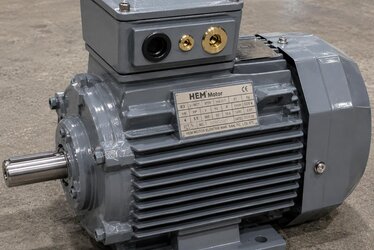
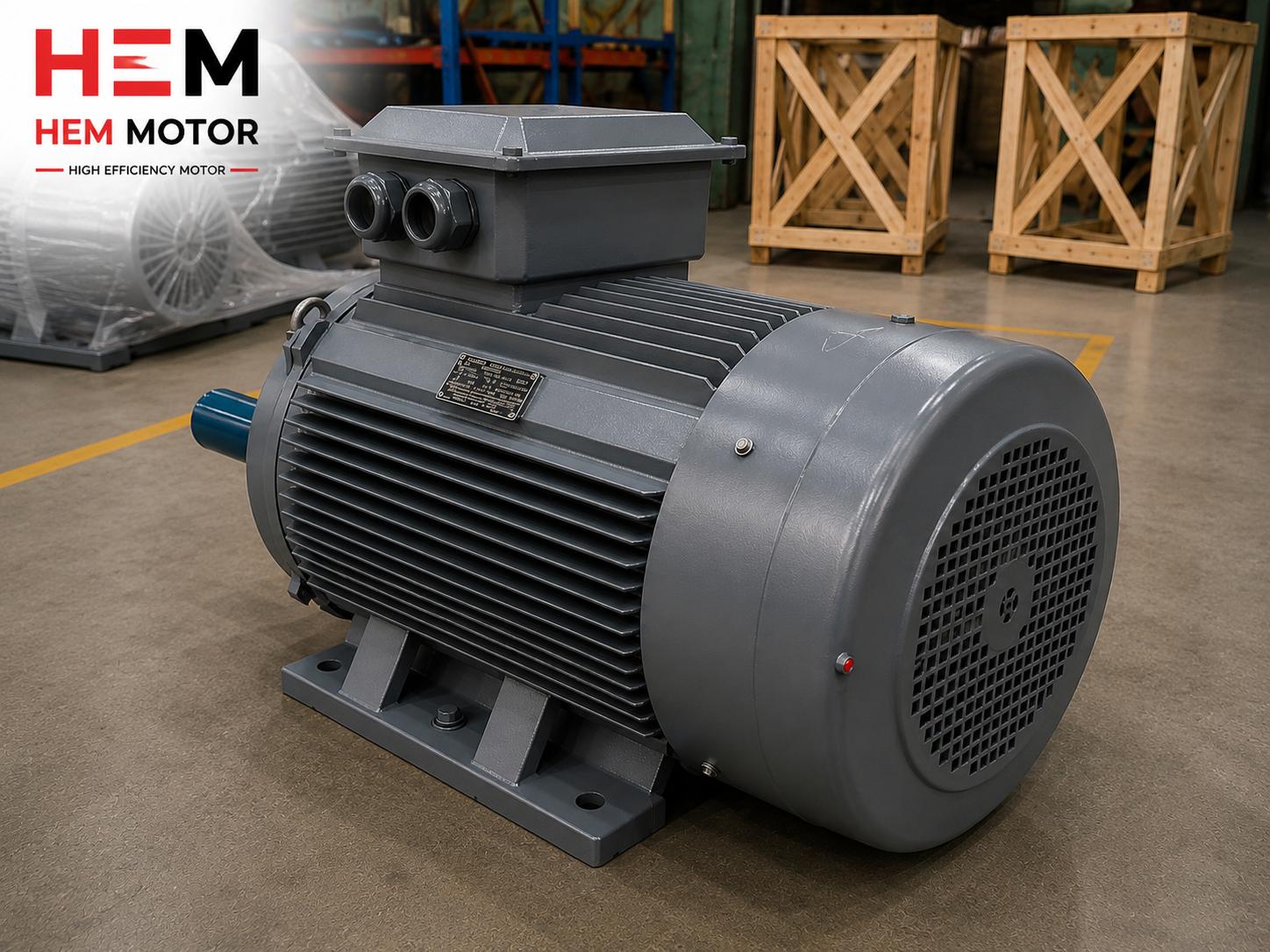
On a standard IEC motor the shaft end is only on the drive side. With a double shaft extension the rotor shaft is also extended out through the rear (NDE) end shield, where a cylindrical shaft end, a keyway and a centre hole are provided. A single motor can then feed two separate mechanical connections: the main load at the front (a pump or gearbox, for example) and a secondary duty at the rear (external fan, tachometer, encoder, cam shaft or a second pulley). This arrangement saves space and offers the synchronisation and control simplicity of using a single drive source instead of two separate motors.
Cast iron (grey cast iron, EN-GJL) frame is a natural advantage for this option. The high mass and damping capacity of cast iron absorb the vibration that arises when load is taken from both ends; the rigid frame keeps the axial alignment between the two bearings, and the machined bearing seat in the rear end shield precisely centres the NDE bearing. Although it is possible on an aluminium frame, for continuous double-ended drive and impact loads the cast iron frame is a markedly safer base. Especially when a radial load such as a belt-pulley drive is taken from the rear, the rigidity of the frame prevents ovalisation of the bearing seat and premature bearing wear.
Drive End (DE) and Non-Drive End (NDE) Shaft
- DE (Drive End): The standard keyed cylindrical shaft end to which the main load is coupled. Its diameter and length are defined per frame size in IEC 60072.
- NDE (Non-Drive End): On a double shaft, the second shaft end extended through the rear shield. It is usually ordered at the same diameter as the DE, but can be made to a different diameter on request.
- Symmetric / asymmetric shaft: If the two ends have equal diameter and length the shaft is symmetric; if different, asymmetric. An asymmetric shaft must be stated separately in the order code.
- Centre hole and chamfer: Both ends carry a centring hole; this is the reference point for balancing and later machining.
Typical Applications
The most common reasons for a double shaft extension are:
- External (forced) fan drive: In applications needing continuous torque at low speed on a VFD, the motor's own fan is insufficient and the rear shaft end can drive an independent cooling fan or provide airflow without a separate fan motor.
- Encoder / tachometer mounting: In closed-loop speed control an encoder is mounted on the rear shaft end; this usually calls for a special short stub and specific balancing.
- Second drive / dual pulley: Driving two separate machines from a single motor (for example two pumps, or a mixer and a feed screw).
- Pump and compressor drive: Balance disc or lube-oil pump drive from the rear in axial pumps.
- Brake / manual turning: Mounting a brake or hand-turning flywheel on the rear shaft end; a practical way to position the rotor by hand during maintenance.
- Water-cooled heavy-duty applications: Driving a pump or turbine from the rear in place of the cooling fan.
What these applications share is the expectation that the duty taken from the rear is continuous and reliable. The double shaft extension is therefore not a comfort option but, in most cases, part of the machine's core operating logic.
Shaft Diameter, Key and Dimension Table
The table below shows the standard drive-end shaft dimensions for common IEC frame sizes; on a double shaft the rear end is mostly matched to these values.
| Frame | Shaft dia. D (mm) | Shaft length E (mm) | Key bxh (mm) |
|---|---|---|---|
| 90S/L | 24 | 50 | 8x7 |
| 100L | 28 | 60 | 8x7 |
| 112M | 28 | 60 | 8x7 |
| 132S/M | 38 | 80 | 10x8 |
| 160M/L | 42 | 110 | 12x8 |
| 180M/L | 48 | 110 | 14x9 |
| 200L | 55 | 110 | 16x10 |
| 225S/M | 60 | 140 | 18x11 |
| 250M | 65 | 140 | 18x11 |
| 280S/M | 75 | 140 | 20x12 |
The rear shaft end diameter must match the bore of the element mounted on it. For low-torque elements such as an encoder a smaller, keyless (friction-coupled) stub may be preferred; for high-torque duties such as a second drive a full-diameter keyed end is required. The key is sized for the torque to be transmitted; an undersized key crushes in its slot and develops clearance, creating vibration and noise.
Balancing, Bearings and Mechanical Limits
Three mechanical points deserve attention on a double shaft:
- Balancing class: Whether the shaft is balanced with the key fitted (half-key) or without a key must be stated. On a double shaft the key condition at both ends affects the balancing result; instead of standard vibration grade A, the reduced vibration grade B may be requested.
- Radial and axial load: If a pulley/belt drive is taken from the rear, the radial load on the NDE bearing governs bearing life. Coupling thrust and belt tension must be assessed separately for each bearing.
- Bearing arrangement: In the cast iron frame the machined bearing seat of the rear shield carries the NDE bearing. Under heavy rear load a larger bearing or a fixed/floating arrangement may be needed.
These three points are interrelated: a high radial load demands both a larger bearing and a tighter balancing class, which in turn affects shaft-end length and frame selection. The right result is reached through an engineering assessment that treats the application as a whole.
Order Code and Option Definition
The double shaft extension is a standard option code with most manufacturers (often "2DE", "double shaft" or similar). The order must clearly state:
- The diameter, length and key size of the rear shaft end (same as DE or different),
- The balancing condition (keyed/keyless, vibration grade),
- The type and approximate weight/load of the element to be mounted on the rear end,
- Direction of rotation and mounting position (B3 foot, B5 flange, etc.),
- Any special arrangement required at the rear shield in place of the fan and fan cowl,
- Shaft-end surface quality and tolerance (e.g. k6 fit), since this determines how tightly the coupling seats.
Checklist for the Right Selection
- Is the load taken from the rear really necessary, or would a separate small motor be more suitable?
- Cooling: if the rear shaft end replaces the motor's own fan, is cooling adequate at low speed? Plan external forced cooling if needed.
- Has NDE bearing life been calculated? Bearing selection is critical under double-ended load.
- Are the balancing and vibration grades suitable for the application?
- Stock or custom build? Standard double-shaft cast iron motors are supplied from stock in certain power/speed ratings, special dimensions from short-lead custom build.
- Guarding: an exposed rear shaft end is a safety hazard; plan a protective cap or guard for any unused end.
Frequently Asked Questions
Does a double shaft extension reduce motor efficiency?
Extending the shaft barely affects electrical efficiency. The real effect is mechanical: if extra load is taken from the rear, bearing friction loss and heating rise slightly. With correct bearing selection and balancing this effect remains negligible. An unused rear shaft end that simply turns freely creates almost no loss at all.
Can the rear shaft end have a different diameter from the front?
Yes. An asymmetric shaft is frequently requested; for example the front can be full diameter for the main drive and the rear just a thin stub for an encoder. In this case both dimensions must be stated separately in the order code, otherwise the manufacturer assumes a symmetric shaft.
Is an external fan always needed with a double shaft?
No. If the rear shaft end is used for a fan, the motor's own fan is removed and cooling is provided by the rear fan. But if the rear end is dedicated to another duty and the motor runs continuously at low speed on a VFD, a separate external forced cooling fan may be required.
On a cast iron frame double shaft motor the right selection is made by assessing together the clear definition of the rear load, shaft diameter/key compatibility, balancing class and bearing life. HEM Motor delivers cast iron frame motors from stock quickly in common power and speed ratings; for double shaft extensions and special rear-end dimensions, share your application and let us define the correct option code together and prepare a tailored quotation.
Double Shaft or Two Separate Motors?
A common question in practice is whether the secondary duty should be fed from the rear end of a single motor or from a separate small motor. A few technical criteria decide it. First, whether the two loads run at the same speed: if the rear duty turns at the same speed as the main load, a double shaft is ideal; if a different speed is needed, a gearbox or pulley ratio is required in between, which complicates the mechanics. Second, whether the two duties must run independently; if the rear fan must keep turning when the motor stops, a separate motor is mandatory, because on a double shaft both ends stop with the rotor.
The third criterion is reliability: when the single motor fails, both duties stop. In critical processes this can be a drawback in terms of redundancy. On the other hand, a single-motor solution means less cabling, less panel volume, one supply and one protection circuit. It is also advantageous in weight, space and maintenance simplicity. The decision should therefore be made together with the process criticality and total cost of ownership, not only technical suitability. On a cast iron frame motor a double shaft, when correctly defined, is a robust and economical solution that serves trouble-free for years.
Related reading: shaft diameter, key and coupling on cast iron motors, shaft material and steel grade (C45), shaft radial and axial load limit, IE4 motor double shaft and shaft end option and external forced cooling fan.