English
 Türkçe


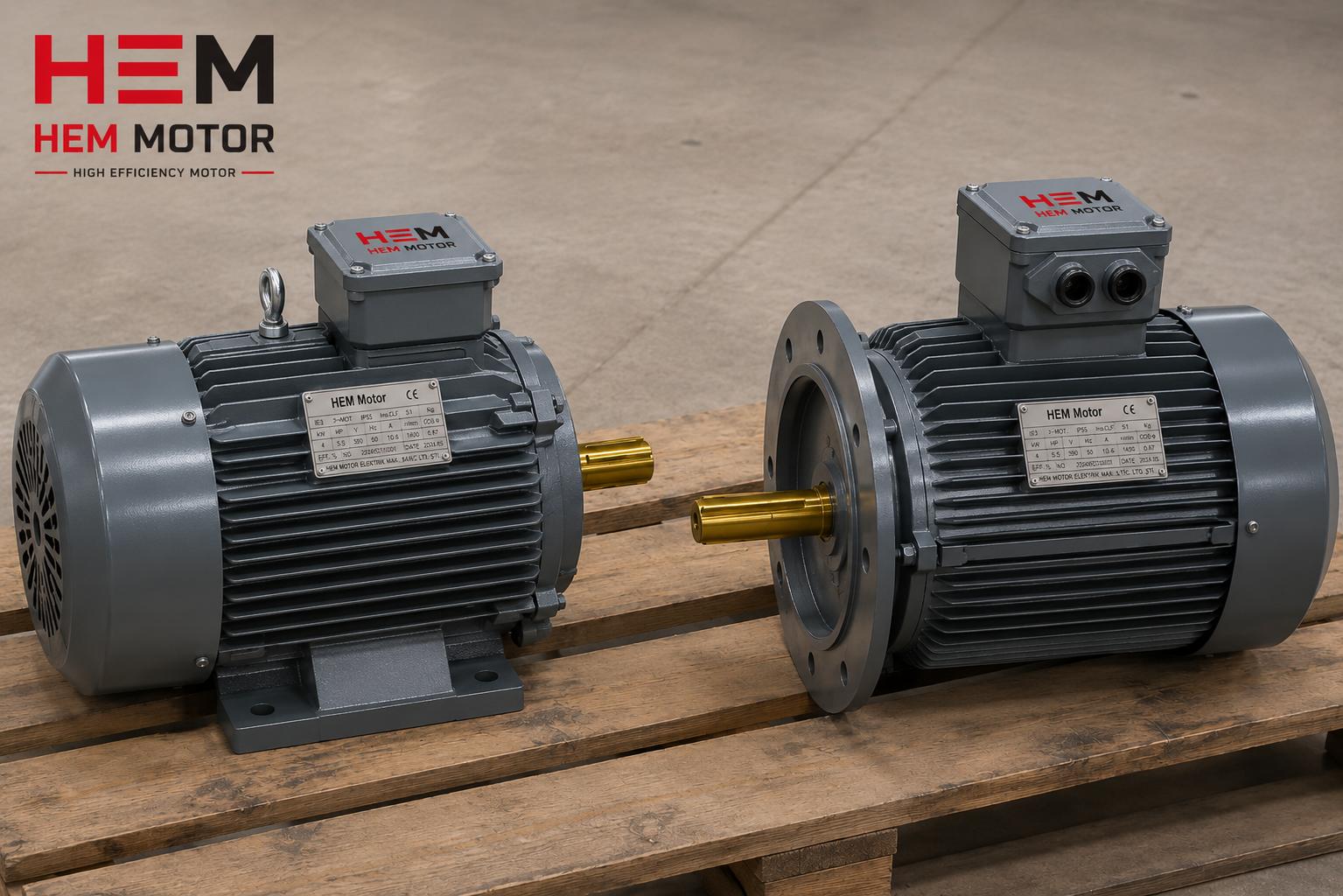

IE4 super premium efficiency motors sit at the heart of modern, energy-saving drives. But a motor being highly efficient does not always mean it offers precise speed and position control. In applications such as conveyor synchronisation, winding/unwinding, positioning, lifts, printing and test benches, an encoder or tachometer that feeds back the motor's actual speed is required. This feedback lets the drive perform closed loop vector control and keep speed and torque constant even when the load changes. At HEM Motor, shipping your IE4 motors with the right encoder option, at the right resolution and with the right mounting details, saves commissioning time and prevents field problems. This article covers the difference between incremental and absolute encoders, resolution (PPR) selection, closed loop vector control, mounting on the NDE shaft end, coupling and cable/shielding details, and which applications require an encoder, all focused on the ordering decision.
Why Is Speed Feedback Needed? Open vs Closed Loop
When running an asynchronous IE4 motor with a drive (frequency inverter) there are two basic control approaches. In open loop (sensorless) control the drive estimates speed from the current and voltage it sends to the motor; there is no feedback. This method is sufficient for many pump and fan applications, is economical and needs no extra hardware. However, at very low speeds, when full torque is needed near zero speed, or when speed must stay extremely constant regardless of load variation, open loop falls short. This is where closed loop comes in.
In closed loop control an encoder is fitted to the shaft end; the encoder reports the actual speed and direction of rotation to the drive at every instant. The drive instantly corrects the difference between target speed and measured speed. This gives full torque at zero speed, stable operation at very low speed and constant speed even under load steps. Our article on the IE4 inverter duty motor, which covers drive compatibility and commissioning more broadly, rounds out the mechanical and electrical groundwork of a closed loop encoder setup.
A terminology distinction is useful here. The classic tachometer (tachogenerator) is a device that produces an analogue voltage proportional to shaft speed and was used for speed feedback in older drives. Today the digital encoder has largely replaced the tachometer because it produces both speed and direction as pulses, is more noise-resistant and more precise. In this article we focus on the encoder, because in modern IE4 motor and drive combinations the standard feedback element is the encoder; but the principle is the same: measure the motor's actual speed and report it to the drive. The real value of feedback control is that it decides based on the speed the motor actually turns at under load, not on its nameplate rated speed.
Incremental or Absolute Encoder? Resolution and Type Selection
Encoders are basically divided into two groups, and the choice depends on whether the application controls speed or position:
- Incremental encoder: Produces a fixed number of pulses per revolution (PPR). It measures speed and relative position; it does not remember absolute position after a power loss and needs a reference search. Sufficient and economical for speed control and most closed loop speed applications.
- Absolute encoder: Gives the exact angular position of the shaft as a code at every instant. It remembers position even after a power loss (especially in the multiturn type). Preferred in positioning, lift, robotics and precise position applications.
Resolution, that is PPR, determines how fine the control will be. The table below summarises typical application-resolution matching.
| Application | Type | Typical Resolution | Output |
|---|---|---|---|
| General speed control (fan/pump closed loop) | Incremental | 1024 PPR | HTL / Push-pull |
| Conveyor synchronisation | Incremental | 1024-2048 PPR | HTL or TTL |
| Winding/unwinding, printing, precise speed | Incremental | 2048-5000 PPR | TTL / RS422 |
| Positioning, lift, robotics | Absolute (multiturn) | Multiturn (e.g. 4096 turns) | SSI / EnDat / BiSS |
The output type (HTL, TTL/RS422, SSI, EnDat, BiSS) must be compatible with the drive's feedback card. So when ordering an encoder, not only the PPR but also the output type and supply voltage (usually 5V or 24V) must be clearly specified. Choosing the wrong output type means the drive cannot read the encoder.
A common mistake in resolution selection is asking for higher PPR than necessary. Very high resolution improves speed measurement at low speed but can stress the maximum frequency the drive can read at high speed. The practical rule is: if precise control and smooth torque at low speed are wanted, choose high PPR (2048 and above); for classic closed loop speed applications 1024 PPR is often sufficient. You must make sure the product of maximum speed and PPR stays below the frequency limit of the drive feedback card. This calculation should not be overlooked, especially on 2 pole high speed IE4 motors.
How Does Closed Loop Vector Control Work?
In closed loop flux vector control the drive uses the actual speed from the encoder to control the motor's magnetic flux and torque-producing current component separately. This makes the motor behave as precisely as a DC motor: it can hold full torque at zero speed, correct speed very quickly under sudden load change and operate stably in four quadrants (forward/reverse, motoring/braking). Sensorless vector control also performs well, but cannot reach the stability of the encoder solution near zero speed and on starts requiring full torque. So in applications requiring load holding such as cranes, lifts and test benches, an encoder is almost mandatory.

Mounting: NDE Shaft End, Coupling, Cable and Shielding
The encoder is mounted on the non-drive end (NDE) of the motor, because the drive end (DE) is connected to the coupling or load. There are four critical points in mounting:
- Shaft end and coupling: The encoder is connected to the shaft with a flexible coupling (for example a bellows coupling). This coupling compensates small axial and angular misalignment but transmits torque; a rigid connection forces shaft runout onto the encoder and fatigues the encoder bearing.
- Centering: The encoder body must be well centred to the motor flange or mount; misalignment produces impact load and reading error.
- Cable and shielding: The encoder cable must be shielded, routed in a separate channel from power cables and the shield must be properly grounded at the drive end. High frequency noise from the drive PWM causes false pulse counting in an unshielded cable.
- Cable distance: Over long distances a TTL/RS422 (differential) output is more noise-resistant than HTL.
In a drive-fed system, shielding, grounding and bearing current must be handled in an integrated way. We detailed this in our grounding and EMC: shielded cable in a VFD system article, and accessory options in our brake, encoder and forced fan accessory options article.
Which Application Needs an Encoder? The Right Order Option
Not every IE4 motor needs an encoder; an unnecessary encoder adds both cost and a failure surface. In the following cases an encoder is the right and usually mandatory option:
- Full torque at zero/very low speed: Crane lifting, lifts, heavy starts.
- Precise speed constancy: Printing, paper, textile winding/unwinding, extrusion.
- Multi-motor synchronisation: Long conveyor lines, draw benches.
- Positioning: Indexing, position holding (here an absolute encoder is needed).
By contrast, in variable torque applications such as standard fans, pumps and compressors, sensorless vector or V/f control is often sufficient; we covered the IE4 threshold in these applications in our IE4 threshold in pump, fan and compressor article. For the right order, the motor, encoder type (incremental/absolute), PPR, output type and supply voltage must be specified together. In IE4 2 pole high speed applications you can also settle the power selection with our IE4 2 pole 3000 rpm motor article.
Common Problems in Encoder Systems and How to Prevent Them
In encoder-equipped closed loop systems, most of the problems seen in the field stem from mechanical or electrical installation errors, not from the encoder itself. The most common symptoms are speed fluctuation, overcurrent or an encoder fault code at the drive, and unstable operation at low speed. Knowing the root causes and remedies speeds up commissioning.
- False pulse counting: Unshielded cable or poor grounding; the fix is a shielded cable and grounding the shield at a single point on the drive side.
- Phase/direction swap: If the encoder A and B channels are wired reversed, the drive reads direction wrong; the connection order must be checked.
- Mechanical misalignment: Coupling misalignment or a rigid connection fatigues the encoder bearing and gives reading errors; a flexible coupling and correct centering are essential.
- Loose shaft connection: If the encoder's connection to the shaft loosens, the speed signal slips; fasteners must be tightened to the specified torque.
- Wrong supply voltage: Feeding 24V to a 5V encoder or vice versa makes the encoder unreadable; the supply must match the drive card.
Most of these checks are resolved from the start when the motor and encoder are prepared together at the factory and correct wiring instructions are given. We recommend that during the incoming and acceptance inspection of an encoder motor, the encoder connection and shaft end mounting are also checked; we covered the general acceptance inspection steps in our incoming and acceptance inspection article.
Frequently Asked Questions
Can an encoder be fitted to any IE4 motor?
Most IE4 motors can be produced encoder-ready at the factory with an NDE shaft end and encoder flange option. Adding an encoder to a standard motor later is also possible but requires shaft end machining, a flange and centering; so if the encoder requirement is known, it is best to specify it at the ordering stage. This way the correct NDE shaft end and mounting interface are provided from the start.
Should I choose an incremental or absolute encoder?
If only speed control is needed, an incremental encoder is sufficient and economical. If position information, remembering absolute position after a power loss, or precise positioning is needed, an absolute encoder should be chosen. Lift, robotics and indexing applications typically require a multiturn absolute encoder.
Why must the encoder cable be separate and shielded?
The drive's PWM output produces high frequency noise; if this noise enters an unshielded encoder cable or one routed in the same channel as power cables, the drive counts false pulses. The result is speed fluctuation, fault codes and unstable control. So the encoder cable must be shielded, separated from power and its shield grounded correctly. Over long distances, choosing an encoder with a differential output (TTL/RS422) markedly improves noise immunity. When planning the cable route, care should be taken that the encoder cable does not run parallel and close to the motor supply cable; if unavoidable, leave distance between them or arrange perpendicular crossings.
Does the encoder affect the motor's life or efficiency?
The encoder is a passive feedback element independent of the motor's electrical efficiency; when correctly fitted it does not affect the motor's efficiency or IE4 class. However, because encoder closed loop control runs the motor at the most correct speed and most suitable magnetic flux under load, it can improve energy use across the whole system. The encoder's own bearing is long-lived; when the mechanical installation is done correctly (flexible coupling, centering) the encoder does not noticeably increase the motor's maintenance burden.
At HEM Motor we ship your IE4 motors with an encoder option suited to your application, at the right resolution, output type and mounting interface. For your precise speed and position applications requiring closed loop vector control, we plan the motor and encoder combination together and offer fast delivery from stock. Share your application's speed, torque and position requirements; request a quote for the right encoder-equipped IE4 motor configuration.