English
 Türkçe


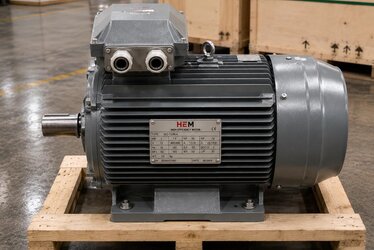
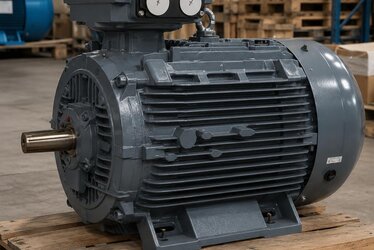
When you run an IE4 super premium motor through a variable frequency drive (VFD), you may not see the high efficiency printed on its nameplate in the field. The most commonly overlooked reason is the drive's switching frequency. To feed the motor, the drive produces a waveform by rapidly turning a DC voltage on and off (PWM, pulse width modulation); the number of these on-off cycles per second is the switching frequency. This frequency directly affects the motor's noise, its heating, the drive's own losses and ultimately the real energy savings. A poorly set switching frequency can silently erode the savings you expect from an IE4 motor. In this guide we explain the relationship between switching frequency and efficiency on IE4 motors, the PWM-related losses and motor heating, and offer a procurement and installation approach to protect those real savings.
At HEM Motor, the situation we encounter most often in efficient-motor sales is a customer who bought the right motor but failed to reach the expected savings because of drive settings or cable selection. Getting a return on an efficient-motor investment depends as much on feeding it correctly as on selecting it correctly.
What Is Switching Frequency?
The frequency drive first converts the alternating current from the grid into direct current, then rapidly switches this DC on and off with semiconductor switches called IGBTs to create a waveform at the frequency the motor needs. The number of these rapid switching cycles per second is expressed in kilohertz (kHz), and is usually adjustable between a few kHz and a few tens of kHz. A low switching frequency means less loss in the drive but more motor hum and current ripple; a high switching frequency means quieter, smoother current but more loss in the drive. The right value is a balance found between these two extremes according to the application.
Effects of Low Switching Frequency
- The drive's IGBT losses decrease, so the drive runs cooler.
- Ripple in the motor current increases, creating extra heating and loss in the winding.
- The motor hums more; audible magnetic noise increases.
- Torque ripple can become noticeable at low speeds.
Effects of High Switching Frequency
- The motor current is smoother; the motor runs quieter and more evenly.
- Harmonic-related extra heating in the motor decreases.
- The drive's own losses increase; the drive runs hotter and may need derating.
- Reflection and voltage stress (dV/dt) problems can grow on long motor cables.
Where Exactly Does PWM Loss Occur?
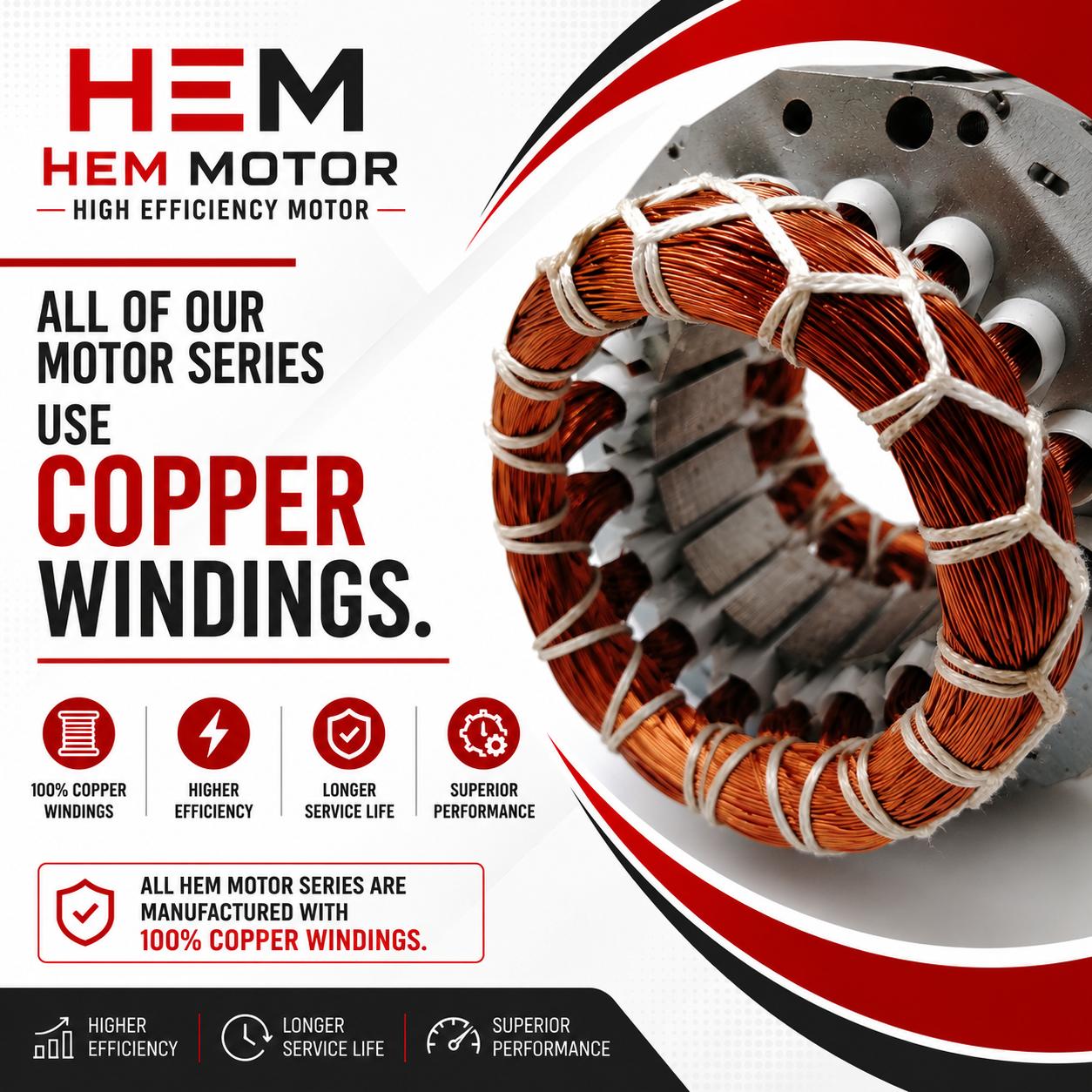
A PWM supply is not an ideal sine wave; alongside the fundamental frequency it contains high-frequency components (harmonics). These harmonics cause extra losses in the motor's copper winding and iron core. In the copper winding the RMS value of the current rises, increasing heating; in the iron core the high-frequency magnetic variation increases eddy current loss. IE4 motors use high-quality silicon steel, optimized slot geometry and high fill-factor copper winding precisely to reduce these losses. But if the drive's switching frequency is set too low, part of the motor's gain is taken back by PWM harmonics. To explore the effect of harmonics on efficiency in depth, our article on harmonics and power quality in high-efficiency motors is useful.
System Efficiency: Motor and Drive Must Be Considered Together
Efficiency is not the efficiency of the motor alone or the drive alone, but of the system the two form together. When you raise the switching frequency, motor loss falls while drive loss rises; when you lower it, the opposite happens. In most applications the lowest total loss is found in a middle region where these two curves cross. So the approach of "set the drive to the highest switching frequency so the motor is quiet" does not always give the most efficient result. The right decision must be made by considering the motor's operating point, cable length and noise requirement together. We also address the importance of this system approach in our guide on the frequency drive with an asynchronous motor.
Magnetic Noise and Its Link to Switching Frequency
A significant part of the high-pitched hum heard from drive-fed motors comes from the magnetic vibration the switching frequency creates in the motor winding and core. At low switching frequencies this sound can stay in the band where the human ear is most sensitive, making it annoying. When the switching frequency is raised, the sound shifts to higher bands where the ear is less sensitive, or becomes inaudible. This is the main reason for preferring a high switching frequency in quiet-critical environments. But this gain comes at the cost of drive loss, so the balance between noise and efficiency must be assessed separately for each facility. IE4 motors run with lower vibration and noise by nature; our article on quiet, low-vibration operation in IE4 motors provides complementary information.
How Are Efficiency Losses Distributed in Core and Winding?
A motor's total loss divides into copper (winding) loss, iron (core) loss, friction-windage loss and load loss. A PWM supply increases especially the iron and copper components of these losses through harmonics. IE4 motors reduce these losses from the design stage by using thin silicon steel and low-resistance, high fill-factor copper winding. Choosing the right switching frequency means protecting this low-loss structure against PWM harmonics. To understand where efficiency losses occur and how the IE4 design reduces them, our article on efficiency losses in IE4 motors offers a detailed framework.
Motor Heating, Bearing Current and the Cable Issue
While a high switching frequency reduces motor noise, fast voltage changes (dV/dt) can cause reflections on long cables and voltage spikes at the motor terminals. This adds extra stress to the insulation. In addition, high-frequency common-mode voltages can cause leakage current through the bearings to ground and premature bearing wear from bearing current. These risks are managed with proper shielded cable, short cable runs, an output filter where needed and proper grounding. To plan this in detail, our articles on VFD and harmonic-related heating and bearing current and motor grounding and EMC offer practical protection steps.
Low-Speed Cooling and Continuous Torque
Independent of switching frequency, if a drive-fed IE4 motor produces high torque at low speed for long periods, cooling weakens because the shaft-mounted fan slows down. In these continuous-torque scenarios an external forced cooling fan should be planned. Otherwise, even with a perfectly tuned switching frequency, the motor will heat up due to inadequate cooling. Our guide on the external forced cooling fan and VFD is complementary here.
Part-Load Efficiency and Correct Sizing
A factor as important as switching frequency is how heavily the motor is loaded. An IE4 motor usually gives its highest efficiency at a certain fraction of rated load; at very low loads the efficiency curve drops. A common mistake in drive-fed systems is choosing a motor much larger than needed and running it continuously at low load. To select the right power is the basic step that comes before switching-frequency optimization. Our article on part and low-load efficiency in IE4 motors explains how oversizing eats into savings.
The Affinity Law in Pumps and Fans: Where Are the Real Savings?
The biggest energy savings achieved with a drive often come not from the switching frequency but from reducing speed on variable-torque loads such as pumps and fans. By the affinity law, reducing speed somewhat in these applications cuts power consumption by a much larger proportion. So the drive's real value is the saving it provides by adjusting speed instead of throttling flow; switching frequency is a parameter that protects, but does not by itself create, this saving. To understand this concept clearly, we recommend our article on the affinity law in pumps and fans with a VFD.
Documenting the Savings: No Improvement Without Measurement
Measuring rather than assuming the savings achieved with an IE4 motor and drive is essential both to see the return on the investment and to make future decisions correctly. Measuring the real active power the motor draws at different operating points with a power analyzer concretely reveals the effect of switching frequency and load change. Understanding the difference between nameplate and field efficiency keeps expectations realistic. Our article on the difference between nameplate and field efficiency guides you in calculating real savings correctly.
A Procurement Approach That Protects Real Savings
To protect the savings you target with an IE4 motor, we recommend the following steps during purchasing and commissioning:
- Size the motor and drive together: Ensure the drive meets the motor's rated current and, if needed, continuous torque at low speed.
- State the cable distance: If there is a long cable, assess the need for an output or dV/dt filter from the start.
- Share the operating point: At what speed and load will the motor mostly run? The switching frequency is optimized for this point.
- Specify the noise requirement: If quietness is critical, a higher switching frequency; if efficiency is critical, a middle value is targeted.
- Plan the cooling: If there is continuous torque at low speed, add an external fan to the order.
To source the right IE4 motor together with a suitable drive match with fast delivery from stock, and for current electric motor prices, get in touch with us. To assess the IE4 threshold in pump, fan and compressor applications, see our article on the IE4 threshold in pumps, fans and compressors, and for the product range our IE4 electric motors page.
Frequently Asked Questions
Does raising the switching frequency increase savings?
Not on its own. Raising the switching frequency reduces the motor's harmonic-related loss and noise, but increases the drive's own loss. The lowest total loss is usually achieved at a middle switching frequency. The right value must be set according to the motor's operating point, cable length and noise requirement; there is no single ideal value for every application.
Does the IE4 motor's efficiency advantage shrink with a drive?
With a correct installation it does not shrink, it is preserved. The IE4 motor's low-loss design is valid with a drive too; however, a very low switching frequency, poor cabling or the wrong filter choice can take back part of this advantage by increasing PWM losses. Designing the system with motor and drive considered together is the key to carrying nameplate efficiency into the field.
Will there be a bearing current problem on a drive-fed IE4 motor?
With a high switching frequency and long cables, common-mode voltages can cause bearing current, which creates premature bearing wear. The risk is managed with shielded cable, proper grounding, insulated bearings where needed and an output filter. Stating the application at the order stage ensures these measures are planned from the start.