English
 Türkçe

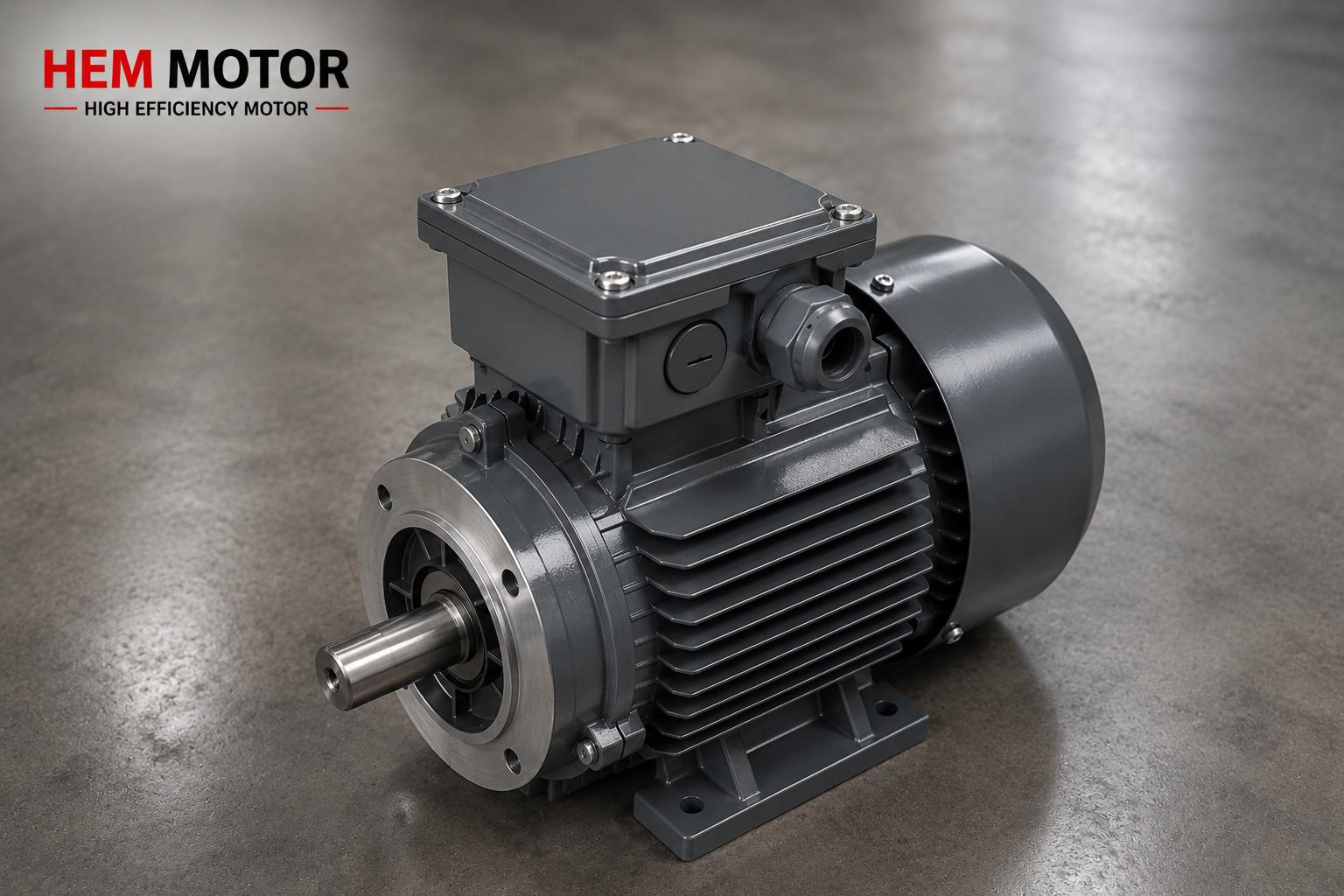

One of the first questions asked when buying an electric motor is "How many years will this motor last?" Yet the IE3 motor service life is a quantity measured not in calendar years but in total operating hours. A motor running eight hours a day and one running twenty-four hours non-stop have completely different "ages" even within the same calendar year. To assess life correctly, you first have to frame the question correctly.
A correctly sized IE3 efficiency-class motor that operates in suitable ambient conditions and is regularly maintained can deliver tens of thousands of trouble-free hours. In many industrial applications, service lives in the range of 40,000 to 100,000 operating hours are common. Turning these numbers into reality is not a matter of luck; it depends on the decisions made from the moment the motor is selected.
In this article we examine the two fundamental components that determine the expected operating life, what the warranty period does and does not mean, and finally the practical meaning of all this for the buyer within the framework of total cost of ownership.
Why Is IE3 Motor Life Measured in Hours?
Motor wear progresses through the abrasion of rotating parts and the thermal aging of insulation materials. Both occur while the motor is energized and turning; when the motor is off, wear practically stops. That is why the question "how old is it" is far less meaningful than "how many hours has it run, at what load, at what temperature."
Two identical IE3 asynchronous motors, one running two hours a day and the other twenty-four, will after five years have seen roughly 3,600 and 43,000 hours respectively. Although their calendar ages are equal, the difference in actual wear exceeds tenfold. This simple example also shows why confusing the warranty period with life is misleading.
How Does the Duty Cycle (S1, S3, etc.) Affect Life?
The continuous duty cycle S1 describes the situation where the motor reaches thermal equilibrium and remains there for a long time. In intermittent duties (S3, S4) the motor starts and stops, so the average temperature may be lower, but frequent starts impose additional stress on the bearing and winding. When assessing life, both the total operating hours and the starting frequency must be considered together.
The Two Components That Set Life in Practice: Bearing and Insulation
A motor's housing, shaft, core stack and copper winding can survive for decades when used properly. In reality, two critical components limit a motor's life: the bearing and the winding insulation. Understanding these two elements is decisive both for estimating life correctly and for supplying the right product.
Bearing: The Limit Renewable at Low Cost
The bearing is the most heavily worn and at the same time the most easily renewed part of the motor. A standard deep-groove ball bearing has a defined fatigue life under oil film, temperature, vibration and axial load. The good news is that when the bearing wears, only the bearing is replaced rather than the whole motor, and this operation is very low in cost compared with the motor's value.
There are several practical rules to extend bearing life:
- Correct greasing: Too much grease is as harmful as too little; manufacturer intervals must be followed.
- Alignment: Misalignment in coupling or belt-pulley connections ends the bearing early.
- Belt tension: An over-tensioned belt imposes side load on the shaft and stresses the bearing.
- Vibration monitoring: Regular vibration measurement warns of bearing failure weeks before collapse.
- Sealing: Suitable seals or shielded bearings should be chosen against dust and water ingress.
Renewing the bearing through planned maintenance is the essence of the predictive maintenance mindset. Keeping the right bearing size in stock turns unexpected stoppages into short interruptions.
Insulation: A Temperature-Dependent, Irreversible Limit
Unlike the bearing, the aging of winding insulation is irreversible. The insulation class defines the temperature the insulation can withstand, and the widely accepted rule here is this: every sustained 10 °C rise in winding temperature roughly halves the insulation life. This "10-degree rule" is the key to understanding motor life.
In modern IE3 motors, class F insulation is common and is generally designed to operate at a class B temperature rise. This combination provides an important thermal margin: the motor does not heat up to the limit of its insulation, leaving a safety buffer in between. This buffer protects the insulation and extends life in cases such as hot ambient conditions, voltage imbalance or mild overload.
The main factors that shorten insulation life are: high ambient temperature, insufficient cooling (fins clogged with dust), overload, voltage fluctuations and phase imbalance. All of these raise the winding temperature and rapidly consume the insulation's thermal budget.
The Warranty Period Is Not the Motor's Life
The most common conceptual mistake buyers make is assuming the warranty period is the motor's life. The warranty period is the commercial commitment the manufacturer makes against material and workmanship faults; it describes not when the motor will wear out, but for how long a manufacturing fault is covered. A motor with a two-year warranty may well run for fifteen years; conversely, the warranty does not cover faults arising from misuse.
What Does the Warranty Typically Cover?
- Material defects: Faulty core stack, defective winding, mold or casting flaws.
- Workmanship faults: Incorrect winding, faulty assembly, an unbalanced rotor.
- Early component failure: Manufacturing-related defects such as a bearing collapsing much earlier than expected.
Typical Situations Outside Warranty Coverage
- Winding burnout from overload and continuous operation above limits.
- Misuse: Wrong connection, reversed phase, missing phase, incorrect voltage.
- Water, dust and chemical ingress; use in an environment not matching the IP protection class.
- Unauthorized intervention, opening and rewinding, label alteration.
- Insufficient maintenance: lack of greasing, obstructed cooling.
When reading the warranty document, it is in the buyer's interest to ensure the scope is clearly defined. A good supplier shares warranty conditions and commissioning requirements transparently. Steering the right product to the right application, supported by resources such as the IE3 motor selection guide, also lowers warranty risk.
Total Cost of Ownership: The Core of the Buyer's Decision
A motor's true cost is far more than its purchase price. In industrial motors, the bulk of the total cost of ownership comes from the electrical energy the motor consumes over its operating life. In most continuously running applications, the energy cost reaches tens of times the purchase price. This is precisely why the IE3 and IE4 efficiency classes directly concern the buyer's pocket.
An IE3-class motor delivers a clear energy saving over the years compared with a less efficient motor. For a continuously running drive, this saving usually pays back the initial price difference in a short time. When length of life and efficiency come together, it becomes clear that the "cheap" motor is in fact expensive and the "efficient" motor is in fact economical.
Practical Decisions That Lower Cost
- Sizing the motor correctly: both a large motor running continuously at half load and a small motor running at its limit are costly.
- Keeping the cooling clean to preserve class F insulation and the thermal margin.
- Keeping spare parts such as bearings and seals in stock to shorten downtime.
- If load varies, running the motor to demand with a variable frequency drive.
When considered together, life and cost become two sides of the same coin. For an efficiency-focused supply strategy, the IE3 and IE4 efficiency comparison can be reviewed; to choose the solution best suited to the application, requesting a quote against current electric motor prices is the soundest route.
Supply and Stock: Protecting Life in the Field
Whatever a motor's life on paper, its real performance in the field is determined by the supply chain. Being able to quickly reach a spare motor of the right size during an unexpected failure dramatically reduces production loss. For this reason, on critical lines the capacity for stock and fast supply is as important as the motor's technical specifications.
The availability of IE3 motors in standard frame sizes from stock is a major advantage for both new projects and spare requirements. Learning the stock status and requesting a quote for the power, pole number, frame type and protection class suited to your application is the first step of a correct start.
Frequently Asked Questions
How many years does an IE3 motor last?
Giving a definite number of years is misleading, because life depends on operating hours, load and temperature. A correctly sized, well-cooled and maintained IE3 motor can serve tens of thousands of operating hours. For a motor running eight hours a day this corresponds to many years; for one running twenty-four hours to a shorter calendar span. What matters is the hours and conditions.
Does the motor break down when the warranty ends?
No. The warranty period is not the motor's life; it is only a commercial commitment against manufacturing faults. When the warranty ends, the motor is usually still at the beginning of its life. With regular maintenance, correct greasing and preservation of the thermal margin, the motor continues to run far beyond the warranty period.
Is bearing replacement expensive?
No. The bearing is the most easily renewed part of the motor and its cost is quite low compared with the motor's value. The real cost comes from the downtime caused by an unplanned failure. That is why predictive maintenance and keeping a spare bearing in stock both extend life and reduce total cost.