English
 Türkçe

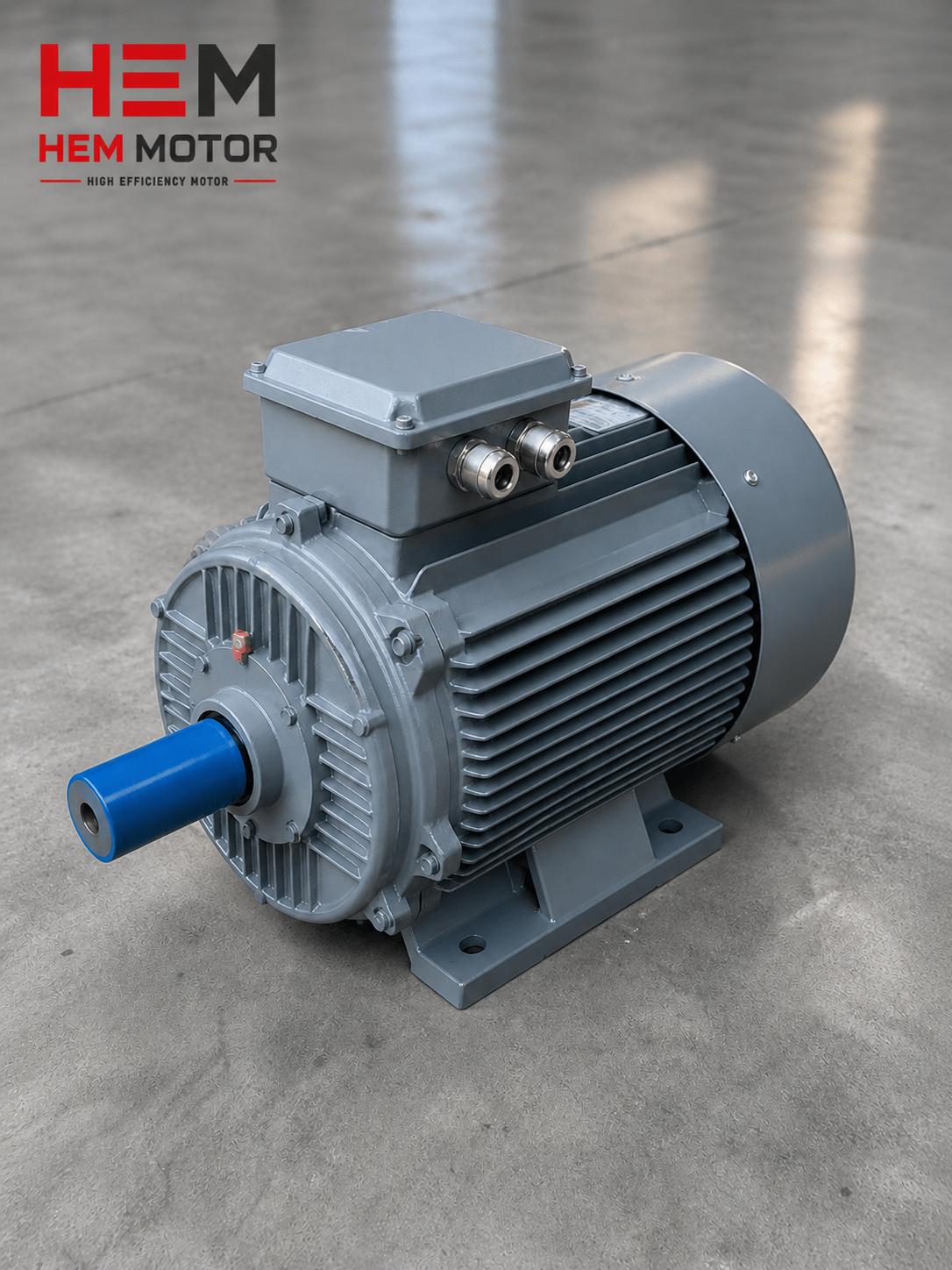

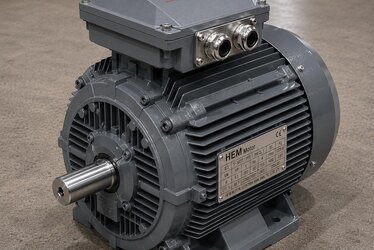
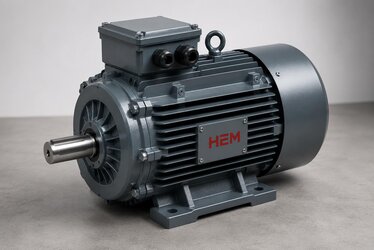
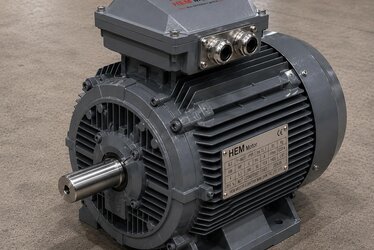
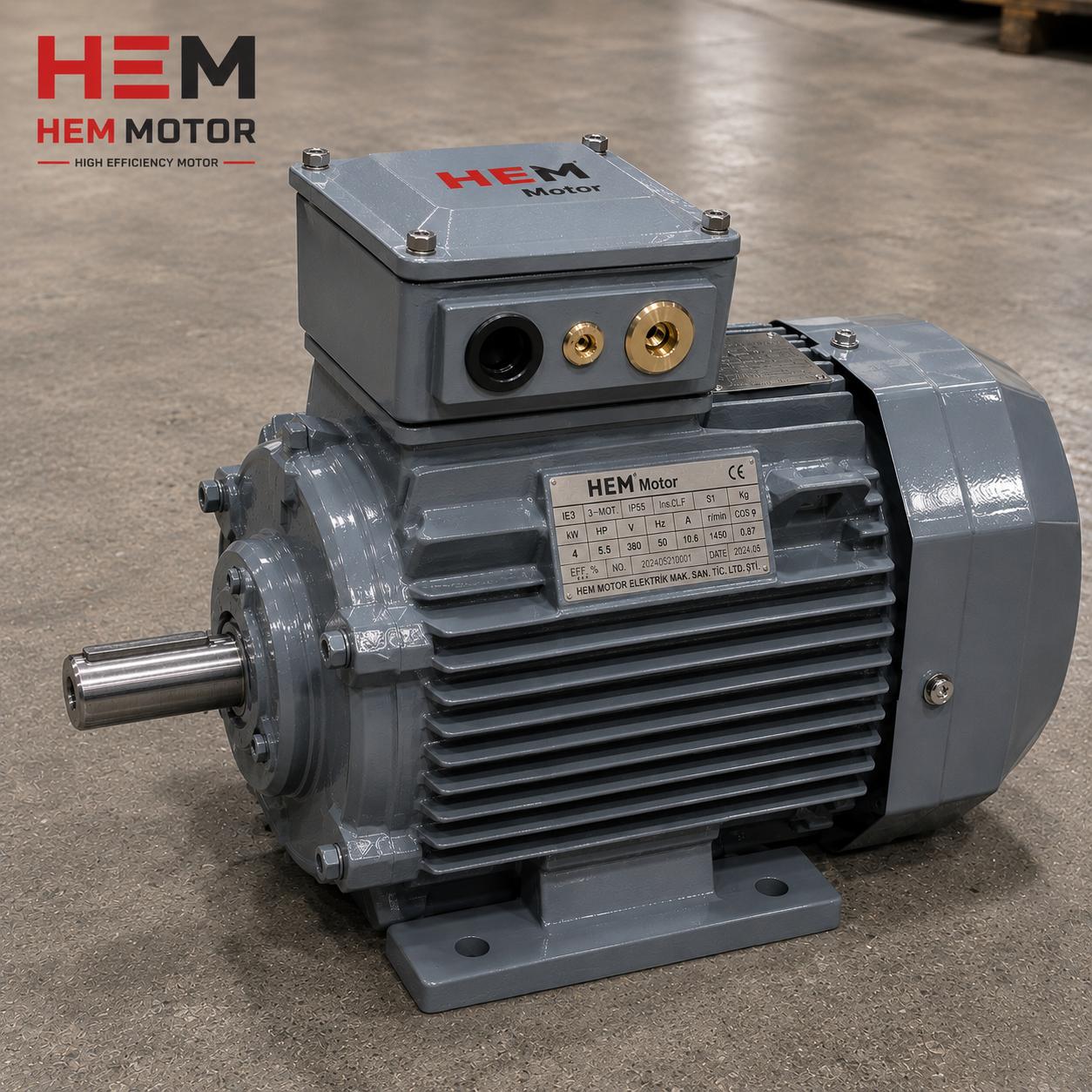
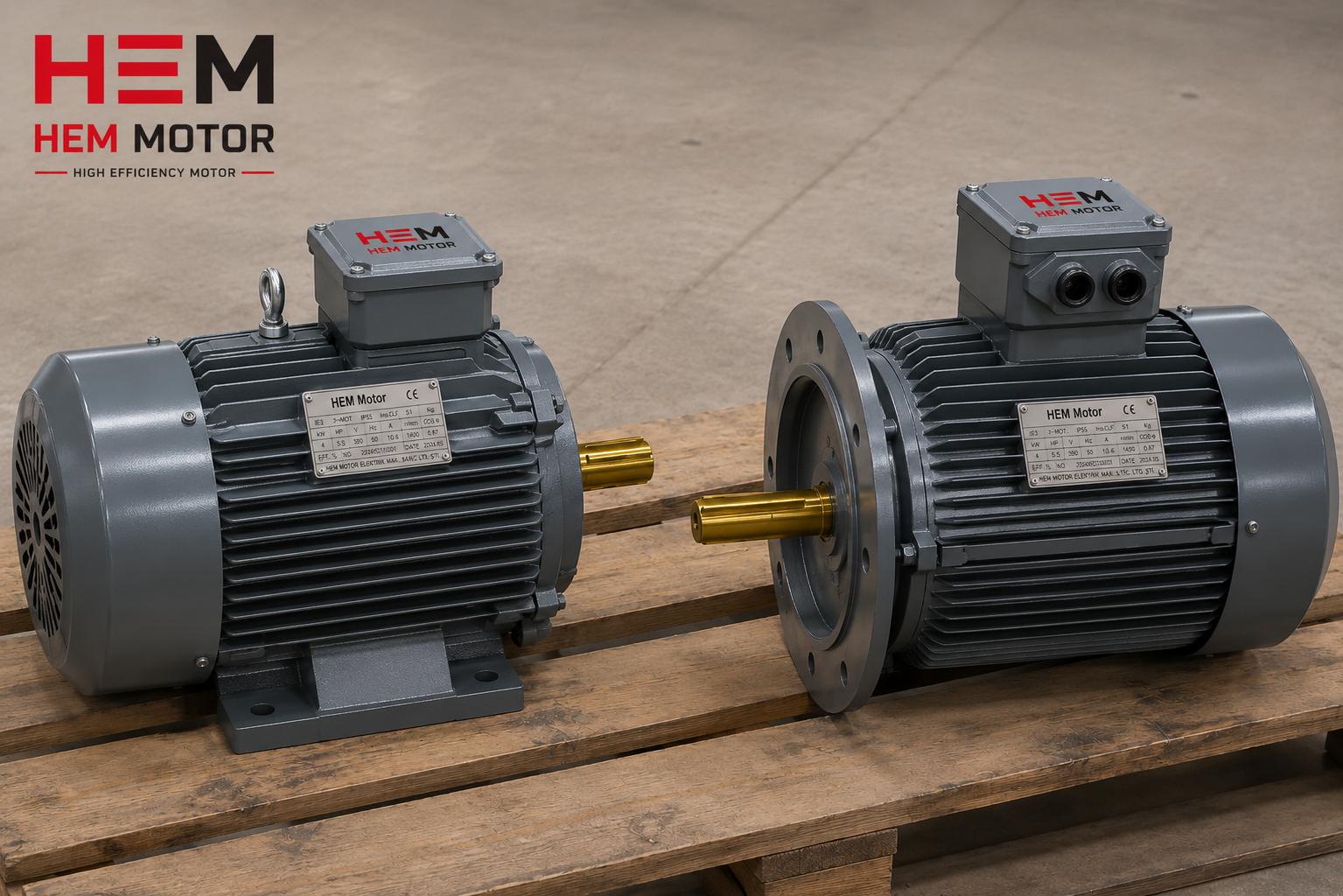
When engineers design an electric motor or order a replacement, one component is almost always overlooked: the cooling fan mounted on the rear end of the shaft and spinning beneath the fan cover. Yet the thermal behavior, service life and noise level of an IE3 Premium efficiency motor depend heavily on this small but critical part being chosen correctly. In the cast iron, IP55, class F insulated, 100% copper wound IE3 and IE4 motors that HEM Motor manufactures, this fan is the heart of the TEFC (Totally Enclosed Fan-Cooled) architecture that cools the fully enclosed frame from the outside.
In TEFC motors, cooling is achieved through the self-ventilated method coded IC411. The fan fitted onto the motor's own shaft generates airflow proportional to rotational speed, directing that air along the frame fins to carry heat into the atmosphere. The most common question at this point is what material the fan should be made of: a light, quiet plastic fan, or a high-temperature-tolerant metal fan? Add to this whether the motor runs in both rotation directions, that is whether a bidirectional fan is required, and the right choice ceases to be a routine detail and becomes an engineering decision.
In this article we examine cooling fan material selection on IE3 motors in detail: the advantages and limits of plastic versus metal/aluminum options, the relationship between ambient temperature and derating, bidirectional and unidirectional fan geometries, and what to watch for when ordering correctly.
The Role of the Cooling Fan in TEFC / IC411 Motors
In an enclosed motor, internal air does not mix with external air. The loss heat generated in the windings and iron core is first conducted to the frame, then transferred to the fins on the frame surface. The part that drives the airflow across these fins is the shaft-mounted external cooling fan. The fan spins inside the fan cover (cowl), drawing air from the rear end of the motor and pushing it forward along the frame.
The defining feature of this self-ventilated design is that cooling capacity depends directly on rotational speed. The air volume produced at 3000 rpm is far greater than that produced at 1000 rpm. For this reason, in low-speed motors or applications run slowly via a VFD, the airflow from the fan may become insufficient; in such cases an external forced cooling fan for low speed VFD comes into play. In a standard self-ventilated design, choosing the right fan material directly affects cooling performance.
For those who want to grasp the cooling method conceptually, a comparison of cooling methods IC411/IC416 in enclosed motors clarifies the context of fan selection. The aerodynamic design of the fan is decisive for both cooling and noise; in this respect the cooling fan aerodynamic noise relationship is well worth studying.
Plastic (Polymer) Fan: Advantages and Limits
Today, reinforced polymer or glass-fiber filled plastic fans are preferred on the majority of IE3 motors operating in standard ambient conditions. There are technical reasons for this, and for most applications the plastic fan is the most sensible choice.
Advantages of the Plastic Fan
- Light weight and low inertia: A plastic fan has far less mass than a metal one. This reduces the moment of inertia of the rotating mass on the shaft; the motor starts and stops faster, and the additional load on the shaft during start-up is lower.
- Quieter operation: Thanks to the damping property of polymer, aerodynamic and vibration-induced noise is generally lower than with a metal fan.
- Corrosion resistance: Plastic does not rust; it lasts longer than metal fans in humid, mildly chemical or wash-down environments.
- Low cost and easy supply: It is economical to manufacture and to replace as a spare part.
- Reduced starting load: A low-inertia plastic fan provides energy and mechanical advantage, especially in frequent start-stop applications.
Limits of the Plastic Fan
The most prominent constraint of the plastic fan is temperature. The continuous operating temperature of polymer material is limited; under high ambient temperature or in environments with high radiated heat such as furnaces, ovens and foundry stations, a plastic fan can soften, deform or become brittle over time. Standard polymer fans are typically designed for a moderate ambient temperature range; above this threshold, the material life of the fan shortens rapidly.
A second consideration is mechanical strength. On very large diameter fans or at continuously high speed, plastic has lower resistance to centrifugal force than metal. For this reason, above certain power and speed limits manufacturers move to metal fans.
Metal / Aluminum Fan: Advantages and Limits
In high temperature, heavy industry and harsh mechanical conditions, a metal fan or, more commonly, an aluminum fan is preferred. Foundry environments, hot rolling mills, conveyors near furnaces and plants with high ambient temperatures are typical examples.
Advantages of the Metal Fan
- High ambient temperature tolerance: An aluminum fan retains its shape and balance even at temperatures where plastic would deform. It is used safely in furnace and foundry areas.
- Mechanical robustness: It is resistant to impact, friction and centrifugal force; the safety margin is high on large diameter and high-speed fans.
- Long life and repairability: In hot and dusty environments, the structural life of a metal fan is more predictable than that of plastic.
- Dimensional stability: Because its geometry is largely preserved under temperature variation, the cooling airflow remains stable.
Limits of the Metal Fan
- Weight and inertia: A metal fan is far heavier than plastic; the moment of inertia on the shaft increases and start/stop times lengthen.
- Higher noise: Because its damping property is low, aerodynamic and vibration noise is generally greater than with a plastic fan.
- Corrosion risk: In humid or chemical environments, unprotected metal fans can oxidize; in such cases a surface coating is required.
- Cost: Manufacturing and replacement cost is higher than for plastic.
Bidirectional or Unidirectional? The Direction Dependence of Fan Geometry
Just as important as fan material is fan geometry. There are two basic types here: the symmetric-bladed bidirectional fan and the curved (directional) bladed unidirectional fan.
Bidirectional (Symmetric) Fan
A symmetric fan has straight, radially symmetric blades; it produces the same amount of air whether the motor turns clockwise or counterclockwise. For this reason, a bidirectional fan is mandatory on motors whose rotation direction changes frequently or that can be run in either direction depending on the application. In direction-reversing systems such as pumps, reversing conveyors, door and elevator drives, the symmetric fan provides safe cooling in both directions.
Its disadvantage is efficiency: because the symmetric geometry is not optimized for a particular direction, it produces less air volume than a curved-blade fan of the same diameter and is generally slightly noisier.
Unidirectional (Curved Blade) Fan
A curved-blade fan is optimized for a single rotation direction. At the same diameter and speed, it offers higher air volume, better cooling and generally lower noise than a symmetric fan. However, if the motor is turned in the reverse direction, the fan cannot produce air and the motor can overheat. Therefore a unidirectional fan should only be used in applications where the rotation direction is fixed.
This balance between fan aerodynamics and efficiency also affects the motor's overall energy performance; the effect of cooling and fan design on efficiency offers an in-depth look at this subject. When buying IE3 and IE4 motors, specifying the correct fan type preserves both efficiency and motor life; it is important to clarify this detail at the ordering stage while researching electric motor prices.
Ambient Temperature, Derating and S1 Continuous Duty
HEM Motor IE3 and IE4 motors are designed for the S1 continuous duty regime; that is, they are sized to run uninterrupted at rated load. However, the rated values apply for a specific reference ambient temperature. When this reference is exceeded, the power the motor can deliver must be reduced; this is called derating.
High ambient temperature strains both the winding insulation and the fan material. When the temperature at which a plastic fan can safely operate is exceeded, either a metal fan is adopted or the motor is run at lower load. For this reason, aluminum-fan versions are preferred in foundry, glass, ceramic and metallurgy plants. The following steps should be followed for correct selection:
- Measure the actual ambient temperature in the plant; base the decision on the continuous ambient value in the area where the motor operates, not on spot temperatures.
- Account for radiant heat from furnaces, ovens and hot surfaces; even if the air temperature is normal, radiation can heat the fan.
- If the temperature is high, use a metal/aluminum fan and apply derating if necessary.
- If the rotation direction varies, choose a symmetric (bidirectional) fan.
- If low-speed or slow VFD operation is involved, evaluate external forced cooling.
Correct Matching for Spare Parts and Replacement
When replacing the fan of an existing motor, matching the diameter alone is not enough. For correct matching, fan diameter, shaft diameter and fit, blade count and geometry (symmetric or curved), material (plastic/metal) and rotation-direction compatibility must all be evaluated together. A wrong fan, for example fitting a unidirectional fan to a reverse-running motor, can eliminate cooling entirely and lead to the windings burning out.
Similarly, fitting a plastic fan as a spare to a motor operating in a high-temperature environment causes deformation and imbalance within a short time. Therefore, on replacement the material and geometry properties of the original fan should be preserved, and if the environment has changed an upgrade should be made accordingly.
Frequently Asked Questions
Is a plastic fan or a metal fan better on an IE3 motor?
There is no single right answer; the choice depends on the environment. In standard and humid environments, a plastic fan is advantageous for its light weight, quietness and corrosion resistance. In places with high ambient temperature such as furnaces and foundries, an aluminum fan is preferred because it operates safely without deforming.
My motor sometimes runs forward and sometimes in reverse; which fan should I choose?
In applications where the rotation direction changes, a symmetric-bladed bidirectional fan must always be used. A curved-blade unidirectional fan produces air in only one direction; in reverse rotation it cannot cool and the motor overheats. Although the symmetric fan is slightly less efficient, it provides safe cooling in both directions.
Do I need to reduce motor power in a high-temperature environment?
When the reference ambient temperature is exceeded, the motor should be run below its rated power; this is called derating. In addition, the fan material must be chosen to suit that temperature. At high temperatures, a metal fan and appropriate derating are applied together so that S1 continuous duty is safely maintained.