English
 Türkçe

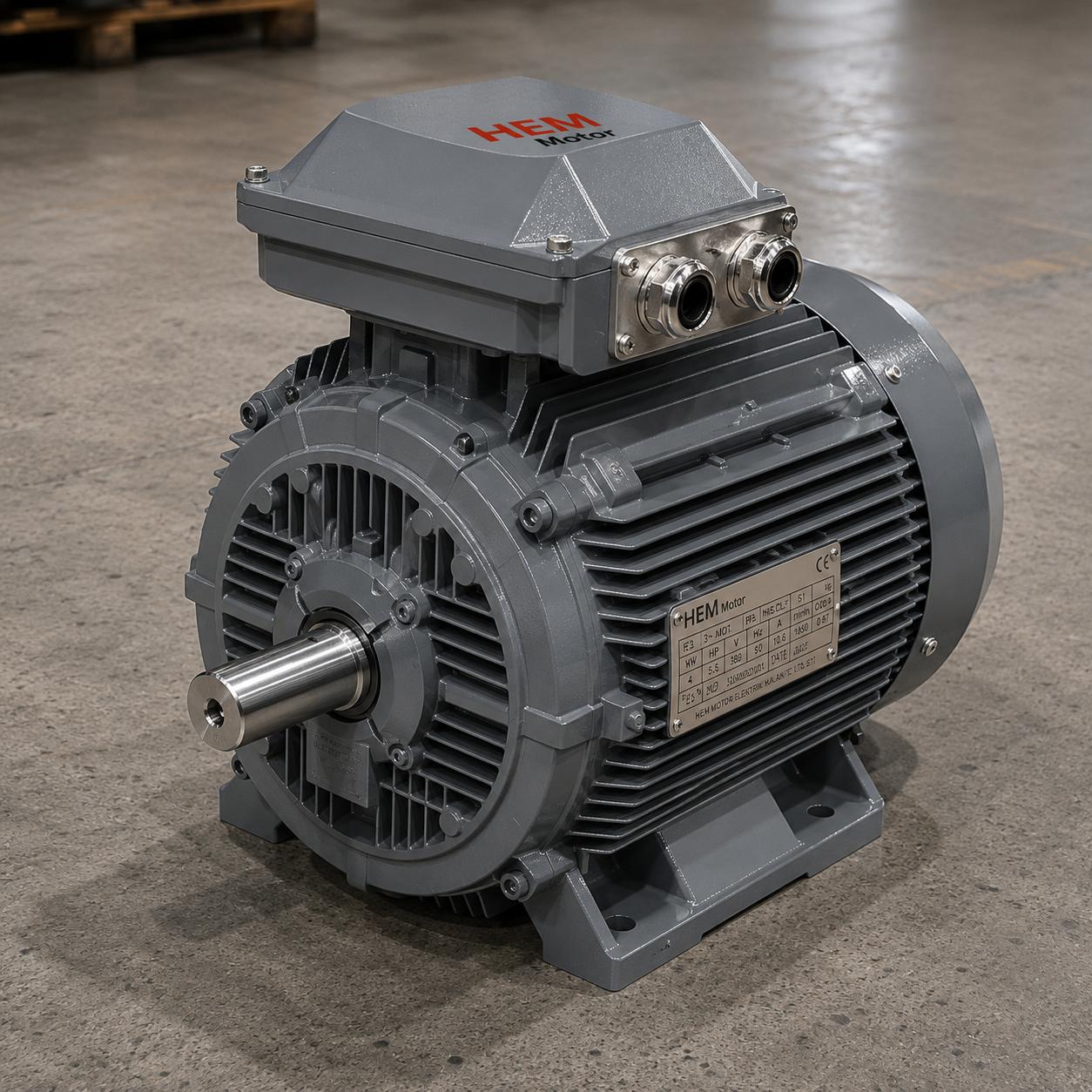

In applications such as cranes, hoists, automatic gates, machine tool tables and direction-changing mixers, an asynchronous motor is forced to run forward and backward continuously. In this kind of service, what determines the motor's life and reliability is usually not the instantaneous torque value but the heat energy dumped into the windings and rotor in a very short time. In particular, when plug braking, that is plugging, is applied, the motor draws currents close to or exceeding the starting current, and each braking step heats the motor by an amount equivalent to several starts. In this article we examine the relationship between frequent reversing and plugging, the heating mechanism, the concept of the permissible number of starts, and the correct motor selection for such heavy-duty service, all from a manufacturer's point of view. With stock, fast replacement and order-based custom manufacturing options, we offer solutions suited to these applications. For a wider product range and electric motor prices, please visit our homepage.
What Is Frequent Reversing and Where Does It Occur?
Frequent reversing is when a drive system runs alternately forward and backward at short time intervals. Many industrial applications require this operating pattern by nature, and the motor is exposed to these cycles dozens of times per minute or hour.
- In overhead and gantry cranes the trolley and bridge movements continuously change direction.
- In hoists and lifting systems, load-raising and lowering cycles are repeated.
- In automatic barriers, shutters and industrial gate drives, open-close motion is frequent.
- Machine tool tables and turret heads perform rapid reversal for positioning.
- In agitators and mixers, direction is reversed for material homogeneity.
The common feature of these applications is that the motor rarely reaches steady state. The asynchronous motor is slowed, stopped or reversed again before it even completes the acceleration phase. The motor therefore operates in a continuous transient regime, and these transitions are the most demanding zone thermally.
How Does Plugging (Plug Braking) Work?
Plugging is the sudden reversal of the rotating field by interchanging two phases while the motor is still rotating forward. This decelerates the rotor very quickly and meets the rapid-stop need of the applications. The physics behind it, however, is quite harsh.
Behaviour of Slip and Current
In a normal start, with the rotor at standstill, the slip is approximately 1. During plug braking, however, the rotating field turns in reverse while the rotor still turns forward; the relative speed almost doubles and the slip reaches about 2. As a result the motor draws currents close to or exceeding the starting (locked-rotor) current. High current means high losses, and most of these losses are converted into heat in a very short time.
Each Braking Equals Several Starts
Thermally, a single plug-braking step usually heats the motor by an amount equivalent to two or three starts. This is because both the kinetic energy of the moving load and the extra electrical energy drawn from the supply are converted into heat in the rotor cage and windings. For this reason, plugging is an operation that consumes the motor's thermal budget very quickly.
Heating Mechanism: The Real Limit Is Temperature, Not Torque
Every start and every plugging step causes a large amount of energy to be dissipated in the rotor cage, bars, short-circuit (end) rings and stator windings. Because this energy is released in a very short time, the temperature rises sharply. A motor that would cause no problem in continuous duty may exceed its insulation limit under frequent cycles.
- Rotor bars and end-rings are stressed thermally and mechanically, increasing the risk of cracking over time.
- Winding insulation ages at high temperature; every 8-10 degree rise can halve the insulation life.
- The governing limit is usually not the torque capacity but the allowable temperature class.
For this reason, it is critical that a motor selected for frequently reversing service has sufficient Class F insulation and thermal margin. Applying PTC/PT100 winding thermal protection to monitor winding temperature directly is a strong precaution.
Duty Type and Cyclic Duration Factor (% ED)
Motors that operate frequently are defined not by continuous duty (S1) but by intermittent duty classes. The asynchronous motor is typically evaluated under duty type S4 or S5 in frequent start-stop and braked service.
The Importance of S4 and S5 Service
Duty type S4 defines intermittent periodic operation that includes the thermal effect of starting; S5 additionally accounts for the effect of electric braking (for example plugging). In these services the motor is specified together with the number of starts and brakings per hour, the moment of inertia and the cyclic duration factor (% ED). For a frequently reversing application, the correct approach is to order a motor defined with these cycle data.
Why Is the Duration Factor Critical?
The cyclic duration factor is the percentage of an operating period during which the motor runs under load. The higher the % ED, the less time the motor has to cool and the higher the thermal load. For braked and irregular-load service, motors in the duty type S7/S8/S9 braked and irregular load category should be evaluated.
Number of Starts: The Zo and Z Concept
Manufacturers specify the permissible number of starts for each motor in the catalogue. These values are not arbitrary; they are the limits that protect the motor's thermal capacity.
- Zo: the permissible number of starts per hour at no load (without external inertia), and it is the highest value.
- Z: the permissible number of starts under a given load and external moment of inertia (FI or GD2 / J).
- As external inertia increases, the permissible number of starts drops rapidly.
The critical point here is this: a single plugging operation is usually charged to the thermal budget like two or three starts. Therefore the total number of reversals possible per hour depends not only on the number of starts but also on the braking method. A crane drum with high external inertia or a large mixer blade severely limits the permissible cycle count. For this reason it is not possible to select the correct motor without knowing the application's hourly cycle and inertia data.
Mechanical Stress: Shaft, Key, Coupling and Gearbox
Frequent reversing is demanding not only thermally but also mechanically. Every torque reversal applies an impact load to all elements in the drive train.
- The shaft and key (keyway) are exposed to repeated reversing loads from a fatigue point of view.
- The coupling and gearbox (reducer) experience backlash and shock during sudden torque changes.
- Bearings fatigue faster under reversing loads; reinforced bearing selection is recommended.
For this reason, smooth mechanical transitions should be the goal in frequently reversing systems; where possible, controlled reversal and suitable ramping should be preferred. On how to change the direction of rotation and phase sequence safely, our content on rotation direction and phase reversal will be a useful guide.
Correct Motor Selection: What to Watch For?
Motor selection for frequently reversing and braked service is very different from buying a standard S1 motor. The aim here is to choose a motor with a high thermal and mechanical margin that is resistant to cycles.
Thermal Margin and Insulation
For a high thermal margin, it is helpful to move up one frame (body) size or to choose a higher insulation class. Class F insulation is the baseline; approaching Class H in heavy service provides extra safety. Thermal sensors to monitor winding temperature should be made standard.
Cooling and Mechanical Robustness
In motors cooled by a shaft-mounted fan, cooling drops as speed falls; this is a disadvantage in applications that slow or stop frequently. In this case a separately driven (forced) cooling fan is recommended so that cooling remains independent of motor speed. In addition, a balanced and robust rotor, reinforced bearings and a cast iron body with high IP55 protection increase durability. A 100% copper winding raises thermal resistance and efficiency.
Plugging or Inverter Braking?
In applications that want to reduce the heat load, controlled reversal with a frequency inverter, DC-injection braking or dynamic/regenerative braking can be preferred instead of plugging. These methods reduce heat and soften the mechanical shock. However, for occasional rapid stops, if the motor is properly sized, plug braking is still a valid and economical solution. For the heating effect of jogging and frequent start-stop operation, our article on jogging and frequent start-stop heating provides additional information; as a directly related topic you may also review our content on plug braking and rapid stopping.
Supply and Fast Replacement with Manufacturer Assurance
As a manufacturer, we supply an asynchronous motor suitable for frequently reversing and braked service. According to your application's requirements, we can customize motors with order-based options.
- Motors dimensioned for a high hourly number of starts, in duty type S4/S5.
- Reinforced rotor, bearings and mechanical structure for reversing service.
- If requested, forced (separately driven) cooling fan and thermal sensor (PTC/PT100) options.
- Stock and fast replacement at common power and speed ratings.
- IP55 protection, Class F insulation, 100% copper winding and cast iron body standards.
To determine the correct motor, it is enough to send us a quotation request that includes data such as the hourly number of cycles, the braking method, the external moment of inertia and the duty type. This way we can offer a solution that fits your application precisely in thermal and mechanical terms.
Frequently Asked Questions
Why does plugging (plug braking) heat the motor so much?
During plugging, the rotating field is reversed while the rotor still turns forward; the slip rises to about 2 and the motor draws currents close to or exceeding the starting current. Both the kinetic energy of the motion and the extra energy drawn from the supply are converted into heat in the rotor and windings in a very short time. That is why a single plug braking step heats the motor by an amount equivalent to two or three starts.
How many times per hour can I reverse direction?
The permissible number of starts depends on the motor's catalogue values, the load and the external moment of inertia. Manufacturers state Zo for no load and Z under load. Because each plugging is charged to the thermal budget like two or three starts, the total number of reversals allowed in braked operation drops significantly. The correct number is calculated from your application's inertia and cycle data.
Which motor should I choose for a frequently reversing application?
You should choose an asynchronous motor in duty type S4/S5, dimensioned according to hourly cycle and inertia data, with a high thermal margin. Reinforced rotor and bearings, a forced cooling fan if necessary, thermal sensors and Class F (Class H if required) insulation are important. Moving up one frame size also increases durability. As a manufacturer, we provide these features on an order basis.