English
 Türkçe

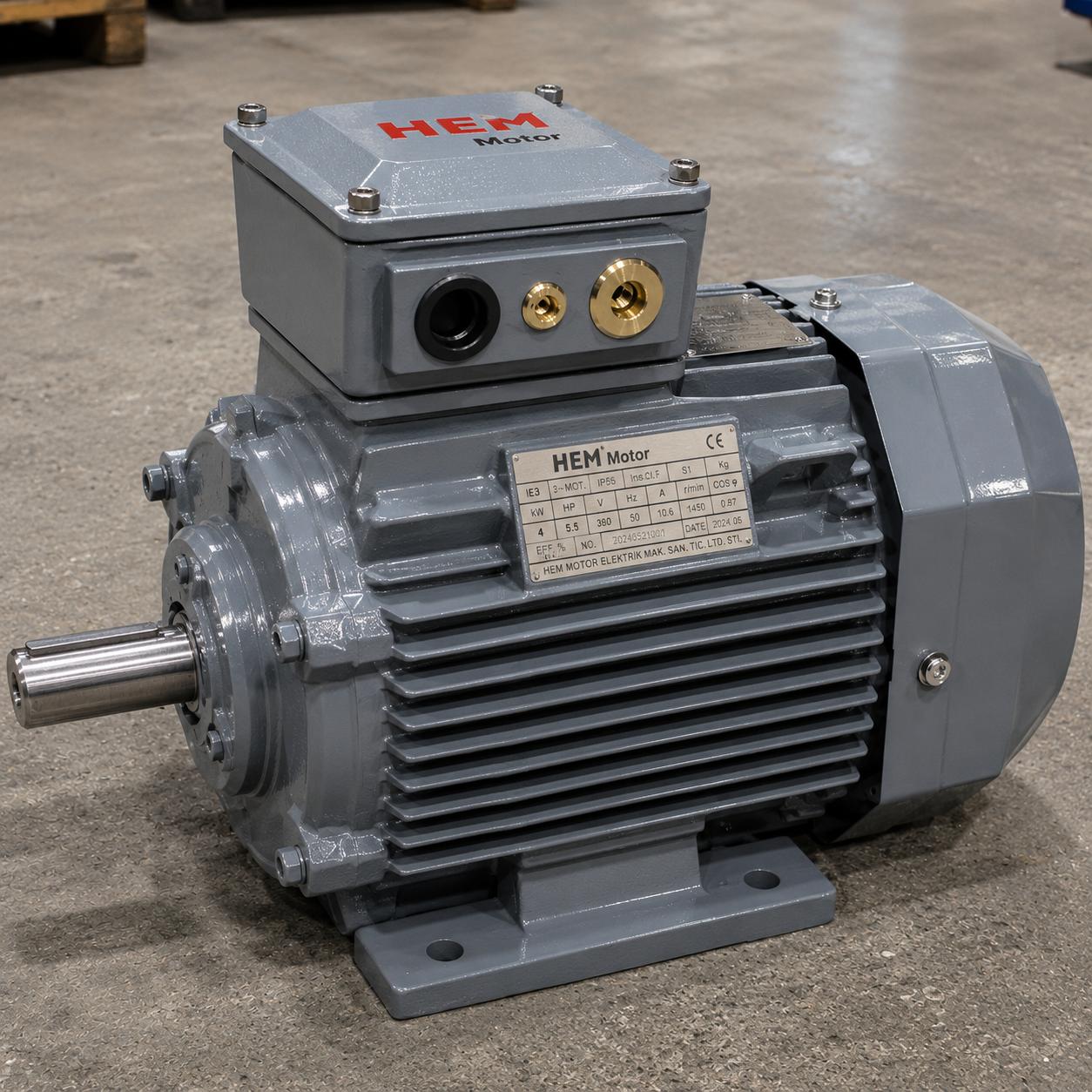

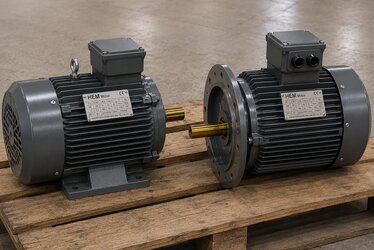
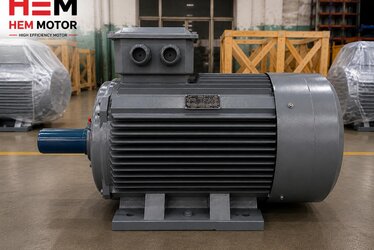
A 2 kW electric motor is one of the most common and fastest-moving power ratings in industry. Although the nameplate shows a single kW value, this rating actually maps to dozens of different motors: as the pole count, speed, frame size, mounting type and efficiency class change, the same 2 kW label becomes a completely different machine. In this guide we walk through correct buying at a single power level, explaining how to evaluate 2/4/6 poles, speed, IEC frame, mounting and stock availability during your 2 kW motor selection. Once you define the right configuration, requesting a quotation and securing fast replacement from stock becomes very easy. For current electric motor prices and stock options, you simply need to describe the motor accurately.
What 2 kW Means and Its Horsepower (HP) Equivalence
2 kW is the rated continuous mechanical power you can draw from the motor shaft. Converted approximately to horsepower, a 2 kW electric motor corresponds roughly to 2.7 to 2.75 HP. So if an old machine is marked "2.7 HP" or "2.75 HP", the power class you need is most likely 2 kW. However, keep one thing in mind: a kW value alone does not define the motor. The same 2 kW power can be produced by a slim motor spinning at 3000 rpm or by a bulkier, higher-torque motor turning at 1000 rpm.
In practice, what matters for manufacturer assurance is the speed and the frame at which you want this power. That is why, at the quotation stage, instead of just saying "I want 2 kW", stating the pole count, speed and mounting style lets the right product be reserved quickly from stock.
Pole Count and Speed Relationship (50 Hz)
In asynchronous motors, the speed is set by the supply frequency and the pole count. On a 50 Hz supply the synchronous speeds are as follows; the real loaded speeds are slightly lower due to slip:
- 2-pole motor: synchronous 3000 rpm, real ~2850-2900 rpm. High speed, low torque.
- 4-pole motor: synchronous 1500 rpm, real ~1430-1450 rpm. The most common, balanced choice.
- 6-pole motor: synchronous 1000 rpm, real ~950-960 rpm. Low speed, high torque.
The critical point here is this: while power stays constant (2 kW), the shaft torque rises as the speed drops. In other words a 4-pole 1500 rpm motor delivers higher torque than a 2-pole model of the same power, and the 6-pole model produces the highest torque but turns the slowest. Whether your application needs speed or torque is what drives the choice.
Which Pole Count for Which Application?
- 2-pole (3000 rpm): Pump, fan, blower and compressor applications needing high speed. Frequently preferred on centrifugal pumps.
- 4-pole (1500 rpm): General-purpose use, conveyors, gearbox input, mixers, crushers and most machine drives. The widest stock is in this class.
- 6-pole (1000 rpm): Direct drive needing high torque and low speed, heavy lifting, certain hoist and agitator applications.
If your machine has a gearbox, a 4-pole input speed is usually preferred. For a direct-drive system that must turn slowly, the options of a low-speed 6/8 pole motor are more suitable.
Frame Size (IEC Frame) and How Dimensions Change at One Power
Another feature of 2 kW power is that it sits on different IEC frames depending on the pole count. As a general trend, a 2 kW electric motor appears in the following frames:
- A 2-pole 2 kW usually fits a smaller frame (e.g. 90); the high speed makes it more compact.
- A 4-pole 2 kW is mostly found in a frame between 90 and 100.
- A 6-pole 2 kW needs a larger frame (e.g. around 112); the lower speed demands more copper and iron.
The frame size directly determines the shaft diameter, shaft length, foot hole spacing and flange dimensions. Therefore, when making a like-for-like replacement (a new motor in place of an old one), not only the power but also the frame, mounting and shaft dimensions must match. To compare dimensions, our shaft and frame table resource makes the job easier.
Why Shaft and Foot Compatibility Matters
A wrong frame choice means the motor will not sit on the machine, the pulley will not fit the shaft, or the foot holes will not align. That is why reading the frame number of the existing motor is the most reliable approach when replacing. When the frame matches, installation takes minutes rather than hours and production downtime is minimised.
Mounting (Connection) Types: B3, B5, B14, B35
The same 2 kW motor is produced in different mounting forms. Knowing which one fits your machine is the basis of getting the right quotation:
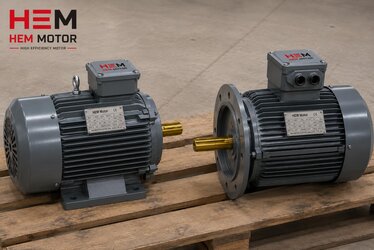
- B3 (foot): Classic foot mounting; bolted to the floor or chassis.
- B5 (large flange): Connected directly to the machine with a large flange; common on pumps and gearboxes.
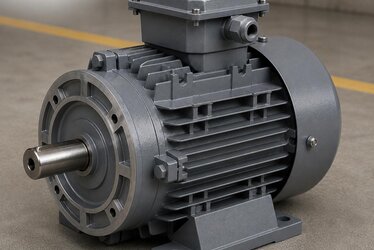
- B14 (small flange): A compact flange with smaller threaded holes; for limited spaces.
- B35 (foot + flange): Both foot and flange; provides versatile mounting.
Correctly identifying the connection type on the existing machine ensures the motor fits on the first attempt. When in doubt, sharing the frame/mounting information together with a photo and nameplate of the old motor is the safest method.
Efficiency Class: IE3 Requirement and the IE4 Option
In Turkey, since July 2021 the IE3 efficiency class has been mandatory for three-phase asynchronous motors connected directly to the line (DOL) between 0.75 kW and 1000 kW. A 2 kW electric motor falls within this mandatory band, so IE3 efficiency is standard for new purchases. For continuously running applications that operate many hours a year, the IE4 super premium option can also be considered for energy savings; although the initial investment is slightly higher, it pays off in electricity consumption over the long term.
For efficiency class and correct power-speed matching, the IE3 electric motor stock guide is a detailed reference. If you are weighing alternatives at nearby powers, our 2.2-3-4 kW IE3 motor stock and speed selection article is also useful.
Single Phase and Three Phase
A 2 kW motor can be found in both three-phase (380/400 V) and single-phase (230 V) forms. Since three-phase supply is widespread in industrial facilities, the three-phase model is the standard and the efficiency-class requirement applies to these models. In small workshops or agricultural use with a single-phase supply, 2 kW single-phase motors may be preferred; however, differences in starting torque and efficiency must be considered with single-phase models.
Voltage, Star-Delta and Tolerance
Three-phase 2 kW motors are typically produced with a 230/400 V nameplate value; that is, star (Y) connection at 400 V and delta (D) connection at 230 V. Most motors are designed to operate within the 380/400/415 V range with a +/-5% or wide voltage tolerance. Star-delta starting is used to reduce starting current on high-inertia loads; at small powers, direct-on-line (DOL) starting is usually sufficient. Following the connection diagram on the nameplate is important for both safety and warranty.
Reading the Right Information From the Nameplate
When reordering an old 2 kW motor, the most reliable method is to read the nameplate on the motor. The nameplate contains the following information, which are the key data you should pass to us for a quotation:
- Power (kW / HP): Confirm it is 2 kW.
- Speed (rpm): Values such as 2850, 1430 or 950 tell you the pole count.
- Frame: The IEC size such as 90, 100, 112.
- Mounting code: B3, B5, B14, B35.
- Voltage and connection: 230/400 V, Y/D.
- Protection and insulation class: IP55, class F, S1 continuous duty.
When you share these six items, the correct 2 kW electric motor is quickly identified from stock and a like-for-like replacement is secured.
Stock, Supply and Fast Replacement Advantage
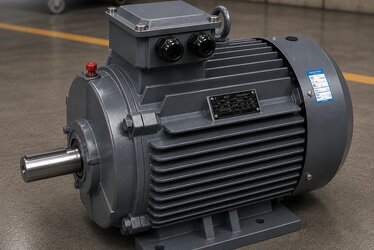
Because 2 kW is one of the most used powers in the field, it is one of the fastest-moving stock items. It is available with both cast iron and aluminium bodies. The cast iron body offers durability in heavy industry and outdoor conditions, while the aluminium body, being lighter, is easier to transport and install.
- Fast replacement: In a production stoppage the most critical issue is time; common powers like 2 kW have high stock availability.
- Manufacturer assurance: Having a manufacturer behind the motor provides warranty and continuity of spare parts.
- Flexible configuration: 2/4/6 pole, different frame and mounting combinations can be supplied at the same power.
By passing your need together with the pole/speed, frame and mounting information, you can quickly obtain a quotation. For a broad product range you can review our IE3 efficient electric motors group.
What to Watch When Getting a Quotation
- Clearly state the power (2 kW) and the speed/pole information.
- Add the frame and mounting type (B3/B5/B14/B35).
- State your body material preference (cast iron or aluminium).
- Pass on voltage and special requests (brake, heater, encoder, etc.).
The Effect of the Right Choice on the Application
A correctly configured 2 kW motor consumes less energy, heats up less, lasts longer and increases the efficiency of your machine. A wrong speed choice, on the other hand, means either insufficient torque or unnecessary speed. For this reason the buying decision should rest not only on power, but on the application's speed-torque profile, frame compatibility and efficiency target. Having so many parameters even at a single power (2 kW) shows how important it is to describe the requirement accurately.
Frequently Asked Questions
How many horsepower (HP) is 2 kW?
2 kW corresponds to approximately 2.7-2.75 HP. So if your old machine is marked 2.7 HP or 2.75 HP, your requirement is most likely the 2 kW power class. Still, the horsepower value alone is not enough; for a correct replacement you also need to share the speed, frame and mounting information.
Should I buy a 2-pole or a 4-pole 2 kW motor?
This depends entirely on your application. For a pump, fan or compressor needing high speed, the 2-pole (3000 rpm) model is suitable. For general-purpose drive, conveyors or gearbox input, the 4-pole (1500 rpm) is the most balanced choice and has the widest range in stock. If you need high torque and low speed, go for the 6-pole model.
Which frame should I order to replace my old 2 kW motor?
The safest way is to read the frame number (e.g. 90, 100, 112) and the mounting code (B3, B5, B14, B35) from the old motor's nameplate and order the same. Since the frame determines the shaft diameter and mounting holes, a one-to-one match must be ensured. If the nameplate is unreadable, you can determine the correct frame by consulting us with a photo and the dimensions of the old motor.