English
 Türkçe

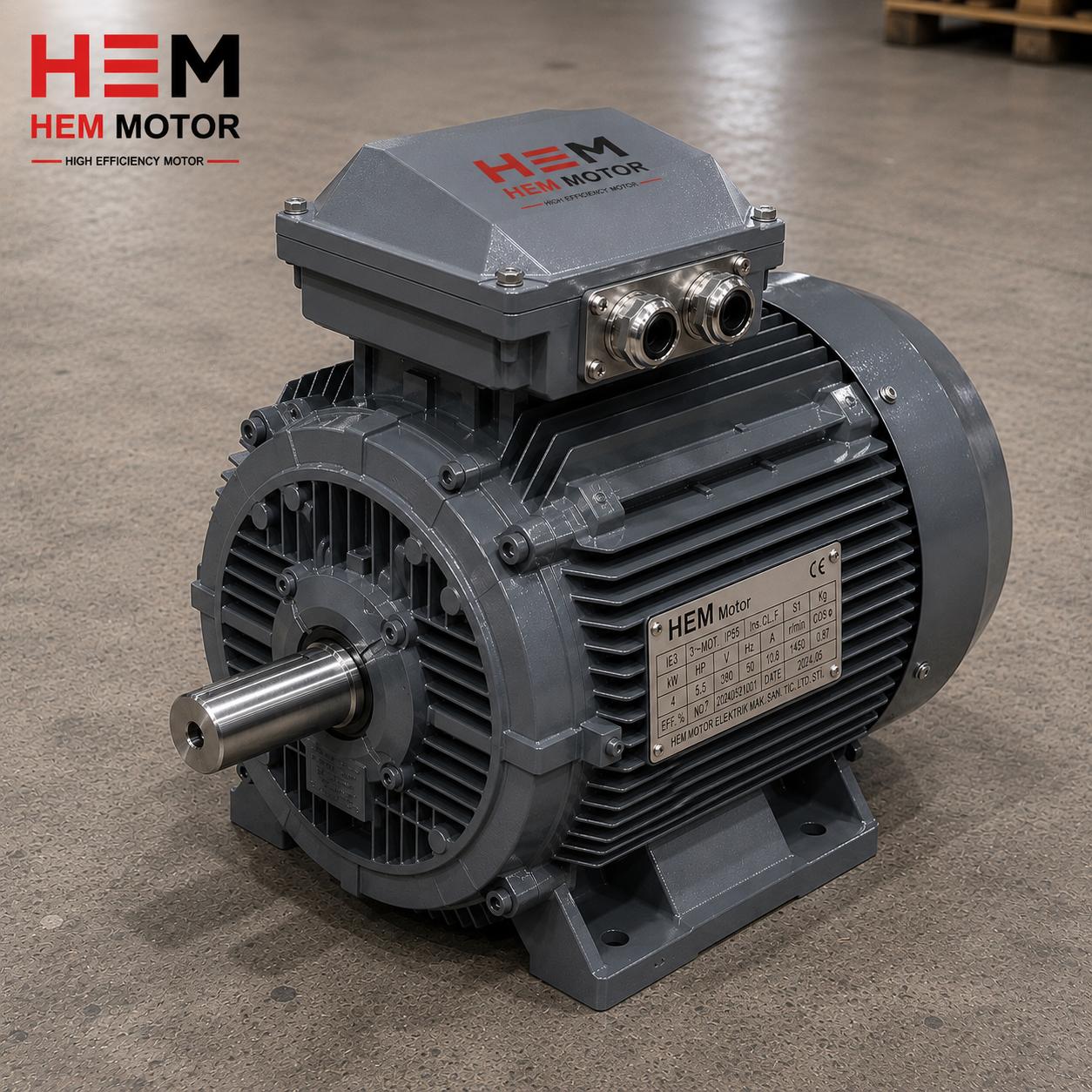

The power figure printed on an IE4 Super Premium motor's nameplate is defined relative to a specific reference condition: at sea level and usually at 40 °C ambient temperature. If your facility's environment is hotter than this reference, the motor cannot deliver its rated power within safe limits. This power reduction is called derating in engineering. When the 40 °C reference threshold is exceeded — for example in a 50 or 55 °C environment — the useful power the motor can deliver falls below its rated value. Ignoring this shortens the life of the winding insulation, drives the motor to premature failure, and creates problems under warranty.
At HEM Motor, this is why we ask about ambient temperature when supplying motors to hot environments such as the vicinity of casting furnaces, boiler rooms, glass and ceramic plants, and rooftop panel rooms. Because the right solution is often to choose an IE4 motor "of the same power but one frame size larger." In this article we cover the effect of high ambient temperature on the motor, the derating logic in the 40-50-55 °C range, correct frame size selection, and the information you should share before delivery. To determine the right frame size together, you can share your environmental conditions with us from our electric motor prices page.
Why Does Ambient Temperature Reduce Motor Power?
The limit of power an electric motor can deliver is determined by thermal endurance far more than by mechanical strength. While the motor runs, copper losses in the winding, iron losses in the core, and mechanical friction losses turn into heat. This heat is rejected to the environment from the frame surface and with the help of the cooling fan. For the heat to be rejected, a temperature difference (delta T) is needed between the motor surface and the environment.
As ambient temperature rises, this difference narrows. A motor whose frame can reach up to 100 °C in a 40 °C environment must reach a higher temperature to reject the same heat in a 55 °C environment. But the winding insulation has a thermal class limit: Class F insulation offers about 155 °C and Class H about 180 °C of endurance. When the environment heats up, this limit is reached sooner. We explained the effect of insulation class on life in detail in our insulation class F/H article.
There is a well-known engineering rule about insulation life: every 10 °C rise in winding temperature roughly halves the insulation life. For this reason, pushing a motor at full power in a hot environment means both immediate failure risk and long-term life loss. Derating is the safety margin that prevents this risk from the start.
The Logic of the Derating Table
Motor manufacturers publish derating tables that describe usable power according to ambient temperature. The logic is this: when 40 °C is taken as reference, the motor can deliver its full rated power. As ambient temperature increases, the percentage of usable power decreases:
- 40 °C and below: The motor safely delivers its nameplate power; no extra measure is needed.
- Around 45 °C: A slight drop in usable power begins; it must be considered in continuous full-load applications.
- Around 50 °C: The power reduction becomes noticeable; moving to the next frame size up may be needed to carry the same load.
- Around 55 °C: The power reduction is serious; increasing the frame size, Class H insulation, or forced cooling is often mandatory.
The point to emphasize here: derating percentages are not a single exact table; they vary with motor design, insulation class, and cooling method. So instead of "picking a table off the internet and making a selection," the safest path is to share your actual environmental conditions with us and determine the suitable motor together. We addressed how high altitude creates a similar power reduction in our high altitude IE4 derating article; if hot and high-altitude conditions occur together, the two effects accumulate.
The Right Solution: Frame Size Increase and Alternatives
To safely obtain the same useful power in a hot environment, there are several supply strategies. Which one is suitable depends on how high the temperature is and on the application's load profile.
1. Moving to the Next Frame Size Up
The most common and reliable method is to choose a motor of the same rated power but one frame size larger. A larger frame means a wider cooling surface and more thermal reserve. Thus the motor can deliver the required power at a safe winding temperature even in a hot environment. We examined the frame-size-to-power match in our frame size and power matching article. In this approach, shaft diameter, foot dimensions, and mounting dimensions will change, so mechanical compatibility must also be reviewed.
2. Higher Insulation Class (H)
Class H insulation instead of Class F provides additional thermal reserve, allowing operation at a higher ambient temperature with the same frame. Because it can offer a solution without increasing frame size, it is a more compact and economical option in some applications.
3. Forced Cooling
Using a separately powered external cooling fan instead of the fan attached to the motor's own shaft is useful especially in applications that need continuous high torque at low speed. Because forced cooling provides a constant air flow independent of the motor's speed, it brings extra safety in hot environments. We detailed this solution in our external forced cooling fan article.
4. Combination Approach
In the harshest environments such as 55 °C and above, a single measure is often not enough; frame size increase + Class H insulation + suitable IP protection are evaluated together. At HEM Motor, we plan these combinations in our IE4 product range according to your environmental conditions.
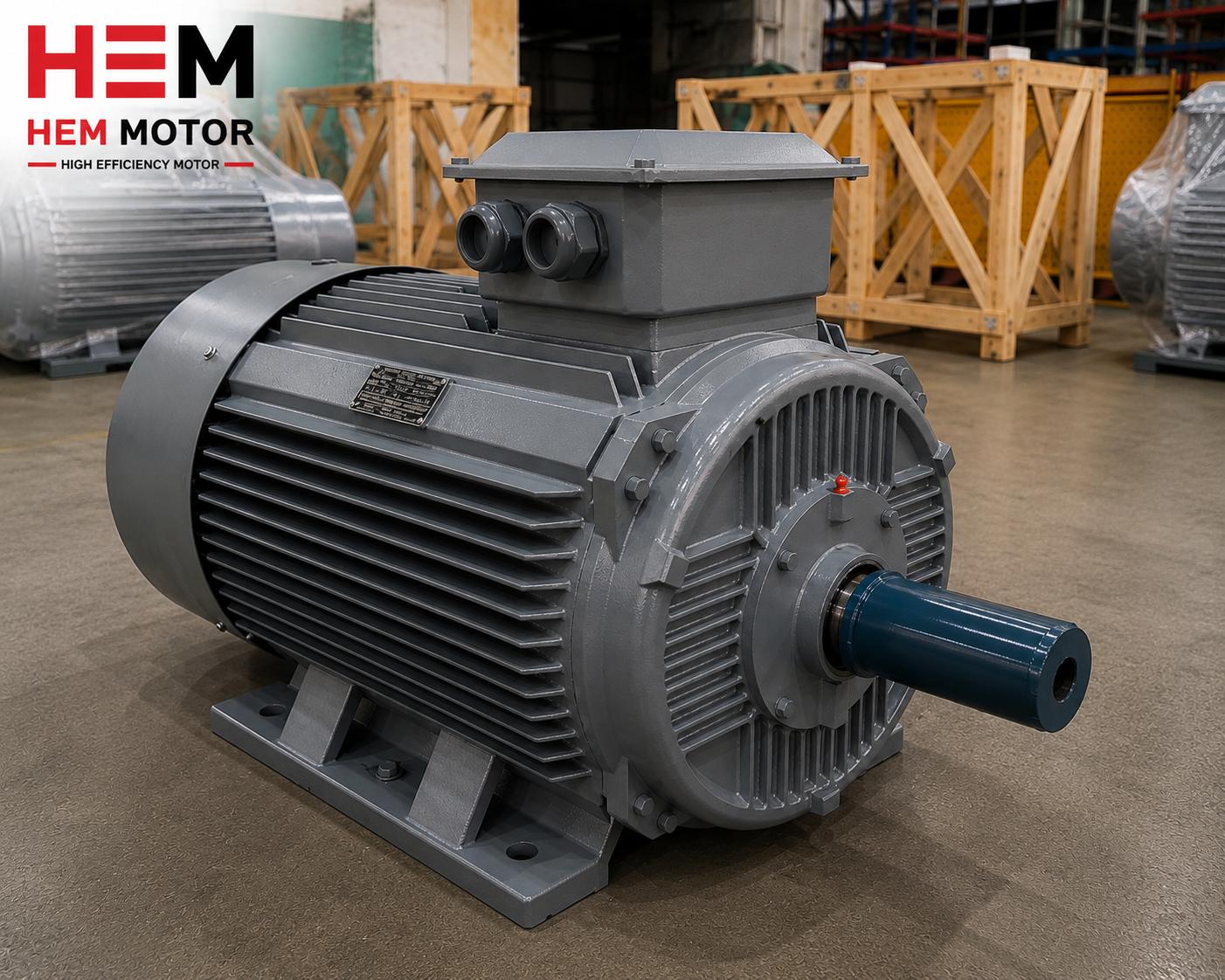
The Advantage of Choosing IE4 in a Hot Environment
Interestingly, a hot environment makes the IE4 Super Premium motor even more sensible. IE4 motors generate fewer losses than IE3 and lower classes; that is, less heat is released inside for the same useful power. Less internal heat means a wider thermal margin in a hot environment. Therefore, switching to IE4 in a facility with high ambient temperature provides a double gain in terms of both energy savings and thermal safety.
If you are curious where the losses are reduced in an IE4 motor, our IE4 efficiency losses article explains the topic along the axes of iron, copper, and friction loss. You can review our IE4 range for hot-environment applications on our general purpose industrial motors page.
What You Should Share With Us Before Ordering
- The measured or estimated maximum temperature of the environment (including the summer peak value)
- The installation location (enclosed factory, under the roof, near a furnace, outdoor)
- The load profile (continuous constant load, stop-start, variable)
- The required useful power and speed
- If altitude is also high, the elevation above sea level
- If replacing an existing motor, the old motor's nameplate (frame size, mounting dimensions)
With this information, we plan the frame size, insulation class, and cooling solution suited to the ambient temperature in one go, ensuring you commission without unexpected power loss in the field.
Evaluating Temperature and Load Profile Together
A common mistake about derating is to think of ambient temperature independently of load. In fact, how hot the motor actually gets depends both on the ambient temperature and on how heavily the motor is loaded. A motor running continuously at full rated power carries the highest risk when stressed in a hot environment. By contrast, in a motor running below its capacity, internal heat generation is lower, so a wide thermal margin remains even in a hot environment.
For this reason, the load profile must also be considered when selecting a motor for a hot environment. A few typical cases differentiate as follows:
- Continuous full load (S1) + hot environment: The harshest combination. A frame size increase or Class H insulation is almost always required. Continuously running main process pumps and fans are in this group.
- Intermittent duty (S3/S4) + hot environment: If the motor stops and cools at regular intervals, internal heat buildup is lower than at continuous load; but if the idle periods do not allow sufficient cooling, derating is still needed. We examined the heating limit of frequent stop-start applications in our heating in S3/S4 intermittent duty article.
- Partial load + hot environment: If the motor runs below rated power, no extra measure is often needed even in a hot environment. However, this may mean buying an oversized motor; this balance must be evaluated together.
Another critical point is that voltage and frequency fluctuation also heats the motor additionally. If the grid voltage deviates from the rated value or an imbalance forms between phases, the motor heats more while doing the same work, and this risk accumulates in a hot environment. We addressed the extra power reduction that should be applied under voltage imbalance in our derating under voltage imbalance article. Therefore, in a motor in a hot environment, both thermal and electrical conditions must be evaluated together.
Monitoring Winding Temperature in a Hot Environment
In a motor running in a hot environment, alongside correct frame and insulation selection, monitoring the winding temperature in real time is also a powerful protection layer. PTC thermistors or PT100 sensors give a warning or stop the motor when the winding temperature approaches the critical limit. This protects the motor from overheating-related failure, especially in facilities where the ambient temperature changes by season and shift.
Temperature monitoring is also valuable for predictive maintenance: a gradual rise in winding temperature may indicate that the cooling fins are dirty or the fan has lost efficiency. We explained the correct installation of temperature protection sensors in our temperature monitoring with PT100 and PTC thermistor article. In hot-environment applications, we recommend ordering these sensors together with the motor.
Cooling Fins and Periodic Cleaning
A motor's ability to reject heat in a hot environment depends on keeping the cooling fins on the frame clean. If a layer of dust, fiber, resin, or oil covers the fins, the motor's heat rejection drops, and the winding temperature rises dangerously in the same environment. That is, a motor, even if correctly selected, can fail prematurely in a hot environment if left unmaintained. We addressed the effect of fin cleaning on efficiency in our cooling fins and dirt buildup article. Adding periodic fin cleaning to the maintenance schedule for motors in hot environments is as important as correct motor selection.
Frequently Asked Questions
What happens if I use a motor selected for 40 °C in a 50 °C environment?
The motor may seem to run at first, but the winding temperature rises above the insulation class. This means rapidly shortened insulation life, premature winding failure, and the risk of falling outside warranty. The correct path is to apply derating according to ambient temperature and select the suitable frame size.
Instead of increasing the frame size, should I just run the motor at a lower load?
Running the motor at a load below its rated power is one way to apply derating in practice, and it works in some cases. However, this means buying an oversized motor or using an existing motor below its capacity. We evaluate together which approach is more economical for your application.
Is an IE4 motor more advantageous than IE3 in a hot environment?
Yes. IE4 motors generate fewer losses for the same useful power, so less heat is released inside. This means a wider thermal reserve and safer operation in a hot environment. In hot environments, switching to IE4 provides a double gain in both efficiency and thermal safety.