English
 Türkçe

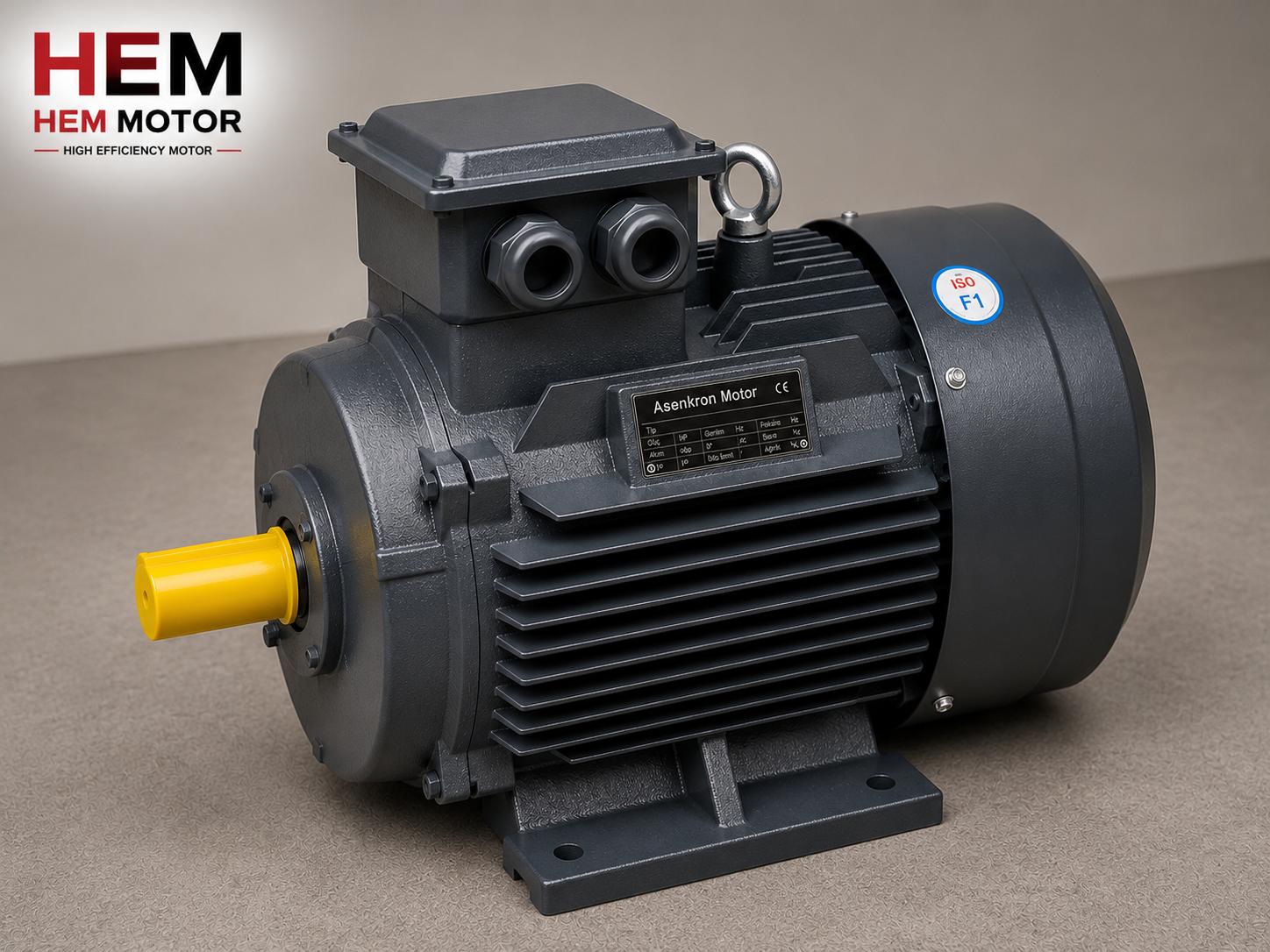

Some machines present the most demanding load type a motor faces while reaching full speed from rest: the high-inertia drive. Flywheel presses, large-diameter industrial fans and wide rotating masses strain the motor under high current for a long time at startup. Because of efficiency mandates, these applications now mostly use IE3 efficient electric motors. High inertia, however, requires special attention to power, starting time and heating when selecting an IE3 motor. As HEM Motor, with our identity as both manufacturer and seller, we guide facilities in choosing the right power and managing start-induced heating in press, fan and flywheel drives. In this article we cover the concept of inertia, why starting time lengthens, the start-induced heating risk and how to select the correct power and torque class according to the application.
Inertia (moment of inertia) is the tendency of a mass to resist rotational motion. The higher the load inertia, the longer the motor takes to bring it to the desired speed. Throughout this long starting period the motor draws current well above its rated value and the winding heats up. The key to motor selection in high-inertia drives is therefore keeping this start heating within safe limits.
This reveals a common mistake in motor selection: choosing the motor based only on continuous running power. A press or large fan may have a low continuous power requirement; but the difficulty at startup is completely different. Even if the motor is comfortable in continuous running, it comes under a serious heat load every time it accelerates the high-inertia mass. For high-inertia drives, the answer to "how many kW is enough?" therefore cannot be given by looking only at the continuous load; starting behavior must also be considered.
The fact that these motors are now mostly in the IE3 class due to efficiency mandates makes the situation a little more subtle. IE3 motors provide high efficiency with low losses in continuous running, which is a significant energy advantage for a press or fan running long hours. But the efficiency class does not automatically improve the motor's starting behavior. On a high-inertia load, an IE3 motor's starting time, heating and torque class must still be evaluated carefully.
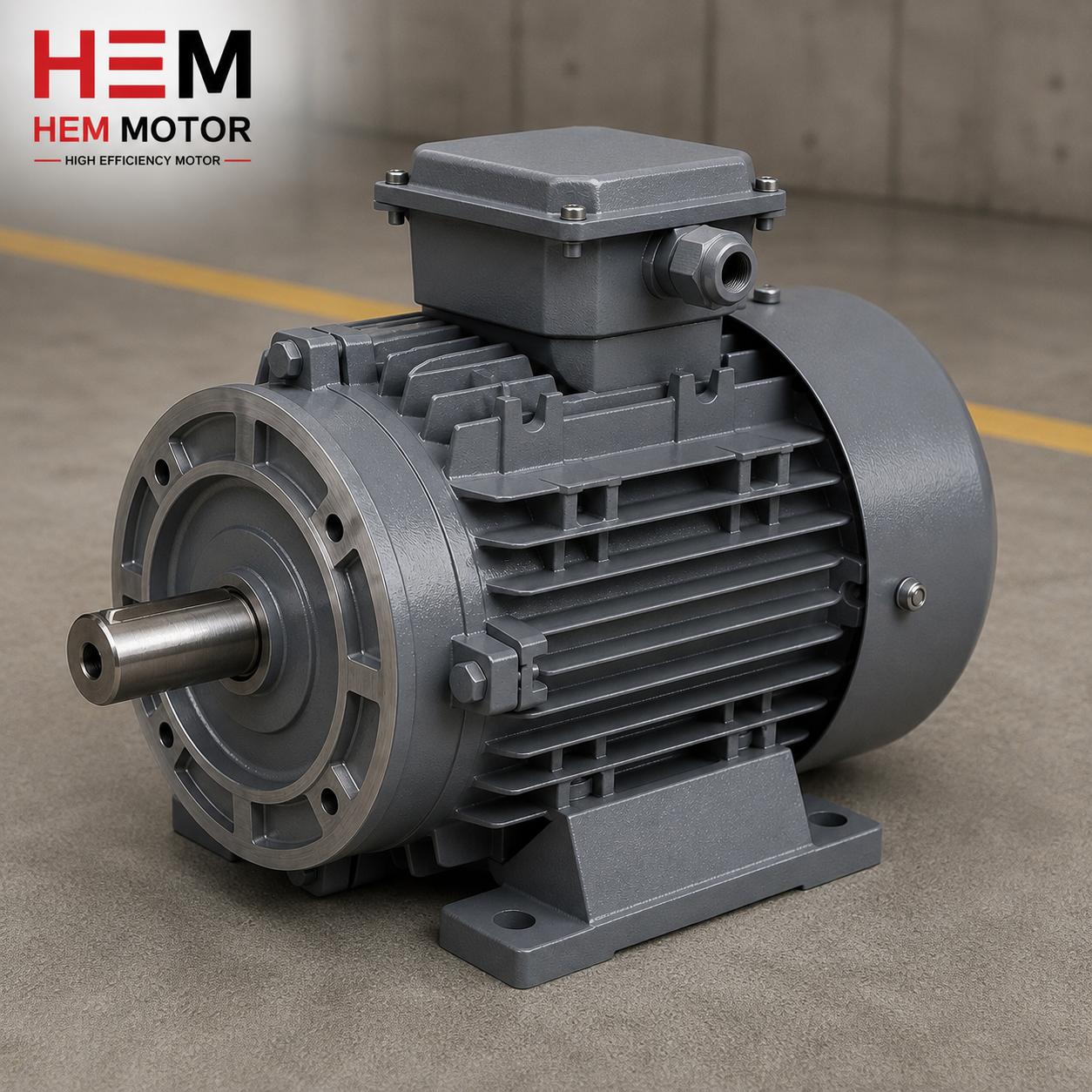
What Is High Inertia, and Which Machines Show It?
A rotating mass's inertia depends on its mass and on the square of that mass's distance from the rotation axis. In other words, the further the mass is spread from the diameter, the greater the inertia. The following machines therefore fall into the high-inertia drive class:
- Flywheel presses: The large flywheel that stores energy in press machines is a massive rotating mass that must be accelerated at startup.
- Large-diameter fans: Industrial blowers and HVLS fans carry high inertia due to their wide blade diameters.
- Centrifuges and mills: Heavy rotating drums and roller groups show high inertia torque at startup.
- Wide conveyor drives: Long, loaded belts create significant inertia and friction load at startup.
Why Does the Starting Time Lengthen?
To accelerate the load, the motor produces an accelerating torque (motor torque minus load torque). The greater the inertia, the longer it takes to reach speed with the same accelerating torque. Starting time is directly proportional to inertia and inversely proportional to net accelerating torque. In a flywheel press, the starting time can be many times longer than for a small pump.
This long start turns directly into a heating problem, because throughout the start the motor draws several times its rated current. Heat, proportional to the square of the current, is no problem on short starts but can raise the winding temperature to dangerous levels on long ones. This is why, for high-inertia loads, "how many consecutive starts the motor can make" is a critical parameter.
The Importance of the Starting-Torque Class
To accelerate a high-inertia load in a reasonable time, the motor must produce sufficient starting torque. Torque classes such as Design N and Design H offer different starting-torque profiles. Selecting the torque class suited to the load shortens the starting time and reduces heating. We covered the topic in detail in our article on torque classes and starting torque.
Separating Continuous Power from the Starting Need
The core difficulty of motor selection in high-inertia drives is meeting two different needs at the same time. The first is the power the machine requires in continuous running; this determines the motor's normal operating load. The second is the torque needed to accelerate the high inertia at startup and the heat load that arises during it. Often the continuous power is low while the starting difficulty is high. In this case, selecting the motor based only on continuous power falls short; a starting margin must be left or a suitable torque class chosen.
Cooling and Continuous Operation
Motor cooling is also a critical parameter in high-inertia drives. Most IE3 motors are cooled by a fan attached to their own shaft; that is, when the motor turns slowly, cooling weakens too. During long starting times, while the motor draws high current at low speed, the cooling fan is not yet running at full efficiency. This accelerates the buildup of start heat. For high-inertia applications, the motor's cooling capacity and, if necessary, an external (forced) cooling option should therefore be considered.
Heating and Duty Type
There are several ways to manage heating in high-inertia drives:
- Class F or H insulation: High-temperature insulation provides margin against start-induced heat surges.
- Correct duty type: In applications with frequent start-stop cycles, the relevant intermittent duty type should be considered instead of continuous S1.
- Soft starting: Controlled acceleration with a soft starter or frequency drive limits the current surge; we covered ramp setting in our article on starting methods.
- Temperature monitoring: Monitoring the winding temperature with a PT100 or PTC thermistor detects overheating in advance.
Flywheel and Impact-Load Interaction
A flywheel actually works two ways: it is a load that must be accelerated at startup, but during operation it acts as an energy store under impact loads, relieving the motor. We detailed this dual character of flywheel systems and their role in impact drives such as crushers in our article on flywheel and inertia under impact load.
Application Notes for Press, Fan and Flywheel Drives
Each of the three typical high-inertia applications has its own points to watch. Knowing these differences makes selecting the right motor easier.
Flywheel Presses
In flywheel presses the motor's main job is to bring the flywheel up to operating speed and maintain that speed between impacts. At the moment of pressing, the flywheel releases its energy, and the motor re-accelerates the flywheel until the next impact. In this cycle the motor is under an intermittent rather than continuous load. The right motor is a model that can accelerate the flywheel's high inertia in a reasonable time, with a suitable starting torque and sufficient thermal capacity. In frequently cycling presses, duty type and heating must be evaluated especially carefully.
Large-Diameter Fans
Industrial blowers and large fans carry high inertia due to their wide blade diameters. These fans are variable-torque loads; although the continuous running power is relatively low, accelerating the wide blades takes a long time at startup. In these applications soft starting or a frequency drive protects both the motor and the grid by limiting the starting current. Considering that the fan motor also runs long hours, an IE3 or IE4 efficiency class provides an important energy advantage.
Mills and Centrifuges
Heavy rotating drums, roller groups and centrifuges also fall into the high-inertia class. These machines may start loaded; that is, both high inertia and high starting torque may be needed at the same time. In this case the motor must have both sufficient starting torque and a thermal margin to withstand a long starting time. Often, choosing one power size higher or a suitable torque class is the most correct approach for safe, long-lasting operation.
Correct IE3 Power Selection
It is a mistake to select motor power in a high-inertia drive based only on the continuous running load. Even if the continuous power seems sufficient, the starting time and heating must be checked. The correct approach is:
- Determine the continuous running power according to the application.
- Evaluate the load inertia and the required starting time.
- Consider the number of starts and the need for consecutive starts.
- If necessary, leave a starting margin by selecting a higher power or a suitable torque class.
- Select a suitable insulation and protection class considering the ambient temperature and dust of the working environment.
- Plan the need for soft starting or a frequency drive from the outset.
When all these steps are evaluated together, the motor is both efficient in continuous running and safe at startup. Rather than focusing on a single parameter, a holistic approach delivers the most correct and economical result in high-inertia drives.
The IE3 efficiency class delivers energy savings with low losses in continuous running, while correct sizing guarantees starting safety. For efficiency class and power matching, our article on the IE3 efficiency class and power table is a useful reference. Contact us for current electric motor prices and stock. On the product side, IE3 Efficient Electric Motors are a suitable starting point for these applications.
Frequently Asked Questions
Why does my IE3 motor heat up on a high-inertia load?
High inertia lengthens the starting time. Throughout this time the motor draws several times its rated current, and heat proportional to the square of the current warms the winding. If starts are frequent, heat accumulates. The solution is to select a motor with a suitable torque class and power, use soft starting and, if necessary, review the duty type.
Should I buy one power size higher for a flywheel press?
Even if the continuous running power is sufficient, the flywheel's high inertia means a long start with high current. If starts are frequent, choosing one power size higher or a suitable starting-torque class keeps winding heating within safe limits. If you send us your press cycle and start frequency, we will recommend the right power.
Is soft starting essential on a high-inertia fan?
While not essential, it is strongly recommended. A large-diameter fan's high inertia creates a long, harsh starting current in direct starting. A soft starter or frequency drive limits this current by raising the voltage gradually, reduces mechanical shock and protects the motor. This in turn extends motor life.