English
 Türkçe

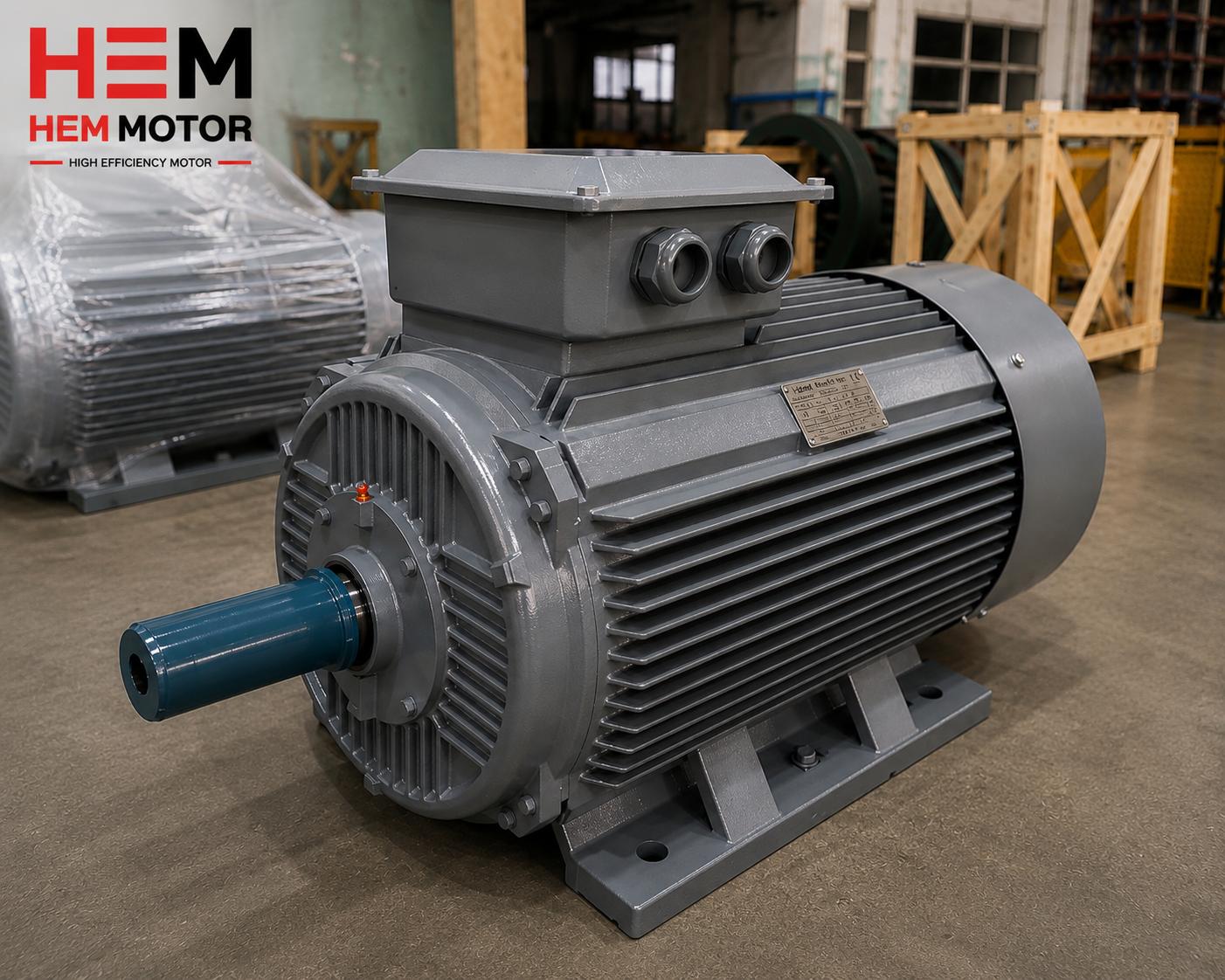

When a high-efficiency motor in a plant runs hotter than expected, trips its protection relay frequently, or loses winding life prematurely, the cause is often not the motor itself but the quality of the electrical supply feeding it. Two of the most critical supply parameters that directly govern the performance of three-phase induction motors are voltage unbalance and phase unbalance. Although expressed as small percentages, these deviations create disproportionately large negative-sequence currents and heating in the winding, leading to both efficiency loss and shortened insulation life. Especially when buying IE3 and IE4 class high-efficiency motors, correctly assessing supply quality and matching the motor with appropriate protection is just as important as selecting the right motor. In this article we examine the physical basis of voltage and phase unbalance, the need for derating, protection methods, and correct motor selection for weak grids from a manufacturer's perspective.
What Is Voltage Unbalance and How Is It Calculated?
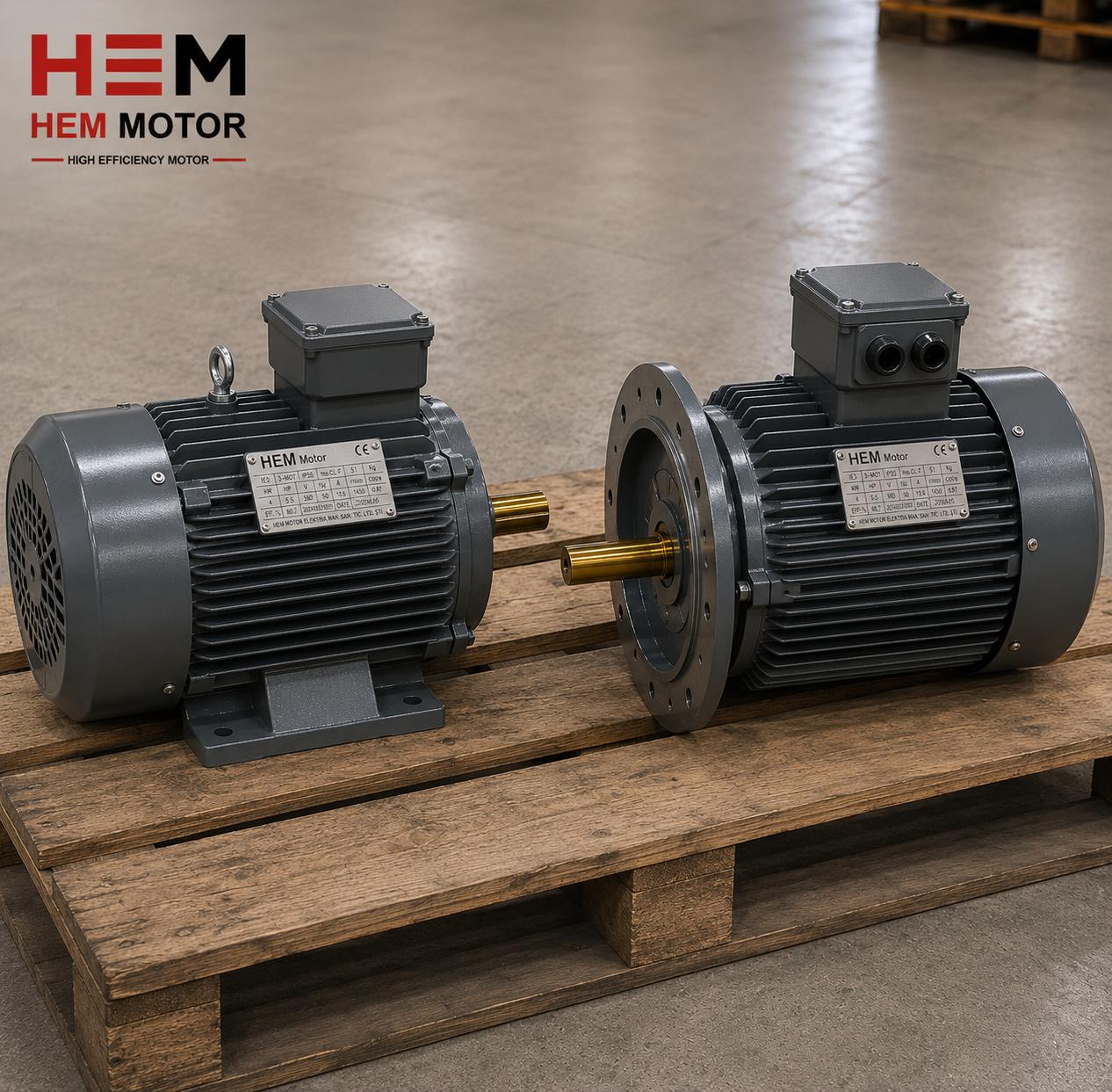
Voltage unbalance is the condition in which the phase voltages of a three-phase supply are not equal to one another. In an ideal system the three phase voltages are equal in magnitude and exactly 120 degrees apart. In practice, unequal distribution of single-phase loads, transformer tap settings, long cables of differing cross-section, loose connections and grid faults create differences between phases. According to NEMA MG-1, the percent voltage unbalance is calculated as the maximum deviation from the average phase voltage divided by that average:
- Unbalance (%) = (Maximum deviation from average / Average of phase voltages) × 100
- For example, if the phases are 400 V, 392 V and 408 V, the average is 400 V, the maximum deviation is 8 V, and the unbalance is calculated as 2%.
- The IEC approach expresses unbalance using symmetrical components as the voltage unbalance factor (VUF), the ratio of negative-sequence voltage to positive-sequence voltage.
Although these percentages look small, their effect on the motor is disproportionately large, because a small unbalance in voltage translates into a much larger unbalance in winding current. A modest percentage measured at the supply point can therefore mean a far harsher picture at the motor terminals and inside the winding.
Negative-Sequence Currents and Disproportionate Heating
An unbalanced voltage system can be decomposed, according to symmetrical-component theory, into positive-sequence, negative-sequence and zero-sequence components. The positive sequence is what actually drives the motor. The negative-sequence voltage, however, produces a magnetic field rotating opposite to the rotor field, inducing currents in the rotor at almost twice the line frequency and at high slip. Because the negative-sequence impedance is close to the locked-rotor impedance and therefore very small, a small negative-sequence voltage produces a large negative-sequence current in the winding.
As a rule of thumb, the percent current unbalance can be roughly 6 to 10 times the percent voltage unbalance. This means a 2% voltage unbalance can produce 12% to 20% extra current in one of the windings. This extra current concentrates locally in the most heavily loaded phase and results in:
- Disproportionate temperature rise in the winding: the hot-spot temperature rises approximately in proportion to the square of the unbalance percentage.
- Efficiency loss and degraded power factor due to increased copper (I²R) losses.
- Additional vibration and torque pulsation from the negative sequence, causing fatigue in bearings and mechanical components.
In terms of insulation life, the well-known 10-degree rule is decisive: every sustained 10 °C rise in winding temperature roughly halves insulation life. For this reason, an unbalance that seems small can seriously shorten the expected service life of the motor. An important point is that the heating is not symmetrical: the phase drawing the most current runs far hotter than the others, and this local hot spot can easily be missed by a conventional protection that looks only at the motor's average temperature. Assessing the true thermal state of a motor under unbalance from average current or average temperature alone is therefore misleading; protection thresholds and selection criteria must be set with the hottest phase in mind.
Why Is Derating Required? The Logic of the NEMA Derating Curve
The safest way to compensate for the excess heating of a motor operating under unbalance is to run it below its rated power, that is, to apply derating. The NEMA MG-1 standard defines a derating curve for this purpose, whose logic is:
- Voltage unbalance up to about 1% can generally be tolerated without additional derating.
- For each increase above 1%, the rated power of the motor should be progressively reduced.
- Typically, at 2% unbalance the motor is derated to about 95% of rated power, at 3% to about 88%, and at 4% to about 82%.
- Above 5% unbalance, continuous operation is not recommended; in this region heating and efficiency loss rise to unacceptable levels.
Derating effectively means that the motor to be purchased should be selected one power step higher. If the plant's supply quality is weak, the correct approach is not to choose a motor at its margin but to secure the project with a motor that has ample thermal margin. Although this may look like a small difference in the initial investment, it is a far more economical choice when weighed against the cost of constant protection trips, production stoppages and premature winding failures. To understand the effect of rated voltage and frequency on power and speed in more detail, we recommend reviewing the effect of rated voltage and 50/60 Hz frequency difference on speed and power.
Phase Loss and the Risk of Single-Phasing
The most extreme and most dangerous form of voltage unbalance is phase loss, or single-phasing. If one phase is interrupted while a three-phase motor is under load, the motor does not stop; it tries to keep running on the remaining two phases. In this condition, the current drawn from the remaining phases quickly rises far above the rated value, and the winding can reach burnout within minutes. Single-phasing arises from a blown fuse, an open contactor contact, a broken cable, or a loose terminal connection.
Phase loss behaves like nearly 100% unbalance, and a conventional thermal overload relay cannot always detect it fast enough. For this reason a separate phase protection relay or unbalance protection function is critically important. The motor's terminal connection arrangement, star-delta selection and voltage matching also affect phase behavior; here it is worth carefully evaluating terminal box 230/400 V star-delta voltage selection.
Voltage Tolerance Range: ±5%, ±10% and IEC 60034-1 Zone A/B
Every motor has a tolerance range around its rated voltage within which it can operate. The IEC 60034-1 standard defines this range in two zones:
- Zone A (±5%): The region in which the motor is expected to maintain its rated performance. The motor can run continuously here, although temperature rise may be slightly above rated.
- Zone B (±10%): The region in which the motor can operate but temperature rise and performance deviations are more pronounced and continuous operation is not recommended.
Voltage tolerance and unbalance effects must be evaluated separately but simultaneously. A motor may withstand ±10% voltage deviation, yet if it also faces high unbalance at the same time, the total thermal load can exceed its capability. In other words, the tolerance range stated in the catalog should be treated as valid only for a balanced supply close to nominal; under real field conditions this range should be thought of as narrowed by the amount of the unbalance. To understand the behavior of IE3 motors against grid fluctuation and tolerance management in more depth, our content on IE3 motor voltage tolerance and grid fluctuation is a good reference.
Effect of Undervoltage and Overvoltage on Torque and Current
Independent of unbalance, a supply that is generally high or low also stresses the motor:
- Undervoltage: Since motor torque is proportional to the square of the voltage, starting and breakdown torque drop noticeably at low voltage. To deliver the same mechanical load, the motor draws more current, creating extra heating in the winding. With high-inertia loads, the motor may fail to reach rated speed.
- Overvoltage: The magnetic circuit approaches saturation, increasing magnetizing current and iron losses. This causes extra heating and efficiency loss even at no load.
As can be seen, both undervoltage and overvoltage lead, through different mechanisms, to the same outcome: excess heating and efficiency loss. Supply quality must therefore be assessed not only for unbalance but also for average voltage level. In practice the most demanding scenario is low average voltage combined with high unbalance at the same time: while the motor is already drawing extra current to meet its torque, that current is also distributed unequally between phases, and the most loaded phase heats up very quickly.
Protection: Phase-Sequence, Unbalance and Thermal Overload Relays
Correct motor selection is incomplete unless it is paired with correct protection. Under weak or variable supply conditions, at minimum the following protection functions should be planned:
- Phase-loss / phase-sequence relay: Detects single-phasing and reverse phase sequence within seconds.
- Voltage unbalance relay (function 46/47): Monitors negative-sequence current and voltage asymmetry and disconnects the motor above a set threshold.
- Thermal overload relay (function 49): Indirectly models winding heating and protects against sustained overload.
- Direct temperature monitoring (PTC / PT100): Uses sensors embedded in the winding to track actual temperature; it is the most reliable method for catching unbalance-related local hot spots.
To decide which of these functions to choose under which conditions, reviewing motor protection relay functions 46/47/49 selection in detail helps you build your project on a solid protection architecture. Planning protection together with the motor, within the same procurement decision, allows thresholds to be tuned to the motor's efficiency and insulation class and produces deliberate, measured tripping behavior instead of unexpected trips in the field.
Why Does a Higher-Class IE4 Motor Tolerate Poor Supply Better?
A high-efficiency IE4 motor generally withstands poor supply conditions better than a standard motor of the same rating. The reasons are:
- Lower losses: Because the IE4 motor produces fewer losses at rated operation, it starts from a lower base temperature under the same unbalance and has a wider thermal margin to tolerate the extra heating.
- Class F insulation with Class B temperature rise: A quality motor is wound with Class F (155 °C) insulation but is often designed to operate at Class B (80 K) temperature rise. This leaves a usable, safe thermal reserve for unbalance-related extra heating.
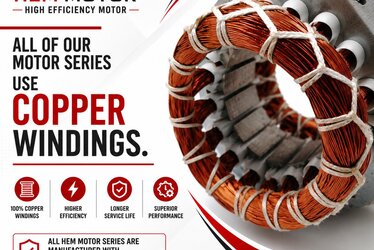
- Better materials and more copper: The lower-resistance windings used for high efficiency also limit, to some extent, the I²R heating caused by negative-sequence current.
In practice this means that, instead of fighting constant protection trips with a marginally sized standard motor on a weak grid, you achieve stable operation with a thermally generous IE4 motor. When evaluating high-efficiency motor options, our high-efficiency electric motors category helps you identify the correct class suited to your supply quality.
Recommendations for Weak Grids, Generators and Long Cable Runs
Practical recommendations for motor selection and system design where supply quality is limited:
- Measure supply quality first: Before selecting a motor, determine the voltage level, unbalance percentage and harmonics with a power analyzer. The correct motor cannot be selected for an unmeasured grid.
- On generator supply: Account for the voltage dip during starting and the voltage surge during load rejection, and select the motor one power step higher.
- On long cable runs: Voltage drop along the cable both lowers average voltage and, if cross-sections or lengths differ per phase, creates unbalance; cable cross-section should be chosen so that voltage drop does not exceed 3-5%.
- Enclosed cabinets and high ambient temperature: When unbalance-related heating combines with heat accumulating in an enclosed space, the motor quickly reaches its thermal limit; in this case additional derating based on cabinet ambient temperature should be applied.
Selecting the Right Motor and Protection Together from a Manufacturer
Voltage and phase unbalance problems are solved not by selecting the motor alone but by evaluating the motor, the protection and the supply conditions as a whole. The advantage of working with a manufacturer is that you can determine the appropriate efficiency class, insulation class, protection class and thermal margin together, based on your plant's supply data. When the correct power step, the necessary derating and the appropriate protection functions are planned together, the motor is both long-lived and sustains its expected efficiency. Sharing your supply measurements at the quotation stage lets the supplier recommend not just a motor but a solution suited to the site. Evaluating suitable solutions and current electric motor prices information is the first step toward building your project on a robust supply-motor-protection chain. A correctly selected motor delivers low operating cost and high reliability even under weak supply conditions.
Frequently Asked Questions
Above what percentage is voltage unbalance dangerous?
Generally, unbalance up to 1% is tolerated without additional measures. Above 1%, derating is required; in the 3-4% range efficiency loss and heating become pronounced, and above 5% continuous operation is not recommended because the winding temperature rises to a level that rapidly consumes insulation life.
Does an IE4 motor really provide an advantage on a weak grid?
Yes. Because the IE4 motor operates with fewer losses, it starts from a lower base temperature and is usually designed to run at Class B temperature rise. This thermal margin absorbs the extra heating caused by unbalance and voltage deviation, allowing the motor to run more safely and stably.
Is a thermal relay enough against phase loss?
A thermal overload relay alone is, in most cases, not fast enough. Against the risk of single-phasing, it is recommended to add a separate phase-loss/phase-sequence relay and a voltage unbalance protection function (46/47). The most reliable method is direct temperature monitoring with PTC or PT100 sensors embedded in the winding.