English
 Türkçe

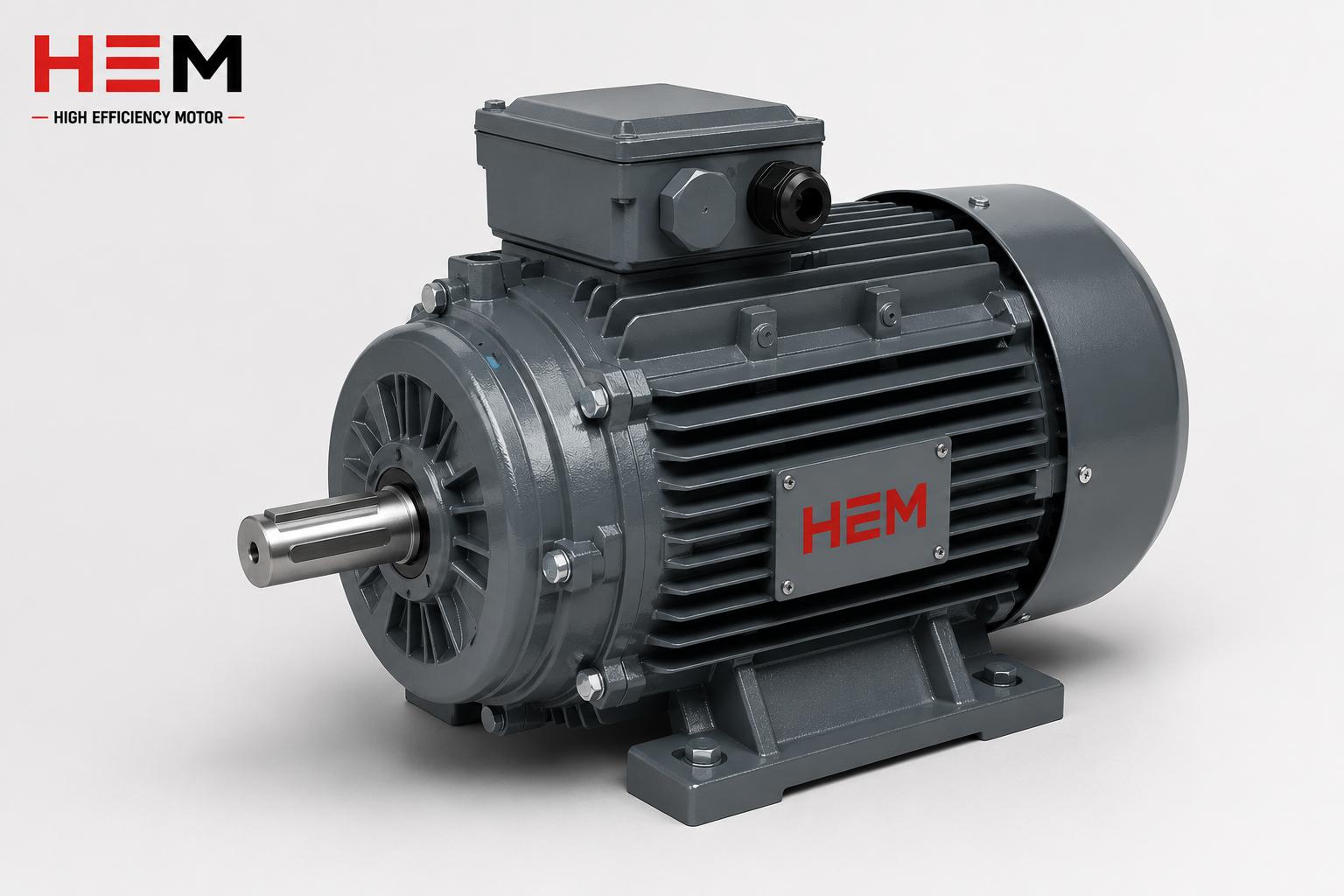

The quiet, cool and efficient operation of an asynchronous motor is the result not only of the materials used, but also of how the winding is placed inside the stator. The angular width spanned by the coils sitting in the stator slots, in other words the winding pitch, directly determines the shape of the magnetic field the motor produces. A well designed winding generates a waveform close to an ideal sine; a poorly designed one carries unwanted harmonic components that show up as noise, vibration and losses.
In this article we examine a fundamental technique that electric motor manufacturers have relied on for decades: winding pitch shortening, known as "chording" or short-pitch winding. The goal is clear. By narrowing the angle a coil spans slightly below full pitch, specific harmonics such as the 5th and 7th are attenuated, making the motor quieter and more efficient.
At HEM Motor, our IE3 Premium and IE4 Super Premium asynchronous motors combine a low-vibration, low-noise design with 100% copper winding quality, resulting in a product that is both high performing and long lasting. When you buy a motor these details usually stay invisible, yet the factors that truly decide how a motor behaves are hidden precisely in this winding engineering.
What Is Winding Pitch? Full-Pitch vs Short-Pitch
In the stator of an asynchronous motor, windings are placed into slots cut around the circumference. Each coil has two sides, and the angular distance between these two sides is called the winding pitch. If the coil sides are spaced exactly one pole pitch apart, that is the full distance between magnetic poles, the coil is called full-pitch. In a full-pitch coil the two sides sit in exactly opposite phases of the magnetic field, and the induced voltage in the coil is at its maximum.
In a short-pitch coil, the angle the coil spans is kept slightly smaller than one pole pitch. A common practice is to spread the coil over about 5/6 of the full pitch. In that case the two coil sides are not in perfectly opposite phases but slightly shifted. At first glance this looks like a loss, because the voltage produced in the fundamental drops a little. The real gain, however, is that the unwanted harmonic components are suppressed far more strongly.
Pole Pitch and Slot Angle
To make this concrete, let us clarify the pole pitch. One pole pitch is the distance between the centers of two consecutive magnetic poles and corresponds electrically to 180 degrees. Once the number of slots around the stator and the number of poles are known, the electrical angle between adjacent slots (the slot angle) can be calculated. By choosing how many slots wide to open the coil, the designer fixes the pitch ratio. In a full-pitch design the coil spans the slot count corresponding to one pole pitch; in a short-pitch design it is kept one or two slots narrower.
This small geometric decision produces a disproportionately large effect on the magnetic behavior of the motor. The winding geometry directly shapes the magnetomotive force (MMF) waveform in the air gap, and therefore determines the source of torque, noise and losses.
Pitch Factor (kp): A Conceptual Explanation
The effect of pitch shortening is expressed mathematically by the pitch factor. This quantity is usually denoted kp and is also called the chording coefficient. The pitch factor is the ratio of the voltage induced in a short-pitch coil to the voltage the same coil would induce if it were full-pitch.
Conceptually the pitch factor is related to the cosine of half the angle by which the coil falls short. When the coil is full-pitch this factor is one, meaning no loss. As the pitch is shortened, the factor for the fundamental drops slightly below one. For example, in a 5/6-pitch coil the fundamental pitch factor is about 0.966, so the fundamental voltage falls by only about three to four percent. This is an acceptably small price.
The beauty of it is that the pitch factor takes a different value for each harmonic. For the 5th and 7th harmonics this factor is far smaller, and with a suitable pitch choice it can be nearly zero. This is exactly the power of chording: it overwhelmingly weakens the harmful harmonics while barely touching the fundamental.
- Full-pitch: The fundamental is maximum, but the 5th and 7th harmonics are also strong.
- Short-pitch (such as 5/6): A small drop in the fundamental, a large suppression of harmonics.
- Pitch factor kp: Takes a separate value for each harmonic; designers exploit this selectivity.
Why Do Harmonics Cause Problems?
In an ideal motor the magnetic field in the air gap should be a pure sine wave. In reality, because the windings are placed discretely into slots and the magnetic circuit is nonlinear, that wave contains high-frequency components, namely harmonics. These appear as multiples of the fundamental frequency, and the most dominant are the 3rd, 5th and 7th harmonics.
In balanced three-phase systems the 3rd harmonic and its multiples largely cancel naturally between phase windings. The 5th and 7th harmonics, however, do not vanish on their own. The 5th harmonic produces a field rotating opposite to the fundamental and creates a braking effect; the 7th rotates in the same direction but generates unwanted parasitic torques and speed ripple.
In practice the consequences of these harmonics look like this: extra losses appear in the rotor and the motor heats up more; torque ripple increases; magnetic noise rises; efficiency drops. Suppressing harmonics is therefore directly tied to quality, from both the engineering and the user point of view.
Slot Harmonics and Tooth Frequencies
Some harmonics arise directly from the number of slots; these are called slot harmonics or tooth harmonics. As rotor and stator teeth pass one another, the air-gap permeance changes periodically, producing high-frequency magnetic ripples. These ripples are heard especially as a high-pitched magnetic whine. When pitch shortening is applied together with distributed winding and skewed slots, the effect of these slot harmonics is also noticeably reduced.
Distribution Factor and the Total Winding Factor
The pitch factor does not work alone; there is another quantity that must be considered together with it: the distribution factor. In real motors a phase winding is not concentrated in a single slot but distributed across several slots around the circumference. This distribution causes the voltages produced by the coil groups to add with small relative phase differences, and as a result the fundamental drops slightly. The quantity expressing this reduction is the distribution factor.
The product of the pitch factor and the distribution factor gives the total winding factor. The winding factor indicates how efficiently the winding uses the fundamental component. The designer optimizes both factors together: shortening the pitch enough to suppress harmonics while keeping the fundamental loss within acceptable limits. A further benefit of the distributed winding is that, just like pitch shortening, it additionally weakens harmonic components. The two techniques complement each other.
- Pitch factor: The coefficient arising from shortening the coil width relative to full pitch.
- Distribution factor: The coefficient arising from spreading the winding across several slots.
- Winding factor = pitch factor × distribution factor, computed separately for each harmonic.
- Both slightly reduce the fundamental while suppressing harmonics much more strongly.
For those who want to understand the real behavior of an asynchronous motor, looking at slip and actual speed in an asynchronous motor alongside winding design is illuminating. The quality of the magnetic field directly affects how smoothly the rotor follows that field.
Effect of Pitch Shortening on Efficiency and Noise
Now let us look at the practical results of all this engineering detail. The main benefits of a short-pitch winding can be summarized as follows.
Lower noise: When the 5th and 7th harmonics and the slot harmonics are suppressed, the vibration forces they produce are reduced. As a result the motor runs mechanically quieter. This kind of winding optimization underlies the low-noise design of HEM Motor products. Readers who want to go deeper can benefit from our article on noise, vibration and low-sound motor selection.
Higher efficiency: Harmonics cause extra losses (stray losses) in the rotor and stator. Weakening these harmonics at the source reduces those losses and raises the motor efficiency. To reach the IE3 and IE4 efficiency classes, such fine design decisions are critical.
Less heating: Reduced extra losses mean reduced heating directly. A motor that runs cooler stresses its insulation less and lasts longer. We detailed the importance of the insulation class in our article on the winding and insulation class F/H.
Smoother torque: When harmonic-driven torque ripple is reduced, the rotating force the motor produces becomes smoother. This is especially beneficial in precise positioning and vibration-sensitive applications.
How Is the Drop in the Fundamental Compensated?
The only drawback of pitch shortening is the small voltage drop in the fundamental. Designers compensate for this in several ways. The most common method is to increase the number of turns very slightly to recover the desired voltage level. In addition, the magnetic circuit design, slot fill and conductor cross-section are optimized together. In the end the roughly three to four percent fundamental loss is easily compensated, while the large suppression gain in the harmonics is retained permanently. From an engineering standpoint this is an extremely favorable trade.
Material Quality and Winding Design Together
No matter how well the winding geometry is designed, the quality of the conductor material is just as important. A 100% copper winding offers lower resistance than aluminum and therefore lower ohmic loss. When a well designed short-pitch winding is combined with high-quality copper conductor, the motor produces a magnetically clean field while operating with minimum electrical loss. Those curious about the difference between copper and aluminum can find a detailed explanation in our article on the copper winding quality difference.
When you buy a motor you cannot see the winding pitch with your eyes; however, the noise level, the heating behavior and the efficiency class on the nameplate are indirect proof of the winding quality inside. A motor that runs quiet, cool and at high efficiency was most likely built with correct pitch shortening and quality conductor. When evaluating different power and speed options and electric motor prices, it is wise to keep these quality signals in mind.
At HEM Motor we manufacture motors across a wide range from 0.55 kW to 355 kW, with 1000, 1500 and 3000 rpm speed options, in B3, B5, B14 and B35 mounting types, with cast iron bodies, IP55 protection, class F insulation and suitability for S1 continuous duty. In all of these motors the goal of low vibration and low noise is achieved through correct winding design and 100% copper quality.
Frequently Asked Questions
Does shortening the winding pitch reduce the motor's power?
The drop in the fundamental is very small, on the order of three to four percent for a typical 5/6 pitch, and it is easily compensated through the number of turns and design optimization. In return, the efficiency, noise and heating gains achieved through harmonic suppression are far more valuable. So the net effect is almost always positive, and there is no meaningful loss in the rated power of the motor.
What is the difference between pitch factor and distribution factor?
The pitch factor is the coefficient arising from shortening the coil relative to full pitch and relates to the coil width. The distribution factor arises from spreading the winding across several slots. Their product gives the total winding factor. Both slightly reduce the fundamental while suppressing harmful harmonics such as the 5th and 7th far more strongly, improving the waveform of the motor.
Is short-pitch winding necessary in every motor?
The vast majority of quality, efficient asynchronous motors use a short-pitch winding because it is one of the most effective and economical ways to suppress harmonics. The technique is practically standard in motors targeting high efficiency classes such as IE3 and IE4. In any application that expects quiet, cool and efficient operation, correct pitch shortening is a sign of a quality design.