English
 Türkçe

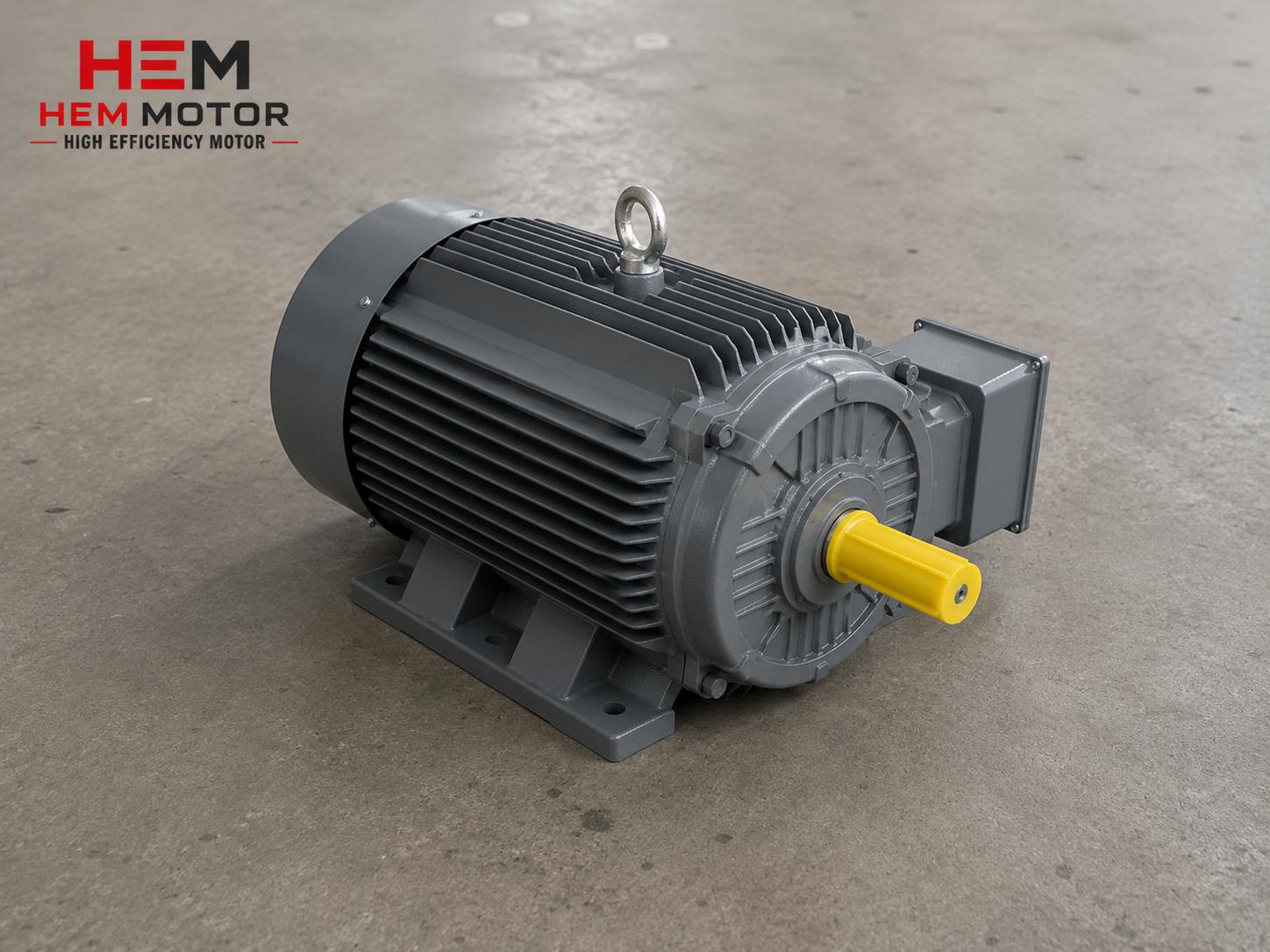

When you run a new asynchronous motor for the first time, especially while it turns at no load, you may hear a thin, high-pitched whine. Many users mistake this sound for a sign of a fault and become concerned. Yet most of this sound is magnetic in origin and is part of the motor's normal operation. The slot count and tooth-passing frequency in asynchronous motors are the key to understanding where this sound comes from and how it can be reduced.
In this article we address the tooth-passing frequency that is the source of the magnetic whine, the rotor slot skew that is the most effective way to reduce this sound, and what to watch for beyond the dB figure in quiet-motor selection. The aim is both to diagnose the noise correctly and to prevent it with the right product.
Tooth-Passing Frequency and Magnetic Whine
In an asynchronous motor, the stator and rotor have core stacks made of teeth and slots. As the rotor turns, the rotor teeth pass in front of the stator teeth in sequence, and during this the magnetic field in the air gap changes periodically. This change creates a mechanical force fluctuation and produces an audible sound. The frequency that gives rise to this sound is called the tooth-passing frequency.
The tooth-passing frequency is roughly equal to the rotor slot count multiplied by the speed. As the speed rises and the slot count increases, this frequency rises; that is why the sound is mostly heard as a high-pitched, thin whine. At no load this sound is more pronounced, because the mechanical noise and vibration brought by the load are not in play, so the magnetic sound is heard more clearly.
At this point the most important message is this: the thin whine heard at no load is not always a fault. It is often a natural consequence of the motor's magnetic design. Real faults (bearing degradation, imbalance, electrical asymmetry) usually reveal themselves with a different character, for example rhythmic, knocking or muffled sounds. The magnetic whine, on the other hand, is a smooth, continuous tone whose frequency changes with speed.
The Most Effective Way to Reduce the Sound: Rotor Slot Skew
The most effective and common method to reduce the magnetic whine is to slightly skew the rotor slots relative to the shaft axis. This design measure is called slot skew. With straight slots, the rotor and stator teeth meet at the same instant, sharply, and this produces a strong periodic force. When the slots are slightly skewed, this meeting is spread along the length; the force becomes softer and distributed.
The benefits of skew are not limited to noise. The same design measure provides several important improvements:
- Reduced magnetic noise: The high-pitched whine from tooth passing drops markedly.
- Reduced torque ripple (cogging): The catch-release character felt as the shaft turns is smoothed.
- Reduced starting hesitations: The tendency of the rotor to stick (cog) at certain angles with straight slots is eliminated by skew, making starting smoother.
- Suppression of harmonic effects: The effect of high-order harmonics in the air gap is reduced.
For this reason, in the majority of modern asynchronous motors the rotor slots are produced skewed at a certain angle. Skew is the invisible but decisive design element of quiet, vibration-free operation. To understand the general sources of motor noise, the electric motor noise sources can be reviewed.
Beyond the dB Figure in Quiet-Motor Selection
When selecting a motor, the sound pressure (dB) figure in the catalog is an important indicator, but it is not sufficient on its own. Even if two motors have the same dB value, one's sound may be an irritating high-pitched tone and the other's a softer, broadband sound. The human ear finds distinct tonal sounds (whine concentrated at a single frequency) far more irritating than general noise. That is why quiet-motor selection requires looking not only at the dB figure but also at the character of the sound.
Slot-Count Combination
The combination of stator and rotor slot counts determines the pattern of the resulting magnetic force waves. Some combinations produce distinct tonal sounds, while others spread the sound across a broader band, making it less irritating. In a well-designed motor, the slot counts are chosen to minimize unwanted resonance and tones.
Slot Skew and Slot Opening
The slot skew we addressed earlier is decisive in reducing the sound. In addition, the slot opening width facing the air gap also matters. Narrow openings can reduce the sound by smoothing the magnetic flux change, but they bring limitations in terms of manufacturing and winding placement. A good design observes this balance.
Speed and VFD Switching Frequency
In practical selection, two decisions have a major effect on the sound:
- Lower-speed choice: 4 or 6-pole motors are quieter than 2-pole motors, because both the speed and the tooth-passing frequency fall, and the fan noise is reduced.
- VFD switching frequency: In motors driven by a variable frequency drive, raising the drive's switching (carrier) frequency lowers the sound by shifting the magnetic sound in the audible range to high frequencies the human ear cannot hear.
When these decisions come together, both the motor's design and its drive method are optimized together for a quiet application. For the relationship between VFD drive and noise, the VFD motor drive and noise resource is a useful guide.
Correct Diagnosis: Magnetic Sound or Fault?
Distinguishing whether a sound is magnetic or fault-related prevents unnecessary interventions and misdiagnoses. A few practical clues are as follows: The magnetic whine is usually smooth and continuous, its frequency changes with speed, and it disappears instantly when the motor's power is cut. By contrast, a bearing fault usually gives a rhythmic, scraping or knocking sound and can continue even while the motor coasts freely (power cut). Imbalance, on the other hand, comes with vibration that depends on load and speed.
If the sound is a distinct, smooth and high-pitched tone at no load and the motor performs normally under load, it is most likely magnetic in origin and poses no problem. In case of doubt, vibration measurement and sound analysis provide a definitive diagnosis.
Other Components of Magnetic Sound and Resonance
Although the tooth-passing frequency is the best-known source of the magnetic whine, it is not the only one. The magnetic field in the air gap is not an ideal sine wave; due to slot structure, saturation and supply harmonics it contains various space harmonics and time harmonics. These harmonics create vibration forces at different frequencies on the stator housing, and each adds its own tone to the sound.
When one of these vibration forces coincides with a mechanical natural frequency (resonance frequency) of the motor, the sound jumps to a much higher level than expected. This is called resonance and is the most insidious enemy of quiet motor design. In a good design, the slot counts and housing stiffness are chosen so that the magnetic force frequencies are kept away from the housing's natural frequencies. That is why, even if two motors are at the same power, one being quiet and the other noisy depends largely on these design details.
Additional Sound Sources in VFD Drive
When the motor is driven by a variable frequency drive, the character of the sound changes. The drive feeds the motor with square-wave-like pulses, and the switching frequency of these pulses can produce an additional magnetostrictive sound in the motor. This sound is often heard at the drive's carrier frequency or its multiples. The good news is that when the carrier frequency is raised, this sound can be shifted above the human hearing limit and the perceived noise drops markedly. However, since a very high carrier frequency causes additional heating in the drive, a balance is observed here too.
- Avoiding the natural frequency: Slot counts and housing stiffness are chosen to prevent resonance.
- Carrier frequency setting: A suitable switching frequency on the VFD shifts the sound to the inaudible range.
- Vibration isolation: Adding anti-vibration mounts to the motor base reduces sound transmitted from the housing to the structure.
- Balancing: A well-balanced rotor minimizes additional mechanically induced vibration and sound.
Quiet-Motor Supply
In applications where noise is critical (hospitals, offices, near living spaces, recording studios, sensitive laboratories), the motor's quietness is not a comfort but a requirement. In such applications, low-speed, skewed-rotor motors with low dB values should be preferred. Sharing your application's noise sensitivity and obtaining stock status and a quote for the most suitable quiet motor is the right approach.
For a selection that observes not only quiet operation but also efficiency and life, requesting an application-specific quote against current electric motor prices is the soundest route.
Frequently Asked Questions
Is the thin whine in my new motor a fault?
Most often no. The thin, high-pitched and smooth whine heard at no load is usually a magnetic sound arising from the tooth-passing frequency and is part of the motor's normal operation. This sound changes frequency with speed and disappears instantly when power is cut. Rhythmic, scraping sounds, or sounds that continue while power is cut, may be a sign of a fault; in that case vibration measurement should be carried out.
What does slot skew do?
Slightly skewing the rotor slots relative to the shaft axis softens the sharp meeting of the rotor and stator teeth. As a result, the magnetic noise and torque ripple (cogging) are reduced and starting hesitations are eliminated. Skew is the invisible design element of quiet, smooth operation used in most modern motors.
How is the quietest motor selected?
Looking only at the dB figure is not enough; the character of the sound also matters. For a quieter choice, a low-speed (4 or 6-pole) motor should be preferred, attention should be paid to the rotor being skewed, and if driven by a VFD the switching frequency should be raised. The slot-count combination and slot opening are also design elements that affect tonal sounds.