English
 Türkçe

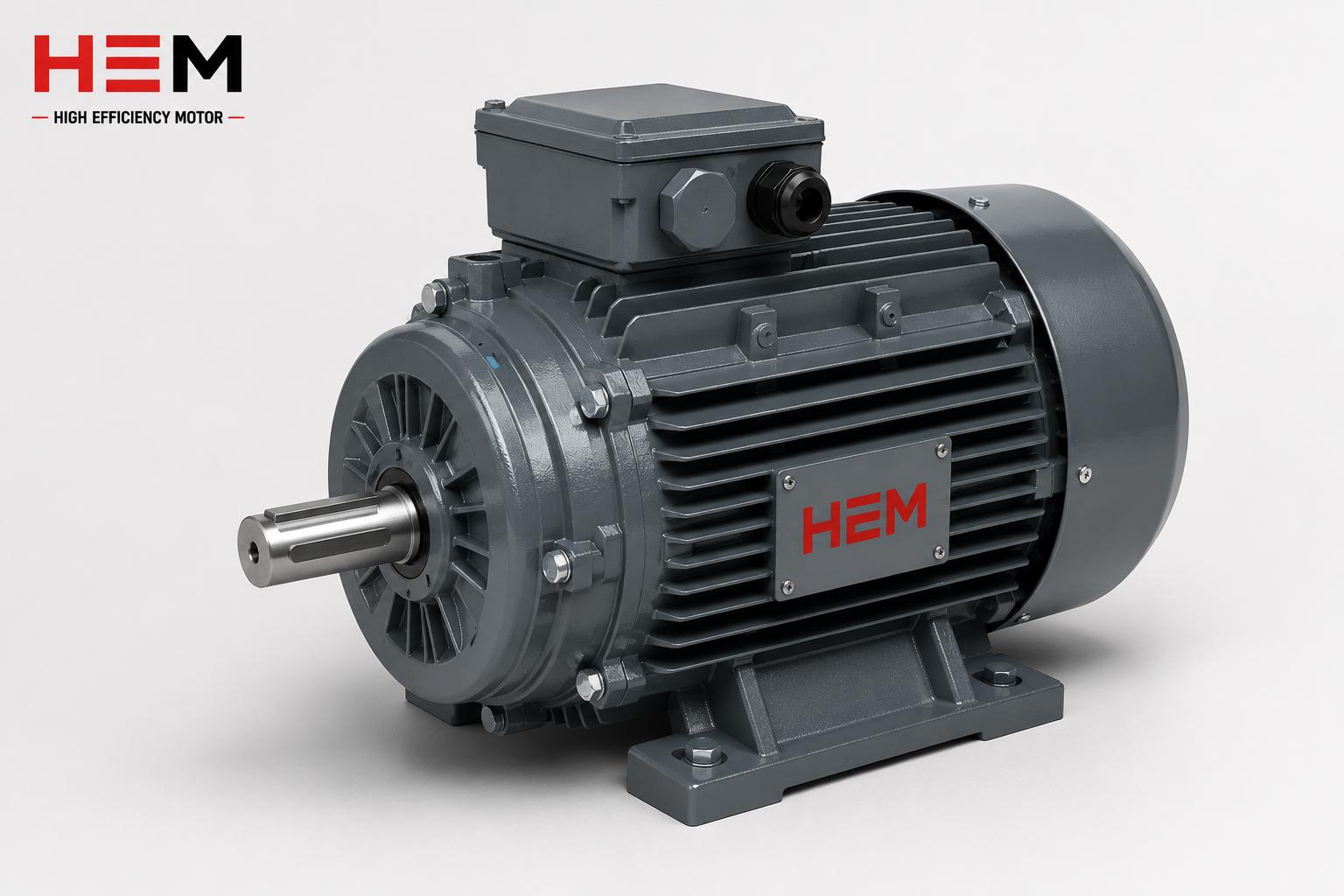

One of the most important factors determining the real life and reliability of an asynchronous motor is a correct understanding of its thermal behaviour. The power value on the motor nameplate expresses the continuous power the motor can produce, under a specific ambient temperature and duty type, without the winding exceeding the insulation class temperature limit. In the real field, however, the motor operates under starts, overloads and variable load profiles. This is where the thermal time constant and the overload model come into play. Understanding these concepts correctly is critical both for selecting the right motor and for setting thermal protection devices correctly.
At HEM Motor, all the IE3 and IE4 class asynchronous motors we manufacture have class F insulation and robust thermal design. But even the highest-quality motor, if protected according to the wrong overload model, will either stop unnecessarily or burn out and end its life prematurely. In this article we address the thermal time constant, the thermal protection curve, cooling time and their effect on correct selection in asynchronous motors.
What Is the Thermal Time Constant?
The thermal time constant is a fundamental parameter defining a motor's heating and cooling rate. Simply put, it determines how long it takes for the winding to reach its final temperature when a load is applied to the motor, and how long it takes to cool when the load is removed. Small motors have low thermal mass, so they heat and cool quickly; large-frame motors, thanks to their high thermal mass, heat slowly, tolerate short-term overloads more comfortably, but also take longer to cool.
This behaviour directly affects motor selection. In an application taking short-term high loads (for example, impact load), a motor with high thermal mass protects the winding by reflecting short peaks into the average temperature. In an application running at a continuous fixed load, the motor stabilises slightly below its rated power and runs at a steady temperature without the thermal time constant coming into play.
Why Are Heating and Cooling Not Symmetrical?
While the motor runs, its own cooling fan turns and heat is dissipated through the body fins; thus there is a certain cooling during the heating process. But when the motor stops, the fan also stops, so cooling is generally slower than heating. This asymmetry is critically important in applications that frequently start and stop (repetitive duty type); because if the motor is reloaded before fully cooling from the previous run, the temperature builds up step by step. This buildup, if the correct duty type is not defined, leads to premature ageing of the insulation.
Overload Model and Thermal Protection Curve
Thermal protection devices (thermal relay, motor protection circuit breaker, electronic motor protection relay) work through a model that mimics the motor's thermal behaviour. As current rises, the motor's heating increases quadratically; the protection device is triggered according to a time-current curve incorporating this relationship. That is, a small overload triggers the protection device over a long time, while a large overload triggers it very quickly.
- Small overload: Currents slightly above nominal are tolerated until the motor approaches its thermal limit; the protection curve triggers over a long time.
- Large overload: High currents heat the winding rapidly; protection comes into play quickly to protect the motor.
- Starting current: Because the high current drawn during starting is short-lived, the protection curve must be selected to tolerate this current; otherwise the motor is stopped at every start.
When selecting the protection device, you must know the motor's overload model and real duty type. An incorrectly set thermal relay either leaves the motor unprotected or causes unnecessary stoppages. On this topic, our electric motor protection thermal relay and fuse selection guide explains how to size protection elements.
Cooling Time and Repetitive Duty Type
How long it takes before a motor can be safely reloaded after an overload depends on the cooling time. In frequently starting applications (lifts, presses, automatic fill lines), the motor accumulates a certain heat each cycle and cools during stop periods. If the run-stop ratio is miscalculated, the temperature increases cumulatively and the motor risks burning.
For this reason, in repetitive duty types (such as S3, S4, S5), the motor's duty type must be correctly defined on the nameplate and match the application. In dual-speed or frequently reversing applications, the thermal load increases further; for these applications our dual-speed (Dahlander) asynchronous motors article conveys special thermal considerations.
Effect of Ambient Temperature
The values on the motor nameplate are generally given for a specific reference ambient temperature. When the ambient temperature rises above this reference, the continuous power the motor can deliver decreases; because the winding's final temperature is the sum of the ambient temperature and the heat the motor produces. In motors operating in hot environments (foundry, furnace, under-roof), the power must be reduced somewhat (derating) or a one-size-larger motor selected. Likewise, at high altitude, air density drops, so cooling efficiency decreases and a similar correction is needed.
Thermal Behaviour and Efficiency Relationship
High-efficiency motors (IE3, IE4) produce fewer losses at the same output power, so they heat less. This widens the thermal margin and extends motor life. In other words, as the efficiency class rises, the motor not only consumes less energy but also operates more comfortably thermally. This provides a clear advantage especially under demanding conditions such as high ambient temperature or continuous full load.
To evaluate the effect of efficiency class on thermal behaviour and total operating cost, our efficiency and pole count comparison in asynchronous motors content details the pole-efficiency relationship. The right efficiency class reduces both the energy bill and the thermal risk.
The Relationship Between Starting, Inertia and Thermal Load
One of the moments a motor heats up the most is starting. During starting, the motor draws a current far above its nominal current, and this high current produces intense heat in the winding. If the starting time is short, this heat does not cause a significant problem; but in motors driving high-inertia loads (large fans, crushers with flywheels, heavy conveyors), the starting time lengthens, and during this period the winding temperature rises rapidly. For this reason, in high-inertia applications, the motor's starting time and heating during start must be evaluated through the thermal time constant.
The situation is even more critical in frequently starting applications. Each start loads a heat pulse onto the winding; if the time between starts is not long enough for the motor to cool, the temperature builds up step by step. This buildup can push the motor to its thermal limit due to frequent starting, even though it appears to run smoothly at nominal load. That is why the number of starts per hour is a parameter as important as nominal power in motor selection.
How Does Starting Frequency Determine Motor Selection?
As the number of starts per hour increases, the motor's thermal load rises. Although small motors with low thermal mass cool quickly, they take a high current pulse at each start; large motors, thanks to their high thermal mass, tolerate starting pulses more comfortably but take longer to cool. For this reason, in frequently starting applications, either a motor with a duty type suited to the starting frequency must be selected, or soft-starting methods that reduce the starting current must be used. The effect of the starting method on thermal load is an inseparable part of motor selection.
Insulation Class and Temperature Limits
To understand a motor's thermal behaviour, you must know its insulation class. The insulation class (usually B, F or H) determines the maximum temperature the winding can withstand. Class F insulation withstands higher temperatures, providing the motor with a wider thermal margin. If a motor has class F insulation but is operated to a class B temperature rise, the remaining margin extends the motor's life and provides additional safety in demanding conditions.
This margin becomes critical especially under demanding conditions such as high ambient temperature, frequent starting or impact load. At HEM Motor, we use class F insulation as standard in the motors we manufacture; this allows the motor both to run comfortably under nominal conditions and to safely tolerate temporary overloads. The right insulation class, evaluated together with the thermal time constant and the protection curve, determines how reliable the motor will be in the real field.
Practical Steps for Correct Selection
- Clarify the duty type: Determine whether it runs continuously (S1), repetitively (S3-S5) or short-time (S2).
- Map the overload profile: Evaluate the frequency and duration of starting, impact and peak loads.
- Account for ambient conditions: Apply power correction at high temperature and altitude.
- Match the protection: Set the thermal relay according to the motor's overload model and starting current.
- Raise the efficiency class: Under demanding thermal conditions, an IE4 motor provides both energy and life advantages.
At HEM Motor, with our wide range of powers and frames, we match the motor best suited to your application's thermal profile from stock. For general industrial applications, our general-purpose industrial motors family offers solutions suited to different duty types. For current electric motor prices and stock, our quotation process responds quickly.
Frequently Asked Questions
How does the thermal time constant affect motor selection?
The thermal time constant determines how well a motor can tolerate short-term overloads. In applications taking impact or repetitive loads, large-frame motors with high thermal mass protect the winding by reflecting short peaks into the average temperature. Under continuous fixed load, the motor stabilises at a steady temperature. When you share your application's load profile, we can determine the frame and power suited to the thermal behaviour together.
Why might a thermal relay trip unnecessarily?
If the thermal relay's protection curve does not correctly reflect the motor's starting current and real duty type, the motor may stop unnecessarily at every start or at every overload spike. In this case the relay setting must be resized according to the motor's overload model. In motors running in repetitive duty types, the duty type must be correctly defined on the nameplate and matched with the relay.
Should motor power be reduced at high ambient temperature?
Yes. The continuous power value on the motor nameplate is given for a specific reference ambient temperature. When the ambient temperature rises above this reference, the power the motor can deliver decreases so that the winding's final temperature does not exceed the insulation class. In hot environments, either power correction (derating) should be applied or a one-size-larger motor selected. The same applies to high altitude, because the drop in air density reduces cooling efficiency.