When a motor failure shuts down a facility, or a new line is about to be commissioned, purchasing teams are frequently faced with two options: a second-hand electric motor circulating on the market, or a brand-new motor from the manufacturer's stock. At first glance, the price tag of the second-hand motor looks attractive. Yet the real cost of an electric motor is not limited to the invoice amount. Winding life, bearing condition, efficiency loss, the absence of a warranty and nameplate uncertainty are all line items that are invisible at the moment of purchase but eventually find their way into the operating budget as risk.
Manufacturing electric motors since 1979 and supplying industrial plants across Asia, Europe and Africa, HEM Motor sells from a broad stock held in Turkiye as of 2026. In this article, looking through the eyes of an electric motor manufacturer, we break down the hidden costs of a second-hand motor item by item, state honestly in which situations second-hand is defensible, and place the delivery speed and risk profile of a new stock motor on the same scale. Our goal is to help you make your purchasing decision not with emotion, but with measurable criteria.

Why Does a Second-Hand Motor Look Attractive?
The appeal of a second-hand electric motor comes down to three things: low initial investment, immediate availability, and the "it will just sit as a spare anyway" mindset. Motors coming out of plant closures, line dismantlements or machine upgrades circulate on the market well below the price of a new unit. In the moment of an urgent breakdown, it may be possible to find a motor the same day from a nearby scrapyard or a second-hand dealer. In this scenario, the second-hand motor acts as a "band-aid" that stops the loss of production.
However, this appeal rests on two assumptions: that the motor is in the condition declared, and that the supply of a new motor would take weeks. The first assumption usually cannot be verified; the second is no longer valid when a manufacturer holding deep stock is involved. When motors in standard frame sizes can be shipped the same day or the next day from our stock in Turkiye, the "speed advantage" of second-hand largely disappears, leaving only the price difference and the burden of risk.
The Hidden Costs of a Second-Hand Electric Motor
The value of an electric motor cannot be judged from the outside. A motor with fresh paint and a polished shaft can mislead the buyer with its showroom appearance even when its winding has reached the end of its life. The five items below are the risks most often overlooked in second-hand purchases and the ones that prove most expensive afterwards.
Winding Insulation and Remaining-Life Uncertainty
The heart of an electric motor is the stator winding, and the life of the winding insulation is directly related to temperature. The insulation material ages chemically with every overheating event; the general rule of thumb is that every 10°C increase in continuous operating temperature roughly halves the insulation life. With a second-hand motor, you cannot know how many times it was overloaded in the past, how many times it ran under phase imbalance, or for how many thousands of hours it served at what ambient temperature. A megger test and an insulation resistance measurement show the current state; they do not show the remaining life. In other words, what you buy in a second-hand motor is an insulation life of which you do not know how much has been consumed. When a winding failure occurs, the rewinding cost approaches or even exceeds the second-hand price of the motor; moreover, the efficiency of a rewound motor typically drops below its factory value.
Bearings and Mechanical Wear
Bearings are the single largest cause of motor failures. In a second-hand motor, it is unknown how many hours the bearings have run, with which grease and at what intervals they were lubricated, and whether they were subjected to radial load from belt tension. A more insidious risk comes from storage: in motors that stand idle for a long time, the bearing balls leave seating marks on the race surface known as "false brinelling", and an early vibration failure begins when the motor is commissioned. A bearing replacement on its own may look cheap; however, the secondary damage that bearing failure causes to the shaft seat, end shields and balance multiplies the workshop bill. In a new motor, the bearings have zero running hours, the grease fill is to factory standard, and vibration values are documented with a test report.
Efficiency Loss: A Silent and Continuous Cost
Every rewinding, every overheating event and every mechanical repair pulls the motor's efficiency below its factory output value. Industry experience shows that every rewinding carried out under uncontrolled conditions can shave 1-2 points off efficiency. One or two percent sounds small; but in a motor that runs 16 hours a day, 300 days a year, this difference turns into an energy cost far greater than the motor itself. Moreover, a significant portion of second-hand motors come from old efficiency classes (IE1, IE2); there is a structural efficiency gap between them and the IE3 and IE4 motors sold from stock today. We examined the payback of replacing an old efficiency-class motor with a new one in detail in our article on IE4 motor payback period; a second-hand purchase represents the exact opposite of that gain, that is, a conscious sacrifice of efficiency.
Absence of Warranty and the Responsibility Gap
A new motor comes with a manufacturer's warranty: the assurance of repair or replacement for material and workmanship defects, an authorised service network and a legal entity to hold accountable. In a second-hand motor this chain does not exist; the seller's declaration that it is "in working order" usually amounts to no more than spinning the motor unloaded and listening to the sound. When the motor fails under load, at the real ambient temperature and under real grid conditions, there is no door left to knock on. We explained what warranty coverage means, what it includes and what it leaves out, in our guide on electric motor warranty coverage; in a second-hand purchase, this entire subject turns into a risk borne by the buyer. Entrusting a critical line to an unwarranted motor is like driving an uninsured vehicle: it looks like a saving until something goes wrong.
Nameplate Uncertainty and Compliance Risk
On the second-hand market, motors with erased, painted-over or replaced nameplates are common. When voltage, frequency, speed, power, efficiency class, protection class (IP) and insulation class data cannot be verified, whether the motor is truly suitable for your system is left to guesswork. The nameplate of a rewound motor may no longer reflect its actual values: the changed wire cross-section and number of turns during rewinding shift the current and heating characteristics. In addition, compliance with current regulations must be questioned in old motors; while there is today a minimum efficiency-class requirement in certain power ranges, commissioning an old-class motor can create problems during audits. In a new motor, the nameplate, the test report and the declaration of conformity confirm one another.

When Can a Second-Hand Motor Make Sense?
To be honest, there are limited scenarios in which second-hand is defensible. The first is non-critical, low-running-hour applications: for a workshop bench that runs a few hundred hours a year, a spare mixer or a temporary site setup, a second-hand motor of known origin that has been tested can be economical. The second is the necessity of finding an exact replacement for a machine with a special frame or mounting size that is no longer in production; if the machine itself is about to reach the end of its life, investing in a new motor for it may not be rational either. The third is motors from a closing plant with documented running hours and complete maintenance records; this transparency is the exception on the second-hand market, but when found it seriously reduces the risk.
The common feature of these scenarios is this: a failure of the motor does not stop production, the energy cost is not decisive in the total cost, and the history of the motor can at least be partially documented. If even one of these three conditions is not met, calling a second-hand purchase a "saving" is misleading.
When Does It Definitely Not Make Sense?
For continuously running main-line motors, for pump and fan groups, and for systems such as cooling and ventilation where downtime is unacceptable, a second-hand motor is an unnecessary gamble. Likewise, in motors that will operate in demanding environments such as high ambient temperature, dust, moisture or chemical vapour, trusting an insulation system with an unknown history means buying downtime. In applications requiring certification, such as explosive atmospheres, a second-hand motor should not even be on the table; using a motor with a broken document chain in such environments creates both technical and legal liability.
Another mistaken scenario is putting a second-hand motor on the shelf as a "spare". The reason a spare motor exists is to come online without hesitation in the moment of a breakdown; yet a motor with an uncertain history keeps the risk of not running waiting on the shelf at the very moment it is needed most. If a backup strategy is to be built, the right address for it is new motors with test reports.
Delivery Speed and Commercial Advantage of a New Stock Motor
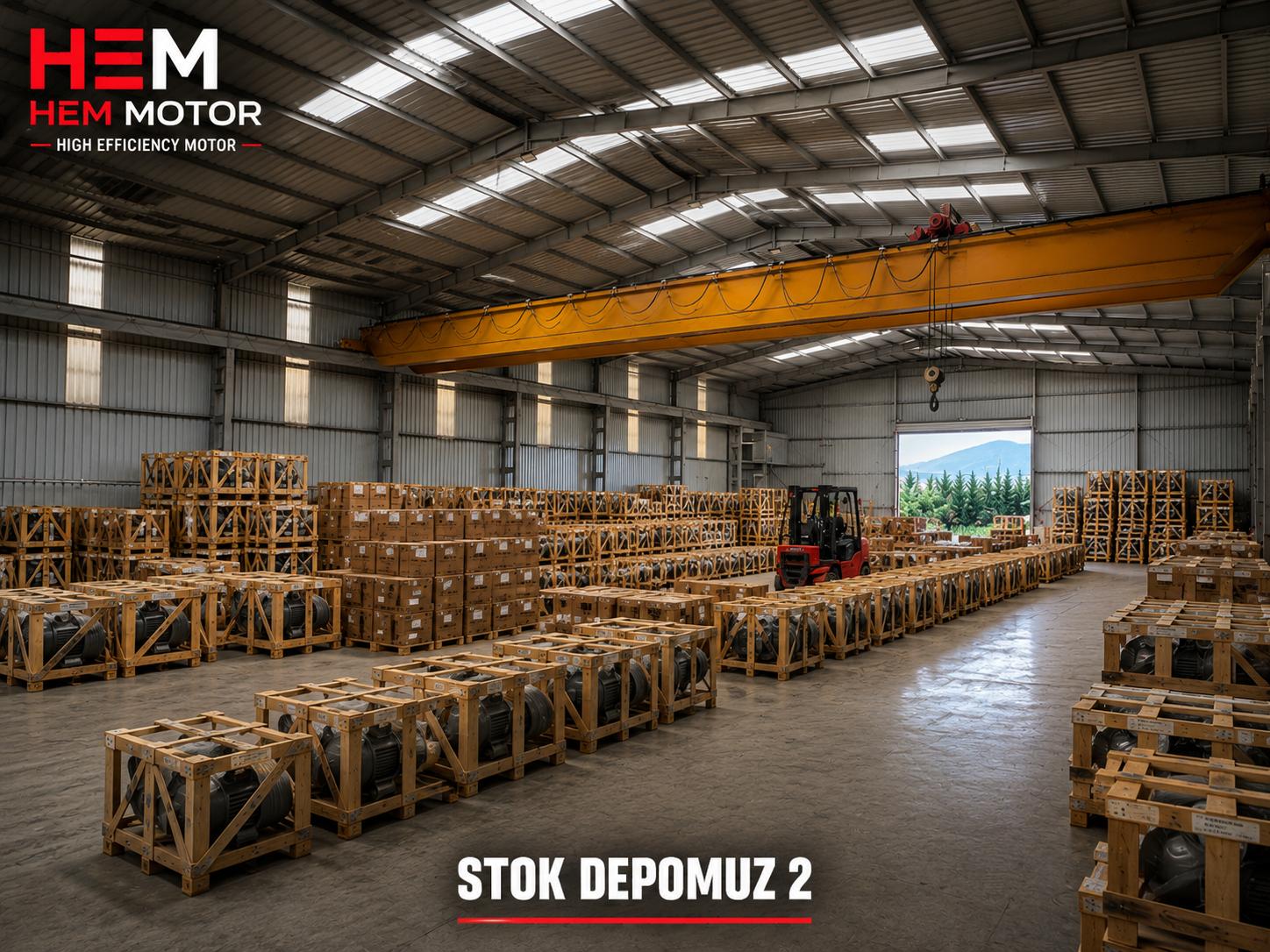
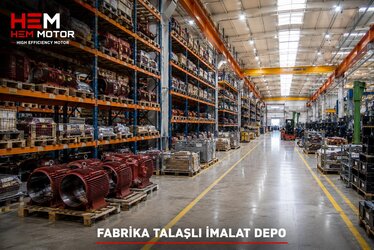
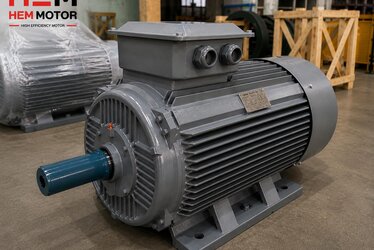
The weakest link in the equation built in favour of second-hand is now delivery time. In the past, a new motor meant a wait of weeks from the manufacturer, and that wait forced operations into second-hand. The broad stock HEM Motor holds in Turkiye has changed this equation: standard electric motors up to high powers above 0.12 kW, with B3, B5, B14 and B35 mounting types, can in most cases be dispatched the same day from stock. In an urgent breakdown scenario, the dilemma of "shall we buy second-hand today or wait weeks for a new one" has turned into "a risky second-hand today, or a warranted new one tomorrow", and the answer to that question is clear for most operations.
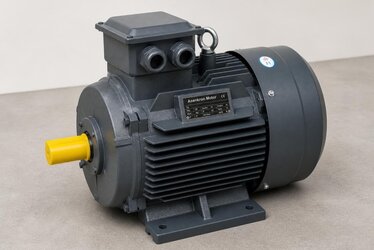
The advantage of a new stock motor is not speed alone. A motor from stock is a product that has passed routine tests, whose nameplate values are verified, whose bearings are at zero hours and whose warranty has not yet started. Because the mounting dimensions comply with standards, there is no compatibility issue with the existing base and coupling. If needed, a second and third unit of the same model can also be supplied from stock; on the second-hand market, finding the twin of the same motor is often impossible. You can review all power and mounting options in our electric motor product catalogue and, by filtering by frame type, identify the model suited to your needs within minutes.
As important as speed is the matter of supply continuity. The advantage of operating as a manufacturer is that the depth of stock is fed continuously through planned production, not on a one-off basis. When you need the same motor again six months after you buy it today, you will once more find a product with the same technical specifications and the same quality in stock. For operations that carry out maintenance planning, this predictability is an operational assurance that cannot be compared with the "whatever is available at the time" reality of the second-hand market. In addition, before dispatch every motor is put through final inspection tests, and on request the routine test report is sent with the motor; in this way your commissioning team begins installation knowing the reference values of the product in hand.
A Practical Risk-Assessment Framework for the Decision
To operations that want to systematise the purchasing decision, we recommend the following five-question framework. First: when the motor fails, does production stop? If the answer is yes, eliminate the second-hand option. Second: how many hours a year will the motor run? In every scenario above three thousand hours, efficiency loss and failure risk overshadow the price difference. Third: is the motor's history documented? If there are no maintenance records, test report and running-hour data, the seller's declaration is not data. Fourth: who is your counterpart in case of failure? If there is no manufacturer giving a warranty, the entire repair and downtime cost is on your balance sheet. Fifth: is the delivery time of a new motor really a problem? For a motor available in stock, the answer to this question is almost always no.
Second-hand purchases that pass through this framework are a minority and are generally limited to low-criticality auxiliary equipment. For main production equipment, the calculation reverses: the price difference of a new motor is the total cost of the warranty, efficiency, delivery assurance and predictability purchased, and that cost usually stays below the cost of a single unplanned stoppage.
As a final note, add the question "who is the seller" to the framework in the second-hand motor decision. A purchase from a seller without a corporate identity and with an unclear invoicing and return process adds a commercial risk on top of the technical risk of the motor. If in case of dispute there is no warranty document, service network or contract to fall back on, every penny gained in negotiation is paid back with interest when a problem arises. Professional purchasing means buying not only the product, but also the institution behind the product.
Frequently Asked Questions
Which tests should I request when buying a second-hand motor?
At a minimum you should request an insulation resistance (megger) measurement, a phase-balance check of the winding resistances, a no-load current measurement and bearing vibration values. However, all of these tests show the current state of the motor; they do not guarantee remaining life. If the test results are undocumented and rest on a verbal declaration, they should not be accepted as data. A second-hand motor that has not undergone a heat-rise test under load can spring surprises under real operating conditions.
Does a rewound motor perform like a new one?
No. Even a good rewinding done in a controlled and measured way cannot replicate the lamination-stack processing, impregnation and test processes of factory production conditions one for one. In practice, rewound motors show a drop in efficiency, an increase in heating and a shift in the current characteristic. Moreover, because the motor's nameplate continues to show the old values, it becomes misleading in system design. Rewinding is a method of rescuing an existing motor; it is not an alternative to a new motor as a purchasing choice.
How quickly can I receive a new motor from stock?
For motors in standard power and mounting types held in our Turkiye stock, dispatch is made the same day or the next business day following order confirmation. With our contracted courier and freight network across Turkiye, delivery reaches most provinces within one to two business days. For special configurations outside stock, we report the production lead time as a definite date during the quotation stage; we do not give a vague "approximate time".
Get a Quote
To receive a new, warranted electric motor quickly from stock without taking on second-hand risk, get in touch with us today. It is enough to share the nameplate details of your current motor; let us quote you an exact match or a more efficient equivalent together with stock availability and a definite delivery date. You can reach our sales team on +90 (532) 345 49 86 or send your request through our contact us page. With the assurance of HEM Motor, do not let your motor keep your production waiting.