English
 Türkçe


Fan selection in air handling units and ventilation systems has undergone a fundamental change in recent years. Traditional scroll-housing fans are increasingly being replaced by free-impeller plug fan (plenum fan) solutions. At the centre of this shift is the correct selection of the motor that directly drives the fan. In this article we examine plug fan motor selection in detail along the axes of power, speed and drive compatibility.
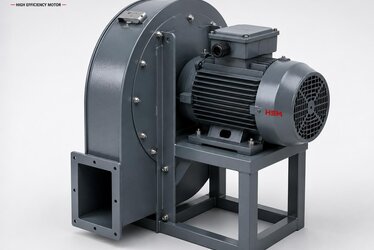
A plug fan is a radial fan with a free-impeller design and no scroll housing. The impeller blows the airflow directly into the plenum volume (a pressurised chamber); no separate air outlet duct is needed. Its most important feature is that the impeller is coupled directly to the motor shaft; there is no belt-pulley system in between.
This direct-drive architecture brings important advantages in both energy efficiency and maintenance; but it also carries its own specific rules to observe in motor selection. Applying these rules correctly means both a quiet, efficient air handling unit and a long-lived system.
Advantages of Direct Drive
In traditional belt-pulley driven fans there is a belt system between the motor and the fan. This system stretches and slips over time and creates friction loss; it also requires regular tension adjustment and belt replacement. In a plug fan, because the impeller is connected directly to the motor shaft, these losses and the maintenance burden disappear.
- No belt loss: Direct coupling eliminates belt friction and slip loss; total efficiency rises.
- Low maintenance: Periodic tasks such as belt tension adjustment, belt replacement and pulley alignment disappear.
- Compact structure: Without a scroll housing the fan fits a smaller volume; AHU design becomes more flexible.
- Continuous speed control: The impeller speed is adjusted continuously and precisely with a frequency converter (VFD).
Speed control with a VFD is one of the strongest aspects of the plug fan. As demand changes, the fan speed can be lowered to adjust the airflow; by the fan laws, when flow drops the power falls much faster. This provides large energy savings in AHUs with variable air needs.
Speed Is Directly the Motor Speed
In belt-pulley systems the fan speed can be made different from the motor speed by the pulley diameter ratio. In a plug fan there is no such freedom: the fan speed is the motor speed. This means that motor selection directly determines fan performance.
Therefore, three components must be chosen together for the correct operating point: impeller diameter, motor pole count and the drive's output frequency. The impeller diameter and speed determine the air flow and pressure the fan will provide. The motor pole count sets the base speed (2 poles ~3000, 4 poles ~1500, 6 poles ~1000 rpm), while the VFD fine-tunes this speed to the desired operating point.
Designing these three together is essential. A wrong pole choice forces the drive to run continuously at an excessive or insufficient frequency, which adversely affects both efficiency and motor life. The correct approach is to determine the target flow-pressure point and select the impeller diameter and pole count to give the base speed closest to that point, leaving the fine adjustment to the VFD.
Bearing Load: Axial and Radial Forces
The most critical mechanical feature of the plug fan architecture is that the fan impeller sits directly on the motor shaft. This means that the load carried by separate fan bearings in belt-pulley systems is transferred directly to the motor bearings in a plug fan. As the fan impeller rotates it produces both radial (perpendicular to the shaft) and axial (along the shaft) forces; all of these forces sit on the motor bearings.
The bearings of a standard general-purpose motor may not be designed to carry this continuous axial and radial load. For this reason, in plug fan applications the motor must be selected with reinforced or increased-load-capacity bearings. In some cases a special bearing arrangement or preloaded bearing structure is needed to handle the axial load.
- Radial load: The weight of the impeller and aerodynamic unbalance produce a force perpendicular to the shaft.
- Axial load: The thrust force of the airflow creates an axial load along the shaft.
- Reinforced bearings: Bearings able to carry this combined load with long life are essential.
- Balancing: The impeller-shaft assembly must be precisely balanced; unbalance shortens bearing life.
Incorrect bearing selection is the most common plug fan failure encountered in the field. For this reason, when selecting the motor, the weight, diameter and axial thrust of the fan impeller must be communicated to the manufacturer from the start.
Protection Class and Efficiency: IP55 and IE4
The motor inside an air handling unit operates in a humid and occasionally dusty environment. For this reason, at least IP55 protection class is recommended for plug fan motors. IP55 provides protection against dust and resistance to water jets from any direction; it protects the motor against condensation and cleaning water inside the AHU. In harsher environments, higher classes such as IP56 or IP65 may come into play.
In terms of efficiency, AHU fans are among the longest-running equipment in a facility; they often run for most of the day, even continuously. This continuous operating profile makes a high-efficiency motor the ideal candidate. An IE4 super premium efficiency class motor pays back its higher initial cost quickly in a continuously running AHU. Because the annual operating hours are high, even a few points of efficiency difference turns into a notable annual saving.
An IE4 motor running at variable speed with a VFD combines both the advantage of stable efficiency and the advantage of low power draw at partial load. This combination forms the basis of modern energy-efficient air handling units.
Drive Compatibility and Practical Selection
Because a plug fan motor always runs with a frequency converter, motor-drive compatibility is an inseparable part of the selection. The drive adjusts the motor speed according to the AHU's instantaneous air need. The points to watch here are selecting the drive to match the motor's power and current, using an appropriate filter on the motor cable if needed, and verifying that cooling stays sufficient at low speed.
If continuous operation at very low speed is required, the motor's own fan cooling may become insufficient; in that case forced (external) cooling may come into play. However, in most AHU applications the operating point stays in the band where the motor fan provides sufficient cooling.
The practical selection order is: first determine the required air flow and pressure, then select the matching impeller diameter and motor pole count, then clarify the VFD that will drive this point and the required protection/efficiency class. Specifying the bearing-load requirement and mounting type from the start ensures fast supply of the right motor.
For fan motor applications you can review our HVAC and fan motor guides and, for speed control, our VFD and drive content. For the stock status of a motor with the right reinforced bearings and IE4 efficiency and current electric motor prices, you can request a quote.
Frequently Asked Questions
How do I determine the fan speed in a plug fan?
In a plug fan the impeller is coupled directly to the motor shaft, so the fan speed is the motor speed. For the correct operating point, the impeller diameter, motor pole count (2/4/6 poles) and VFD output frequency are chosen together. The pole count sets the base speed, while the VFD fine-tunes that speed to the desired flow-pressure point.
Why are reinforced bearings needed in a plug fan motor?
Because the fan impeller sits directly on the motor shaft; the axial and radial load carried by separate fan bearings in belt-pulley systems is transferred directly to the motor bearings in a plug fan. Standard motor bearings may not be enough to carry this continuous combined load; therefore a motor with reinforced or increased-load-capacity bearings must be selected.
Which efficiency class is suitable for an AHU fan?
Because AHU fans are among the longest-running equipment in a facility, at least IE4 super premium efficiency is recommended. Due to the continuous, long-hour operating profile, the higher initial cost is paid back quickly. An IE4 motor running at variable speed with a VFD combines both stable high efficiency and low power draw at partial load.