English
 Türkçe

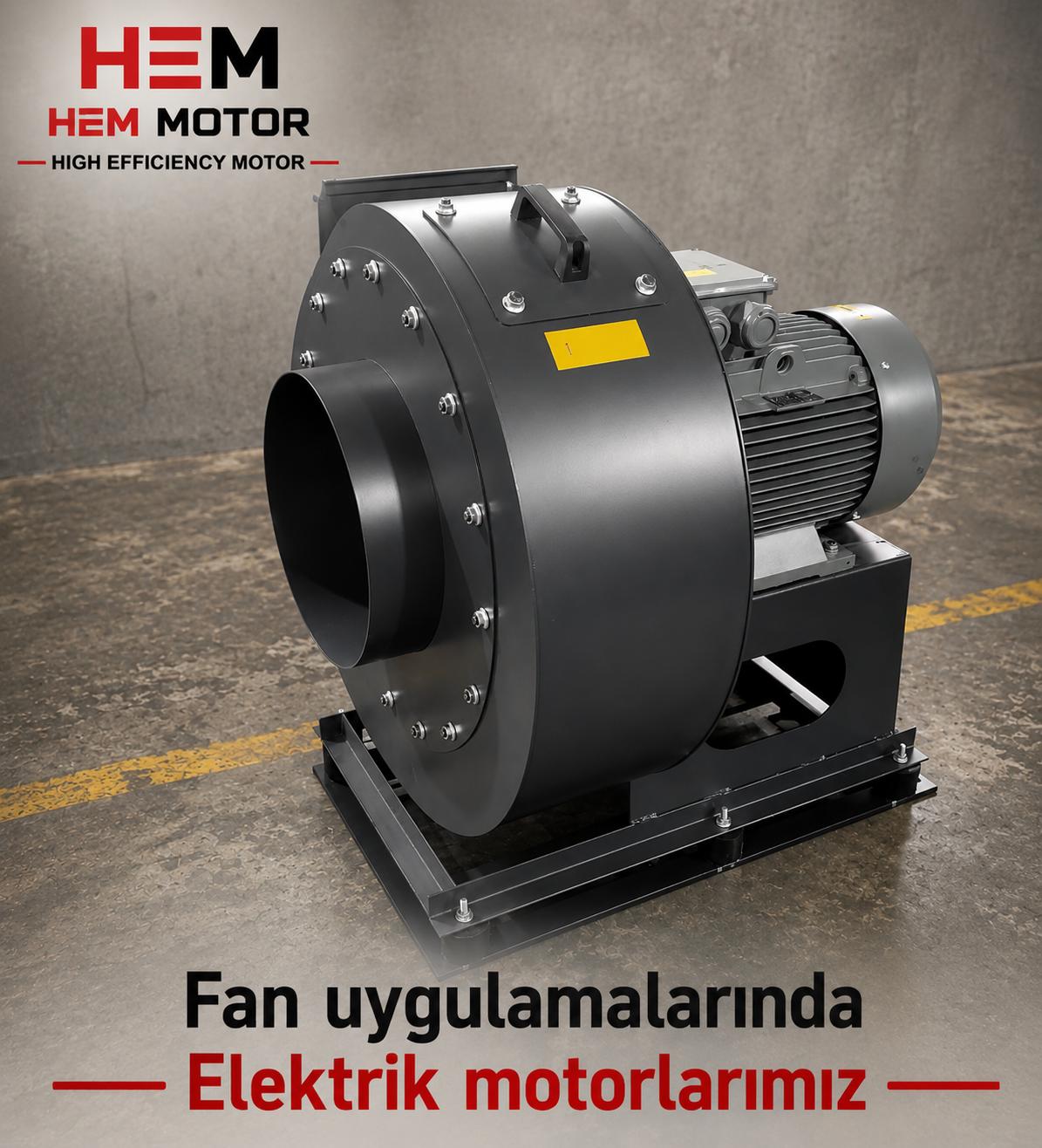

In large production halls, logistics warehouses, gyms and livestock barns, HVLS ceiling fans (High Volume Low Speed) have become increasingly common. With their wide-diameter blades turning at low rotational speed, they move an enormous volume of air. At the heart of these systems, correct HVLS fan motor selection directly determines the energy bill, the quietness of operation, the system's lifespan and its maintenance cost. As HEM Motor, with our identity as both a manufacturer and a seller, we supply motors that combine the right frame, the right speed and the right drive type from a single source. In this guide we cover the high-volume low-speed principle, geared and direct-drive solutions, power calculation and the technical details to watch during purchasing, all from a sales-oriented perspective.
Unlike a small desktop fan, an HVLS fan does not aim to throw air at high velocity; it creates a slow but large-mass airflow over a wide area. This fundamental difference completely changes motor selection. Instead of a high-speed, low-torque motor, you need a drive arrangement capable of producing high torque at low output speed. This is exactly where motor, gearbox and efficiency-class decisions become interconnected.
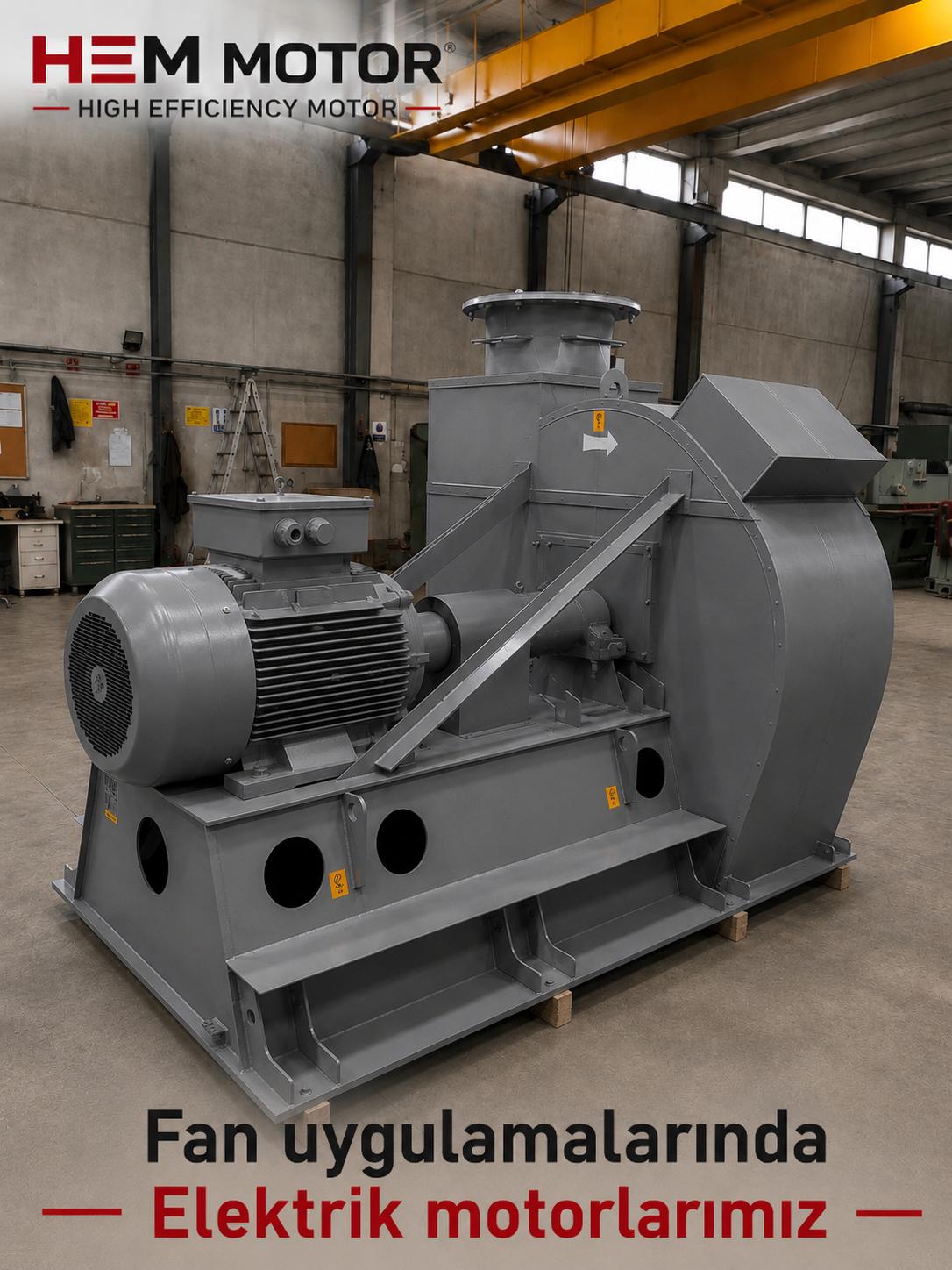
The HVLS Principle: Why High Volume, Low Speed?
An HVLS fan's performance is measured by the large diameter of its blades and the low speed of its rotation. Because wide blades create a large swept area, even a low number of revolutions per minute pushes a large amount of air slowly downward. This slow airflow spreads across a wide area at floor level, breaking up heat stratification, reducing perspiration and, in winter, bringing the warm air trapped near the ceiling back down to working level.
Low speed also reduces noise and vibration. The wind rush and motor hum produced by small high-speed fans is almost nonexistent in HVLS systems. However, to achieve this quietness, the motor must be balanced, low in vibration and capable of producing sufficient torque at low speed.
Aerodynamic Load and the Torque the Motor Faces
A fan is a typical variable-torque load: the required power rises in proportion to the cube of the speed. Slightly reducing the speed cuts the power significantly, which is the foundation of the HVLS energy advantage. At startup, however, the inertia of the wide blades is high; the motor must produce sufficient starting torque to set this large mass in motion from rest. Correct motor selection must satisfy both the low power of continuous running and the high inertia torque at startup.
This dual requirement reverses the logic we know from small fan motors. A standard desktop fan reaches speed instantly with low-inertia blades; in an HVLS fan, because the blade diameter is measured in meters, the same mass sits far from the rotation axis and the moment of inertia grows multiplicatively. Starting behavior is therefore as important a design criterion as continuous power. A correctly selected motor brings the blades up to speed smoothly and gradually; a wrongly selected one either struggles at startup or, being oversized, loses efficiency at partial load.
Another important point is that HVLS fans usually run continuously for long periods. In a production hall, the fan turns without interruption throughout a shift. The motor must therefore be reliable and low-loss not only at startup but also through hours of continuous running. This is where efficiency class comes in: even a small efficiency difference, accumulated over a year, creates a significant energy-cost difference. That is exactly why IE3 and especially IE4 motors are preferred in HVLS applications.
Geared or Direct Drive? Two Core Architectures
HVLS fans use two main drive architectures, and motor selection is shaped by this choice.
Geared HVLS Drive
In this approach, a standard 1500 rpm or 1000 rpm asynchronous motor drives the fan hub through a gearbox. The motor's high speed is reduced to a low output speed, and torque is increased by the same ratio. The worm gear reducers in the HEM Motor range (HEM30–HEM130 frames) and bevel-helical reducers are suitable for these applications. The self-locking feature of a worm gear reducer prevents the fan from back-driving when stopped, providing an additional safety advantage.
- Advantage: A standard, stock-available IE3/IE4 motor is used; in case of failure the motor is easily replaced with an equivalent.
- Advantage: By selecting the gear ratio, the same motor family can serve different blade diameters.
- Watch out: Gearbox efficiency loss and periodic oil maintenance must be planned.
Direct Drive (Gearless) HVLS
Here a low-speed, high-pole motor, or a motor whose speed is set by a drive, connects directly to the fan hub; there is no gearbox. Direct drive eliminates gear losses, removes the risk of oil leakage and is quieter. To produce high torque at low speed, however, you need either a special high-pole motor or a motor whose speed is electronically reduced with a variable frequency drive (VFD).
- Advantage: No gears or oil requiring maintenance; quiet and clean operation.
- Advantage: With a VFD, speed and therefore airflow are adjusted steplessly.
- Watch out: Drive compatibility, motor insulation class and cooling at low speed must be carefully planned.
Selecting the Right Power and Speed
HVLS motor power depends on the blade diameter, blade count, blade profile and the targeted airflow. Because a fan is a variable-torque load, oversizing the motor increases both the initial investment and the efficiency loss at partial load. The correct approach is to calculate the continuous running power and to check the starting inertia torque separately.
- Speed choice: In geared systems, a 1500 rpm (4-pole) motor is the most common input speed; quieter, higher-torque applications use 1000 rpm (6-pole).
- Efficiency class: Because fans run long hours daily, an IE3 or IE4 efficient motor pays for itself quickly through annual energy savings.
- Duty type: S1 continuous-duty rating and Class F insulation ensure long-term reliable operation.
- Protection class: In dusty production environments, IP55 and higher protection extends motor life.
Inertia and Starting Time
Wide HVLS blades create a large flywheel effect. As the motor accelerates this stationary mass, it sees a long starting time and high starting current. The longer the starting time, the more the motor winding heats up. For high-inertia HVLS applications, soft starting or controlled acceleration with a frequency drive is therefore recommended. For details on starting methods, our guide on the star-delta versus soft starter comparison offers a practical roadmap.
A longer starting time matters especially in facilities that need consecutive starts. If a fan is stopped and restarted several times during the day for maintenance or safety reasons, each start loads heat onto the winding, and this heat needs enough time to dissipate. Otherwise the winding temperature gradually rises and life shortens. When selecting an HVLS motor, you should therefore consider not just a single start but also the daily start frequency.
Balance Between Quietness and Vibration
The greatest appeal of HVLS systems is the low noise level. But this quietness does not come from low speed alone; the motor's mechanical balance and vibration level are also decisive. An unbalanced rotor or a poor bearing structure can produce annoying vibration and hum even at low speed. Moreover, since HVLS fans are usually mounted on a high ceiling, any vibration is transmitted to the supporting structure and is undesirable both for comfort and structurally. An HVLS motor should therefore have a low-vibration, well-balanced structure with quality bearings.
Relationship with the HVAC and Ventilation Range
HVLS fans are part of the broader HVAC and ventilation ecosystem. The HEM Motor range includes motor families dedicated to fan and ventilation applications. To position the right fan motor, our articles on aspirator and fan motor selection and fan motor supply in HVAC projects provide complementary information along the flow and pressure axes. On the product side, the Ventilation Electric Motors and HVAC Sector Electric Motors categories include options suitable for HVLS drives.
Calculating the Required Power Correctly
Determining fan power correctly prevents both excessive consumption and insufficient airflow. You can find the logic of motor power calculation for fan, pump and conveyor applications in our motor power calculation guide. For current electric motor prices and stock availability, you can get clear information from our team.
A common mistake in determining power is oversizing the motor "just in case." But because a fan is a variable-torque load, choosing the motor larger than needed both raises the initial investment and causes the motor to run at partial load. Asynchronous motors run at peak efficiency at loads close to their rated power; at very low load, efficiency and power factor drop. The correct approach is therefore to size the motor exactly to the need, neither too large nor too small, based on the real aerodynamic load.
Typical Use Areas of HVLS Systems
Knowing where HVLS fans are used also makes correct motor selection easier, because each environment requires a different protection and durability profile.
- Production and assembly halls: For air circulation and worker comfort in wide open areas; a high protection class matters in dusty environments.
- Logistics and warehouse buildings: To break up heat stratification in high-ceilinged, large-volume spaces; efficiency stands out due to continuous running.
- Gyms and social spaces: Since low noise and vibration are critical, a well-balanced, quiet motor is needed.
- Livestock barns: In an environment of moisture, dust and corrosive gases, a durable body and high protection class are essential.
Each of these applications has different priorities, from the motor's body material to its protection class. When you describe your environment, we recommend the most suitable motor according to these priorities.
Mounting Type and Mechanical Compatibility
In an HVLS motor, mechanical compatibility is as decisive as performance. In a geared drive the motor bolts directly to the gearbox input flange; B5 or B14 flange selection is therefore critical. The flange diameter, hole pattern and shaft dimension must match the gearbox exactly. A wrong flange size means the motor cannot be fitted to the gearbox, or causes early bearing failure due to a centering error. To see the differences between mounting types clearly, the mounting categories in our product range provide guidance.
In coupled (foot-mounted, B3) arrangements, a coupling sits between the motor and the fan hub, and axis alignment is highly important. A poorly aligned coupling produces vibration and noise and shortens bearing life. Which mounting type to choose should therefore be planned from the outset together with the drive architecture. Choosing the right mounting type both eases installation and improves long-term reliability.
The Payback of the Efficiency Class
Because HVLS fans run long hours daily, the efficiency class directly affects operating cost. An IE4 motor runs with lower losses than an IE3 motor; this difference, negligible in a short-running machine, turns into meaningful annual savings in a continuously rotating HVLS fan. The investment decision should therefore account not only for the motor's initial price but also for its annual energy consumption. In a long-life application, the extra cost of an efficient motor pays for itself through energy savings.
Purchasing and Supply Tips
- Exact matching: When replacing an existing HVLS system, send the full power, speed, IEC frame, mounting type and shaft dimensions from the motor nameplate; we supply an exact equivalent.
- Mounting type: In geared drives a B5/B14 flanged motor must match the gearbox input; foot-mounted (B3) solutions are used in coupled arrangements.
- Spare plan: In facilities with multiple HVLS fans, stocking a single critical spare motor minimizes downtime during a failure.
- Drive compatibility: If used with a VFD, the motor insulation class and cable selection should be requested compatible with the drive.
- Protection class: In a dusty production environment, IP55 and higher protection prevents dust ingress and extends motor life.
- Duty type: In continuously rotating fans, S1 continuous duty and Class F insulation ensure reliable long-term operation.
Instead of evaluating all these criteria one by one, it is enough to send us your application's blade diameter, target airflow, operating hours and ambient conditions. As HEM Motor, we recommend a motor that combines the right body, the right speed, the right efficiency class and the right mounting type, together with a gearbox suited to your drive architecture, from a single source. This holistic approach optimizes both the initial investment and the long-term operating cost.
Frequently Asked Questions
How many poles should I choose for an HVLS fan motor?
In geared drives, a 1500 rpm (4-pole) input motor is the most common and economical choice; large-diameter fans needing lower noise and higher torque prefer 1000 rpm (6-pole). In direct drive, low speed is obtained with a high-pole motor or a frequency drive. We clarify your needs based on blade diameter and target speed and recommend the right motor.
Is a geared HVLS or a direct drive better?
If budget and fast supply from stock are your priorities, a standard IE3/IE4 motor plus a worm gear reducer is practical, and the motor is easily replaced in a failure. If you want maximum quietness, zero oil maintenance and stepless speed control, a VFD-driven direct drive is more suitable. We supply the motor side from a single source in both architectures.
Why does an HVLS motor draw high starting current?
The high inertia of the wide blades requires the motor to accelerate a stationary mass, demanding a long starting time and high starting current. Soft starting or controlled acceleration with a frequency drive limits this current, reduces winding heating and eases the sudden load on the grid.