English
 Türkçe

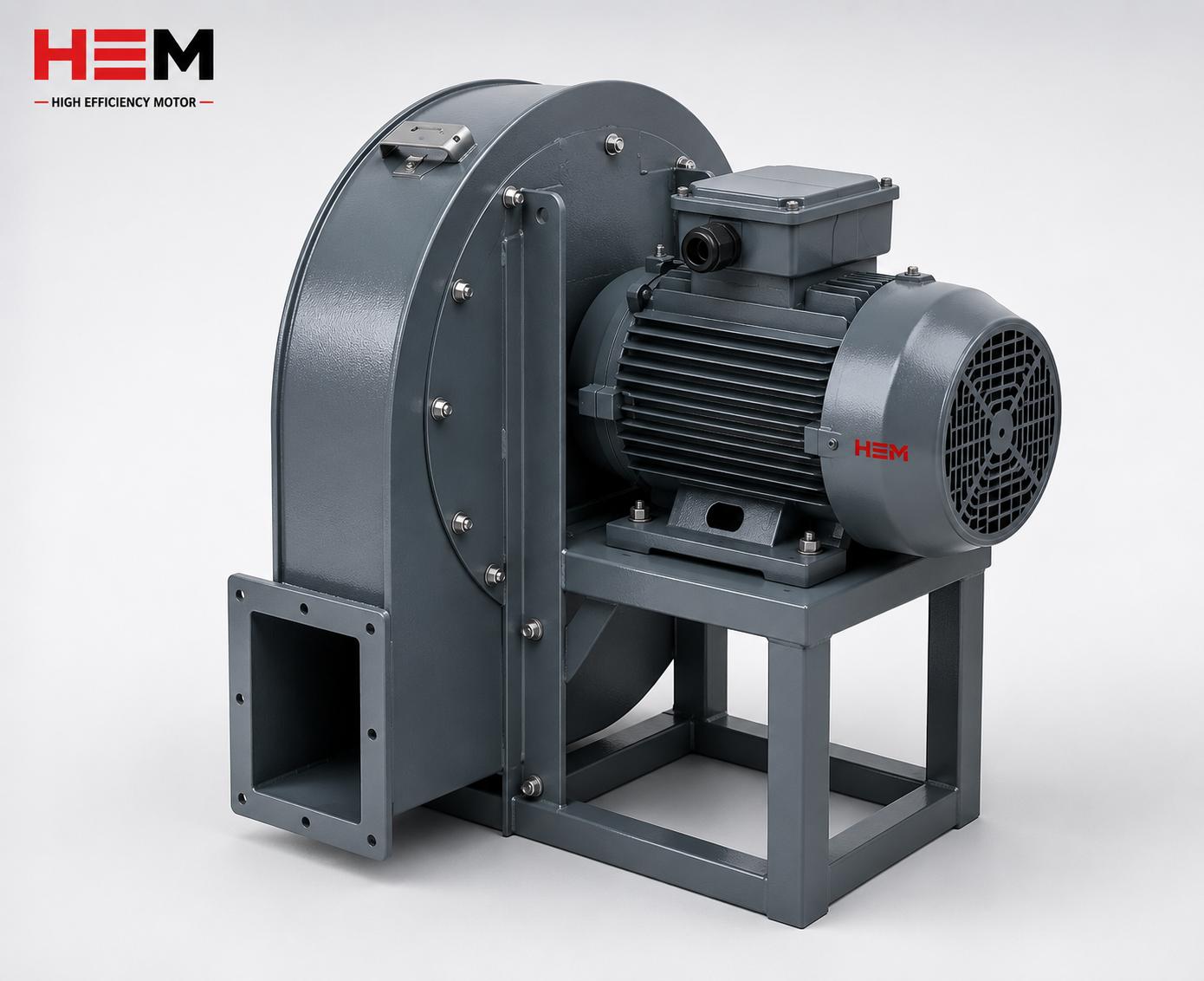

Enclosed car parks are among the most critical yet least noticed ventilation zones in modern buildings. Carbon monoxide (CO) from vehicle exhaust, heavier-than-air gases that can leak from LPG-powered cars, and the dense smoke produced during a fire all pose a direct threat to human health and life safety inside these confined volumes. For this reason, enclosed car park ventilation is usually solved not with classic ducted systems but with the jet fan (impulse ventilation) principle. At the heart of this system lies an electric motor selected for continuity, efficiency and durability.
At HEM Motor, we supply motors for jet fan and ventilation applications in enclosed car park projects across the IE3 Premium and IE4 Super Premium efficiency classes, in a broad power range from 0.55 kW up to 355 kW, all suitable for the S1 continuous duty regime. In this article we will examine in detail the technical criteria you must consider when selecting an enclosed car park jet fan motor, under the headings of CO and LPG extraction, thrust force, continuous duty and high-temperature resistance.
Our goal is to help engineers and facility managers select the correct motor on the first attempt, eliminating risks such as failure, unnecessary energy consumption and insufficient extraction. Throughout the article we will address both the design (specification) stage and the process of replacing an existing motor by matching it from the nameplate.
The Jet Fan and Impulse Ventilation Principle
Traditional ventilation systems require a dense network of ducts to carry fresh air in and contaminated air out. In enclosed car parks these ducts are avoided because they are both costly and reduce ceiling height. Impulse (jet fan) ventilation, on the other hand, directs the air inside the car park through axial jet fans mounted on the ceiling, without using any ductwork.
The main idea of this system is simple: fresh air enters the car park through supply louvres or ramps at specific points. Jet fans, strategically placed on the ceiling, use the thrust force they generate to sweep this air from contaminated areas toward the exhaust fans. This creates an airflow corridor throughout the entire car park with no dead zones. This approach both prevents CO accumulation and, in the event of a fire, directs smoke in a controlled manner toward the extraction shafts.
Why Is Thrust Force Decisive?
In jet fan systems, fan performance is measured by thrust force (in Newtons) rather than the "flow rate" used for classic fans. Thrust determines how far and how powerfully the fan pushes the air. The car park's geometry, column layout, ramp positions and total area directly affect the total thrust force required. Insufficient thrust causes the airflow to dissipate and CO pockets to form.
This is where motor selection comes in. The fan impeller that delivers the desired thrust must be driven at the correct speed and at the correct power. If the motor's power (kW) and speed (rpm) are insufficient, the fan cannot produce the rated thrust. At HEM Motor, with synchronous speed options of 1000, 1500 and 3000 rpm, we offer motors that provide the impeller-motor match required by the jet fan manufacturer.
CO and LPG Extraction: Designing for Gas Characteristics
In enclosed car park ventilation there are two main groups of hazardous gases that must be extracted, and their physical behaviours differ:
- Carbon monoxide (CO): Having roughly the same density as air, it mixes with and spreads through the ambient air. CO sensors automatically activate the jet fans and exhaust fans once a threshold value is exceeded.
- LPG and heavier-than-air gases: Because LPG is denser than air, it settles toward the floor and into low pits. Therefore the extraction strategy must cover not only the ceiling level but also louvres near the floor.
- Fire smoke: Being hot, it rises; ceiling-level jet fans direct the smoke toward the extraction shaft, keeping the escape routes visible.
For the same system to manage all three scenarios, the motors must operate stably both during normal daily CO extraction and in the high-flow emergency mode. Two-speed (dual-speed) motors are particularly valuable here: quiet, energy-efficient CO extraction at low speed, and maximum flow for emergencies at high speed.
Smoke control in car parks should be evaluated as an independent discipline alongside our smoke exhaust fan motor supply guide. Likewise, when the car park is part of a building HVAC concept, the fan motor supply in HVAC projects should be planned in an integrated way.
S1 Continuous Duty and High-Temperature Resistance
The most distinctive feature of enclosed car park jet fan motors is their suitability for uninterrupted operation. Unlike a comfort fan, car park ventilation runs all day, often 24/7. For this reason the motor must belong to the S1 continuous duty regime. S1 means that the motor reaches thermal equilibrium while running continuously at rated load and operates without exceeding that temperature.
Fire Scenario and the F300/F400 Context
Car park ventilation motors often serve a dual role: both daily CO extraction and smoke extraction in the event of a fire. For fans that must operate within hot smoke during a fire, high-temperature resistance (for example the ability to run at high temperature for defined periods, generically the F300/F400 class smoke extraction requirements) is a critical criterion. In these applications the motor's insulation class, winding quality and bearing lubrication durability are directly related to life safety.
In the motors we offer at HEM Motor, the F insulation class, 100% copper winding and reinforced bearing structure provide long service life under continuous and demanding operating conditions. For special smoke extraction applications requiring high-temperature resistance, optional solutions can be evaluated.
IE3 / IE4 Efficiency: The Economics of Long Running Hours
In a car park ventilation system that runs all day, the efficiency of the electric motor is the largest single component of the operating cost. Over its lifetime a motor consumes far more in energy than its initial purchase price. That is why IE3 Premium and especially IE4 Super Premium efficiency-class motors quickly pay for themselves in high-running-hour applications such as car parks.
- Lower energy losses: IE4 class motors significantly reduce losses compared with lower efficiency classes, which means substantial savings across thousands of annual operating hours.
- Lower heating: High efficiency generates less waste heat, which in turn extends the life of the motor and bearings.
- Drive compatibility: When used together with a variable frequency drive (VFD), additional savings are achieved by adjusting flow according to the CO level.
- Environmental compliance: Higher efficiency classes also offer an advantage in terms of compliance with current ecodesign and energy regulations.
To review HEM Motor's ventilation-focused product group, you can visit our ventilation electric motors product page, and we can determine the efficiency class suitable for your project power together.
IP55 Protection, Bearings and Balance: Mechanical Durability for Continuity
The enclosed car park environment, though it may not look it, is a harsh one for the motor. Tyre dust, exhaust soot, brake-pad dust and humid air all try to penetrate the motor. For this reason a protection class of at least IP55 should be selected for jet fan motors. IP55 means full protection against dust and resistance to water jets coming from any direction. For more aggressive environments, IP56, IP65 or IP66 protection options can be evaluated on request.
Bearing and Vibration Management
In a continuously running fan motor, the bearings are the most worn part of the system. A reinforced bearing structure and correct lubrication extend the motor's maintenance interval. At the same time, dynamically balancing the fan impeller together with the motor rotor minimises vibration. Low vibration both extends bearing life and reduces the noise transmitted into the structure, which is especially important in car parks beneath residential buildings.
The main reason a cast iron body is preferred for jet fan motors is mechanical strength. In a fan that operates suspended from the ceiling and is continuously exposed to vibration, the cast iron body both dissipates heat better and provides structural robustness.
Motor Selection Parameters: Step by Step
When selecting the correct jet fan motor, the following parameters should be clarified in turn:
- Power (kW): Determined according to the thrust and flow values requested by the fan manufacturer. HEM Motor offers solutions in the 0.55 kW – 355 kW range.
- Speed / number of poles: 3000 rpm (2-pole), 1500 rpm (4-pole) or 1000 rpm (6-pole). Lower speed is generally quieter with lower thrust; higher speed is more powerful.
- Frame size: A standard frame dimension compatible with the fan hub and the mounting system.
- Mounting type: B3 (footed), B5/B14 (flanged) or B35 (combined). Jet fans usually favour flanged or combined mounting.
- Protection class: IP55 as standard; higher protection when required.
- Efficiency class: IE3 or IE4, selected according to running hours.
- Duty regime: S1 continuous; high-temperature resistance where a fire scenario exists.
Reversible (Bidirectional) Operation
Some jet fan designs feature reversible (bidirectional) operation to change the airflow direction. This is particularly valuable in scenario-based smoke control, to direct smoke toward the nearest shaft according to the location of the fire. A motor and fan that will operate bidirectionally require symmetrical blades and a suitable winding design; it is important to state this requirement clearly during the project stage.
Sourcing, Stock and Nameplate Replacement Matching
When replacing a faulty jet fan motor in an existing car park, the most reliable method is to match from the old motor's nameplate information. The power, speed, voltage, frequency, number of poles, mounting type and frame size on the nameplate are sufficient to determine the correct equivalent. A mismatched motor can alter the fan thrust and upset the entire ventilation balance.
At HEM Motor, with our broad power and speed range, we provide both supply for new projects and rapid replacement support for existing systems. For aspiration applications in dusty environments, our aspirator fan motor selection guide will serve as a complementary resource. For current electric motor prices and project-based solutions, you can get in touch with us.
Frequently Asked Questions
Why must an enclosed car park jet fan motor be of the S1 continuous duty class?
Because car park ventilation, unlike comfort fans, runs all day and often without interruption. The S1 continuous duty regime guarantees that the motor can reach thermal equilibrium while running continuously at rated load and safely maintain that temperature. A non-S1 motor would overheat in continuous operation, shortening the life of the winding and bearings and even leading to failure.
How does the extraction design change in car parks with a high density of LPG vehicles?
Because LPG is heavier than air, it settles toward the floor and into low pits. Therefore the extraction strategy must rely not only on ceiling-level jet fans but also on exhaust louvres near the floor. The jet fans are positioned to draw air from the accumulation zones near the floor and sweep it toward the exhaust shafts. On the motor side, sufficient thrust and, if necessary, a dual-speed high-flow mode become important.
What should I pay attention to when replacing an existing car park fan motor?
First, note the old motor's nameplate information completely: power (kW), speed (rpm) / number of poles, voltage, frequency, mounting type (B3/B5/B35), frame size, protection and efficiency class. By matching from these values, you must select an equivalent that preserves the fan thrust and the ventilation balance. Upgrading the efficiency class (for example to IE4) is generally recommended, as it provides energy savings over long running hours.