English
 Türkçe

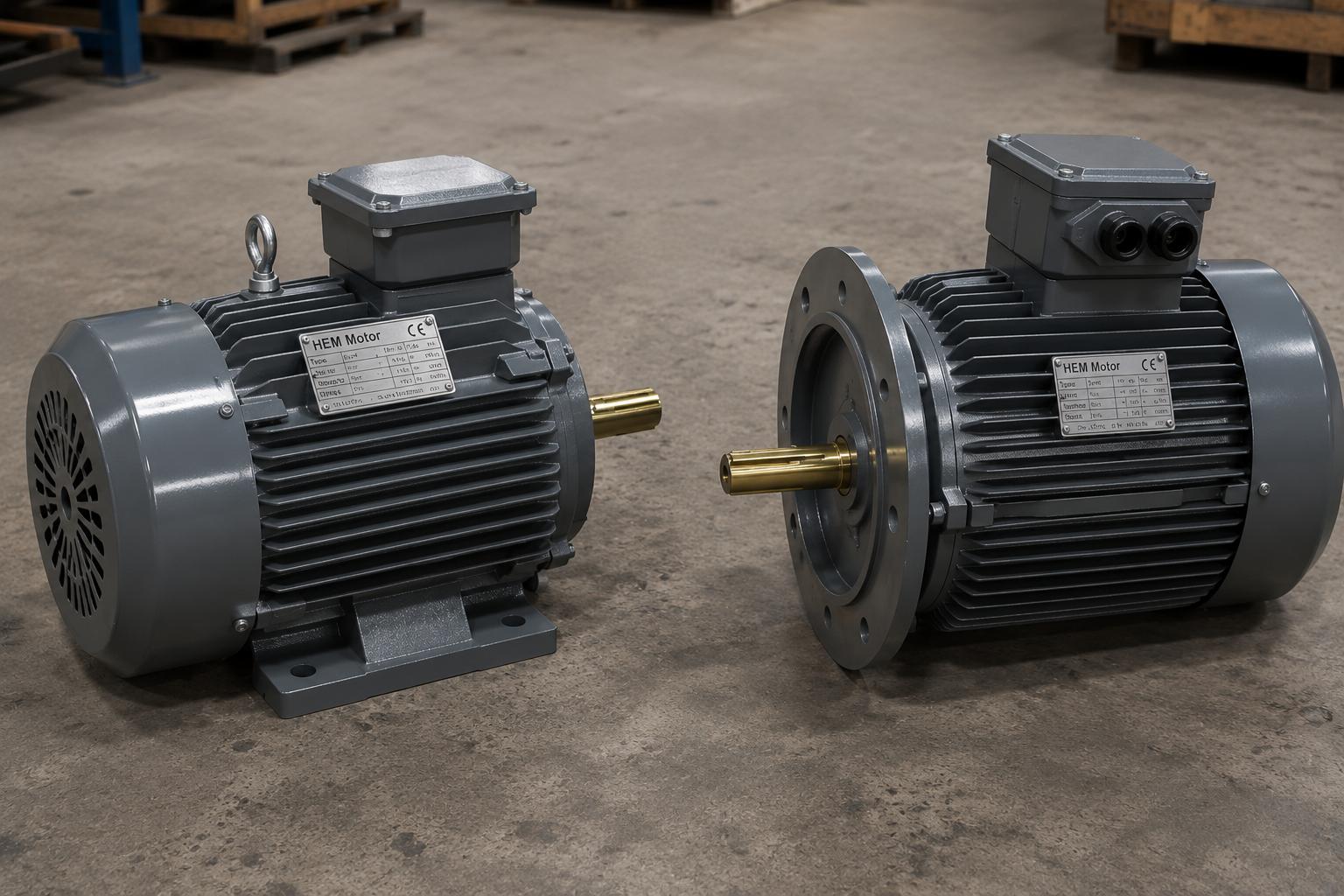

When studying electric motor catalogs, a careful buyer quickly notices an interesting pattern: motors are always listed with even pole numbers such as 2, 4, 6 or 8 poles. You will never find a 3-pole or 5-pole asynchronous motor anywhere. This is no coincidence; it is a direct consequence of the operating physics of the three-phase asynchronous motor. In this guide, with HEM Motor's manufacturer and seller perspective, we explain why odd-numbered poles do not exist, how pole count relates to speed, the even-pole speed table and how this knowledge translates into correct motor selection. Choosing the right pole count is the most fundamental decision determining a motor's speed, torque, quietness and suitability for the application.
Pole count expresses how many pole pairs the motor's magnetic field forms. When the grid frequency stays fixed (50 Hz in Türkiye), the motor's synchronous speed depends only on the pole count. Fewer poles mean higher speed; more poles mean lower speed. Knowing which speed a given job requires therefore directly becomes a pole-selection decision.
Why Is Pole Count Always Even?
An electric motor's stator winding creates magnetic poles. By the fundamental law of magnetism, every north (N) pole must have a south (S) pole opposite it. Poles always form in N-S pairs; a north pole on its own is physically impossible. Therefore a motor has at least one pair, meaning 2 poles. The next step is two pairs, meaning 4 poles, followed by three pairs, meaning 6 poles.
This is exactly why odd-numbered poles do not exist: because poles come in pairs, the total number is always even. A "3-pole motor" would mean leaving one unpaired pole in the middle, which cannot occur magnetically. That is why catalogs show 2, 4, 6, 8, 10, 12 poles, and never 3, 5 or 7.
This is also directly related to the winding layout of three-phase motors. In a three-phase motor, each phase consists of winding groups placed symmetrically around the stator. These windings are fed with a 120-degree phase difference to create a rotating magnetic field. Because the resulting poles always appear, by the laws of physics, as an equal number of north and south poles, the total pole count must be even. So an odd pole count is not just a design choice but an unavoidable consequence of the motor's operating principle.
Understanding this fundamental rule offers a practical benefit to the buyer: anyone who sees an "odd pole count" in a catalog or quote immediately recognizes a typo or a misunderstanding. Likewise, it becomes possible to back-calculate the pole count from the speed value on the motor nameplate. Knowing the pole-speed relationship is therefore the cornerstone of ordering the right motor.
The Pole Pair and Synchronous Speed Relationship
Synchronous speed is the speed at which the magnetic field rotates inside the stator, and it depends on the grid frequency and the number of pole pairs. With the frequency fixed at 50 Hz, as the number of pole pairs increases, the magnetic field must take more steps for one full revolution, so the speed drops. Therefore:
- 2 poles (1 pair): synchronous speed at 50 Hz is 3000 rpm — the highest speed.
- 4 poles (2 pairs): synchronous speed 1500 rpm — the most common in industry.
- 6 poles (3 pairs): synchronous speed 1000 rpm — low speed, high torque.
- 8 poles (4 pairs): synchronous speed 750 rpm — very low speed applications.
Synchronous Speed, Slip and Actual Speed
In an asynchronous motor the rotor turns slightly slower than the magnetic field; this difference is called slip. Without slip, no current would be induced in the rotor and no torque would be produced. That is why the actual speed on the nameplate is slightly below synchronous speed: while a 4-pole motor's synchronous speed is 1500 rpm, its rated nameplate speed is typically in the 1400–1450 rpm range. This difference is normal and a natural result of the motor producing torque under load. Our article on slip and actual speed clarifies why the nameplate reads 1440 instead of 1500.
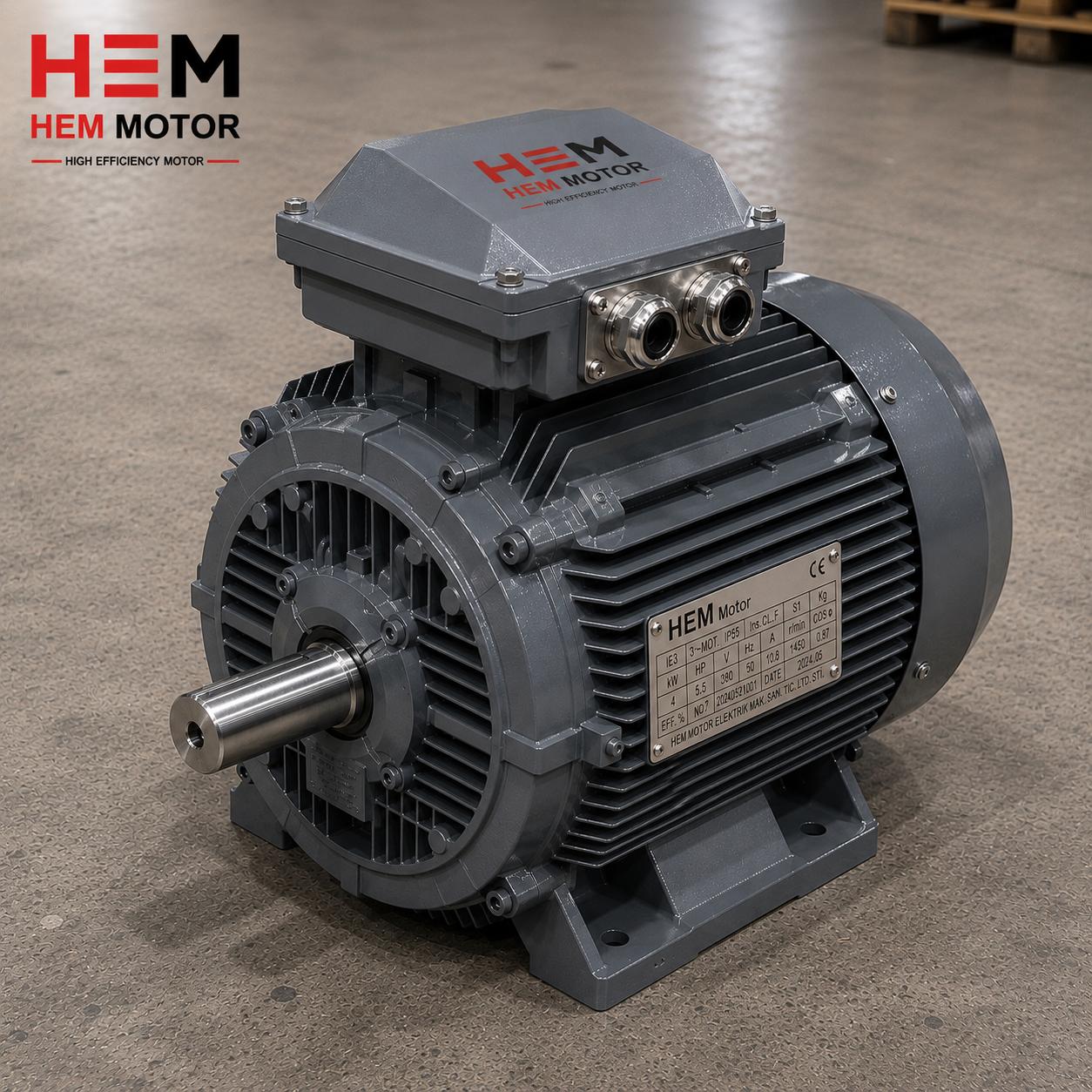
The Relationship Between Pole Count and Torque
In a motor of the same power, as the pole count increases the speed drops but the shaft torque rises. The reason is simple: power depends on the product of torque and speed. When power stays constant and speed falls, torque must rise. A 6-pole motor therefore produces much higher torque than a 2-pole motor of the same power but turns at a much lower speed. This relationship directly affects motor selection: high-pole motors are chosen for low-speed applications needing high torque, and low-pole motors for applications needing high speed.
In practice this means the buyer must know what their machine requires. A centrifugal pump wants high speed, while a large mixer wants high torque at low speed. Two motors with the same kW nameplate, if their pole counts differ, are suited to completely different jobs. Therefore not just power but pole count too is a selection parameter at least as important.
Even-Pole Speed Table (50 Hz)
The table below summarizes synchronous speed and typical loaded rated speed by pole count on a 50 Hz grid. This table is the fundamental reference for correct pole selection.
- 2 poles: synchronous 3000 rpm, loaded approximately 2850–2950 rpm — pumps, compressors, high-speed fans.
- 4 poles: synchronous 1500 rpm, loaded approximately 1400–1460 rpm — general industry, conveyors, gearbox input.
- 6 poles: synchronous 1000 rpm, loaded approximately 950–980 rpm — low-speed fans, mixers, high torque.
- 8 poles: synchronous 750 rpm, loaded approximately 700–730 rpm — very low speed, heavy torque applications.
How to Choose the Right Pole Count
Pole selection is based on the speed and torque the application requires. For a motor of the same power, as the pole count increases the speed drops but the shaft torque rises. The correct decision is to determine your machine's drive speed and select the pole count closest to it.
- If high speed is needed (centrifugal pump, high-pressure compressor): 2 poles, 3000 rpm.
- General-purpose medium speed (conveyor, gearbox input, most machines): 4 poles, 1500 rpm — the most frequently chosen.
- Low speed, high torque (large-diameter fan, mixer, heavy starting): 6 poles, 1000 rpm.
- Very low speed: 8 poles, 750 rpm, or a lower output speed via a gearbox.
Poles or Gearbox?
When a very low output speed is needed, choosing an ever-higher pole count is not always economical. High-pole motors become more expensive and efficiency can drop; instead, a standard 4-pole motor plus a gearbox combination is often smarter. To decide which method suits you, our article on speed adjustment with pulley and belt and our comprehensive 2, 4, 6 pole selection guide help you decide.
For example, when a very low output speed such as a few revolutions per minute is required, even an 8-pole motor does not turn slowly enough. In this case the right solution is to use a standard 4-pole motor with a worm gear or bevel-helical reducer. The gearbox reduces the speed to the desired low level while raising the torque by the same ratio. This approach is both more economical and lets you use a standard motor that is easily available from stock. Special high-pole motors are preferred only in specific cases where a gearbox is unsuitable or direct drive is mandatory.
Dual-Speed Motors
Some applications need two different speeds from a single motor. In this case, Dahlander-connected dual-speed motors offer two speeds by changing the pole count. We covered which jobs make these special motors sensible in our article on dual-speed Dahlander motors.
Changing Speed with a Frequency Drive
Pole count determines the motor's structural speed, but speed need not stay fixed by only one method. A variable frequency drive (VFD) adjusts the synchronous speed steplessly by changing the frequency applied to the motor. A 4-pole motor turning at 1500 rpm at 50 Hz turns more slowly when the frequency is lowered. This makes it possible to obtain a wide speed range even with a fixed-pole motor. At very low speed, however, motor cooling weakens, and external cooling or a suitable motor selection may be needed. Still, the basic rule does not change: the motor's pole count is always even; the VFD only adjusts around this structural speed.
What to Watch When Buying
Power (kW) alone is not enough in a motor order; you must always specify the pole count or speed. At the same kW, a 2-pole and a 4-pole motor are for completely different applications. When replacing an existing motor, sending the speed value from the nameplate lets us select the correct pole count. Contact us for current electric motor prices and stock.
There are a few practical points to watch when ordering:
- Send the nameplate speed: The speed on the existing motor's nameplate directly reveals the pole count; around 2900 means 2 poles, around 1440 means 4 poles, around 950 means 6 poles.
- Clarify the drive speed: Stating the speed your machine actually needs ensures the correct pole count is selected.
- Give power and speed together: "A 5.5 kW motor" is not enough; a full description like "5.5 kW, 1500 rpm (4 poles)" prevents a wrong delivery.
- Add the mounting type: Whether it is B3 foot-mounted or B5/B14 flanged guarantees mechanical compatibility.
When you send this information completely, we recommend both the right pole count and the efficiency class most suited to your application. This removes the risk of receiving the wrong motor and optimizes your operating cost.
The Effect of Correct Pole Selection on Operations
A wrong pole count means not just the wrong speed but also a loss of efficiency and money. For instance, when a low-speed motor is fitted to an application requiring high speed, a pulley-belt or another speed increaser must be added in between, which means extra losses and maintenance. Conversely, fitting a high-speed motor where low speed is needed creates a need for a gearbox or stepped transmission. Choosing the right pole count from the outset often eliminates these intermediate solutions, providing a simpler and more efficient drive arrangement.
Frequently Asked Questions
Why is there no 3-pole motor?
Magnetic poles always form in north-south pairs; a single unpaired pole is physically impossible. That is why a motor has at least one pair (2 poles) and the pole count is always even: 2, 4, 6, 8. An odd pole count cannot be manufactured.
If the nameplate says 1450, is the motor 4-pole?
Yes. A 4-pole motor's synchronous speed at 50 Hz is 1500 rpm; due to slip, the actual loaded speed is typically between 1400 and 1460 rpm. Seeing 1440 or 1450 on the nameplate indicates a 4-pole motor. Similarly, a value around 2900 points to 2 poles, and around 950 to 6 poles.
At the same kW, which pole count should I choose?
This depends entirely on the speed the application requires. High-speed pumps and compressors use 2 poles; conveyors, gearbox inputs and general industry use 4 poles; low-speed fans and mixers use 6 poles. If you send us the speed of the machine you are driving, we will recommend the right pole count and power together.