English
 Türkçe

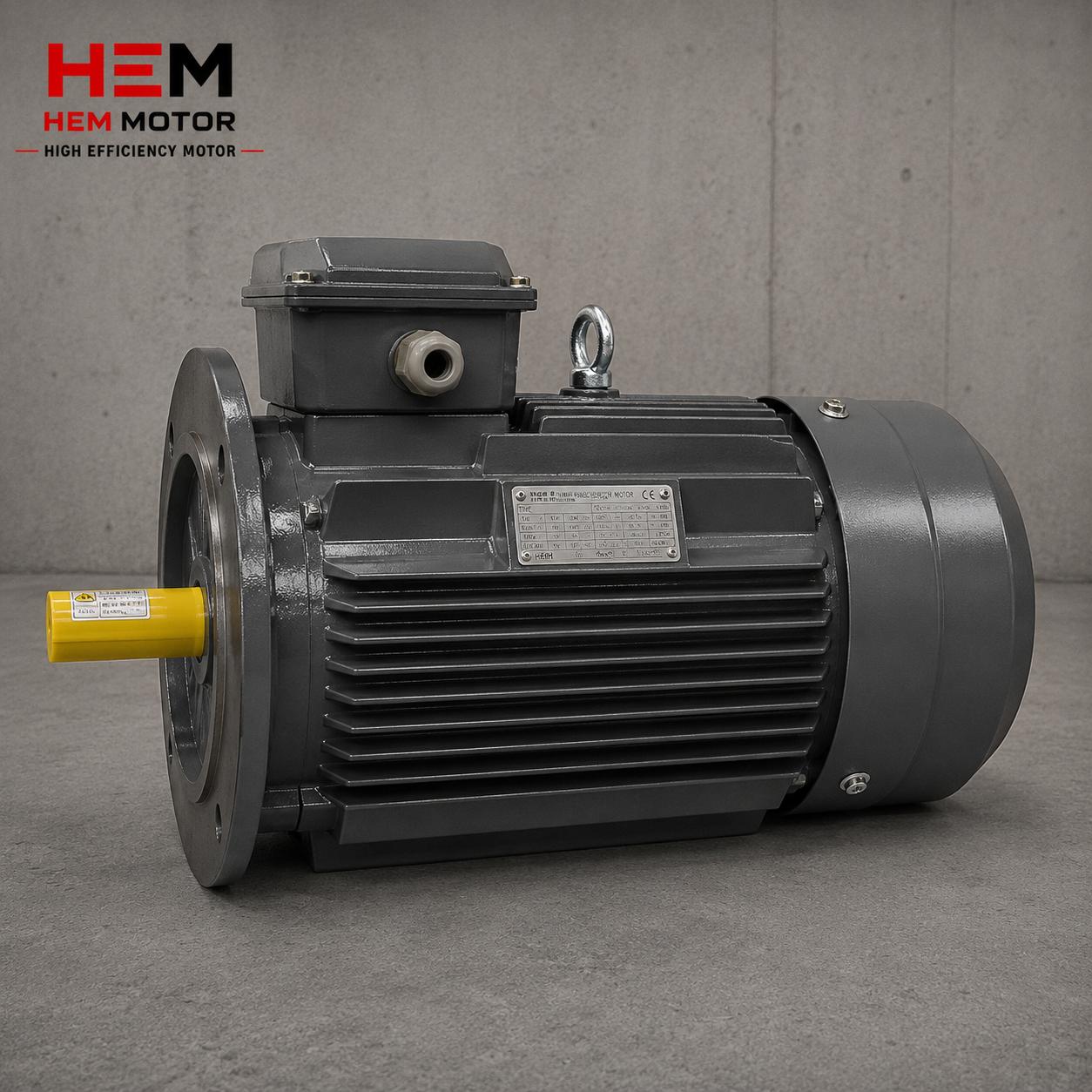

Replacing a motor that has failed or needs renewal in a facility is a far more nuanced decision than it first appears. The phrase "I need a 55 kW motor" is not enough on its own to place an order, because a 55 kW electric motor does not describe a single product but a whole family that differs by pole count, speed, frame size and mounting type. Two motors carrying the same 55 kW nameplate may not fit the machine at all when swapped, because their speeds and frames differ. In this article we examine step by step how to make the correct purchase at a common rating such as 55 kW: the 2-pole versus 4-pole distinction, speed-frame matching, mounting types, the starting method and why stock assurance is critical.
55 kW Is One Power, But Many Motors
In electric motors the power value describes the mechanical power the motor can produce at the shaft end; however, this power alone does not define the motor. The same 55 kW power can be produced by the motor turning at different speeds. Speed in turn is determined directly by the motor's pole count. A two-pole motor turns at roughly 3000 rpm synchronous speed on a 50 Hz grid; a four-pole motor turns at roughly 1500 rpm synchronous speed. Under load these values drop somewhat due to slip, but the order of magnitude stays the same. So when we say 55 kW, two basic options come to mind: high-speed 2-pole and medium-speed 4-pole.
This distinction is not merely a difference in numbers; it directly determines the application. At the same power, a lower-speed motor produces higher torque, because torque is related to power divided by speed. A higher-speed motor delivers the same power with lower torque, turning faster. That is why, when selecting a motor, the question "how many kW" must be immediately followed by the question "how many rpm." When the speed is chosen wrongly, the motor will not drive the machine correctly even if it has the right power.
2-Pole or 4-Pole?
Knowing which applications the two options suit is the foundation of correct buying. A general framework can be drawn as follows:
- 2-pole (about 3000 rpm): Suitable for centrifugal pumps requiring high speed, high-pressure fans and many compressor applications. This equipment runs efficiently at high rotational speed.
- 4-pole (about 1500 rpm): The right choice for conveyors, mixers, general drive systems, geared applications and machines requiring medium speed. Because it produces higher torque, it is also more suitable for heavy-starting loads.
The speed the application requires is most often determined by the design of the driven machine itself. A pump provides a certain flow and head at a certain speed; therefore the correct-speed motor is essential to run the pump at the right point. Likewise the speed calculation of a conveyor line, the gearbox ratio and the motor speed are set together. For this reason the speed the machine requires should be the starting point when selecting the motor. For the effect of speed selection on the suction side in pump applications, our centrifugal pump motor and NPSH content offers a complementary view.
Which Frame Does 55 kW Correspond To?
The basic parameter that describes the physical size of the motor is the frame size. The frame size gives the height between the foot base of the motor and the shaft axis, that is, the axis height, in millimetres. A motor of 55 kW power generally corresponds to a 250 or 280 frame size, depending on the pole count and the manufacturer's design. Four-pole 55 kW motors are often in the 250 frame, while two-pole models may also be found in a similar frame range. However, this is not a strict rule; therefore in a replacement order the frame size should be verified from the nameplate rather than assumed.
The importance of the frame size shows up in mechanical compatibility. The foot hole spacing, shaft diameter, shaft length and flange dimensions of a motor to be connected to a machine are related to the frame size. A motor in the wrong frame, even at the right power, will not bolt onto the machine, the coupling will not align, or the belt pulley will not fit. For this reason, when replacing a 55 kW motor, not only the power but also the frame size of the old motor must be matched exactly.
Information to Verify From the Nameplate
For a correct replacement, the following information on the failed motor's nameplate must be read and compared with the new motor:
- Power (kW): Make sure the 55 kW value is the same on the new motor; in some cases the decision to step up or down a rating should be evaluated separately.
- Speed / pole count: The rpm value and pole count on the nameplate must match exactly the speed the application requires.
- Frame size: The frame code such as 250 or 280 is critical for mechanical compatibility.
- Mounting type: Mounting codes such as B3, B5, B35 determine how the motor connects to the machine.
- Voltage and frequency: The connection type and grid voltage must be verified for the motor to run correctly.
Mounting Types: B3, B5 and B35
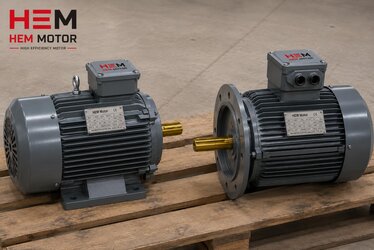
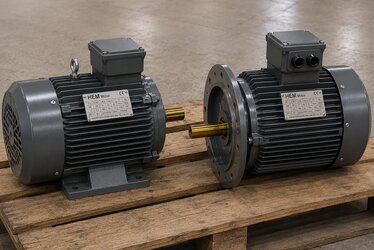
The mounting type determines how the motor connects mechanically to the machine. The three most common types can be summarised as follows: B3 is a foot-mounted design; the motor is bolted to the floor or frame through its feet and drives the load from the shaft end with a coupling or belt. B5 is a flange-mounted design; the motor connects directly to the machine, such as a pump body or gearbox, through a large flange on the shaft side. B35 is a combined foot-and-flange mounting; the motor is both supported on its feet and can be connected by its flange, making it a versatile solution.
Choosing the mounting type wrongly makes mounting impossible even if you have bought a motor at the right power and speed. A foot-mounted motor cannot be fitted to a flange application; a flange-mounted motor does not seat directly on a floor meant for feet. For this reason the mounting type is as decisive as power and speed in a 55 kW motor order. B35 motors are preferred in many facilities because they provide mounting flexibility; however, if the machine design dictates a specific mounting type, that must be followed.
Starting at 55 kW: Direct-On-Line Is Restricted
As the motor grows, the current drawn at the moment of starting grows too. Direct-on-line starting, that is, switching the motor in at full voltage all at once, is trouble-free on small motors; but at a power such as 55 kW the starting current rises to several times the rated current. This high current can both cause a voltage dip on the grid and stress the supply protection devices. For this reason direct-on-line starting at 55 kW is restricted in most facilities, and a softened starting method should be planned.
There are two basic methods commonly used at this power:
- Star-delta starting: The motor is connected in star at start, turning at reduced voltage, and switches to delta after accelerating. It significantly reduces starting current; however, because it also reduces starting torque, it is only suitable for light-starting loads.
- Soft starter: By gradually raising the motor voltage, it increases the current in a controlled way. It both limits the current and reduces the mechanical shock; it is more flexible for heavy-starting loads such as conveyors.
The choice of starting method is important for correctly designing not only the motor but the entire line. In high-inertia or heavy-starting applications the method must be chosen carefully; on this our autotransformer compensated starter content offers a complementary perspective for tough starting conditions.
Factors Affecting the Choice of Starting
Three basic factors stand out when determining the right method: the starting character of the load, the strength of the grid, and the generator capacity if any. A light-starting fan and a heavy-starting crusher require completely different starting strategies, even on the same 55 kW motor. If the grid is weak or the supply comes from a generator, limiting the starting current becomes even more critical; otherwise the voltage collapses at every start and other equipment is affected.
Stock and Supply: The Right Speed-Frame Must Be Ready for Critical Lines
A motor failure can mean production stopping. In that case the greatest loss of time is not finding the replacement motor in the right power, speed and frame. Even at a common power such as 55 kW, if the motor you need is 4-pole, 250 frame, B35 and you only have a 2-pole model on hand, that motor is useless to you. For this reason, for critical lines the question is not just "is there a 55 kW" but "is there a 55 kW in the right speed and frame."
HEM Motor delivers motors in different pole counts, frames and mounting types across a broad power range quickly from strong stock, minimising facilities' waiting time. Determining the right speed-frame combination in advance for critical lines and keeping it ready as a spare significantly reduces the risk of unplanned downtime. To supply the right motor quickly and receive technical support in choosing the suitable pole and frame, the electric motor solutions offered by HEM Motor are a useful guide. To understand the effect of the motor's internal design on efficiency and performance, you can also review our asynchronous motor rotor bar material content.
Tips for Spare Motor Planning
- Record the nameplate information (power, speed, frame, mounting, voltage) of the motors on critical lines in advance.
- Keep a strategic spare motor for the most frequently used power-speed-frame combinations.
- In a replacement order, convey all of the old motor's nameplate information completely; act on data, not guesswork.
- Include the starting method and protection class in the spare plan; the motor must be compatible.
Efficiency Class and Energy Cost
At a medium-to-high power such as 55 kW, a motor consumes a serious amount of energy when it runs all day. For this reason the motor's efficiency class matters as much as, or even more than, the purchase price. Two motors of the same 55 kW power in different efficiency classes can create a difference of thousands of kilowatt-hours per year. In a continuously running application, this difference turns into an energy cost far above the purchase price over the motor's life. Therefore the efficiency class should be evaluated as carefully as power and speed in a 55 kW motor selection.
How the efficiency class shows up on the bill depends on the motor's operating time and load profile. On a motor running long hours at high load, a high efficiency class pays for itself within a few years. By contrast, on a motor that runs little or sits as a spare, the efficiency difference has a more limited effect. For this reason the efficiency class decision should be made considering the motor's real operating profile. The motor's internal design, especially the rotor material, directly affects the efficiency class that can be reached; therefore when making an efficiency-focused choice, the structural features of the motor should also be taken into account.
Determining the Load Profile Correctly
It must not be forgotten that a 55 kW motor does not always run at 55 kW load. In most applications the motor turns at a load below its rated power. Determining the motor's real load correctly is important both for the correct power selection and for the correct efficiency decision. An oversized motor turns continuously at low load, becoming both inefficient and an expensive solution. Conversely, a motor selected below the limit wears out early by being overloaded. For this reason the 55 kW decision should begin with a correct analysis of the machine's real power requirement.
A Step-by-Step Approach in a Replacement Order
To supply the right product quickly and without error in place of a failed 55 kW motor, following a systematic approach is the safest way. Orders placed in haste, based on incomplete information, often result in a motor that does not fit and a second delay. When the correct sequence is followed, time is saved and the risk of mechanical mismatch is eliminated.
The recommended steps in a replacement order are as follows:
- First read the failed motor's nameplate completely; note the power, speed, pole, frame, mounting type and voltage information.
- Check the machine's mechanical connection; verify the shaft diameter, coupling type, and flange or pulley dimensions.
- Review the starting method and the protection settings in the panel; the new motor must be compatible with this method.
- Convey all this information to the supplier completely and confirm that the correct speed-frame combination is in stock.
These steps enable both users with and without an engineering background to make a correct purchase. What matters is making the decision not by guesswork but with the old motor's nameplate data and the real conditions of the machine. An order made with the right information makes it possible for the correct motor to come online quickly before production stops.
Frequently Asked Questions
Can I directly replace a 55 kW motor with another 55 kW motor?
Not always. It is not enough for both motors to be 55 kW; the pole count (speed), frame size and mounting type must also match. A motor with a different speed will not drive the machine correctly, and a motor with a different frame will not seat mechanically. For this reason, before replacement, the power, speed, frame and mounting information on the old motor's nameplate must be verified exactly.
Why can't I use direct-on-line starting at 55 kW?
Because at this power the starting current rises to several times the rated current and can cause a voltage dip on the grid. For this reason direct-on-line starting at 55 kW is restricted in most facilities; instead a method that reduces the starting current, such as star-delta or a soft starter, should be planned. The method is chosen according to the load's starting character and the grid strength.
How do I decide between 2-pole and 4-pole?
The decision is made according to the speed the driven machine requires. For pump, fan and compressor applications requiring high speed, 2-pole (about 3000 rpm) is suitable. For medium-speed applications requiring higher torque, such as conveyors, mixers and general drive, 4-pole (about 1500 rpm) is the right choice. The machine's design speed is the starting point of the selection.