English
 Türkçe

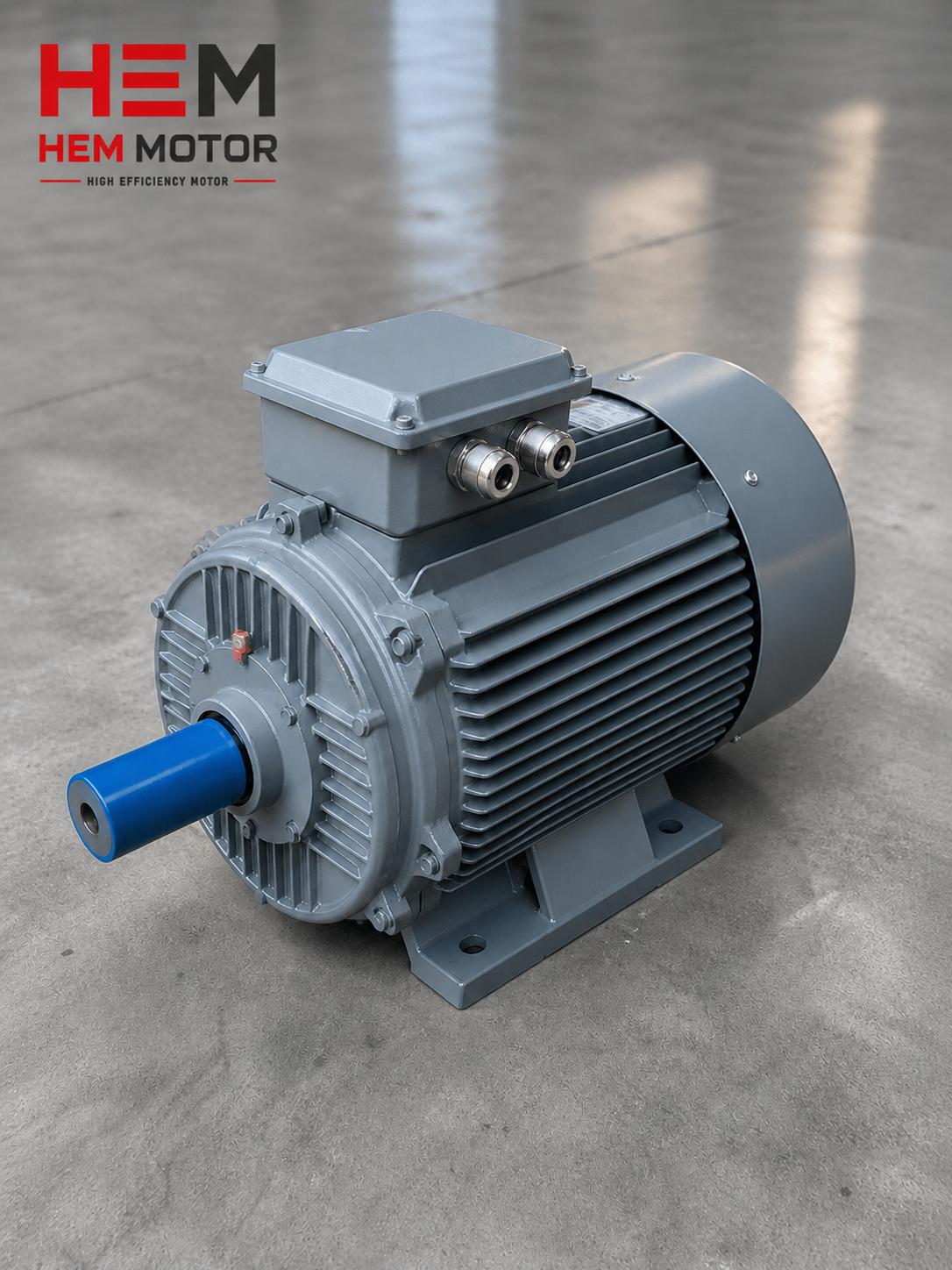

When buying an electric motor, most businesses look only at power (kW) and speed; yet connecting, protecting and running the motor correctly depends on knowing the full-load current (amps) accurately. On a 400V three-phase supply, the current drawn per kW directly determines cable cross-section, thermal relay setting, fuse and contactor selection. In this article we explain the power-speed relationship, the logic of approximate current per kW at 400V, and how to select the correct cable and protection from these values, from the perspective of an electric motor manufacturer and seller. If you want to buy the right motor together with the right panel, you can review our product pages for current electric motor prices and stock information.
The Relationship Between Power, Speed and Full-Load Current
In a three-phase asynchronous motor, full-load current is determined by power, supply voltage, power factor (cos φ) and efficiency. Even two motors of the same power draw different currents if they have different efficiency classes (IE3/IE4) and different power factors. Therefore "so many amps per kW" is only a rough starting point; for the exact value the motor nameplate must always be the reference.
- Full-load current (FLA): The current the motor draws at rated power and rated voltage; it appears on the nameplate.
- Power factor (cos φ): As it falls, the current drawn for the same power rises; this is why compensation matters.
- Efficiency: As it rises (from IE3 to IE4), the current drawn from the grid for the same shaft power slightly decreases.
- Speed/poles: At the same kW, 2-pole (3000 rpm), 4-pole (1500 rpm) and 6-pole (1000 rpm) motors have different currents and power factors.
The Logic of Current per kW at 400V
The practical rule can be summarized as follows: on a 400V three-phase motor, the full-load current drawn per kW is roughly a little above two amps, and this ratio drops as efficiency and power factor improve. So in large, high-efficiency motors the current per kW is lower than in small motors. This logic helps to estimate the current roughly for a motor whose nameplate cannot be read or which has not yet been delivered; however, panel and cable selection must be based on the exact FLA value on the nameplate, not on this estimate.
Selecting Cable Cross-Section from Full-Load Current
Cable cross-section is chosen so that it safely carries the motor's full-load current, does not overheat, and leaves an acceptable voltage drop at the far end. Three basic criteria are evaluated together:
- Current-carrying capacity: The cable must carry the full-load current according to its installation method (conduit, tray, buried) and ambient temperature.
- Voltage drop: Over long cable runs the cross-section must be large enough to keep voltage drop within limits both at start-up and in continuous running.
- Short-circuit withstand: The cable and protective device must be compatible with the possible short-circuit current.
Especially over long distances, voltage drop can be more limiting than current-carrying capacity; we covered this in detail in our article on long cable distance and voltage drop on asynchronous motors. To correctly determine panel, busbar and cable cross-section based on rated current, our guide panel and cable sizing by rated current on IE3 motors offers a directly applicable framework.
Thermal Relay and Overload Protection Setting
The thermal (overload) relay is the most basic device protecting the motor from continuous overcurrent, and its correct setting is critical. The relay is set according to the motor's full-load current; too high a setting leaves the motor unprotected, while too low a setting causes unnecessary trips.
- The thermal relay setting is determined by the full-load current on the motor nameplate.
- For motors with a service factor, the setting may be raised somewhat.
- The trip class (e.g. Class 10 / 20) should match the motor's start-up time; loads with heavy starting require a higher class.
A motor protection circuit breaker (MPCB) can be used instead of or together with a thermal relay. For correct settings, our articles motor protection circuit breaker (MPCB) selection and setting and thermal relay selection and setting on asynchronous motors are complementary.
Contactor and Fuse Selection
In a motor circuit, the contactor is the element that switches the motor and is selected according to the AC-3 category designed for motor loads. AC-3 accounts for the high inrush current during start-up and the load at shutdown. If the contactor is not sized to the full-load current and application, the contacts wear out prematurely.
- Contactor: Selected by the motor's full-load current and AC-3 category; a larger size may be preferred for frequent starting and stopping.
- Fuse/breaker: Provides short-circuit protection; selected so it does not trip at the motor's high starting current but cuts quickly on a short circuit.
- Coordination: The fuse, contactor and thermal relay must be evaluated together (type 1 / type 2 coordination).
For details on high starting current and contactor sizing, you can review our related article starting current and contactor selection on IE4 motors.
Speed Selection: Same kW, Different Current and Torque
Whether a motor of the same kW is 2, 4 or 6-pole changes its speed, torque, current and power factor. Loads like pumps and fans usually run at high speed (2-pole), while loads requiring high torque such as conveyors and mixers run at low speed (4-6 pole) or via a gearbox. Speed selection must be made correctly for both mechanical compatibility and current/torque characteristics.
- 2-pole (3000 rpm): High-speed applications such as pumps, fans and compressors.
- 4-pole (1500 rpm): The most common speed; general industry, conveyors and gearbox inputs.
- 6-pole (1000 rpm): Higher torque, quieter running; large-diameter fans and heavy loads.
To calculate the required power and speed for your application, our article on motor power calculation for pump, fan and conveyor provides a practical starting point.
HP-kW Conversion and Reading the Nameplate
In Türkiye motors are expressed in kW, while in some older machines and imported equipment they are expressed in HP (horsepower). For correct purchasing you need to be able to convert these two units and read the motor nameplate correctly. The nameplate is the most reliable source carrying all the motor's critical information:
- Power (kW/HP): The rated power the motor can deliver at the shaft. The HP value is converted to kW by multiplying by approximately 0.75.
- Speed (rpm): The speed at rated load; it determines the pole count and therefore the torque.
- Voltage and connection: Values such as 230/400V and star/delta connection; the connection suitable for the grid voltage must be selected.
- Full-load current (A): The basis of panel, cable and protection selection.
- cos φ and efficiency class: Indicates reactive draw and energy cost.
- Frame, mounting type, IP and insulation class: Mechanical compatibility and environmental resistance.
If the nameplate information is incomplete or has become illegible, ordering the correct replacement motor becomes difficult. In that case mechanical data such as frame dimensions, shaft diameter and mounting type also come into play. To read an IE3 motor nameplate in detail, our article reading the IE3 motor nameplate: kW, speed, cos φ and efficiency offers a step-by-step guide.
Supply Voltage: The Difference Between 400V and 690V
A motor of the same power draws lower current at a higher supply voltage. This is an important advantage especially at large powers: 690V supply instead of 400V lowers the current for the same kW, making thinner cable, a smaller contactor and lower conductor losses possible.
- 400V: The most common industrial supply voltage in Türkiye; standard at medium and small powers.
- 690V: Provides a current advantage in high-power motors; lowers panel and cable cost.
- Connection: The motor must be ordered with the winding and connection (star/delta) suitable for the voltage.
We covered the effect of voltage selection on current, cable and panel at high power in detail in our article on 690V supply voltage motor selection. This is a decision that seriously affects panel cost especially when building a new facility.
Starting Current and Panel Sizing
Although full-load current is decisive for continuous operation, the motor's starting (inrush) current is several times the full-load current and must be considered when selecting panel components. The high current drawn at start-up must not trip the fuse or stress the contactor and cable.
- The starting current is highest in direct-on-line (DOL) starting.
- Star-delta starting reduces the starting current and torque; it must be selected carefully for loaded start-up.
- A soft starter raises the current gradually and reduces the grid shock.
For the source of starting current and methods to reduce it, our article on starting current and starting methods in asynchronous motors offers a comprehensive comparison.
Correct Purchasing: Nameplate, Equivalent and Panel Compatibility
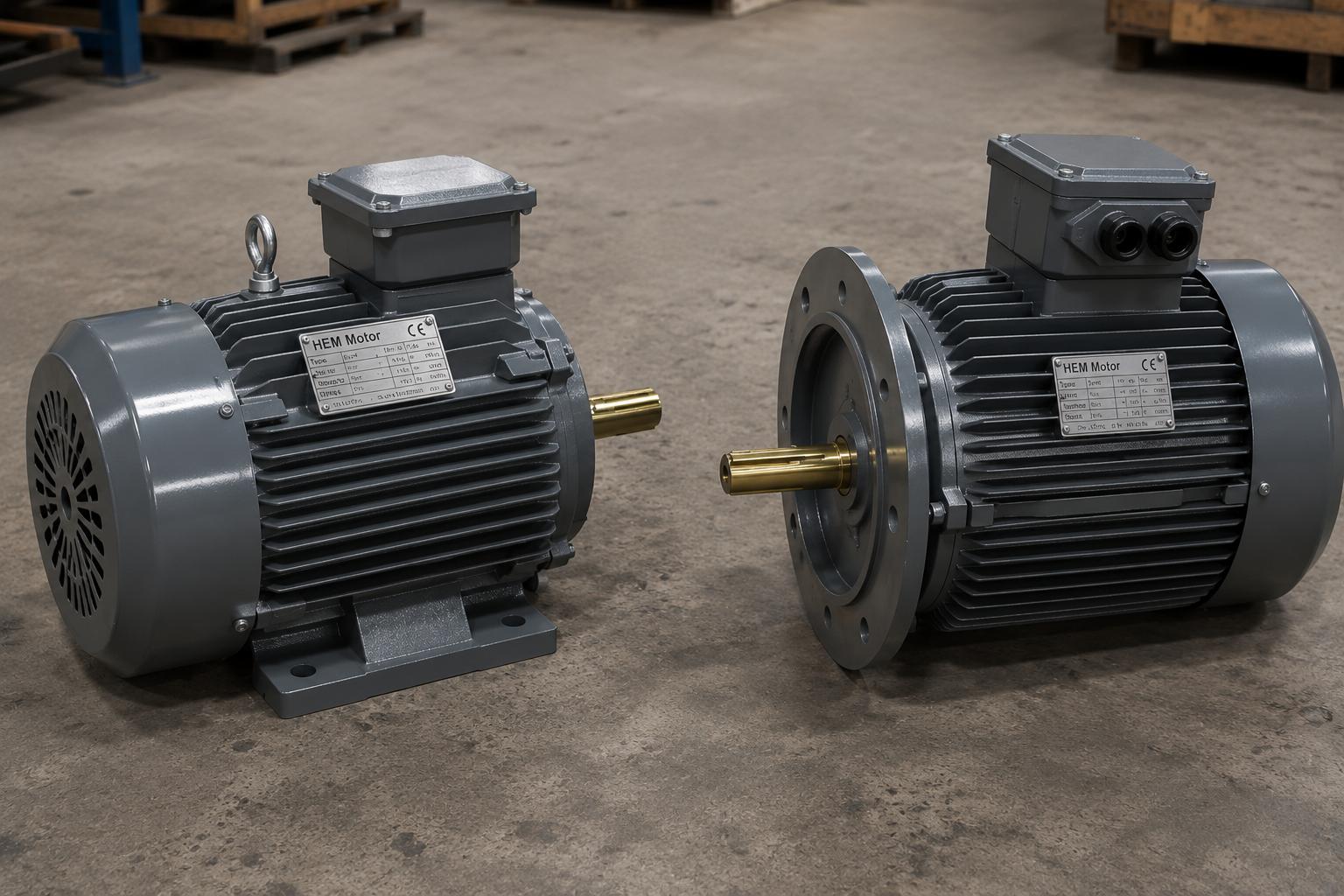
As an electric motor manufacturer and seller, the point we emphasize is this: correct purchasing is not just about kW and speed. The motor's full-load current, mounting type, frame size, shaft diameter and terminal box orientation must be evaluated together so the motor fits the panel and mechanical system without trouble.
- If you are replacing an existing system, request an exact equivalent based on the old motor's nameplate values.
- In a new facility, select the standard motor closest to the calculated power-speed and size panel components according to FLA.
- Choosing an IE3/IE4 efficiency class both meets regulations and lowers current per kW and energy cost.
In the HEM Motor product range, standard power-speed combinations can be delivered quickly from stock, while a clear lead time is offered for special requests.
Frequently Asked Questions
Where can I find the motor's full-load current?
The most accurate source is the motor nameplate; full-load current (usually shown as "A" or "I") appears together with rated voltage and power. If the nameplate cannot be read, a rough estimate can be made using the approximate current-per-kW logic at 400V, but this is only for preliminary sizing. Panel, cable and protection selection must be based on the exact nameplate value.
Should I select cable cross-section only by current?
No. Cable cross-section is chosen with three criteria together: safely carrying the full-load current, keeping voltage drop within limits over long distances, and short-circuit withstand. Especially on long feeder lines, voltage drop can be more limiting than current-carrying capacity and require a larger cross-section.
At the same kW, should I buy 2-pole or 4-pole?
This depends on the driven load. For applications requiring high speed such as pumps, fans and compressors, 2-pole (3000 rpm) is suitable. For applications requiring high torque and low speed such as conveyors, mixers and gearbox inputs, 4-pole (1500 rpm) or 6-pole (1000 rpm) is preferred. Speed selection also changes the current, torque and power factor.