English
 Türkçe

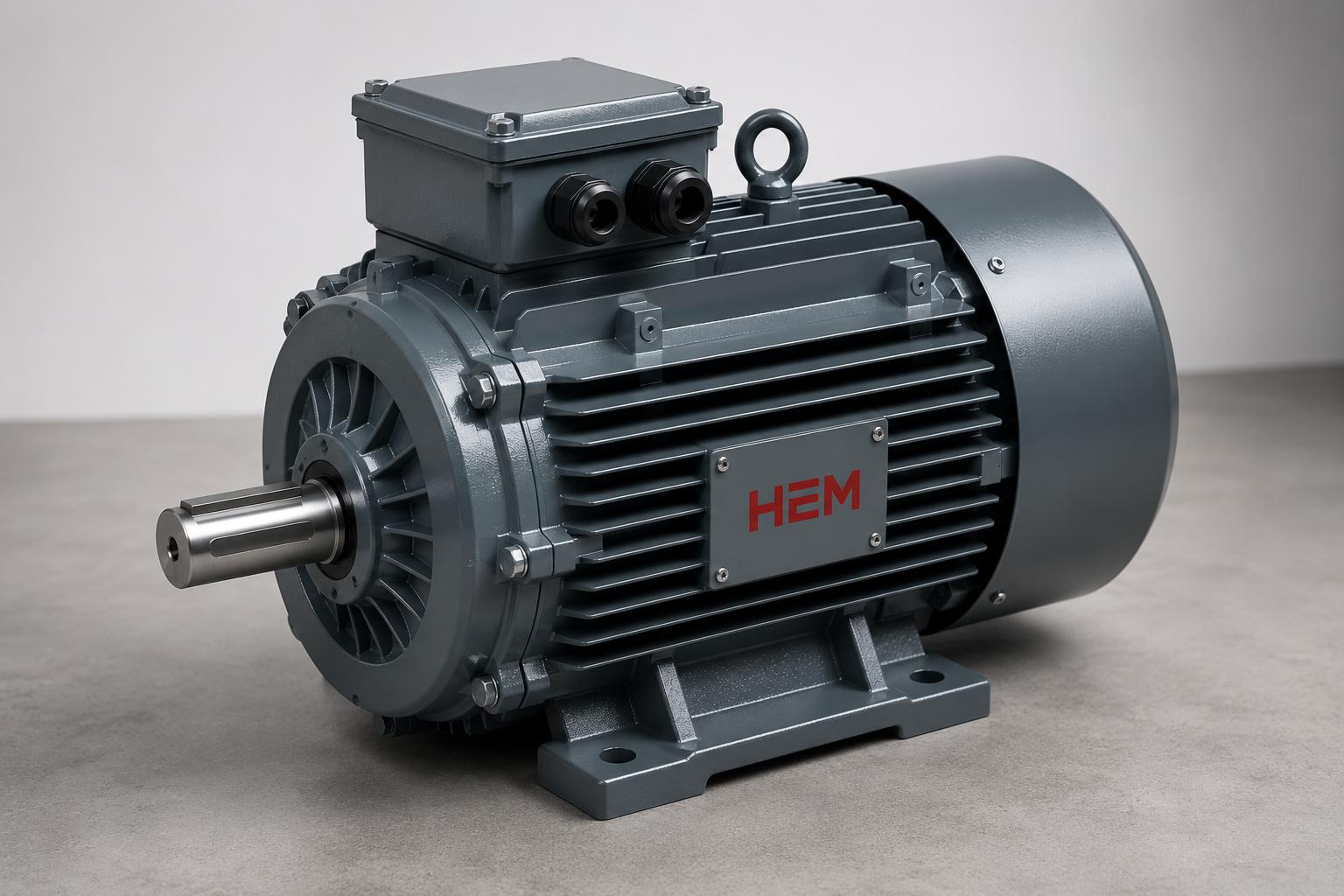

When electric motors come to mind in Turkish industry, the first speed that appears is the roughly 1500 rpm delivered by 4-pole motors. In conveyors, gearbox inputs, mixers, pumps, fans and countless general industrial applications, this is the most-used speed. That is because 1500 rpm is a balanced point between torque and speed; neither excessively high like 3000 rpm (with bearing and vibration issues), nor low like 1000 rpm (a larger and more expensive frame for the same power). In this guide we examine the logic of the kW-frame table for the most-used powers in 4-pole motors, correct frame matching and correct buying from stock, from a manufacturer and seller point of view. The aim is to help the buyer clarify at which power, in which frame and in which mounting type they should request a motor.
Why Are 4-Pole and 1500 rpm the Most-Used Speed?
In asynchronous motors, speed depends on the number of poles and the mains frequency. On a 50 Hz supply, the synchronous speed of a 4-pole motor is 1500 rpm, while its actual speed under load is around 1440-1470 rpm due to slip. This speed range is the most suitable value for driving most machines directly or through a gearbox. The reasons the 4-pole choice is so common are:
- It produces higher torque than a 2-pole motor of the same power, turning hard-to-start loads more easily.
- It runs with lower noise and vibration than 2-pole motors; bearing life is longer.
- Since the standard input speed of gearboxes is 1400-1500 rpm, 4-pole motors are the de facto standard for gearbox inputs.
- A large portion of applications such as pumps, fans, conveyors and mixers operate most efficiently in this speed range.
For in-depth information on slip and actual speed, our content on slip and actual speed in asynchronous motors explains why 1440 rpm is seen instead of 1500.
The 4-Pole 1500 rpm Power-Frame Matching Logic
For a buyer to order correctly, they need to know which IEC frame size a kW value corresponds to. The frame size determines the motor shaft height (H dimension) and overall dimensions, which is critical when replacing an existing motor and for the mounting space on the machine. The following table summarizes the most-used powers in 4-pole (about 1500 rpm) motors with their typical IEC frame sizes:
- 0.37 kW — typical frame 71; small machines, dosing and conveyor drive
- 0.55 kW — typical frame 71/80; gearbox input and small fans
- 0.75 kW — typical frame 80; one of the most common small powers
- 1.1 kW — typical frame 90S; geared conveyors
- 1.5 kW — typical frame 90L; general industry
- 2.2 kW — typical frame 100L; pump and fan
- 3 kW — typical frame 100L; mixer and agitator
- 4 kW — typical frame 112M; medium power applications
- 5.5 kW — typical frame 132S; pump, compressor
- 7.5 kW — typical frame 132M; one of the most demanded powers
- 11 kW — typical frame 160M; conveyor and fan
- 15 kW — typical frame 160L; heavy-duty conveyor
- 18.5 kW — typical frame 160L/180M; pump stations
- 22 kW — typical frame 180L; large fan and pump
- 30 kW — typical frame 200L; heavy industrial drive
- 37 kW — typical frame 225S/M; high power applications
- 45 kW — typical frame 225M; crusher auxiliary drives
- 55 kW — typical frame 250M; large pump and fan
- 75 kW — typical frame 280S; main drives
- 90 kW — typical frame 280M; high power
These matchings are typical values; small differences may occur depending on the manufacturer series. Still, the basic rule for the buyer is clear: as kW increases, the frame grows, the shaft height rises and the shaft diameter thickens. When replacing a motor, not only kW and speed but also frame size and mounting type must be matched.
The Relationship of Frame Size with Shaft Diameter and Mounting
Frame size is not just a dimension code; it defines the mechanical interface of the motor. Each IEC frame size corresponds to a standard shaft diameter, key dimension and flange holes. This standardization allows motors of the same frame size from different manufacturers to fit the machine exactly; this is the basis of replacement and equivalent selection.
Why Is Shaft Diameter Important?
For example, the shaft of a 132 frame motor is usually 38 mm, while a 160 frame is 42 mm in diameter. The coupling, pulley or gearbox input shaft is selected according to this diameter. Wrongly assuming the shaft diameter causes the coupling or pulley not to fit and wastes time during assembly. Therefore, when ordering, frame size, mounting type (B3/B5/B35) and shaft diameter must be confirmed together.
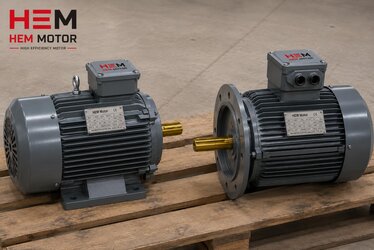
- B3 foot-mounted: The most common type for belt-pulley, coupling and general mounting.
- B5 flange-mounted: Direct flange connection to pump, gearbox and machine body.
- B35 (foot + flange): Flexible-mounting applications requiring both foot and flange.
Our IM mounting code reading guide, which examines the relationship of mounting type and frame in detail, offers a concrete checklist for error-free ordering.
Correct Power Selection: Reading the Table According to Load
The table shows the buyer which kW value corresponds to which frame; however, what determines which kW power is needed is the load demand of the machine. A common mistake is to blindly copy the power of the existing motor. The correct approach is to calculate the real power demand of the machine or confirm it from the nameplate. Points to consider in power selection:
- In a continuously running (S1) application, the motor should be selected to run below its nominal power; continuous full load leaves no heating margin.
- For loads with high starting inertia (fans, crushers), power selection must be based not only on rated power but also on starting torque.
- At the same kW power, a 4-pole motor delivers higher torque than a 2-pole motor; this difference is decisive at the gearbox input.
For torque calculation from kW and speed, our content on rated torque calculation: finding torque from kW and speed helps determine the correct motor according to load. For speed and pole selection in the most demanded powers such as 11 and 15 kW, the 11 and 15 kW motor selection guide is also a practical reference.
Stock, Supply and Correct Buying
Since 4-pole 1500 rpm motors are the most demanded speed class, they are also prioritized in stock management. As a manufacturer and seller, we take care to keep the most demanded powers between 0.75 kW and 90 kW in stock as 4-pole, which allows most standard demand to be met with fast delivery from stock. The information the buyer should clearly state for correct buying is:
- Power (kW) and speed (4-pole / 1500 rpm)
- Mounting type (B3, B5, B35) and, if needed, frame size
- Efficiency class (IE3 mandatory threshold, IE4 advantageous in continuous duty)
- Shaft diameter and special requests (special flange, second shaft end, etc.)
Once this information is clear, the quote comes out fast and error-free, and returns due to wrong frame or wrong mounting type are prevented. For current electric motor prices and stock status, you can contact us with your requirement list. For a general overview of the most demanded power and speed combinations, our content on the IE3 motor stock guide: power and speed combinations is a complementary resource.
Efficiency Class, Regulation and the IE3/IE4 Decision in 1500 rpm Motors
Since 4-pole 1500 rpm motors are the longest-running motor class in industry, efficiency class selection is especially important at these powers. Current regulations make at least the IE3 efficiency class mandatory for three-phase, single-speed, direct-on-line motors of 0.75 kW and above. Therefore, when buying a 4-pole motor, IE3 is no longer a preference but a minimum legal threshold. In continuously running conveyor, pump and fan applications, stepping up to the IE4 class lowers the annual energy cost even further.
Points the buyer should consider in efficiency class selection:
- If annual operating hours are high (for example, above a single shift), the extra cost of an IE4 motor returns through energy savings within a few years.
- Old-stock IE2 or lower motors neither comply with regulation nor run cheaper in the long run; these motors only come up in special cases outside the scope of the regulation.
- High-efficiency motors run cooler, which extends winding insulation and bearing grease life, reducing maintenance cost.
Our content examining what the difference between IE3 and IE2 means for old-stock motors, the IE3 versus IE2 motor difference and old-stock evaluation, guides the correct class decision. In short, for a 4-pole motor that will run for thousands of hours per year, the efficiency class is not just a label but a long-term operating cost decision that should be made consciously at the time of purchase rather than regretted later.
Frequently Asked Questions
Why does a 4-pole motor run at 1440 rpm instead of 1500?
Although the synchronous speed of a 4-pole motor is 1500 rpm on a 50 Hz supply, an asynchronous motor slips under load. Because of this slip, the actual speed is around 1440-1470 rpm. This is normal and does not mean the motor is faulty; on the contrary, slip is the fundamental principle that allows an asynchronous motor to produce torque.
Should I buy a 2-pole or 4-pole motor at the same kW power?
It depends on the application. For pumps and fans that need high speed, 2-pole (3000 rpm) is preferred, while for torque-priority conveyors, mixers and gearbox inputs, 4-pole (1500 rpm) is chosen. At the same kW power, a 4-pole motor delivers higher torque and runs more quietly.
Can I order a motor without knowing the frame size?
For a standard motor, kW and speed information largely determines the frame size; however, in replacement applications the existing motor frame, shaft diameter and mounting type must be confirmed. Otherwise the new motor may not fit the machine. When a nameplate photo and existing dimensions are sent, the correct frame is matched quickly.