English
 Türkçe

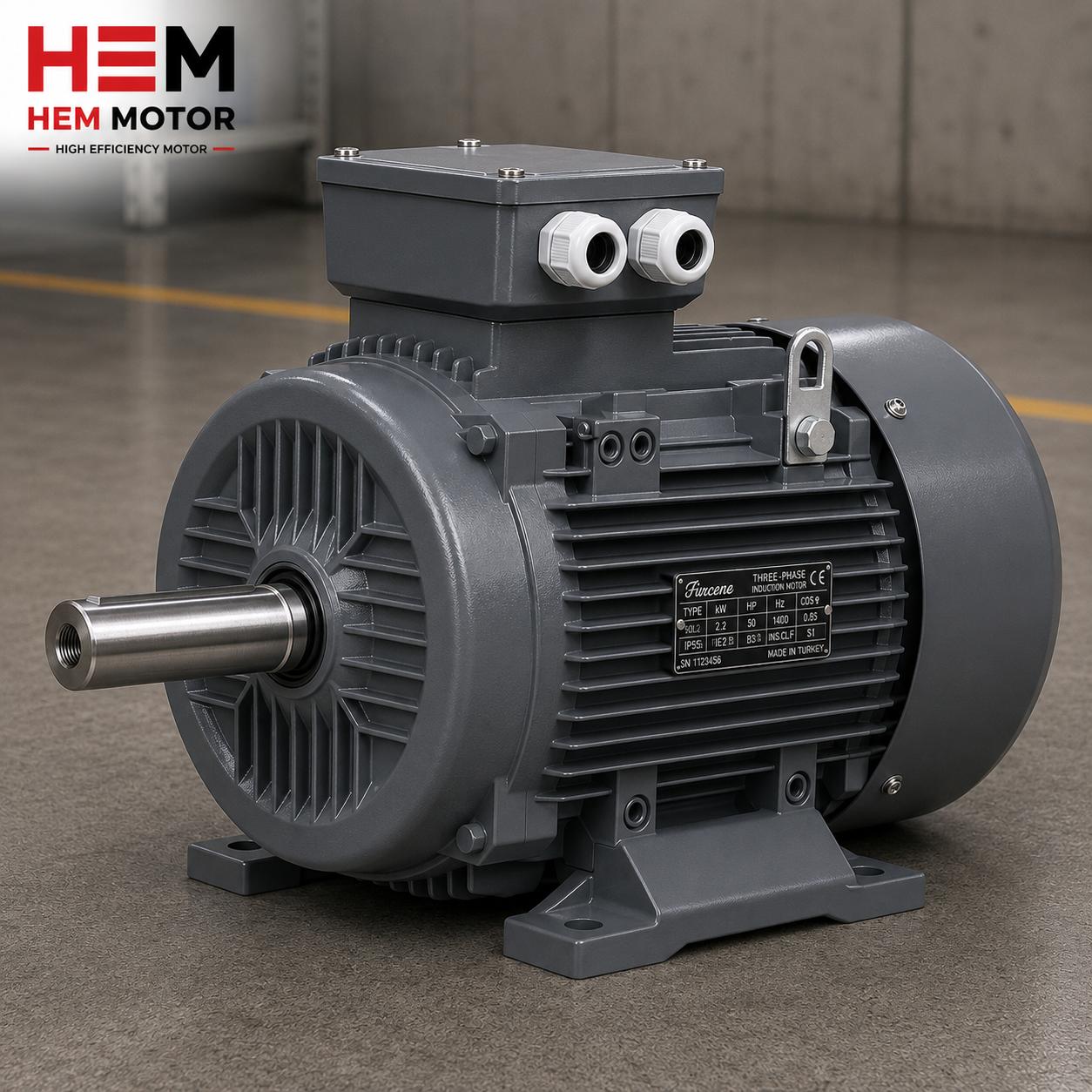

One of the most frequently purchased power ratings in industry is the 0.75 kW electric motor. In pumps, fans, small conveyors, gear reducer inputs, dosing systems, mixers and countless machine modules, this power value is a standard building block. However, selecting a 0.75 kW motor is not as simple as it looks: whether a motor of this same power is 2, 4 or 6 pole completely changes the speed, torque and energy consumption of your machine. A wrong pole choice either spins the machine faster than needed, causing premature wear, or produces insufficient torque, overstressing the motor. In this guide we cover the correct selection of a 0.75 kW motor in terms of 2/4/6 pole, speed, frame size, efficiency class and mounting type, and address stock, equivalent replacement and fast quotation from a manufacturer and seller perspective.
Why Is 0.75 kW Such a Critical Power Value?
0.75 kW (about 1 horsepower) is a special threshold in efficiency regulation. Under Turkish and European Union rules, since 1 July 2021 a minimum IE3 efficiency class is mandatory for direct-on-line (DOL) three-phase asynchronous motors in the 0.75 kW to 1000 kW range. In other words, 0.75 kW is precisely the lower boundary where the IE3 requirement begins. Therefore a 0.75 kW three-phase motor you buy today must be at least IE3 to comply. For the legal basis and timeline of this matter, our article on IE3 and IE4 efficiency regulation offers a clear reference.
Because 0.75 kW sits both at the top of the small-power class and at the start of the medium-power class, it acts as a bridge across many applications. The same 0.75 kW value can be used for a booster pump, a roof exhaust fan, a belt conveyor or a worm gear reducer input; yet the required speed differs in each. This is exactly why pole count is as decisive as the power itself.
2, 4 and 6 Pole: The Speed and Torque Difference
In asynchronous motors, the pole count determines the synchronous speed. At a 50 Hz grid frequency the approximate speeds are: 2 pole ≈ 3000 rpm, 4 pole ≈ 1500 rpm, 6 pole ≈ 1000 rpm. When power stays constant (0.75 kW), the torque the motor produces rises as the speed falls. So a 6 pole 0.75 kW motor produces much higher torque than a 2 pole one but turns much more slowly.
- 2 pole motor (3000 rpm): High speed, low torque. Ideal for centrifugal pumps, small high-pressure fans, booster sets and compact applications. Fast but noisier in operation.
- 4 pole motor (1500 rpm): The most balanced and most preferred option. Standard in conveyors, general industry, reducer inputs, ventilation fans and most machine modules. Quiet and efficient.
- 6 pole motor (1000 rpm): Low speed, high torque. Suitable for mixers requiring heavy starting, low-speed drives and systems needing quiet operation.
The right pole choice depends on the drive character of your machine. To examine which pole count suits which task with detailed examples, our guide on which pole count for which task is a comprehensive reference.
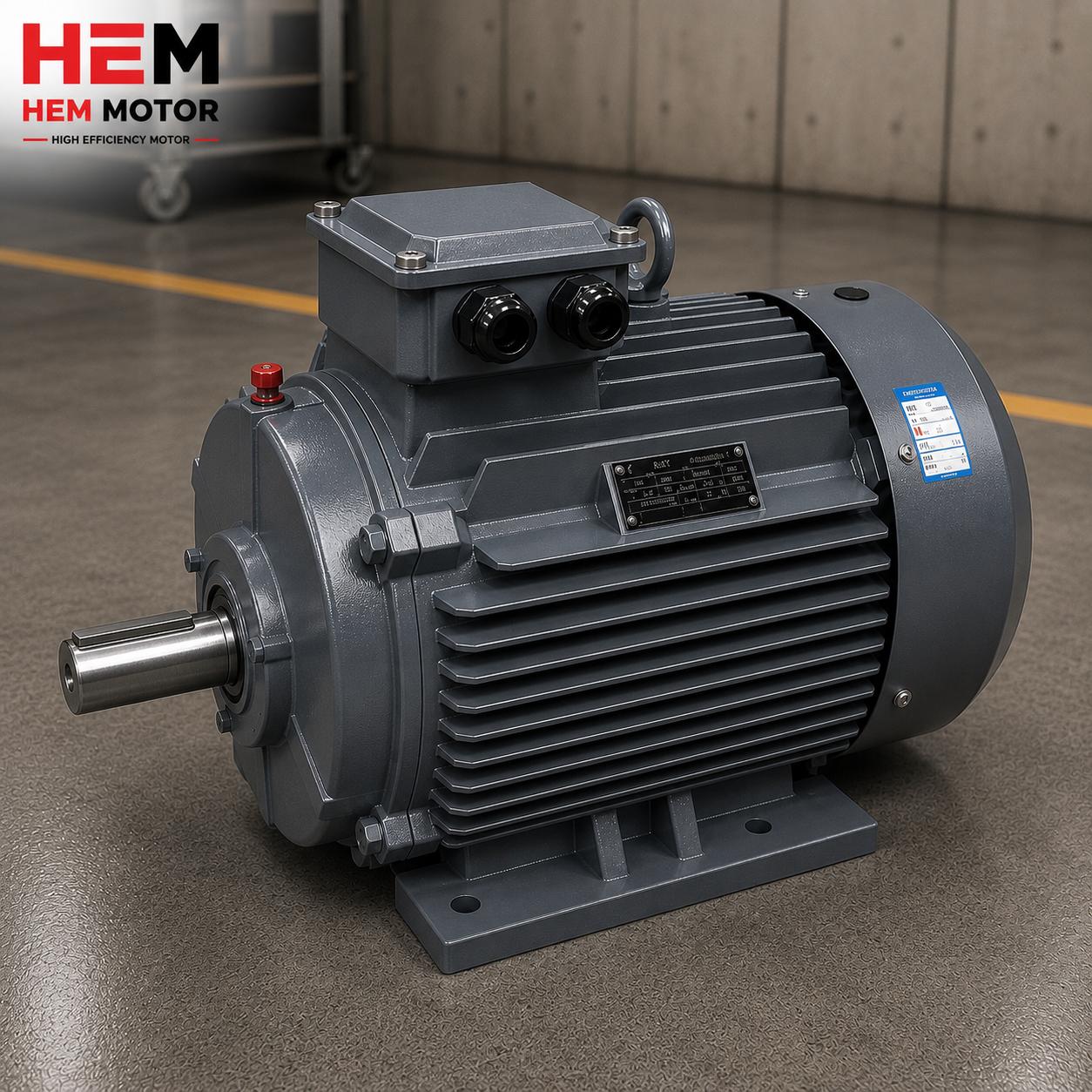
Is Your Priority Speed or Torque?
The basic question in selection is: does your machine want speed or pulling power? In a centrifugal pump, since flow increases in proportion to speed, a 2 pole high-speed motor makes sense. By contrast, in a mixer or a conveyor that starts under heavy load, a 4 or 6 pole motor is preferred for high starting torque. If your machine will be coupled to a reducer, a 4 pole (1500 rpm) input speed is usually standard, and the reducer brings the output speed down to the required level. To evaluate gearless direct drive with low-speed, high-pole motors, see our article on direct drive with low-speed high-pole motors.
Frame Size and Shaft Diameter
In 0.75 kW motors, the frame size varies with pole count. 2 and 4 pole 0.75 kW motors are generally in the 80 frame (IEC 80) structure; the 6 pole versions, producing higher torque, may shift up to the next frame, the 90 frame. The frame size determines the foot hole spacing, the shaft height (for example 80 mm), the shaft diameter and the flange dimensions. If you are replacing an existing motor, the new motor's frame size and shaft diameter must be exactly the same for mounting compatibility.
- 80 frame 0.75 kW: the most common structure in 2 and 4 pole, shaft diameter usually 19 mm.
- 90 frame 0.75 kW: in 6 pole versions, shaft diameter usually 24 mm.
- Shaft diameter and key size should be confirmed before ordering for coupling/pulley compatibility.
- The foot hole spacing (B3) and flange diameter (B5/B14) must match the machine base.
If you are confused about HP-kW conversion, 0.75 kW is approximately 1 HP; making this conversion correctly prevents ordering the wrong power. For a detailed explanation, our guide on understanding motor power correctly, HP or kW is helpful.
Mounting Type: B3, B5 and B14
0.75 kW motors are offered in three basic mounting types, and this choice determines how the motor connects to the machine:
- B3 (foot-mounted): Bolted to the chassis or floor via the feet under the frame. Common for belt-pulley and coupled connections.
- B5 (large flange): Connected directly to a pump, fan or reducer housing via the large flange on the front cover.
- B14 (small flange): Used in compact machine connections via the threaded holes on the small flange, especially at the worm gear reducer input.
A B35 (combined foot + flange) option is also available for applications requiring connection both to the floor and to the machine. In our standard production, 0.75 kW motors are offered with IP55 protection class, Class F insulation and 100% copper winding; this combination provides long life in humid and dusty environments. To learn which motor flange fits a worm gear reducer, you can review our worm gear reducer and IEC flange compatibility product page.
Efficiency Class: IE3 or IE4?
When buying a 0.75 kW three-phase motor, at least IE3 efficiency class is mandatory by regulation. However, in applications running long hours under continuous load, stepping up to the IE4 Super Premium class can pay for itself quickly through energy savings. Although the difference may look small in absolute terms at low power, the total saving is significant in facilities running many motors. When deciding on investment, the motor's annual running hours and the electricity tariff should be considered.
- For lightly used or spare motors, IE3 is an economical choice.
- For continuously (S1 duty) running motors, IE4 is advantageous in the long term.
- If it will run with a variable frequency drive (VFD), high efficiency is maintained at partial load too.
Stock, Supply and the Right Quotation
Because 0.75 kW is one of the highest-demand power values, fast delivery from stock provides a major advantage. Replacing a failed pump or fan motor with an exact equivalent the same day prevents production downtime. Working with a manufacturer's assurance means instant access to standard power, speed and mounting combinations, the right price and a clear lead time. To obtain a correct and fast quotation, it is enough to share the motor power (0.75 kW), pole/speed, efficiency class (IE3/IE4), mounting type (B3/B5/B14) and frame size. For practical information on stock and speed combinations in small powers such as 0.75 and 1.1 kW, our article on the 0.75 and 1.1 kW IE3 motor stock guide is a useful reference. For current electric motor prices and stock status, please contact us directly.
Pre-Order Checklist
- Power: is 0.75 kW (≈1 HP) confirmed?
- Pole/speed: which is needed, 2 (3000), 4 (1500) or 6 (1000)?
- Do the frame size and shaft diameter match the existing motor?
- Is the mounting type (B3/B5/B14) suitable for the machine connection?
- Was the efficiency class (IE3/IE4) chosen according to running hours?
- Is the protection class (at least IP55) suitable for the environment?
Typical Application Areas of the 0.75 kW Motor
A 0.75 kW motor appears in almost every branch of industry. This power value is the driving heart of small but continuously working machines. With the right pole and mounting choice, it is used safely in the following applications:
- Booster sets and small water pumps: A 2 pole (3000 rpm), B5 flange structure is usually preferred; high speed means high flow and pressure in the pump.
- Ventilation and exhaust fans: A 4 pole (1500 rpm) motor offers quiet, balanced operation; B3 foot or B14 flange connection is common.
- Belt conveyors and screw conveyors: A 4 pole motor is often used together with a worm gear reducer; a B14 flange input is standard.
- Mixers and agitators: A 4 or 6 pole motor is chosen because high starting torque is required.
- Dosing and feeding systems: A 4 pole input is preferred to obtain a low output speed together with a reducer.
In each of these applications it is important that the motor is in a protection class suitable for the ambient conditions. For 0.75 kW motors running in humid, dusty or outdoor areas, at least IP55 protection is essential. The choice of cast iron or aluminium frame is made according to the balance of mechanical strength and weight; in vibrating applications such as pumps and fans, a cast iron frame extends bearing life. For selecting a 2 pole high-speed pump and fan motor in the IE4 efficiency class, our article on IE4 2 pole 3000 rpm pump and fan motor is a complementary resource.
Selecting an Exact Equivalent and Reading the Nameplate
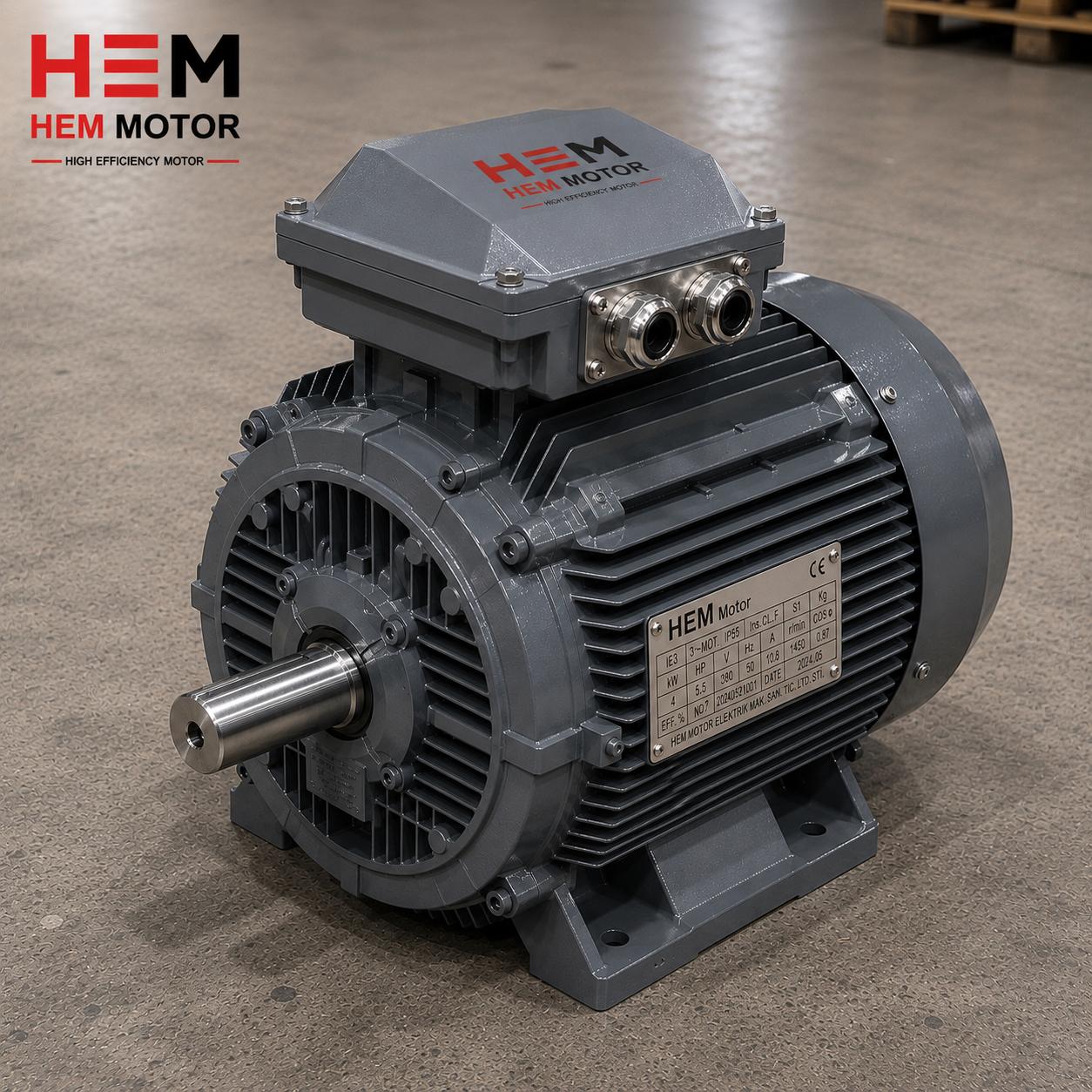
If you are replacing an existing 0.75 kW motor, the safest way to choose the correct equivalent is to transfer the nameplate information completely. The power (kW), speed (rpm), voltage and connection (380/400V, Y/Δ), efficiency class (IE3/IE4), protection class (IP55), frame size and mounting type (B3/B5/B14) on the motor nameplate ensure the order arrives exactly correct. The shaft diameter and flange dimension in particular are critically important for mounting compatibility; a motor of the same power but a different frame may not physically fit the machine.
- Power and speed values should be confirmed from the nameplate.
- Voltage and connection type (star/delta) should be checked.
- Frame size, shaft diameter and key size should be measured or read from the nameplate.
- Mounting type (B3/B5/B14) and flange diameter should be matched.
When working with a manufacturer's assurance, a suitable 0.75 kW equivalent can be supplied quickly in place of an old or different-brand motor. This way your production line does not stop for long during an unplanned failure. Standard 0.75 kW combinations available from stock are the greatest advantage in emergency replacement needs.
Frequently Asked Questions
Which pole count should I choose for a 0.75 kW motor?
It depends on whether your application wants speed or torque. For tasks needing high speed such as centrifugal pumps and high-pressure fans, a 2 pole (3000 rpm) motor is used; for conveyors, reducer inputs and general industrial applications, the most balanced choice is a 4 pole (1500 rpm) motor; and for heavy-starting mixers and low-speed drives, a 6 pole (1000 rpm) motor producing high torque is preferred.
Is IE3 mandatory for a 0.75 kW three-phase motor?
Yes. Since 1 July 2021, a minimum IE3 efficiency class is mandatory for direct-on-line (DOL) three-phase asynchronous motors in the 0.75 kW to 1000 kW range. 0.75 kW is exactly the lower boundary where this requirement begins; therefore a newly purchased 0.75 kW three-phase motor must be at least IE3. IE4 may be preferred in continuously running applications.
What is the frame size of a 0.75 kW motor?
2 and 4 pole 0.75 kW motors are generally in the 80 frame (IEC 80) structure. The 6 pole versions may shift to the 90 frame because they produce higher torque. If you are replacing an existing motor, the frame size, shaft diameter and mounting type must be exactly the same for mounting compatibility; sharing the nameplate details before ordering ensures correct matching.