English
 Türkçe

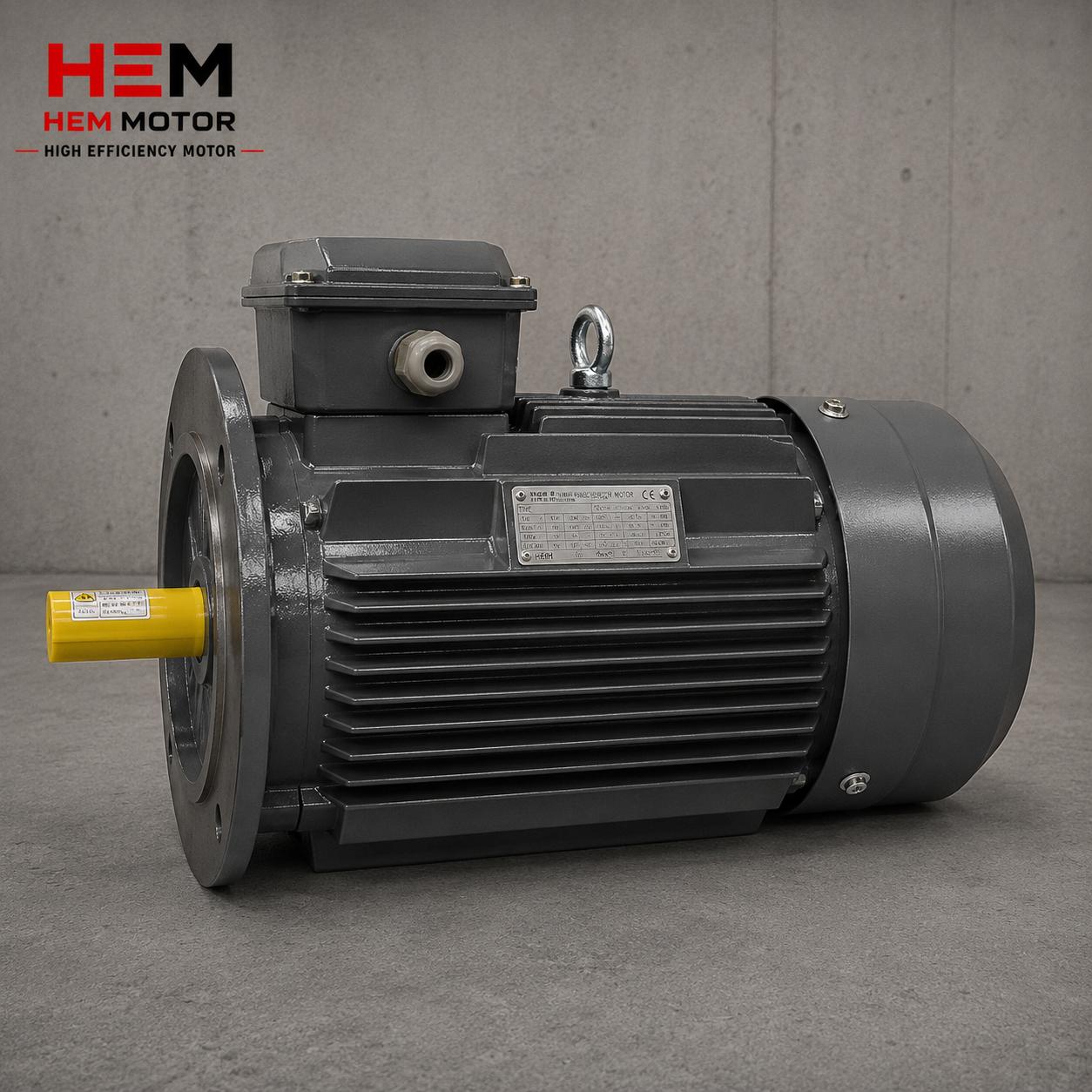

In a spinning mill the heaviest line on the electricity bill is usually not heating or lighting, but the spindle drive motors that turn quietly all day long on the ring spinning machines. Because these lines run 24/7 under an almost constant load, every efficiency point gained at the motor flows straight into the annual energy bill. This is exactly where the IE5 synchronous reluctance motor (SynRM) stands out: it does the same work with lower losses, runs at a lower rotor temperature, and when matched to the correct drive it permanently improves the energy profile of the textile line. In this article we treat a real ring spinning application as a case study, lay out the motor's energy profile, and walk step by step through the most critical issue of all: the correct VFD drive match.
Why Is the Spindle Drive on a Ring Spinning Machine Considered a Continuous Line?
The ring spinning machine is the classic spinning system that drafts, twists and winds cotton or blended fibre into yarn. The heart of the machine is the spindle drive system, where hundreds of spindles turn at high speed simultaneously. These spindles come online when the shift begins and, in most mills, run uninterrupted across three shifts — meaning 24 hours a day, seven days a week. This continuous, constant-load profile turns motor selection from an ordinary preference into an engineering decision that directly affects the company's profit-and-loss sheet.
On a continuously running drive, every watt lost at the motor shaft turns into heat, increasing both the cooling load and the electricity consumption. On a motor that runs only a few hours a day the efficiency difference may be negligible; but on a spindle drive that turns more than 8,000 hours a year, the same difference becomes thousands of kilowatt-hours of loss — or savings — every year. That is why ring spinning lines are among the applications where a high-efficiency motor investment pays back fastest.
How Does a Constant-Load Profile Magnify the Efficiency Gain?
Most of the total money a motor spends over its lifetime is not the purchase price but the electricity it consumes. On a continuously running spindle drive the electricity cost can easily reach dozens of times the purchase price. When the load profile is constant the motor runs continuously in the same region of its efficiency curve, which means an IE5 class motor operates at an average efficiency very close to its rated value. In applications where the load fluctuates the efficiency gain is hard to predict, but in ring spinning the load is almost a flat line, so the savings calculation becomes clear and predictable.
The Energy Profile of the IE5 Synchronous Reluctance Motor
The synchronous reluctance motor differs from the classic asynchronous motor at one fundamental point: its rotor has no windings or cage, but instead a special lamination geometry that exploits the reluctance (magnetic resistance) difference. In an asynchronous motor, rotor current, slip and the associated rotor losses are unavoidable; in a SynRM motor there is no rotor current, so rotor copper losses are almost eliminated. This produces two important results: the motor reaches a higher efficiency and the rotor runs at a much lower temperature.
Low rotor temperature is an overlooked but very valuable advantage on continuous lines such as ring spinning. Bearing temperature falls, lubrication life lengthens, the winding insulation is exposed to less thermal stress, and the motor's expected service life increases. Given that the ambient temperature in a spinning hall is already high, a motor that radiates less heat also eases the hall's air-conditioning load. So the return of the IE5 SynRM is not limited to the motor's own efficiency; it indirectly reflects on cooling and maintenance costs as well.
Where Exactly Do the Savings Come From?
- Motor efficiency: The IE5 ultra premium class runs with markedly lower losses than IE3 and even IE4. Under continuous load this difference translates directly into kilowatt-hour savings.
- Drive-based speed optimisation: Because the SynRM motor always runs with a VFD, the spindle speed is set exactly to the value the process requires; needlessly high speed means needlessly high energy use.
- Low rotor temperature: Less heat loss, less cooling demand and longer component life together lower the total cost of ownership.
- Lower maintenance burden: With no cage or windings in the rotor, the failure risk tied to those components disappears, easing planned maintenance intervals.
When these items come together, the payback of an IE5 SynRM investment in ring spinning is shaped largely by the power rating, annual running hours, load factor and the electricity tariff the business pays. In a facility that runs long hours, at high load and pays a high unit energy price, the payback period shortens markedly. To see the same logic in pump, fan and compressor applications, you can review our IE5 motor savings profile under continuous load article.
A SynRM Motor Cannot Run Alone on the Grid: The Drive Match
Here the most critical technical fact must be stressed: a synchronous reluctance motor cannot be connected straight to the grid and run like a classic asynchronous motor. Because its rotor has no cage, it cannot start on its own (no DOL start); it must always be driven by a VFD (variable frequency drive). For this reason a SynRM motor is always selected and commissioned as a motor-drive package. Choosing the motor from one brand and the drive on a separate logic is risky for both performance and warranty.
The drive is parameterised specifically for the motor's rotor geometry and magnetic characteristic. If the correct match is not made, the motor either fails to reach its rated efficiency or runs unstably. That is why, when moving a ring spinning line to a SynRM motor, drive selection is as important as motor selection, and the two must be evaluated together.
Autotune and Panel Sizing at Commissioning
Two things must absolutely be done correctly at the commissioning stage. The first is autotune — the drive automatically identifying the motor and tuning its control parameters to the motor's real electrical characteristic. In a synchronous reluctance motor, without correct autotune the motor will not run at optimum efficiency; if this step is skipped, the savings on paper will not materialise in the field. The second is panel and cable sizing: VFD drives generate harmonics, produce heat and require adequate ventilation. If the panel volume, cooling and cable cross-section are not calculated correctly from the start, the drive trips on thermal protection or its life shortens.
- Autotune: Mandatory at first commissioning; it lets the drive identify the motor whether at standstill or rotating.
- Panel sizing: The panel volume and cooling are chosen with the drive's heat loss and ventilation need in mind.
- Cable and EMC: A shielded motor cable, correct cross-section and proper grounding are required for both safety and electromagnetic compatibility.
- Protection settings: Overcurrent, overtemperature and speed limits are set according to the requirements of the process.
A correct installation and protection strategy reduces planned downtime on continuous lines. To see the importance of motor protection class and ambient conditions in more detail, our comprehensive guide to the IE5 ultra premium motor is a good starting point.
Fundamental Differences Between Synchronous Reluctance and Asynchronous Motors
When making the decision it helps to see the differences between the two technologies clearly. In a classic asynchronous motor the rotor lags behind the stator's magnetic field; this slip induces current in the rotor, which produces rotation but also creates rotor losses and heating. In a synchronous reluctance motor the rotor turns at the same speed as the stator field — that is, synchronously. Because no current is induced in the rotor, rotor copper losses disappear and total losses fall. On a continuously running spindle drive, this fundamental difference turns into a large energy gap over the years.
Another difference is on the durability side. The rotor cage of an asynchronous motor is exposed to thermal and mechanical stress at very high speed and under frequent starts and stops. Because the SynRM rotor has no cage, the failure modes tied to that stress are largely eliminated. On high-speed, continuously running lines such as ring spinning, this is a concrete advantage for both reliability and maintenance planning. In return, the SynRM motor's dependence on the drive makes installation and commissioning a more careful engineering process than with asynchronous machines, which is why the package approach is essential.
Case Study: Conversion on a Typical Ring Spinning Line
Consider a typical scenario: a spinning hall running three shifts that has used asynchronous motors on its spindle drives for many years. The motors may still be running; but the annual operating hours are above 8,000 and the load is almost constant. On such a line, the energy profile of moving to an IE5 SynRM + suitable VFD package can be grouped under three headings: the clear improvement in motor efficiency, the precise speed control provided by the drive, and the longer maintenance intervals thanks to the lower rotor and bearing temperature.
The variables that determine whether the conversion makes sense are clear: the higher the power rating, the greater the absolute saving; the more annual operating hours, the shorter the payback; if the load factor is constant and high, the efficiency gain shows up fully on the bill; and as the electricity unit price rises, the value of every saved kilowatt-hour grows. Ring spinning is one of the rare applications where all four of these variables work in favour of the investment, which is why in most mills the IE5 SynRM conversion offers a predictable and attractive payback.
What Should You Watch When Planning the Conversion?
- Measure the real load factor and annual operating hours of the existing motor; fill in your assumptions with true values.
- Evaluate the motor and drive as a package; looking at the motor price alone is misleading.
- Check panel space, ventilation and cabling against the new drive.
- Make sure autotune and protection settings are done correctly during commissioning.
- Assess payback not by energy savings alone but together with reduced maintenance and downtime risk.
Common Mistakes When Converting from Asynchronous to SynRM
Even when the decision to move to a high-efficiency motor is correct, some mistakes at the implementation stage can overshadow the expected savings. The most common misconception is to see the IE5 synchronous reluctance motor as a part that can be swapped one-to-one for the old asynchronous motor. In reality the SynRM motor will not turn without a drive; if the existing line has direct grid feed, that feed must be replaced with a suitable VFD and a matching panel arrangement. Failing to plan this difference from the start creates surprise cost and delay during installation.
The second common mistake is selecting the motor correctly but specifying the drive carelessly. The drive's current capacity, the control software's support for the synchronous reluctance mode, and a parameter set matched to the motor's magnetic characteristic are all essential. The third mistake is rushing the commissioning; if autotune is skipped or the protection settings are left at defaults, the motor will neither reach its rated efficiency nor run stably. Avoiding these three mistakes ensures the energy profile on paper is reproduced exactly in the field.
- One-to-one part fallacy: The SynRM motor will not run without a drive; the conversion is a package transformation, not a simple motor swap.
- Incompatible drive: A drive with insufficient current capacity or no SynRM mode lowers the motor's efficiency and stability.
- Rushed commissioning: If autotune and protection settings are not done correctly, the expected savings cannot be achieved.
- Neglecting environment and ventilation: The spinning hall's high ambient temperature and dust load must be considered in motor and drive sizing.
The Importance of Correct Supply and Engineering Support
Because the SynRM motor is a package solution, choosing the right supplier is as critical as choosing the right motor. Supplying the motor and drive as a compatible set, receiving technical support at commissioning and sizing for the ambient conditions all ensure that the savings on paper materialise in the field. HEM Motor delivers high-efficiency motors across a broad power range quickly from strong stock, minimising the waiting time of spinning lines and guiding the correct motor-drive match technically.
At the quotation stage, not only price but delivery time, warranty coverage, drive compatibility, commissioning support and efficiency certificates should be evaluated. The right supplier is one that stands behind the motor throughout its life, not one that sells it once and walks away. To clarify the right IE5 synchronous reluctance motor and drive package for your ring spinning line, you can contact us for comprehensive electric motor solutions and engineering support.
Frequently Asked Questions
Can an IE5 synchronous reluctance motor be connected directly to the grid and run?
No. Because the SynRM motor has no cage in its rotor, it cannot start on its own and does not run directly on the grid. It is always selected and commissioned as a package with a VFD drive. For this reason the motor and drive must be evaluated as a compatible set, not separately.
How long does an IE5 investment take to pay back on a ring spinning line?
The payback period is not a fixed number; it depends on the motor's power rating, annual operating hours, load factor and the electricity tariff the business pays. Because ring spinning runs 24/7 at constant load, these four variables generally work in favour of the investment and the payback shortens predictably.
Why is autotune so important at commissioning?
Autotune is the drive identifying the synchronous reluctance motor and tuning its control parameters to the motor's real characteristic. If this step is not done correctly, the motor cannot reach its rated efficiency and may run unstably, meaning the savings on paper will not materialise in the field. Correct autotune and panel sizing are the precondition for the package to deliver its expected performance.