English
 Türkçe



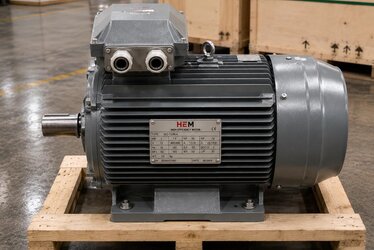
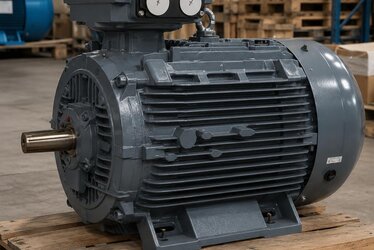
Among IE4 super premium motors, 7.5 kW and 11 kW are by far the two most sought-after power ratings in pump, fan and compressor applications. The popularity of these two powers is no coincidence: most mid-scale industrial drives fall precisely into this range. But high demand brings with it a common mistake: buyers selecting a motor by looking only at the kW label. In reality, correct buying requires evaluating, beyond the kW figure, the load profile, the speed/number of poles and stock availability together. This guide covers, in technical but applicable terms, how to read the efficiency-load curve in 7.5 and 11 kW IE4 motors, how speed selection ties to the application, and what to watch for in replacement.
Our goal is not to hand you a memorized table, but to help you validate an IE4 motor selection against your own application's real load and speed needs. A correctly chosen motor is a decision that preserves the label efficiency in the field and genuinely turns energy savings into money in your pocket.
Why Are 7.5 and 11 kW the Most Sought-After IE4 Powers?
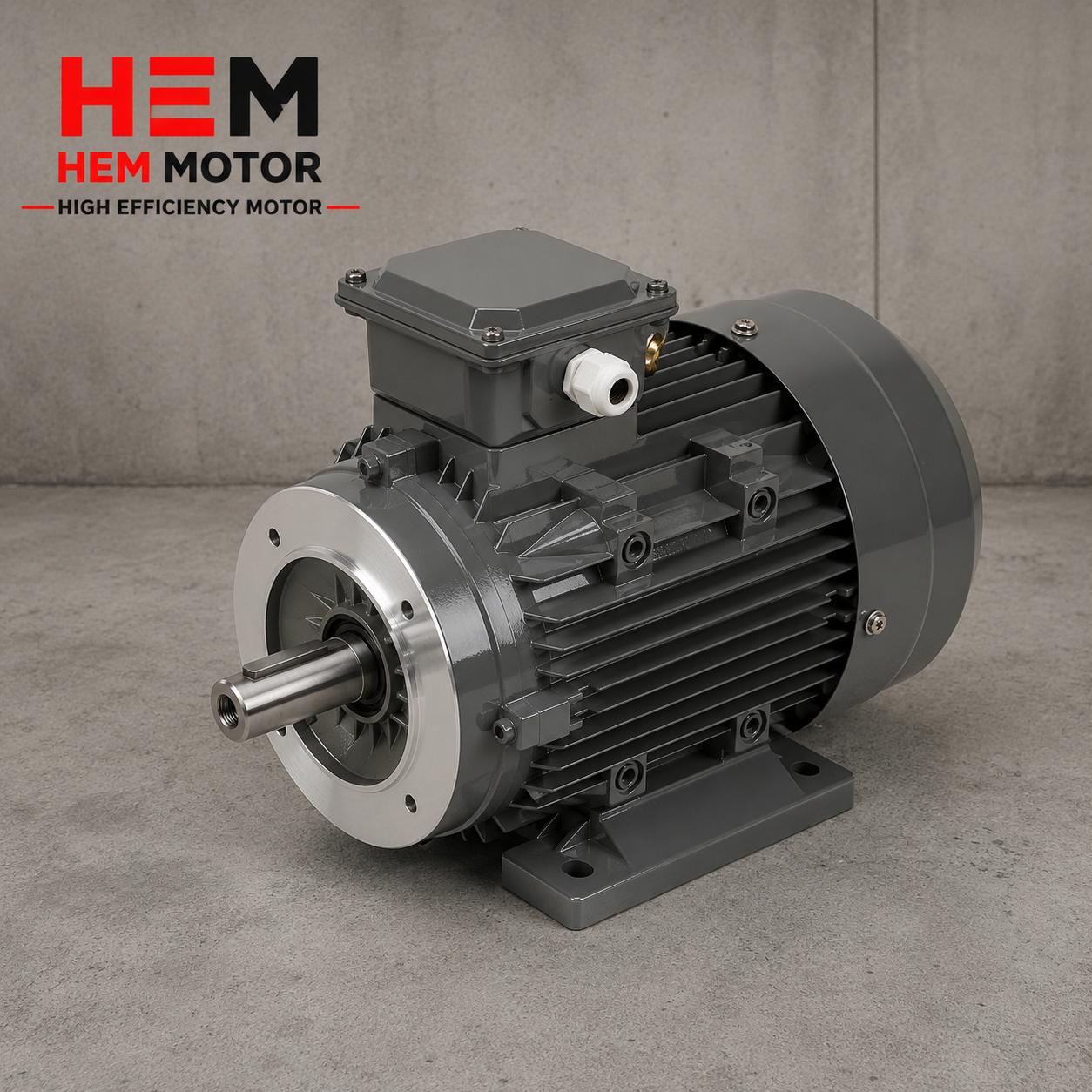
7.5 kW and 11 kW sit right at the heart of the mid segment in the IEC standard power steps. Motors at these powers are widely used in medium-size centrifugal pumps, industrial fans, screw compressors, conveyors and general machine drives. The intensity of demand also increases stock availability at these powers; this is a critical advantage, because for a stopped line the most expensive thing is waiting time.
However, being "the most sought-after power" does not mean "fits directly into every application." The same 7.5 kW motor may run perfectly in a pump yet remain inefficient in a fan if chosen at the wrong speed. That is exactly why the kW value is the starting point, not the destination.
The Efficiency-Load Curve: A Motor's Real Character
The efficiency value written on a motor's nameplate is the efficiency at rated (full) load. But motors rarely run at full load in practice. The efficiency-load curve, which shows how efficiency changes with the load ratio, is the heart of correct selection. The typical behavior in IE4 motors is:
- The efficiency peak is usually around 75% load: Most IE4 motors deliver their highest efficiency not at full load but at roughly three-quarters load. This shows why deliberately selecting the motor slightly above the load makes sense.
- Efficiency and power factor drop at low load: When the motor runs far below its rated power (for example 30-40% load), both efficiency and power factor begin to decline noticeably.
- Undersizing is also risky: A motor continuously loaded above 100% overheats and its life shortens.
The critical conclusion is this: choosing an oversized motor is, contrary to belief, not safe but inefficient. If you select the motor far above the actual load, it runs continuously at a low load ratio; its efficiency and power factor drop, and you eat the savings the IE4 class promises right from the start. The correct approach is to select the motor slightly above the expected continuous load, so it falls within the peak-efficiency region.
Speed and Pole-Number Selection
7.5 and 11 kW motors are offered in different speed/pole options, and this choice ties directly to the application. The two most common options are 2-pole and 4-pole.
2-Pole (about 3000 rpm)
These high-speed motors are ideal for applications requiring high flow and high speed:
- High-speed centrifugal pumps
- Screw and piston compressors
- High-speed blowers and exhausters
4-Pole (about 1500 rpm)
These medium-speed motors cover the broadest range of general drives:
- Conveyor and handling systems
- Industrial fans and ventilation
- General machine drives, gear-reduced applications
Wrong speed selection makes the system inefficient even at the correct kW. For example, choosing an over-speed motor in a fan application leads both to excessive energy consumption and to mechanical strain. That is why speed is a decision at least as important as kW.
Critical Compatibility Points in Replacement Selection
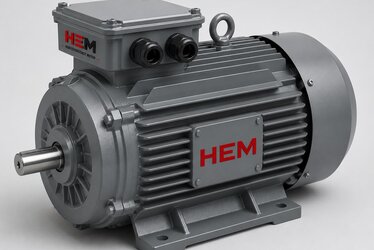
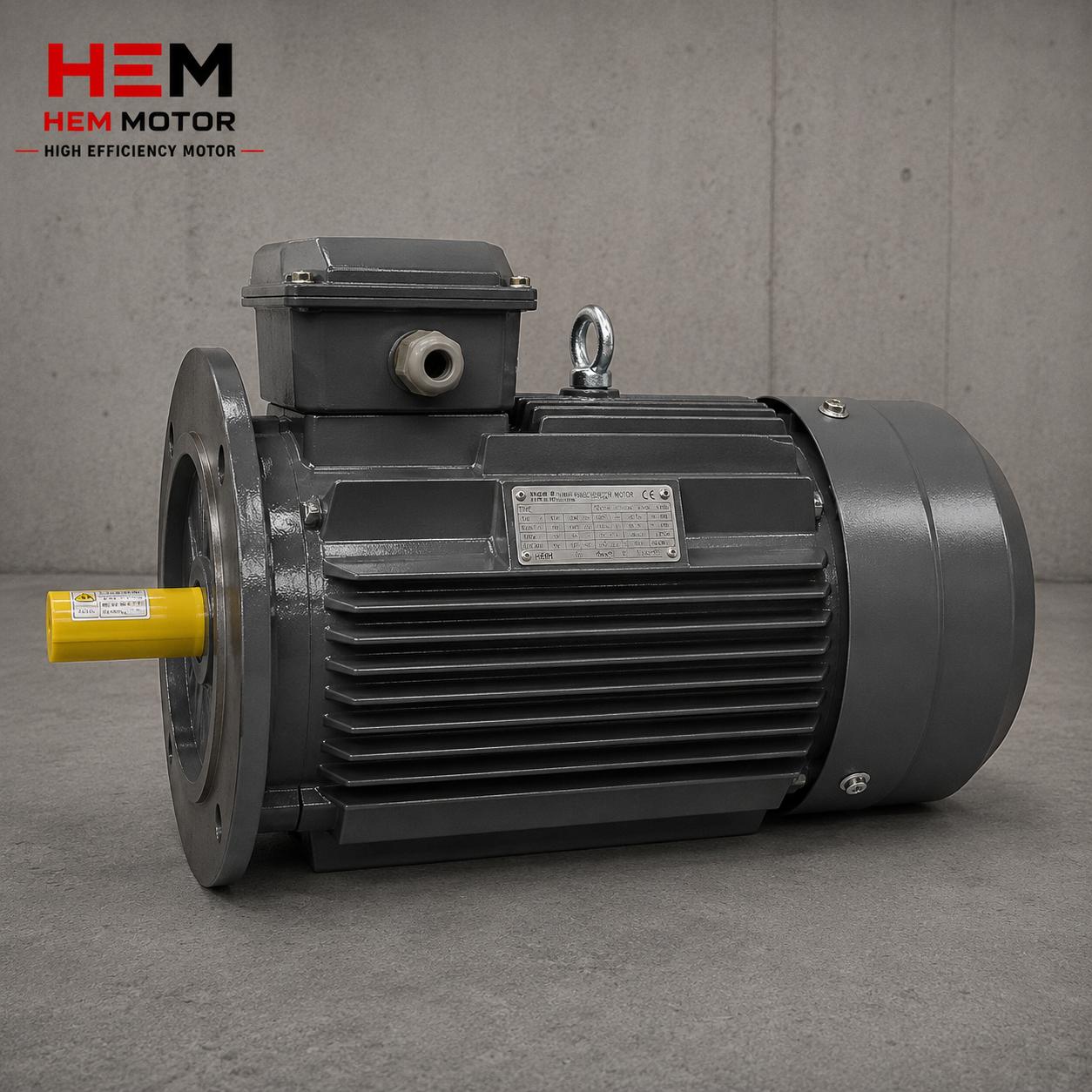
When placing a new IE4 motor in place of a failed or to-be-replaced motor, matching only the kW and speed is not enough. If mechanical compatibility is not ensured, the motor will not seat into the field and extra adaptation cost arises. The points that must be checked in replacement:
- Frame size: The IEC standard frame size (for example 132M, 160M) must match so that the mounting holes and overall dimensions fit.
- Shaft diameter and length: The shaft dimensions must be identical so that the coupling, pulley or gear connection seats smoothly.
- Flange/mounting type: The B3 foot, B5 flange or B35 foot-and-flange connection must match the existing mounting exactly.
- Terminal box orientation and protection class: The IP class suited to the cabling and ambient conditions must be preserved.
If even one of these four items does not match, even a motor at the correct kW will cause problems in the field. In a replacement request, conveying the existing motor's nameplate information completely is the shortest route to a correct match.
Stock, Supply and the Right Quote
Because 7.5 and 11 kW are the most sought-after powers, stock availability is usually high; but in busy seasons the exact variant in the right speed and mounting type may not always be on the shelf. That is why conveying your need in advance with a clear specification eliminates waiting time. For current electric motor prices and stock availability, clarifying your technical specifications and requesting a quote guarantees both the right product and fast supply. For broader options, you can also evaluate the three-phase electric motor and efficient industrial motor range.
The request you send your supplier should include: power (kW), pole/speed, frame size, mounting type (B3/B5/B35), shaft dimension, protection class (IP), application type and, if a replacement, the existing motor's nameplate information. A request with this clarity ensures the correct product arrives and speeds up the supply process.
Deciding Between 7.5 kW and 11 kW
When your application sits on the boundary, hesitating between 7.5 kW and 11 kW is common. The way to make this decision correctly is to calculate the real continuous load the motor will face as clearly as possible. In pumps this is the shaft power derived from the product of flow and head; in fans it is the air flow and static pressure; in compressors it is the pressure ratio and air demand. After this calculation, a reasonable safety margin is added to the resulting power and it is rounded up to the next standard power step.
The critical point here is that the safety margin must not be exaggerated with a "just in case" mindset. If the calculated continuous load is 6.8 kW, then 7.5 kW is the right choice; selecting 11 kW would run the motor continuously at roughly 60% load and keep it below the peak-efficiency region. By contrast, if the calculation gives 8.5 kW, the 7.5 kW would be continuously overloaded and overheat; in that case 11 kW is the right decision. In other words, the choice between the two powers must rest on a load calculation, not on emotion.
Points to Watch in IE4 Motors Running with a Drive (VFD)
A significant portion of 7.5 and 11 kW IE4 motors, especially in pump and fan applications, are run with a frequency converter (VFD). Variable speed provides serious energy savings at partial load, because in a centrifugal pump or fan the power varies with the cube of the speed. Reducing the speed by just 20% can cut the drawn power by nearly half. That is why, in variable-flow applications, the IE4 motor plus drive combination yields far lower operating cost than a fixed-speed system.
However, in a motor intended to run with a drive, several technical points deserve attention:
- Insulation class and voltage spikes: Drives switch rapidly; the winding insulation is expected to withstand these voltage spikes.
- Cooling at low speed: The standard shaft-mounted fan provides less cooling at low speed. In motors that will run across a wide speed range, a forced (independent) cooling fan may be required.
- Bearing currents: At high powers, measures such as an insulated bearing or a grounding brush should be considered against drive-induced bearing currents.
Once these points are clarified, a drive-fed IE4 motor offers both high efficiency and the flexibility of variable speed together. In fixed-load, single-speed applications a drive is not mandatory; in that case a soft starter is often sufficient and protects motor life by reducing inrush shocks.
Practical Tips for Maintenance and Long Life
To preserve in the field the efficiency and life a correctly chosen IE4 motor promises, a few simple measures make a big difference. These measures both reduce unexpected downtime and let the motor sustain its rated performance for years:
- Bearings: Following the periodic lubrication plan and avoiding over-greasing directly affects bearing life.
- Alignment and vibration: Coupling or pulley misalignment creates both vibration and early bearing failure. Laser alignment is recommended at commissioning.
- Cooling and cleanliness: If the cooling fins and fan cover clog with dust and dirt, the motor overheats; regular cleaning is critical.
- Electrical protection: In three-phase systems, a phase-protection relay stops the motor on phase loss and prevents winding burnout.
This simple discipline ensures that the label efficiency is preserved in the field and that the motor sustains its investment value for a long time.
Reading the Efficiency-Load Curve in the Field
Knowing the theoretical efficiency curve is one thing; verifying it in your own facility is another. The most practical way to understand the real load ratio on 7.5 and 11 kW motors is to measure the current the running motor draws with a clamp meter and compare it with the nominal current. If the drawn current is in the range of roughly 75-100% of nominal, the motor is operating in its peak-efficiency region. If it continuously draws below 50%, the motor was most likely oversized, and stepping down to a lower power would improve both efficiency and power factor.
This simple measurement is especially valuable in replacement decisions: instead of blindly buying the new motor at the same power as the old one, it gives you the chance to see the real load profile and choose the right power. In many facilities, motors bought oversized years ago "just to be safe" deliver noticeable energy savings when stepped down to a lower power.
Frequently Asked Questions
Does it make sense to choose an 11 kW motor instead of 7.5 kW just to be safe?
Usually no. If you select the motor far above the actual need, it runs continuously at a low load ratio. Since efficiency in IE4 motors usually peaks around 75% load, both efficiency and power factor drop at very low load and you eat the savings the class promises. The correct approach is to bring the motor slightly above the expected continuous load, into the peak-efficiency region.
Should I choose 2-pole or 4-pole?
It depends on the application. For high-speed centrifugal pumps and compressors, 2-pole (about 3000 rpm) is preferred; for conveyors, fans and general machine drives, 4-pole (about 1500 rpm). Speed selection is at least as decisive as kW; the wrong speed makes the system inefficient even at the correct power.
What should I watch for when replacing an old motor with an IE4?
Matching kW and speed is not enough. The frame size, shaft diameter and length, flange/mounting type (B3/B5/B35) and terminal box orientation must match the existing motor exactly. If even one of these mechanical dimensions differs, even a motor at the correct kW will not seat into the field. In a replacement request, conveying all of the existing motor's nameplate information is the safest route.