English
 Türkçe

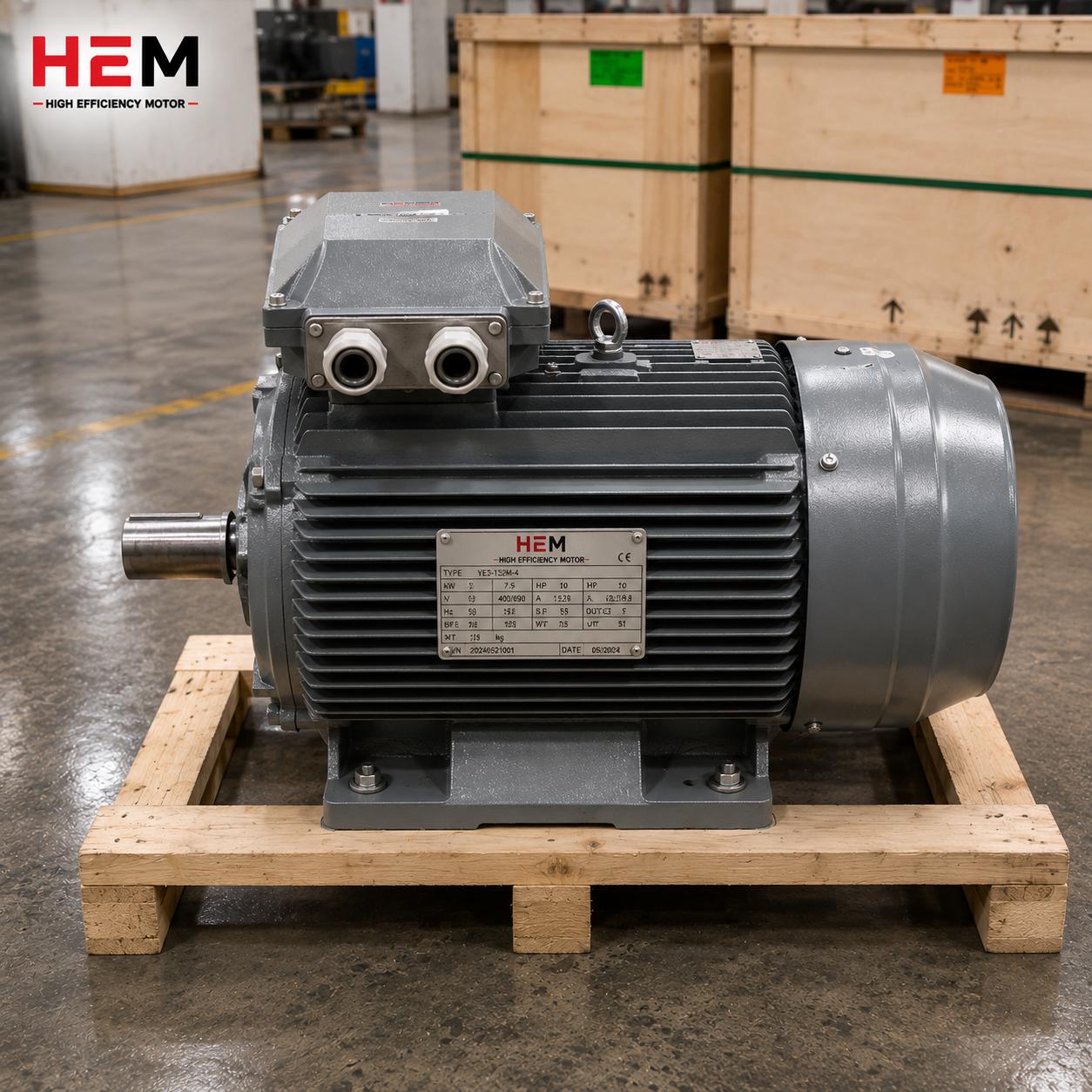

Two of the most popular tiers in the medium-to-high power class, the 55 kW and 75 kW IE4 electric motors, form the backbone of industrial pump, fan, compressor, conveyor and general drive applications. Making the right purchase at these power levels requires far more than simply stating a kW figure and waiting for a quotation, because behind the same 55 kW or 75 kW output lie different speed, pole number, frame size and stock situations. The wrong speed or the wrong frame selection causes the motor not to fit the machine, the shaft height not to match, or unexpected delays during commissioning. In this guide we explain the speed-pole relationship in 55 and 75 kW IE4 super premium motors, frame size matching, mounting types and the effect of fast delivery from stock on the purchasing decision, from the perspective of a manufacturer and seller. Our aim is to deliver the right motor to the field the first time and to prevent unplanned downtime.
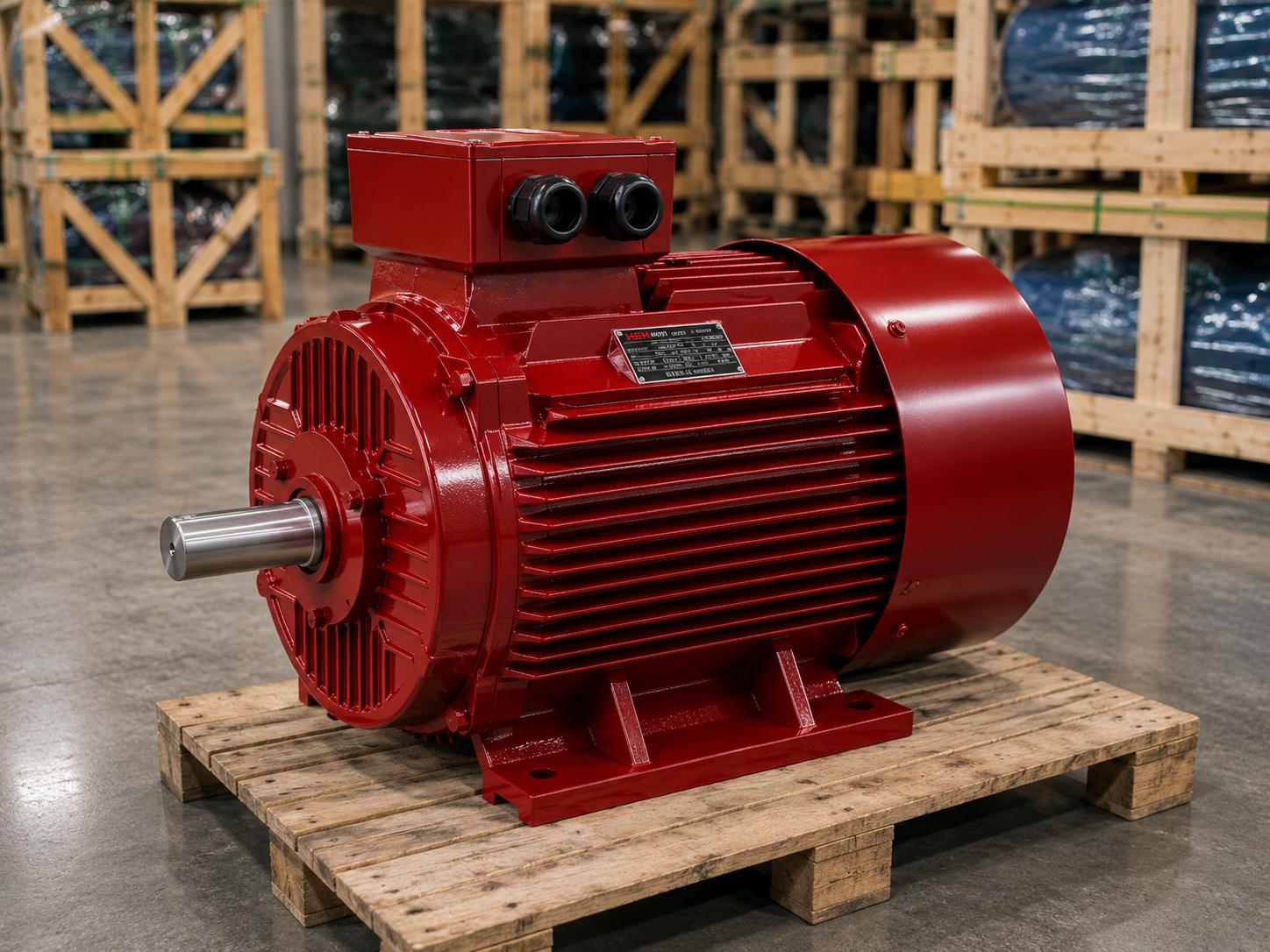
Why Are 55 and 75 kW Critical Power Tiers?
55 kW and 75 kW are the medium-to-high power tiers most frequently encountered in industrial facilities. These outputs match the typical motor requirements of medium-sized centrifugal pumps, large ventilation fans, screw compressors, main conveyor drives and general-purpose industrial machinery. In line with the European Union Ecodesign regulation and national legislation, the high efficiency class requirement for motors in this power range has progressively tightened. At outputs such as 75 kW, and in certain pole configurations, the IE4 efficiency class has now become the market expectation. For this reason, choosing an IE4 electric motor directly for a 55 or 75 kW retrofit or new investment both lowers energy cost and secures regulatory compliance.
At these power levels, the energy cost dwarfs the purchase price of the motor itself. A 75 kW motor running continuously (S1 duty) turns for thousands of hours throughout the year, and a difference of a few points in the efficiency class translates into tangible savings on the annual electricity bill. An IE4 super premium motor operates with lower losses and shortens the payback period. To understand the logic of a correct efficiency-class investment, the payback analysis of switching to IE4 high-efficiency electric motors is worth reviewing. The higher initial cost of a premium motor is recovered, often within a relatively short operating window, through reduced electricity consumption alone.
The Speed and Pole Relationship: 2, 4, 6 Poles
A motor's speed is determined by its pole number and the mains frequency. On a 50 Hz network, the synchronous speeds are as follows: 2 poles ≈ 3000 rpm, 4 poles ≈ 1500 rpm, 6 poles ≈ 1000 rpm. In asynchronous (induction) motors, the actual running speed is slightly below these values because of slip. At outputs such as 55 and 75 kW, the pole selection depends directly on the speed and torque character demanded by the application:
- 2 poles (≈3000 rpm): High-speed centrifugal applications; certain pumps and compressors, high-pressure fans.
- 4 poles (≈1500 rpm): The most common and most widely stocked speed. The ideal balance for general-purpose drives, pumps, fans, conveyors and gearbox inputs.
- 6 poles (≈1000 rpm): Heavy drives requiring higher torque and lower speed; large-diameter slow fans and some crushing-screening applications.
The same 55 kW output delivers high speed and low torque at 2 poles, and low speed with high torque at 6 poles. Whatever speed your machine needs to run at, the motor must run at that speed; otherwise the speed has to be adapted with a gearbox or belt-pulley ratio. The correct pole selection is the most critical decision in the purchase. For more comprehensive information on pole selection, the 2-4-6 pole selection guide for asynchronous motors is a useful resource. Choosing the wrong pole number can compromise both performance and energy efficiency, so it deserves careful attention at the specification stage.
Frame Size Matching
55 and 75 kW motors seat into specific frame sizes under the IEC standard. The frame size determines the height of the shaft axis above the base (the shaft height) and the position of the mounting holes; it therefore directly affects whether the motor will physically fit the machine. Typically:
- 55 kW, 4 poles: Usually falls into the 250 or 280 frame class.
- 75 kW, 4 poles: Usually found in the 280 frame class.
- As the pole number changes (2 or 6 poles) the frame size for the same output may also change; higher-pole motors generally seat into a larger frame.
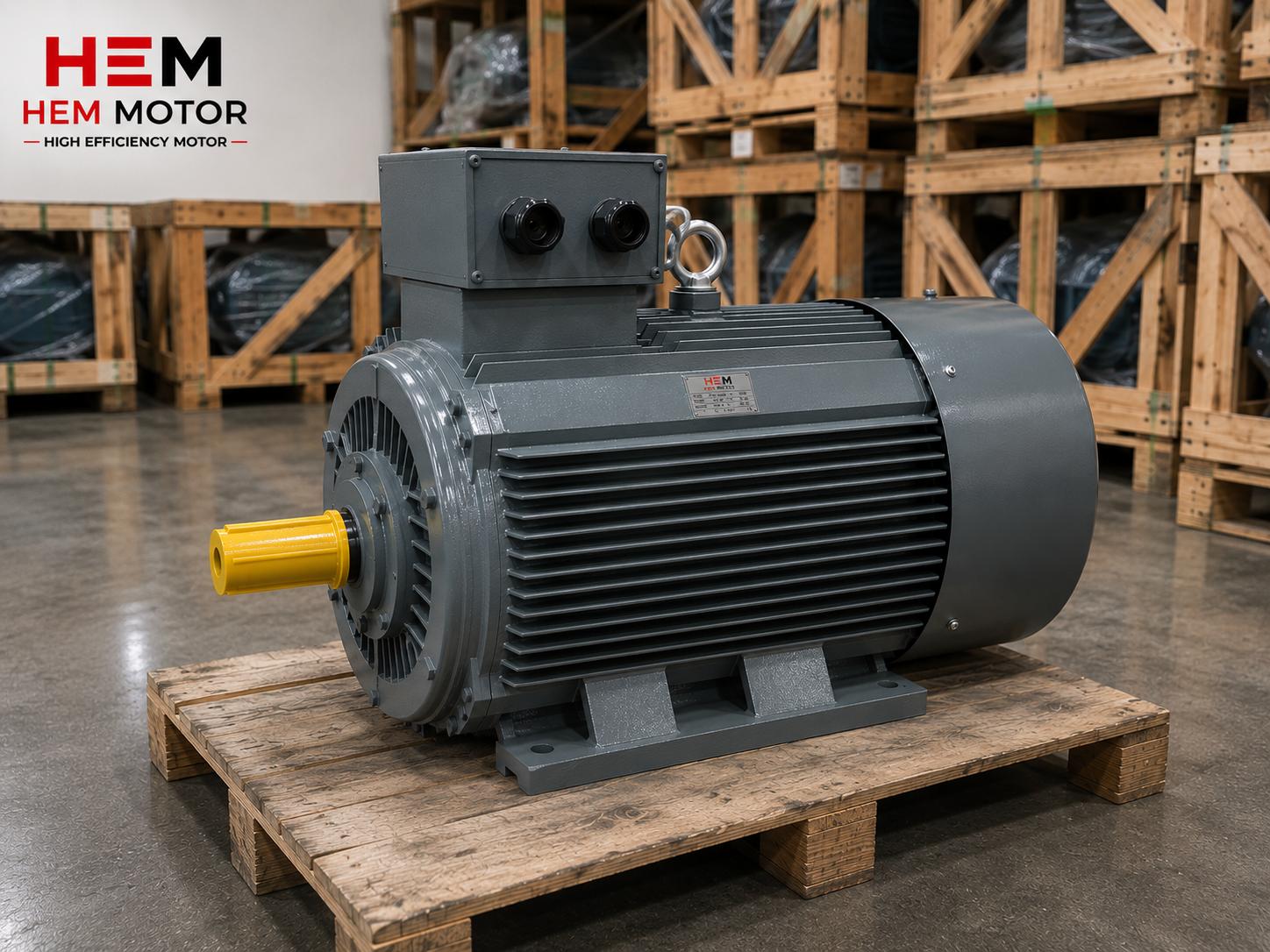
In a retrofit purchase, it is essential to match the existing motor's frame size, shaft diameter, shaft height and mounting type exactly. Otherwise the motor will not seat on the base, or the coupling/pulley alignment will not hold. For this reason, when requesting a quotation, instead of merely saying "a 75 kW motor", sharing the nameplate information and frame size of the existing motor prevents the wrong motor from arriving. The topic of cast iron body frame size and power matching addresses correct frame selection from a stock perspective and explains how shaft height and mounting dimensions tie back to the IEC designation.
Mounting Type: B3, B5, B35
In 55 and 75 kW motors, the mounting type determines how the motor connects to the machine and influences the stock decision:
- B3 (foot-mounted): Connected to the base or frame via feet under the body. Common in belt-pulley and coupled connections. At these powers, the most frequently stocked type is generally B3.
- B5 (large flange): Connected directly to the pump, gearbox or machine body through the flange on the front cover.
- B35 (combined foot + flange): The most flexible mounting type, able to connect both to the base with feet and to the machine with a flange. Frequently preferred at high powers.
The correct mounting type selection affects stock availability as much as the motor's fit to the machine. B35 combined mounting, because it allows both foot and flange connection, offers a single-motor solution in many applications. When deciding among mounting types, the technical distinctions on the electric motor mounting types page serve as a guide. Specifying the mounting type clearly up front avoids costly returns and re-orders, especially when the motor must integrate directly with an existing machine frame.
Cooling, Heating and Continuous (S1) Operation
The amount of heat produced in the medium-to-high power class is markedly higher than in small motors; therefore, cooling and heat management is a decisive factor in motor life. At outputs such as 55 and 75 kW, the standard cooling method is the fan at the shaft end blowing air over the cooling fins on the body (IC411 type surface cooling). In a motor running continuously (S1 duty), the winding temperature must stay below the value permitted by the insulation class. Because IE4 super premium motors operate with lower losses, they produce less heat at the same output; this both makes cooling easier and extends the life of the winding and bearings.
- Class F insulation, class B temperature rise: A common design approach; it leaves an additional temperature margin on the insulation and extends life.
- Ambient temperature and altitude: An ambient temperature above 40°C or an altitude above 1000 m may require power derating; this should be evaluated before ordering.
- Keeping the air inlet and outlet clear: The front of the motor's fan cover must not be obstructed; a blocked air path means overheating.
- PTC/thermistor protection: In high-power motors, thermal protection that monitors winding temperature acts like a fuse, protecting the motor from overheating.
Setting up heat management correctly at these powers not only prevents failures; it also preserves efficiency. An overheating motor produces more losses as winding resistance rises, partially losing the savings offered by the IE4 class. When cooling, insulation and efficiency are considered together, a correctly selected 55 or 75 kW motor runs for years with low operating cost.
VFD Operation and Starting Current Management
55 and 75 kW motors are often commissioned with a soft starter or variable frequency drive (VFD) rather than direct-on-line (DOL) starting. At these powers the DOL starting current can reach several times the rated current; this both stresses the supply network and causes mechanical shock. High starting current is a serious problem particularly on generator-fed sites. The solution approaches are as follows:
- Star-delta starting: The classic method that reduces starting current; effective with suitable load profiles.
- Soft starter: Ramps up the start to reduce both current and mechanical shock.
- Variable frequency drive (VFD): Provides both a soft start and, with variable speed, additional energy savings in pump and fan applications.
For motors that will run with a VFD, the winding insulation and bearing structure are expected to be drive-compatible. Stating at the ordering stage whether the motor will run with a drive ensures that a correctly equipped motor is delivered. For starting current management on generator-fed sites, the power and speed options guides provide detailed direction on matching motor power to available supply capacity.
Application-Based Selection of 55 and 75 kW Motors
The same output value requires a different motor configuration in different applications. The most common applications in the 55 and 75 kW class, and the recommended approaches, can be summarized as follows:
- Centrifugal pump: 2 or 4 poles are usually preferred; the speed is determined by the flow and head curve. In continuously running pumps, the IE4 efficiency class significantly reduces energy cost.
- Large ventilation fan: 4 or 6 poles are selected according to the air flow; low-speed large fans lean toward 6 poles. Low vibration and balanced operation are priorities in fan applications.
- Screw compressor: Because it runs continuously under load, a robust cast iron body and a high efficiency class gain importance; B5 or B35 mounting is frequently used in compact designs.
- Main conveyor drive: Usually 4 or 6 poles together with a gearbox; pole selection and drive support are important on belts requiring high starting torque.
- Crushing-screening and heavy drives: Because of the impact load profile, reinforced bearings and a robust body are needed; 6-pole low speed is often preferred.
Defining your application correctly clarifies both the motor configuration and stock availability. For example, the pump electric motors range offers application-specific speed and connection options for pump applications. A correctly defined need prevents the purchase of an unnecessarily large or insufficiently small motor and ensures the most efficient use of the investment.
Stock and Fast Delivery: The Decisive Factor in the Purchase
At medium-to-high powers such as 55 and 75 kW, the availability of the motor in stock largely determines the purchasing decision. When the main motor on a production line fails, every hour of downtime means serious cost. At this point, the immediate delivery of a compatible motor from stock is often more valuable than the arrival of a motor with the most precise technical specifications weeks later. Therefore:
- The most sought-after combinations (such as 55 kW 4-pole B3, 75 kW 4-pole B3) should be kept ready in stock.
- Spare motor planning should be carried out for critical production lines, and it should be determined which powers will be held in stock.
- Delivery from stock brings the commissioning plan forward and minimizes production loss.
As a manufacturer and supplier, we take care to keep the most preferred speed and mounting combinations of 55 and 75 kW IE4 motors in stock. To obtain a motor suitable for your needs and information about current electric motor prices, you can contact us and get an exactly compatible quotation by sharing the nameplate information of your existing motor.
Checklist for Purchasing 55 and 75 kW Motors
To make the right purchase at these powers, the following information should be clarified before ordering:
- Power and efficiency class: 55 or 75 kW, and whether IE4 is required (important for regulatory compliance).
- Speed / pole: 2, 4 or 6 poles, according to the speed required by the machine.
- Frame size and shaft diameter: In a retrofit, must match the existing motor exactly.
- Mounting type: B3, B5 or B35.
- Protection and insulation: Standard IP55 and class F; higher protection may be requested in harsh environments.
- Duty type: Continuous (S1) operation or intermittent.
- Stock status: Whether delivery from stock is possible in an emergency.
This checklist ensures both that you obtain a correct quotation and that the wrong motor is prevented from arriving. An order placed with accurate information means fast delivery and trouble-free commissioning, which together protect production continuity and the return on your motor investment.
Frequently Asked Questions
Is IE4 mandatory for 55 and 75 kW motors?
Efficiency legislation has made the high efficiency class mandatory in certain power and pole ranges, and the IE4 expectation has increased at outputs such as 75 kW. For regulatory compliance and low energy cost, choosing an IE4 super premium motor directly at these powers is the safest approach. We recommend clarifying the class suitable for your current situation at the ordering stage.
What does choosing 4 poles instead of 2 poles change for the same 75 kW output?
The pole number determines the motor's speed: 2 poles offers approximately 3000 rpm high speed, while 4 poles offers approximately 1500 rpm balance. At the same output, 4 poles produces higher torque and is more widely stocked. Which speed you choose depends on the speed and torque requirements of the machine you are driving; the wrong pole number forces you to adapt the speed with a gearbox or pulley.
Is it enough to state only the kW when requesting a quotation?
No. Behind a 55 or 75 kW output lie different speeds, poles, frame sizes and mounting types. For an accurate and fast quotation, you should specify the speed/pole, frame size, shaft diameter, mounting type and duty type alongside the kW. In retrofit purchases, sharing the nameplate information of the existing motor speeds up the delivery of an exactly compatible motor from stock.