English
 Türkçe

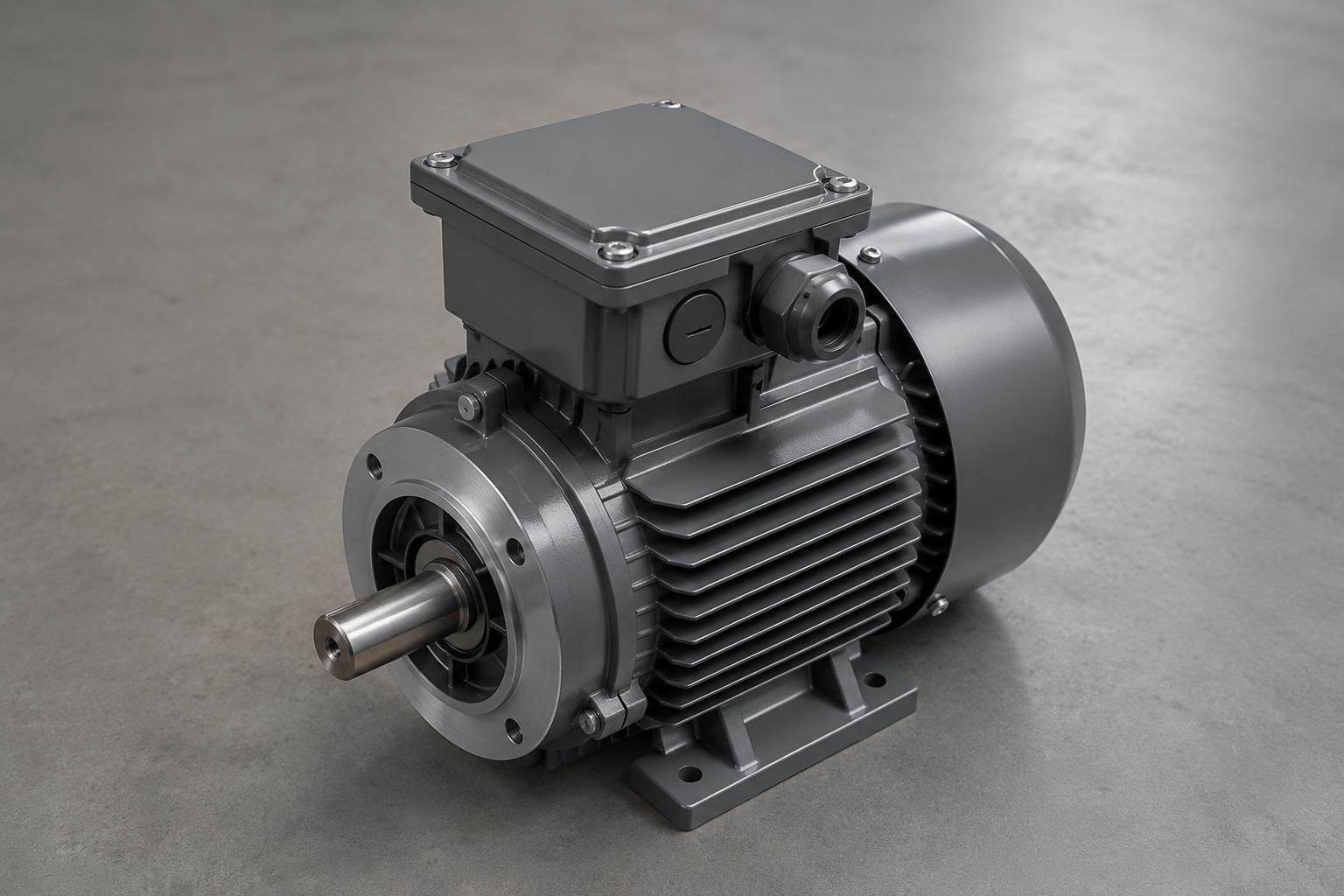

In small-power induction motors, efficiency is the parameter most often overlooked yet most impactful over the long run. Motors that fit IEC 80 and 90 frames, such as 0.75 and 1.1 kW units, make up the best-selling power band in industry; pumps, fans, conveyors, small gearboxes and countless machine units all operate in exactly this range. Precisely because of this prevalence, choosing an IE4 high-efficiency motor creates a serious energy and cost impact when considered on a per-unit, fleet-wide basis.
In this article we examine in detail the efficiency curve of 0.75 and 1.1 kW IE4 motors, their behaviour under partial load, the pole-speed-torque relationship and correct frame and mounting selection. Our aim is to give the field engineer and the buyer a clear technical answer to "which motor, at which load, and why," and then to explain the process of fast stock supply and the right quotation.
The fact that the efficiency curve is steep in small motors — meaning efficiency changes rapidly as you move away from the rated point — is a property that penalises sizing mistakes. For this reason, correct power selection comes even before class selection.
Why Is the Efficiency Curve Steep in 0.75 and 1.1 kW IE4 Motors?
While large motors easily exceed 95% rated efficiency, in small powers the physical losses remain proportionally large. A 0.75 kW motor typically has a rated efficiency in the 80-84% range; at 1.1 kW this rises somewhat, generally into the 82-86% band. So even though both belong to the same IE4 class, the achievable efficiency ceiling falls as the frame shrinks.
The reason is loss scaling. A motor has four basic loss groups: copper losses (stator and rotor winding resistance), iron losses (hysteresis and eddy current), mechanical losses (bearing friction and fan) and stray load losses. In a small motor the winding cross-sections are thin, so resistance is high and copper loss is proportionally large. Air-gap and magnetic-circuit tolerances also limit efficiency in a small frame. The IE4 super premium efficiency class suppresses these losses with better steel, more copper and optimised magnetic design; but by physics, a small motor cannot reach the efficiency of a large one.
The practical result: 0.75 and 1.1 kW IE4 motors offer 1.5-3 points higher efficiency than their IE3 counterparts. This difference may look small, but when a motor runs thousands of hours a year the cumulative saving becomes significant.
Behaviour Under Load: Why Is the 50-75% Band Critical?
The efficiency printed on a motor's nameplate is the value at rated load (usually 100%). Yet in the field, motors rarely run at full load. In a typical application a motor settles in the 60-80% load band. The greatest advantage of IE4 motors is that they preserve their efficiency in this partial-load region.
In 0.75 and 1.1 kW IE4 motors the efficiency curve peaks around 75% load and stays almost flat down to 50%. This means the operating point where the motor will most often be found lies in the high-efficiency region. However, below 25% load the picture changes: because the magnetising current stays constant and iron and mechanical losses are load-independent, the losses grow relative to the small power drawn and efficiency drops fast.
- 100% load: The rated efficiency point; the nameplate value applies here.
- 75% load: The efficiency peak for most IE4 motors; the most economical operating zone.
- 50% load: Efficiency is still very close to rated; the IE4 advantage is preserved.
- 25% load: Efficiency drops noticeably; here you pay the penalty of oversizing.
- Below 25%: Efficiency collapses, power factor worsens; the motor was wrongly selected.
This curve shows why correct sizing is vital. A "safe" motor chosen far larger than the load runs continuously in the low-load region and, despite being IE4, behaves with low efficiency in practice. The right approach is to size the motor so that it runs just above the expected continuous load, ideally around the 75% load point.
Pole, Speed and Torque Relationship
In an induction motor the synchronous speed is set by mains frequency and pole count. On a 50 Hz supply, 2 poles give ~3000 rpm, 4 poles ~1500 rpm and 6 poles ~1000 rpm synchronous speed; actual speed is slightly lower due to slip. At the same power, as speed falls the torque the motor produces rises, because power is the product of torque and angular velocity.
In the 0.75 and 1.1 kW band, pole selection depends entirely on the character of the driven load:
- 2 poles (high speed): Applications that demand speed, such as centrifugal pumps, high-speed fans and blowers. Low torque, high speed.
- 4 poles (medium speed): The most common choice; conveyors, general-purpose drives, gearbox input. The speed-torque balance is ideal.
- 6 poles (low speed): Slow-turning loads requiring high torque; some mixers and feed units. A larger frame may be needed at the same power.
An important point: at the same power rating, as pole count rises the produced torque rises, so the motor frame may grow too. A 0.75 kW 2-pole motor fits an IEC 80 frame, while its 6-pole equivalent may need a larger frame. For this reason, when making an IE4 motor selection, not only power but pole and frame compatibility must be evaluated together.
Frame and Mounting Type: IEC 80 and 90
0.75 and 1.1 kW motors typically fit IEC 80 and 90 frame sizes. The frame number expresses the height of the shaft axis above the mounting plane (in mm); 80 mm for IEC 80, 90 mm for IEC 90. Thanks to this standardisation, motors from different manufacturers are interchangeable, with compatible bolt holes and shaft diameters.
Mounting type is also an inseparable part of the selection. The most common types:
- B3 (foot-mounted): Classic floor/base mounting; fixed with feet.
- B5 (flange-mounted): Bolts directly to the machine or gearbox via a large flange.
- B14 (small flange): Tapped-hole small flange; compact mounting.
- B35 (foot + flange): Both foot and flange; the most flexible solution.
Choosing the wrong mounting type creates field incompatibility even if the motor itself is correct. Therefore clarifying frame, pole and mounting type together at the quotation stage prevents surprise delays. As protection class, at least IP55 is recommended even for small motors; in dusty and humid environments this class directly affects motor life.
The 0.75 kW Regulatory Threshold and Payback
0.75 kW is a special threshold in efficiency regulation; very small motors below this power may be subject to different rules, while for 0.75 kW and above the minimum efficiency class requirements are applied more strictly. This threshold makes the 0.75 kW motor a critical starting point both technically and commercially.
The payback calculation is simple: the higher initial-cost difference of the IE4 motor is recovered over time through the energy it saves. The longer the motor runs (the higher its annual operating hours) and the higher the electricity unit price, the shorter the payback period. In a single-shift motor payback may take a long time, while in a pump motor running three shifts non-stop the IE4 difference often pays for itself in less than a year.
In high-count installations the effect multiplies. If a facility has dozens of 0.75-1.1 kW motors, the few points of efficiency gained on each add up to a notable annual saving. For this reason small-power IE4 motors, contrary to the "small power is unimportant" fallacy, are among the categories that deliver the highest return on a fleet basis.
Practical Steps for Correct Sizing
The logical sequence to select the right motor in the field is as follows. First determine the real power requirement and continuous operating point of the driven load. Then select the power so that this point falls in the motor's 75% load region. Next clarify the pole count according to the load's speed need, the mounting type according to how it connects to the machine, and the protection class according to environmental conditions.
A typical mistake in this process is choosing the motor one or two steps larger "just in case." This approach both raises the initial cost and runs the motor continuously in the low-load region, eliminating the IE4 advantage. A correctly sized motor saves more than correct class selection alone.
When replacing existing equipment, collecting the nameplate data completely speeds up the process. For detailed application notes you can review our electric motor technical guides section and our IE3 and IE4 efficiency class comparisons. For current electric motor prices and stock availability, please contact us.
Frequently Asked Questions
How much more efficient is a 0.75 kW IE4 motor than its IE3 counterpart?
In the small-power band an IE4 motor typically offers 1.5-3 points higher rated efficiency than its IE3 counterpart. At 0.75 kW, IE4 efficiency is generally in the 82-84% band while IE3 is a few points below. Although this difference looks small in absolute terms, when the motor runs long hours and is used in high counts the cumulative saving becomes significant.
Why is choosing a motor larger than the real load a problem?
Because the efficiency curve drops fast below 25% load. A motor chosen far larger than the load runs continuously in the low-load region; despite being IE4 it behaves with low efficiency in practice and its power factor worsens. The correct approach is to size the motor so that the expected continuous load falls ideally around 75%.
Which frame do 0.75 and 1.1 kW motors come in?
These powers typically fit IEC 80 and 90 frames. 2-pole versions usually fit a smaller frame, while 6-pole high-torque versions may require a larger frame. For correct supply, specifying power, pole, frame and mounting type together when requesting a quote ensures fast stock delivery.