English
 Türkçe

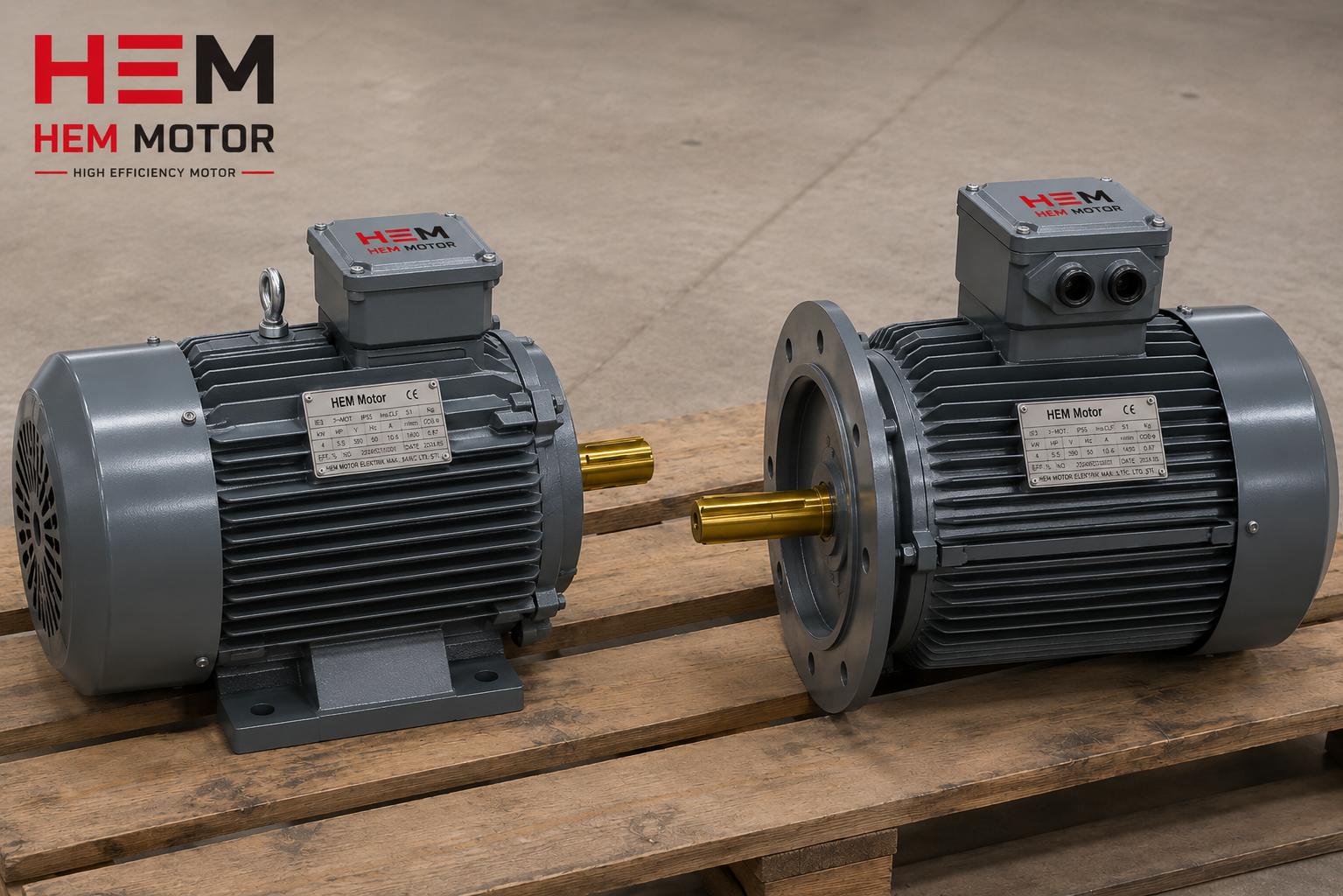

45 kW and 55 kW are two of the most frequently encountered medium-to-large power steps in Turkish industry. Pump stations, large fans, compressors, conveyor drives and crushing-screening lines very often arrive at a decision point right between these two ratings. The choice does not end with the question "how many kW is enough"; the efficiency class, the load curve, the pole count (speed) and, most importantly, stock availability must be evaluated together. A motor sized at the wrong step either heats up under constant strain and fails early, or is chosen oversized and runs inefficiently at low load. In this article we examine the selection of 45 and 55 kW IE4 motors along the axes of efficiency, load curve, speed and correct power procurement; our aim is to help you choose the motor best matched to the plant's real load profile and quickly available from stock.
Why Is the Choice Between 45 and 55 kW Difficult?
The power difference between these two steps falls right in the middle of the load demand in many applications. A pump or fan may draw close to 45 kW at a certain operating point; but when system resistance, temperature and flow demand change, consumption can rise above 45 kW. In that case the engineer faces two paths: choosing the 45 kW motor and relying on the service factor margin, or stepping up to 55 kW to stay on the safe side. Both decisions have different consequences in terms of efficiency, initial investment, stock and energy cost.
- If 45 kW is chosen: Initial cost and frame size are smaller, and since it runs near full load rather than partial load, it stays in the peak region of the efficiency curve. But if the load occasionally exceeds it, a risk of continuous overload and overheating arises.
- If 55 kW is chosen: The safety margin is wide and it comfortably handles starting and transient load peaks. But if the motor mostly runs at half load, it can drift away from the peak of the efficiency curve and the power factor drops.
The right decision rests not on a fixed rule but on the distribution of load over time (the load curve).
The Efficiency Curve: At What Load Is an IE4 Motor Most Efficient?
IE4 Super Premium class motors are designed to deliver high efficiency over a wide load range. In a classic induction motor, efficiency usually peaks around seventy-five percent load and stays high up to full load; at very low loads it falls markedly. In IE4 motors this curve is flatter and higher, meaning the efficiency loss is limited even at partial load. Nevertheless, oversizing always means loss: running a 55 kW motor continuously at thirty percent load lowers both efficiency and power factor.
Therefore the "bigger is safer" approach is misleading in motor selection. The correct approach is to place the motor's real operating point in the peak region of the efficiency curve. To understand how efficiency losses in IE4 motors are distributed among iron, copper and friction components and where they are reduced, our content on efficiency losses in IE4 motors is helpful.
The Partial-Load Trap
Many plants buy a motor one or two steps larger with the thought "I will grow later". Yet if the motor runs constantly at low load, the investment is tied up unnecessarily and efficiency drops. To examine in detail how oversizing eats the savings, see our article on partial and low-load efficiency in IE4 motors, and to determine the right load ratio, our guide on at what load to run a motor.
Pole and Speed Selection: 1500, 3000 or 1000 rpm?
The same 45 or 55 kW power is offered at different speeds, and speed selection is critically important depending on the application:
- 2 poles (about 3000 rpm): For high-speed pumps, high-pressure applications and some compressors. A smaller and lighter frame at the same power, but watch for noise and vibration at high speed.
- 4 poles (about 1500 rpm): The most common choice. Fans, pumps, conveyors and most general industrial applications run at this speed; the balance of efficiency and noise is ideal.
- 6 poles (about 1000 rpm): For low-speed heavy applications requiring higher torque. Requires a larger frame at the same power.
To compare the relationship between speed and efficiency by pole count, our content on efficiency and pole count in induction motors is a good reference. A motor chosen at the wrong speed, even if at the right power, has to be matched to the machine with a pulley-belt ratio, which means extra loss and maintenance burden.
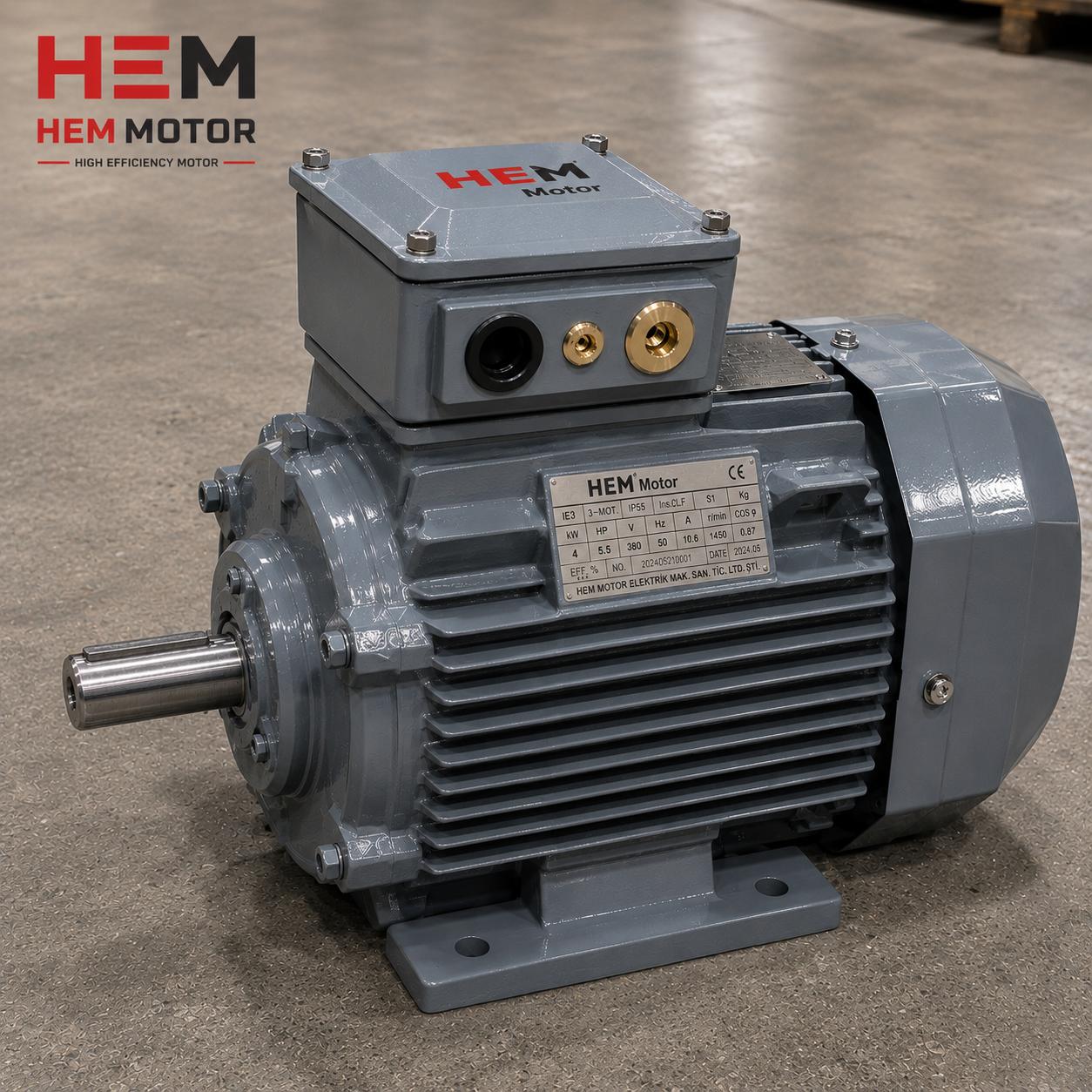
Stock Availability and Correct Power Procurement
45 and 55 kW are among the most demanded steps in the IE4 class and are usually held in stock. However, the combination of speed (poles) and mounting type (B3, B5, B35) directly affects the delivery time from stock. The most common 4-pole B3/B35 configurations can mostly be shipped off the shelf, while less-demanded speed-mounting combinations may require a production order.
- In an urgent failure-replacement situation, conveying the power, speed, frame size and mounting type from the existing motor's nameplate accurately speeds up the exact stock match.
- In a new investment, once the load curve is clarified and the 45-versus-55 decision is made, the nearest configuration in stock should be evaluated.
- The IE4 class has already become mandatory in the 75–200 kW range after 1 July 2023; while IE3 is still the minimum for 45 and 55 kW, choosing IE4 is sensible for energy cost and future-proofing.
Our content on IE4 premium efficient motor procurement, where we cover stock, lead time and project planning in depth, helps you plan the ordering process. Contact us for current electric motor prices and 45/55 kW stock availability.
Checklist for Correct Procurement
- Measure or calculate the power demand at the application's real operating point; rely on data, not estimation.
- Determine whether the load profile is constant or variable; for variable loads, evaluate together with a VFD.
- Match the speed and mounting type exactly to the machine; avoid trying to correct speed with a pulley-belt.
- Account for service factor and voltage tolerance; leave a margin in plants with grid fluctuation.
Reading the Load Curve Correctly: Constant or Variable?
The core of the decision between 45 and 55 kW lies in correctly understanding how the motor is loaded throughout the day. The load curve is a graph of the power the motor draws over time, and it differs completely from application to application. When read incorrectly, the most expensive mistake is made: either an unnecessarily large motor is bought and efficiency is lost at partial load, or an insufficient motor is constantly strained.
- Constant load profile: In applications such as a conveyor, a fixed-flow pump or a continuously running compressor, the power demand is almost constant. Here it is best to choose the motor to run near that constant point, at the peak of efficiency.
- Variable load profile: If the load changes over time (for example a pump with changing flow, or a crusher receiving fluctuating feed), the difference between average load and peak load can be large. Here the motor must be chosen to safely handle the peak load while remaining efficient at the average load.
- Intermittent load: If there are short high-load periods and long idle periods, the duty type (S1, S2, S3...) selection becomes critical; an S1 motor suited to continuous duty may be over-dimensioned in this case.
The most accurate way to measure the load curve is to record current and power for a period on an existing system. In a new investment, the power demand and safety margin given by the machine manufacturer are taken as the basis. Estimate-based sizing is the most common and most costly mistake at this power step.
Service Factor and Safety Margin
The service factor (SF) is a margin that shows how much load the motor can carry above its rated power for a short time. If the service-factor margin of a 45 kW motor is enough to handle transient peak loads, 45 kW can be chosen without needing to step up. But the service factor is for short peaks, not continuous overload; mistaking it for a continuous power margin causes the motor to overheat and fail early.
45 or 55 from the Total-Cost Perspective?
The purchasing decision should not be made by looking only at the initial price. The real cost of a motor is the sum of the initial investment and the energy it consumes over its life, and in continuously running motors the energy cost rises far above the initial price. For this reason the 45-versus-55 decision should be assessed through the total-cost-of-ownership (TCO) window.
- Initial investment: 45 kW usually means lower initial cost and a smaller frame; mechanical mounting and transport are also easier.
- Energy cost: If the motor runs at the correct load point, efficiency is at its peak; if the wrong step is chosen, efficiency drops in either direction (overload or partial load) and the energy cost rises.
- Maintenance and life: A small motor running in constant overload fails more often; the correct motor running comfortably lasts longer.
- Future flexibility: If a production increase is realistic and near, stepping up one size can be considered; but oversizing with a "maybe later" thought is usually a loss.
The most correct decision in this power class is to measure the real load profile, place the motor at the efficiency peak, and choose the efficiency class (IE4) to lower the energy cost. Evaluating the nearest configuration that can be quickly supplied from stock also shortens the delivery time.
Frequently Asked Questions
45 kW is enough but it sometimes exceeds it; should I buy 55 kW?
If the exceedances are short transient peaks (starting, sudden load rise), a 45 kW IE4 motor with a service-factor margin is sufficient in most cases and runs at the peak of the efficiency curve. But if the load regularly and for long periods exceeds 45 kW, continuous overload heats the motor and shortens its life; in that case 55 kW is safer and more correct in total cost. The decision depends on the duration and frequency of the exceedance.
Does choosing IE4 over IE3 really pay off at 45-55 kW?
Yes. At this power step the motor usually runs for long hours; the few-point difference in efficiency class translates into a noticeable saving in annual energy consumption. The higher initial cost of the IE4 motor is generally recovered through energy savings within a few years in continuously running applications. For little-used or spare motors, IE3 may be more economical.
At the same power, should I buy 2 poles or 4 poles?
This depends entirely on the application. For pumps and compressors requiring high speed, 2 poles (3000 rpm) is preferred; for fans, conveyors and general drives, 4 poles (1500 rpm) is the most common and correct choice in terms of both efficiency and noise balance. Do not select poles without learning your machine's design speed; the wrong speed means pulley correction and extra loss.