English
 Türkçe

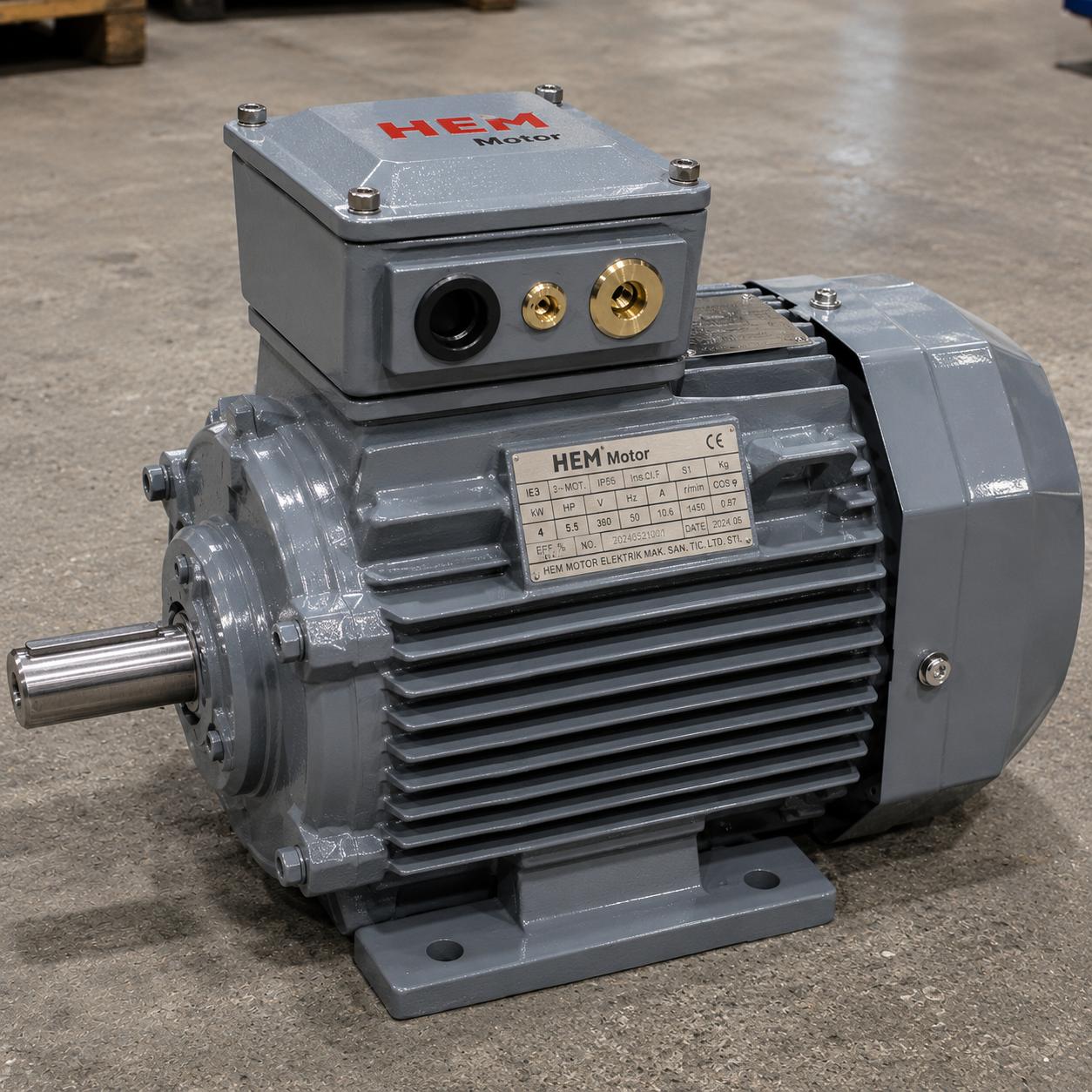

Many IE3 motors running on a frequency drive (VFD) work well enough without speed feedback, that is, in open-loop mode. But some applications demand high torque at low speed, precise speed holding and stable behaviour under rapid load changes. This is where an encoder or tachometer is added to the motor and the drive switches to closed-loop mode. In this guide we address encoder and tachometer speed feedback on IE3 motors in terms of closed-loop control, installation and correct supply, explaining which applications require feedback and how to source the motor with this hardware.
At HEM Motor we supply IE3 efficiency-class motors with encoder preparation and the right shaft-and-flange options on request. First, let us clarify what speed feedback does and why it is indispensable in some applications.
The Difference Between Open-Loop and Closed-Loop Control
In open-loop control the drive does not measure the motor's actual speed; it estimates the speed from its mathematical model and the frequency it applies. This is sufficient for pumps, fans and many general applications. But when the load changes, slip in the motor increases and the actual speed deviates from the target. We explained why an asynchronous motor runs slightly below its nameplate speed in our article on slip and actual speed in asynchronous motors; closed-loop exists precisely to compensate for this slip.
In closed-loop control, an encoder or tachometer mounted on the motor continuously measures the shaft's actual speed (and, with an encoder, its position) and feeds it back to the drive. The drive instantly closes the gap between the target speed and the actual speed. The result: the speed stays constant even when the load changes, and high, stable torque is produced even at low speeds.
Which Applications Require Feedback?
- High torque at low speed: Applications needing full torque near zero speed, such as hoisting, winding and extrusion.
- Precise speed holding: Processes where speed deviation degrades product quality, such as yarn, paper, film and coating lines.
- Synchronized multi-drive: Synchronized lines where multiple motors must turn at the same speed.
- Rapid load change: Applications where speed must stay constant under sudden load impacts.
- Positioning: Indexing and position-control applications where encoder position information is required.
By contrast, open-loop is usually sufficient for variable-torque applications such as pumps and fans; unnecessary feedback hardware adds cost and mounting complexity. We addressed the energy aspect of drive use in pumps and fans in our article on savings with a high-efficiency motor and frequency drive.
Encoder or Tachometer?
Both carry speed information to the drive but work differently:
- Encoder (incremental/absolute): Generates digital pulses; provides both speed and position information. It is the standard of modern closed-loop vector control. An incremental encoder gives speed and relative position; an absolute encoder gives exact position.
- Tachometer (tacho-generator): Generates an analogue voltage proportional to speed; provides only speed information, not position. It is an older but simple solution still used in some systems.
Today, digital encoders are preferred in newly installed closed-loop systems; they are noise-resistant, precise and integrate easily with drives.
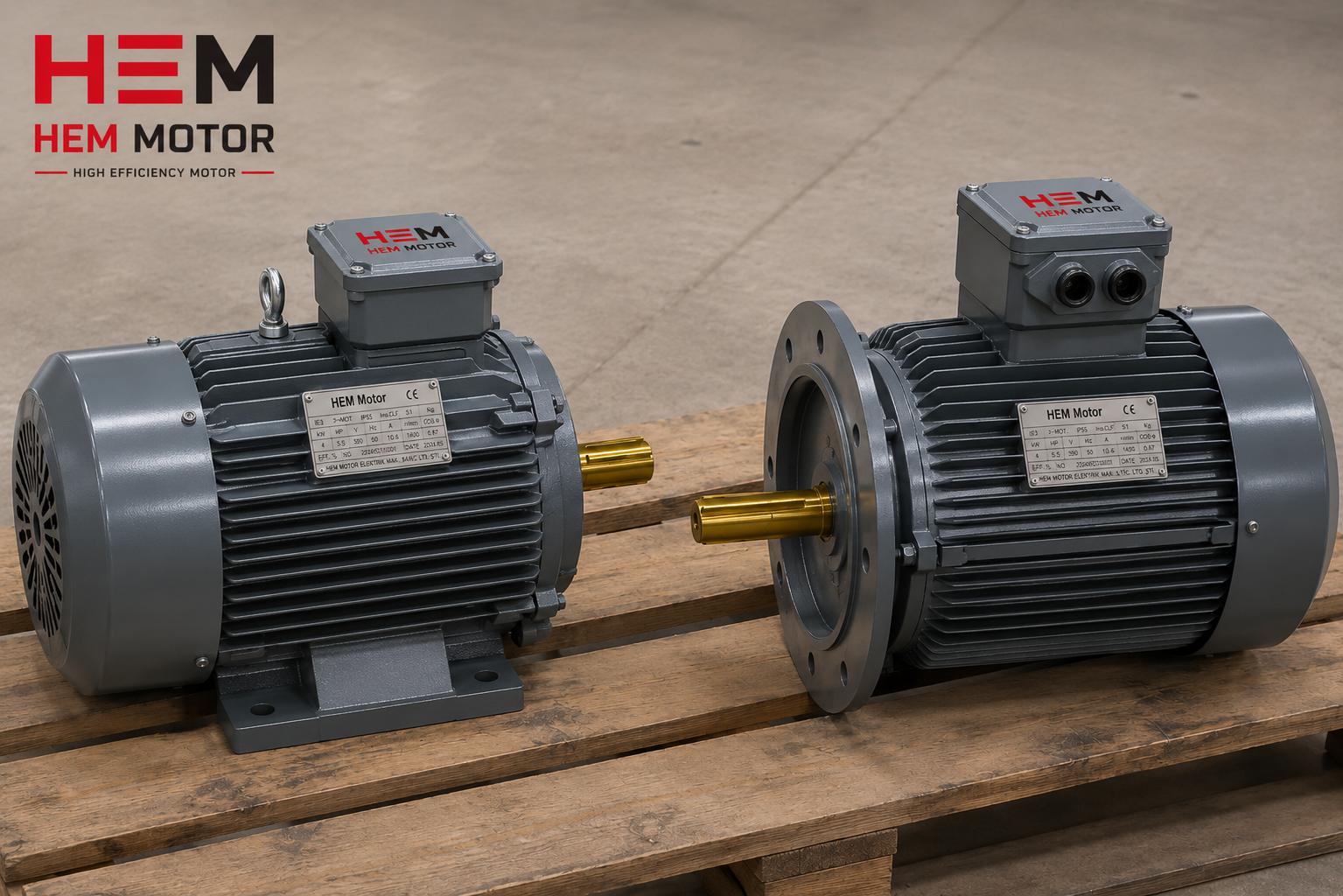
Installation: Connecting the Feedback Hardware to the Motor
The encoder is usually connected to the shaft end on the motor's rear end shield (fan side) or to a special mounting flange. For this reason, when an encoder-ready motor is requested, the rear shaft-end preparation and the encoder mounting interface must be determined from the outset. Points to watch during installation:
- Misalignment: A flexible coupling should be used between the encoder shaft and the motor shaft; misalignment damages the encoder bearing and measurement accuracy.
- Vibration: In high-vibration environments, the encoder selection and mounting must be vibration-resistant.
- Cabling: Encoder signal cables must be run separately from power cables and shielded; otherwise drive noise corrupts the measurement.
- IP protection: In dusty and humid environments, the encoder protection class must be chosen to match the motor.
For VFD-motor matching and general drive compatibility, our guide on asynchronous motor with a frequency drive (VFD) explains the infrastructure to set up before closed-loop.
Correct Supply: Requesting the Motor Ready for Feedback
Setting up an encoder-based closed-loop system afterwards is far more troublesome than supplying the motor with encoder preparation from the start. It is therefore important to clarify at the ordering stage whether your application requires feedback. For correct supply:
- Define the application's speed sensitivity, torque profile and position requirement.
- Decide whether an encoder or tachometer is needed based on the feedback type your drive supports.
- Specify the motor's rear shaft-end and mounting-interface preparation before ordering.
- Confirm the IE3 (or higher if required) efficiency class and mounting type together.
For the general features of IE3 motors you can browse our IE3 electric motors product group, and contact us for an encoder-ready motor and current electric motor prices.
The Effect of Drive Operation on the Motor
Running an IE3 motor with a frequency drive imposes additional thermal and electrical loads on the motor. The drive applies a pulse-width-modulated (PWM) voltage instead of a sine wave; this can cause additional losses and heating in the winding. When running at low speed, the motor's own fan provides less cooling, because the fan slows down with the motor. For this reason, in drive-fed closed-loop applications, and especially those requiring high torque at low speed, the motor's cooling need must be carefully assessed.
In these cases the use of an external (forced) cooling fan may come into play. An external fan provides constant cooling independent of the motor's speed, so the motor does not overheat even while delivering full torque at low speed. When building a closed-loop system, the motor's cooling solution is something that should be planned from the outset just as much as the encoder preparation. To address drive and installation compatibility more broadly, our article on electric motor commissioning and first-start checklist is a useful resource.
Insulation and Bearing Currents
Another issue the motor is exposed to in drive operation is the bearing currents that high-frequency switching can create. Over the long term these currents can cause bearing damage. For this reason, in closed-loop and drive-fed applications the motor's insulation structure and, where needed, insulated-bearing or grounding solutions are assessed. The encoder's ability to measure healthily also depends on correctly managing this electrical noise; this is why shielded cabling and correct grounding matter not only for the encoder but for the motor itself.
Encoder Resolution and Signal Type
In encoder selection, not only "is there an encoder" but also resolution and signal type matter. Resolution is the number of pulses the encoder produces in one full turn; higher resolution means more precise speed and position control. However, not every application requires the highest resolution; the need is determined by the signal the drive can process and the precision of the application.
- Resolution: A high pulse count for high-precision positioning; lower resolution may suffice for simple speed control.
- Signal type: An encoder matching the signal format the drive supports must be chosen; an incompatible signal type creates an integration problem.
- Incremental / absolute: An absolute encoder in systems that must remember position after a power cut; an incremental encoder if only speed and relative position are sufficient.
Because correct encoder selection depends on the drive's brand and model, it is important to share the drive information before ordering. This way the motor, encoder and drive are planned as a coherent whole from the start.
Closed-Loop Supply with HEM Motor
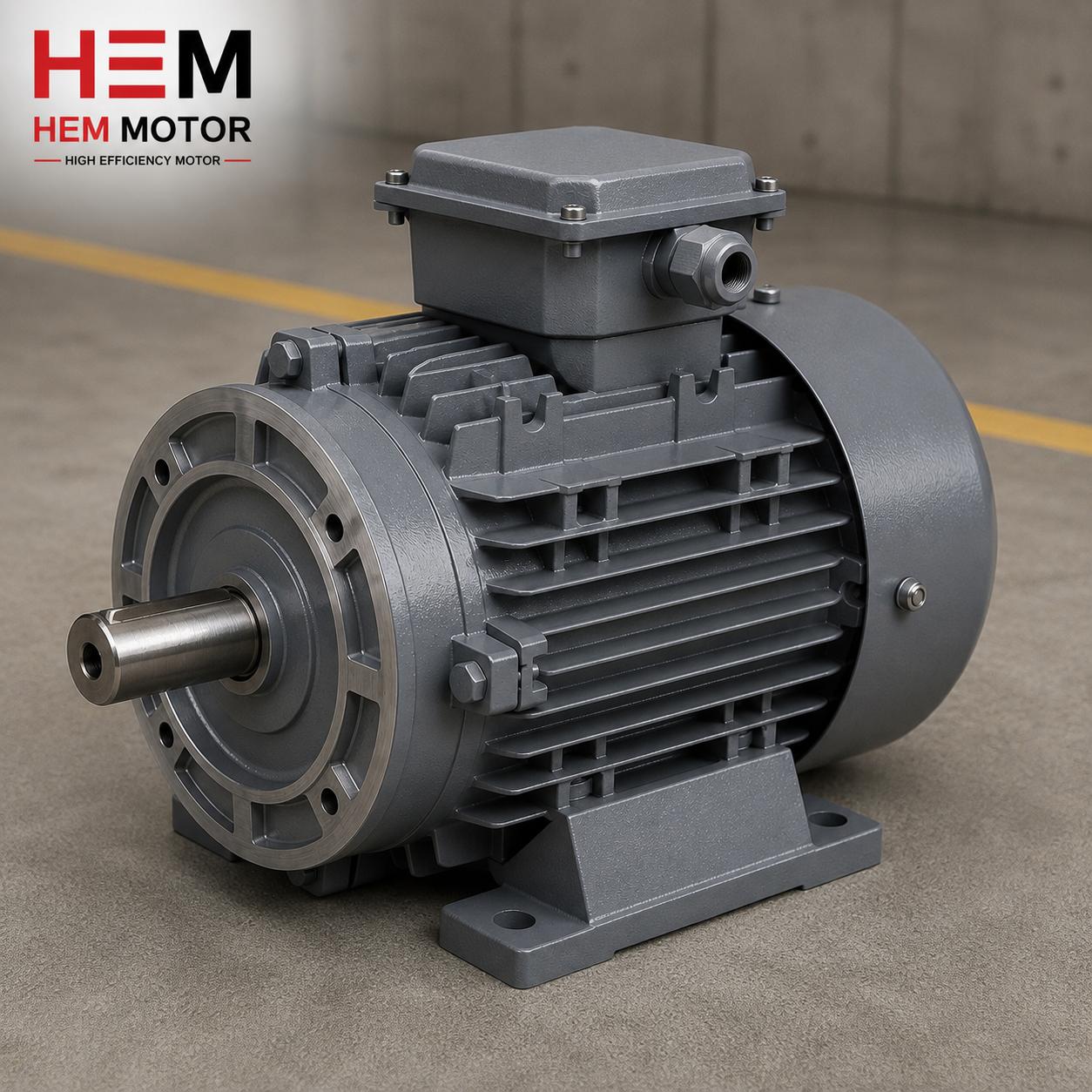
In a closed-loop drive, the harmony of motor, encoder and drive is the key to success. At HEM Motor we evaluate your application's speed and torque requirements and recommend your motor in the IE3 efficiency class with encoder preparation and the correct mounting interface on request. Our standards of 100% copper windings and class-F insulation ensure safe, long service life under the thermal loads brought by drive operation. In applications requiring high torque at low speed, we also evaluate the external cooling fan option together where needed.
Vector Control and the Advantage of Closed-Loop
Modern frequency drives drive an asynchronous motor using the vector-control method. Vector control manages the motor's magnetic field and torque separately, so the motor can be run with a control precision similar to a DC motor. In open-loop vector control the drive performs this management based on estimation; in closed-loop vector control, thanks to the real speed information from the encoder, much more precise and stable control is achieved. Producing full torque at near-zero speed in particular is possible only with closed-loop.
This difference is decisive in applications such as hoisting, winding and precise positioning. In open-loop, torque weakens and speed becomes unstable at low speed; in closed-loop the motor carries the load stably even at the lowest speeds. For this reason the application's speed-torque profile is the basic criterion determining whether open- or closed-loop is required. The right decision optimizes both performance and cost; building closed-loop unnecessarily adds cost, while failing to build it when needed leads to a loss of performance.
Encoder Maintenance and Field Reliability
The encoder is one of the motor's most sensitive components and requires special attention under field conditions. Vibration, dust, moisture and electrical noise can corrupt the encoder's measurement accuracy. For this reason the encoder's mounting, cabling and protection class must be chosen according to the environment in which the motor will operate. During regular checks it should be verified that the encoder connection has not loosened, the coupling is sound and the signal cable is undamaged.
An encoder failure causes the closed-loop system to lose control; for this reason the encoder's reliability is as important as the motor itself in critical applications. A sound mounting, shielded cabling and correct grounding ensure the encoder runs long and error-free. When the system is planned holistically, the motor, encoder and drive together form a reliable drive and the risk of unplanned downtime is minimized.
Frequently Asked Questions
Can an encoder be added to any IE3 motor afterwards?
Technically an encoder can be added to many motors, but this depends on the motor's rear shaft-end preparation, mounting interface and on-site access. Adding it afterwards can be troublesome on site because it requires a suitable coupling, mounting bracket and alignment, and it demands careful alignment for measurement accuracy. The soundest approach, if the feedback need is known from the start, is to supply the motor with encoder preparation. If you send us your application, we will recommend the motor with a suitable shaft and mounting interface.
Do I need closed-loop control on my pump?
Most pump and fan applications are variable-torque and work well enough with open-loop control; in these applications an encoder usually adds unnecessary cost and mounting complexity. Closed-loop is mainly needed in applications requiring high torque at low speed, precise speed holding, synchronized multi-drive and positioning. If speed deviation on your pump does not degrade product or process quality, open-loop is sufficient. If you are unsure, we will assess your application and recommend the right solution.
How do I choose between an encoder and a tachometer?
The choice depends on the information you need and your drive's support. If you also need position information or are building a new system, a digital encoder is the right choice; it is noise-resistant, precise and integrates easily with modern drives. If only speed information is sufficient and your existing system is tacho-generator based, a tachometer can be used. Today, an encoder is generally recommended for new installations. We can determine the compatible feedback type together according to your drive's brand and model.