English
 Türkçe

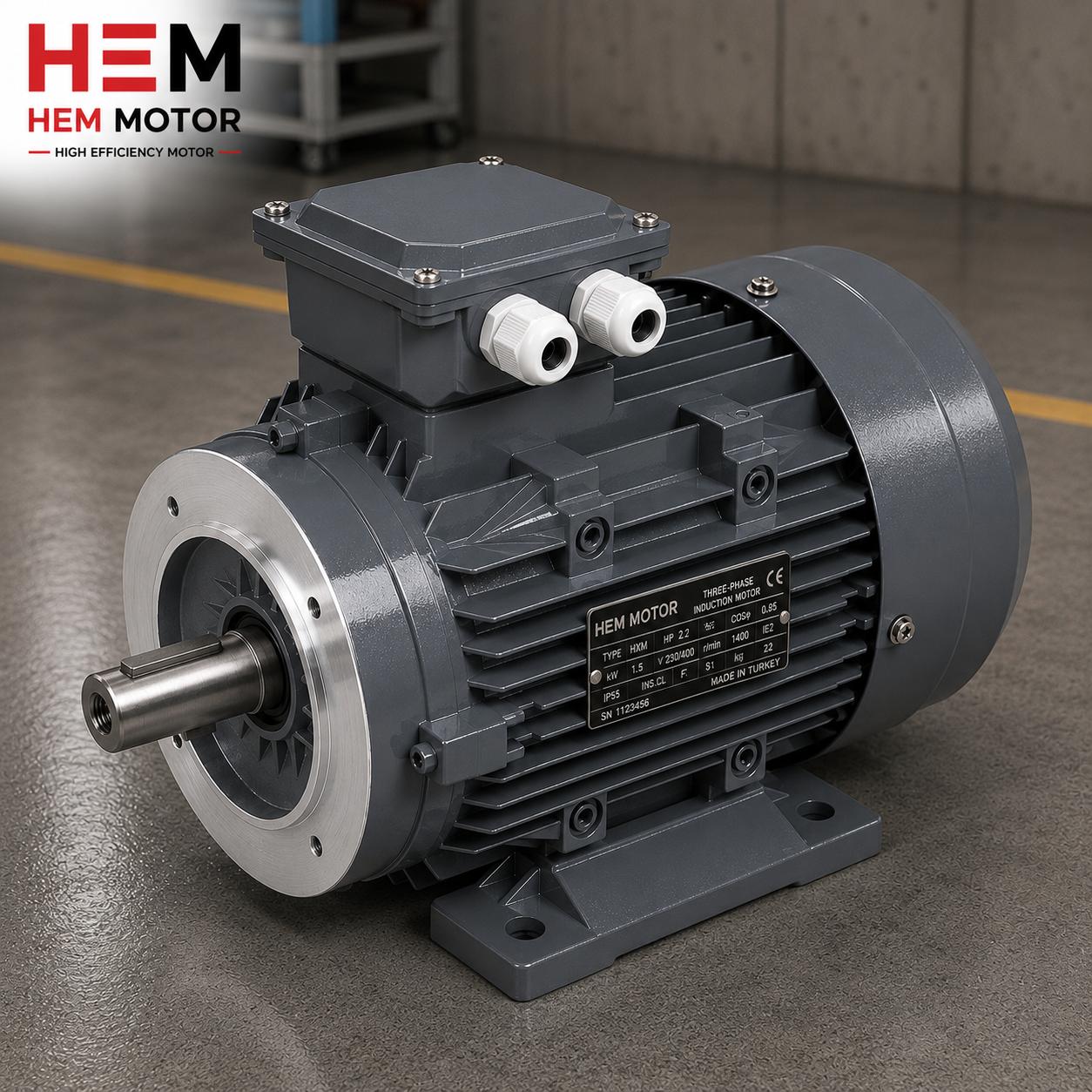

In industrial drive systems, the belt-pulley connection is one of the most common and economical methods of transmitting a motor's power to a machine. However, this seemingly simple solution creates a constant and significant mechanical load on the motor shaft. In a directly coupled connection the motor shaft carries only the torsional (torque) load, whereas in belt-pulley drive the shaft is also subjected to a serious radial load arising from belt tension. When this radial load is not correctly calculated, the bearings fail prematurely and the shaft can be damaged even if the motor is of the correct power. In this article, HEM Motor examines radial load, pulley diameter and bearing selection for belt-pulley drive in IE3 cast-iron motors, pulley positioning, and the technical requirements of correct buying.
Why Does the Shaft Carry Radial Load in Belt-Pulley Drive?
In a belt-pulley system, the motor torque is transmitted through the pulley to the belt, and from there to the driven machine. For torque to be transmitted, the belt must be at a certain tension. This belt tension creates a radial force acting directly on the motor shaft. Because this force acts perpendicular to the shaft axis, it tries to bend the shaft and stress the bearings.
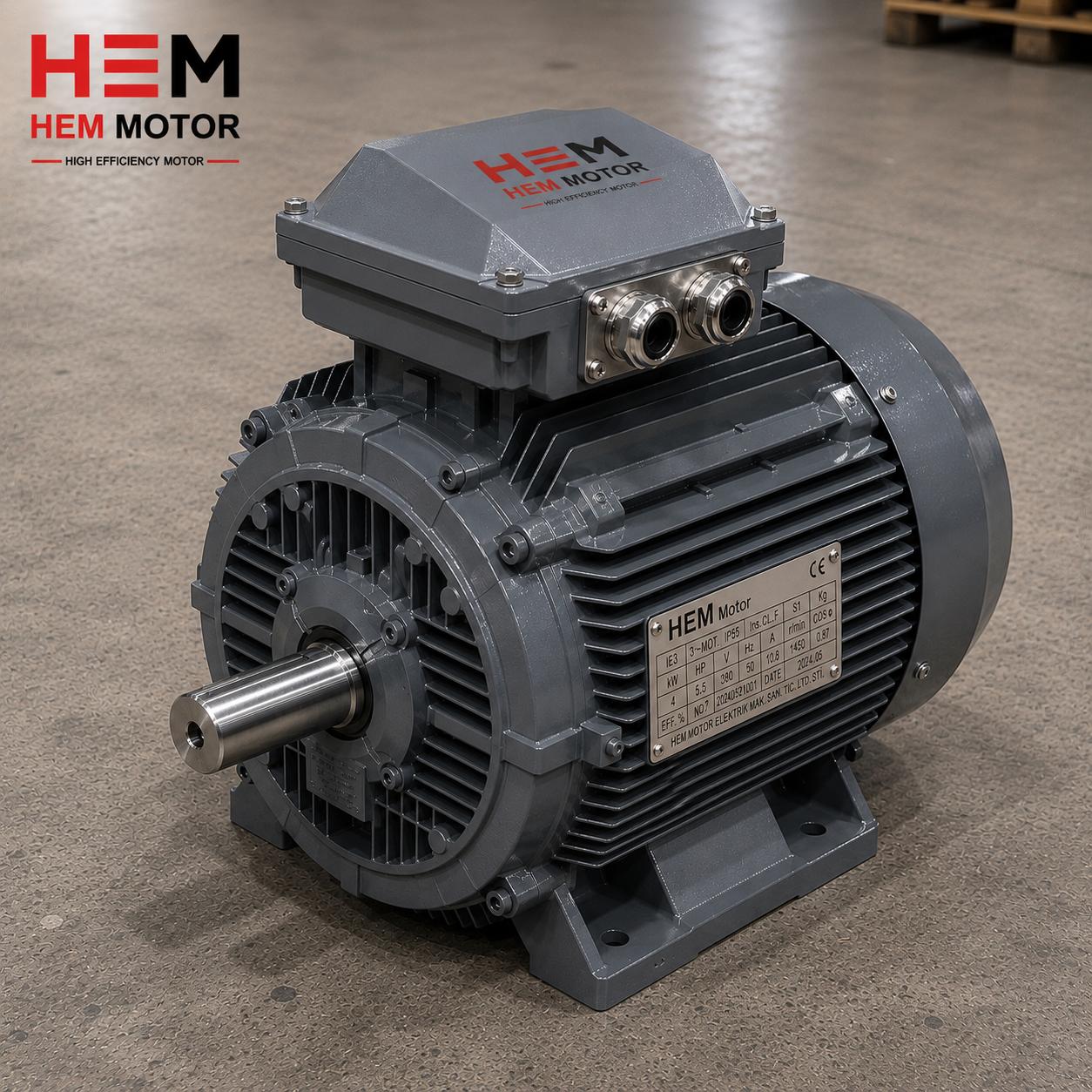
In a directly coupled connection there is no such side force; the shaft transmits only the rotational torque. Therefore, the bearing and shaft structure of a motor selected for belt drive must be assessed to safely carry this additional radial load. At this point, the cast-iron frame provides an important advantage with its high mechanical strength and vibration damping. To examine the motor's shaft and bearing load limits in detail, our electric motor shaft radial axial load bearing limit article is a fundamental reference.
The Relationship Between Pulley Diameter and Radial Load
In belt-pulley drive, the most critical design decision is the pulley diameter, and its relationship with radial load is often misunderstood. The basic rule is: to transmit the same torque, the smaller the pulley diameter, the higher the belt force and therefore the radial load.
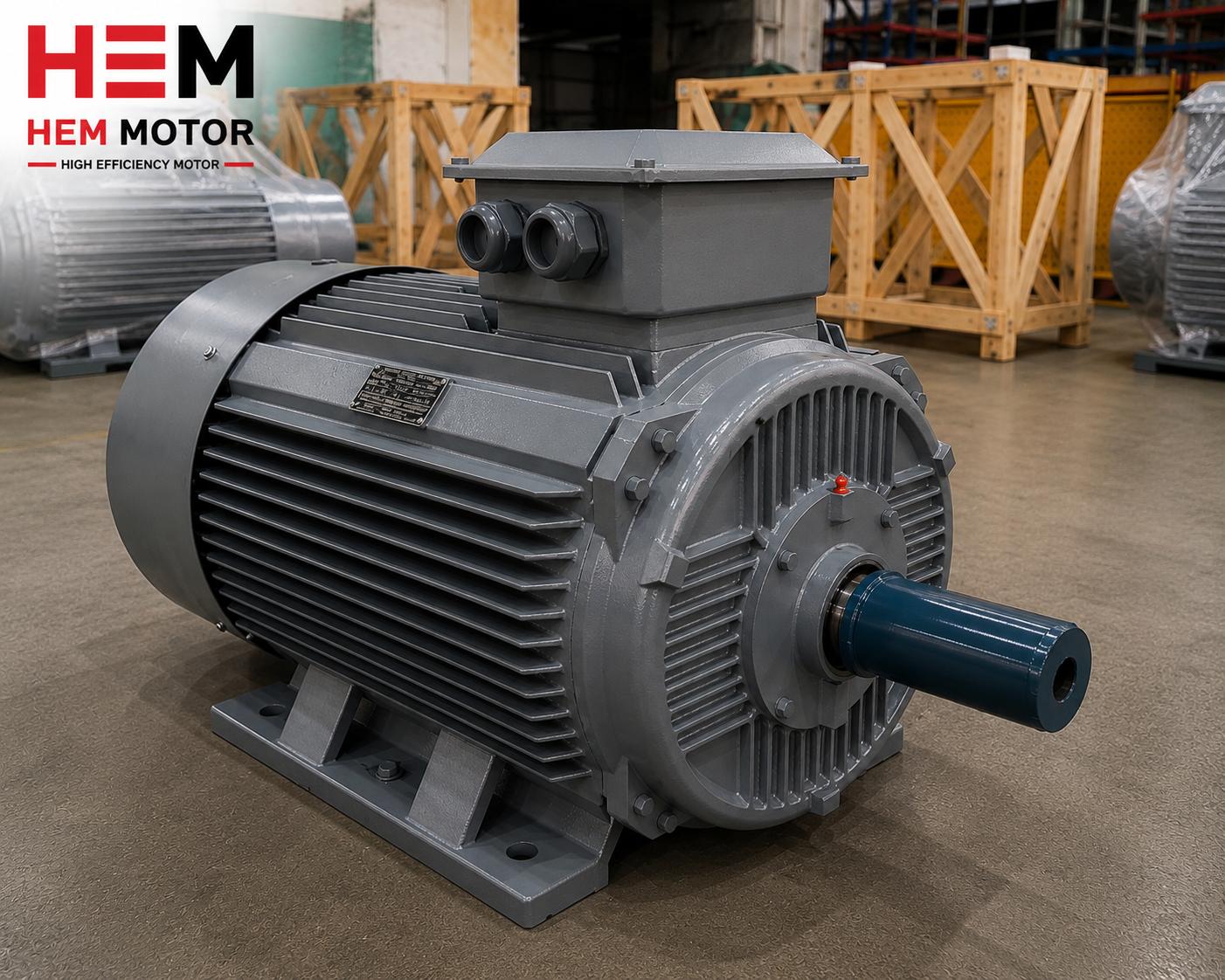
The reason for this is a simple mechanical principle. Torque is the product of force and pulley radius. If the motor must transmit a certain torque and the pulley diameter is small, the belt must apply a greater tangential force to produce the same torque. This large force directly increases the radial load on the shaft. Conversely, when a larger-diameter pulley is used, the same torque can be transmitted with a lower belt force and the radial load on the shaft decreases.
- Small pulley: Compact structure, but high belt force and high radial load; the bearings are stressed more.
- Large pulley: Lower belt force, lower radial load; bearing life lengthens, but takes up space.
Therefore, pulley diameter selection must be made not only by speed-ratio calculation but also with regard to shaft and bearing strength. A very small pulley, even if it provides the speed ratio, can dangerously stress the motor shaft and bearings.
Bearing Life and the Cube-of-Load Rule
The most striking and often overlooked fact in bearing selection is the relationship between bearing life and load. Bearing life (L10) is inversely proportional to the cube of the load. This mathematical relationship dramatically reveals the importance of radial load.
The practical consequence of this rule is: when the load doubles, bearing life drops to one-eighth. That is, a design error that doubles the radial load (for example, an undersized pulley) reduces bearing life by 87 percent. This can mean that a bearing that would last years in a continuously running drive fails within months.
- If the load doubles, life drops to 1/8.
- If the load rises by a factor of 1.26, life halves.
- Reducing the load by a reasonable amount multiplies life.
Therefore, minimizing radial load in belt drive directly determines bearing life and thus the motor's maintenance interval and reliability. The correct pulley diameter and correct belt tension are the most critical variables of this equation.
Pulley Positioning: Seating Near the Shaft Shoulder
What determines the effect of radial load on the bearings is not only the magnitude of the load but also the position of the load on the shaft. The farther the pulley is seated toward the shaft end, that is, the farther out from the bearing, the greater the bending moment it creates and the greater its effect on the bearings.
The correct practice is to seat the pulley as close to the shaft shoulder as possible. When the pulley is close to the bearing, the lever arm created by the radial force shortens and the load on the bearing decreases. Positioning the pulley at the shaft end, far from the shoulder, is a typical error that increases both bearing load and shaft bending.
To safely manage radial load, three basic measures must be applied together:
- Use the largest possible pulley: Reduces belt force and radial load.
- Seat the pulley near the shaft shoulder: Lowers the bending moment and bearing load.
- Select reinforced bearings: In applications requiring high radial load, reinforced bearings increase durability.
The end shield and shaft machining of cast-iron frame motors are produced with the precision to carry these loads; on this, our cast-iron motor end shield bearing housing machining article explains the mechanical details.
Why Are IE3 Cast-Iron Motors Suitable for Belt Drive?
The constant radial load and vibration created by belt-pulley drive bring the durability of the motor frame and shaft structure to the forefront. IE3 cast-iron frame motors are an ideal choice for these demanding conditions:
- High mechanical strength: The cast-iron frame firmly supports the shaft and bearings under radial load.
- Vibration damping: The mass and rigidity of the cast material damp the vibration created by belt drive.
- High efficiency: The IE3 efficiency class lowers energy cost in continuously running belt drives.
- Fast delivery from stock: Standard IE3 configurations respond quickly to emergency and planned needs.
HEM Motor offers our IE3 cast-iron frame motors with a shaft and bearing structure suited to the radial load needs of your belt drive applications, with fast delivery from stock. You can benefit from our technical support on correct pulley diameter and bearing selection, and reach our full motor portfolio from our homepage.
Frequently Asked Questions
What is the drawback of using a smaller pulley in belt drive?
Although a small pulley provides a compact structure, it requires the belt to apply a much greater force to transmit the same torque. This increases the radial load on the motor shaft. Since bearing life is inversely proportional to the cube of the load, a small pulley seriously shortens bearing life. Using the largest possible pulley both lengthens bearing life and reduces shaft bending.
What happens if I set the belt tension too high?
Excessive belt tension unnecessarily increases the radial load on the shaft and leads to premature bearing failure. A very loose belt, on the other hand, causes slip and torque transmission loss. The correct approach is to set the belt within the tension range recommended by the manufacturer; it should be neither loose enough to slip nor tight enough to stress the bearing.
What should I specify when selecting a motor for belt drive?
In addition to motor power and speed, you should specify the pulley diameter to be used, the pulley's position on the shaft, and whether the application runs continuously or intermittently. This information is needed to calculate the radial load the shaft must carry and to select the appropriate bearing structure. In applications requiring high radial load, a reinforced bearing option should be considered.