English
 Türkçe



Selecting the right motor for the smallest drive points in a plant often demands more attention than high-power applications. Machines in the IE3 micro-power motor class at 0.18 and 0.25 kW run everywhere from small conveyors and dosing pumps to labelling machines and sample mills. At these smallest powers, getting the relationship between speed, pole count, frame size and stock availability right directly affects both the initial investment and the running cost. As the manufacturer and supplier shipping these products from stock, we share in this article the technical framework you need to make the correct choice together with us.
Although 0.18 and 0.25 kW look like small numbers, the efficiency gain at these powers in the IE3 class is very valuable. At micro-power levels relative losses grow; even a small absolute loss corresponds to a meaningful percentage drop in efficiency. For this reason, IE3 selection at these powers requires a different engineering approach compared with large motors.
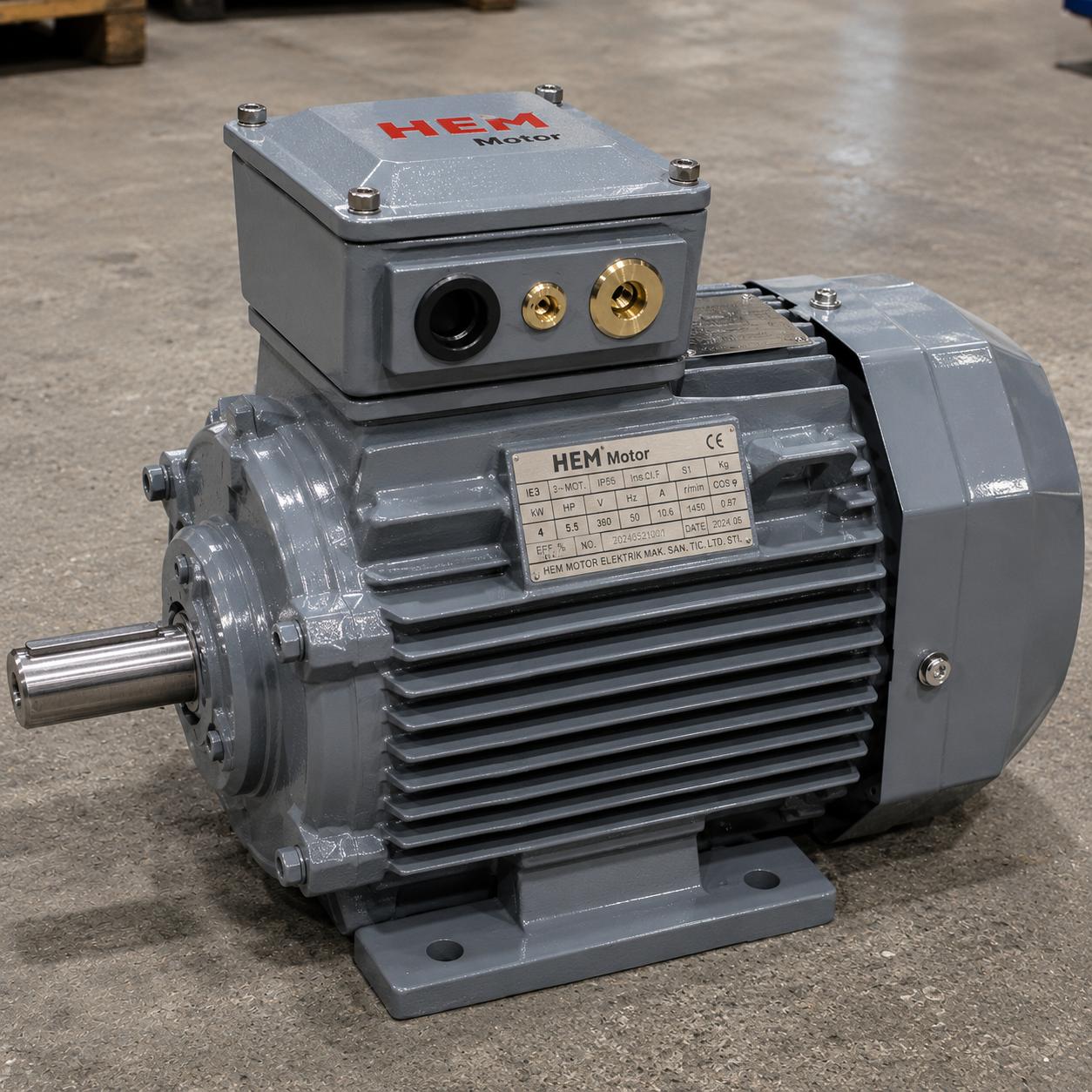
Speed and Pole Relationship in 0.18 and 0.25 kW Micro-Power Motors
The most critical decision in micro-power motors is the choice of pole count. The pole count determines the synchronous speed of the motor, and the resulting torque must match the real need of your application. On a 50 Hz supply, a 2-pole motor runs at roughly 2850-2900 rpm under load, a 4-pole at roughly 1400-1450 rpm, a 6-pole at roughly 900-950 rpm and an 8-pole at roughly 700-720 rpm. When you produce the same 0.18 kW at different pole counts, the torque at the shaft end changes completely.
Why Torque Comes First and Power Second
Many users look at the kW value first; yet what really matters in a drive system is torque. In the formula P = M × ω, when power is held constant, torque rises as speed falls. So a 0.25 kW 6-pole motor produces roughly three times the rated torque of a 0.25 kW 2-pole motor. Slow, high-torque mixers favour 4 or 6 poles, while small fans and centrifugal pumps usually call for 2-pole solutions.
Common Mistakes in Pole Selection
- Choosing a 2-pole motor in an application that does not need high speed, overloading the gearbox unnecessarily.
- Ignoring that 6- and 8-pole motors may have a lower power factor (cos φ).
- Failing to account for slip, which means the real loaded speed differs from the nameplate value.
- Not planning the speed range and cooling conditions if a frequency inverter will be used later.
Frame Size: The IEC 63 and 71 Boundary at Micro-Power
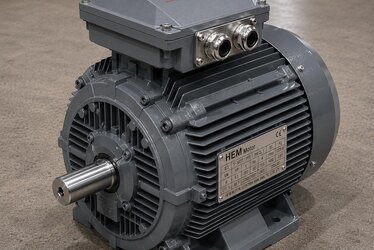
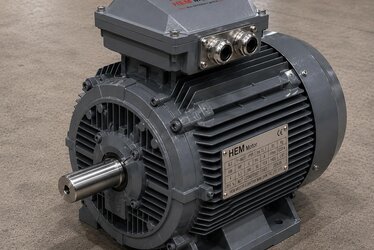
0.18 and 0.25 kW motors are typically built in IEC 63 and 71 frame sizes. Frame size is not just a dimension; shaft diameter, shaft height (centre height), flange hole pattern and mounting foot dimensions are all directly tied to this number. In a 63 frame the shaft diameter is usually 11 mm, and in a 71 frame around 14 mm. If you do not want to change the coupling, pulley or gearbox input shaft in your existing system, frame and shaft compatibility sits at the centre of the purchase decision.
At micro-power levels the same kW value can arrive in different frames depending on pole count. For example, a 0.25 kW 2-pole motor may fit in a 63 frame, while the same power as a 6-pole may move up to a 71 frame. This means the flange and foot holes change. Therefore, when checking stock, you should state not only the power but the pole count and the desired frame/mounting type together.
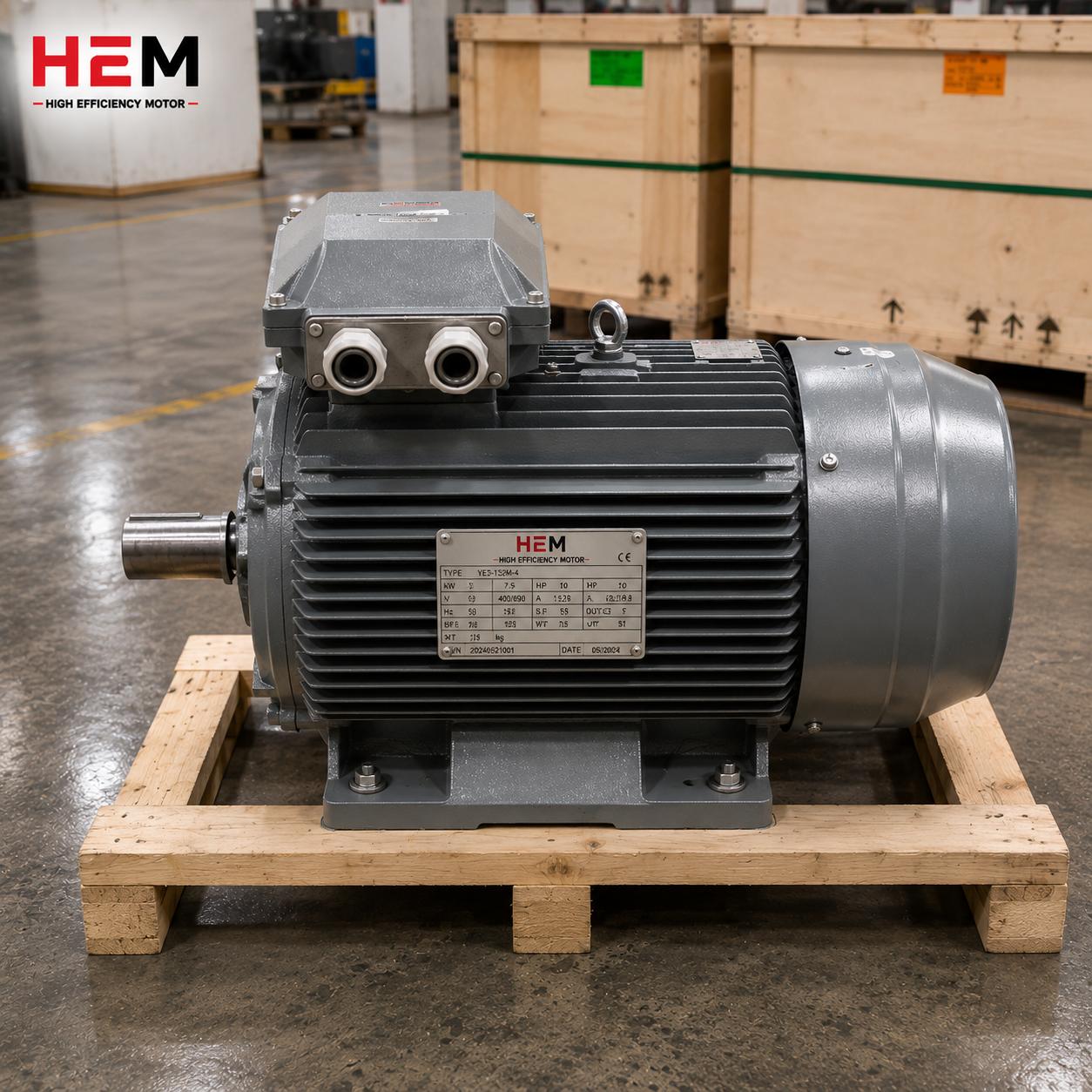
Mounting Type (B3, B5, B14, B34)
Mounting type is very important in micro-power motors because many applications bolt directly to the machine via the flange. B3 foot-mounted, B5 large-flange, B14 small-flange and B34 combined foot-and-small-flange versions are available. Pump and gearbox inputs often demand B14 and B5, while belt and conveyor drives favour B3. Giving the correct mounting code is critical to avoid mismatch on site.
What IE3 Efficiency Class Means at Micro-Power
IE efficiency classes define the motor's electrical efficiency under load. At micro-power, absolute efficiency values are lower than for large motors, because constant losses (iron loss, friction, windage) are relatively more dominant. But precisely for this reason the IE3 class earns its value here: a small efficiency increase, accumulated over years in a continuously running motor, yields meaningful energy savings. A single motor may look small, but a plant can run hundreds of micro-power motors together.
Another point to watch in efficient motor selection is avoiding over-sizing. An oversized motor runs at partial load and drifts away from the peak of its efficiency curve. For more detail on this, we recommend our approach on over-sizing and downsizing.
Factors Affecting Efficiency at Micro-Power
- Insulation class and temperature rise: Class F insulation with Class B temperature rise extends motor life.
- Winding quality: Better copper fill and low-resistance windings reduce copper loss.
- Magnetic sheet quality: Low-loss silicon steel reduces iron loss.
- Bearings and lubrication: Minimise mechanical losses.
A Correct Buying Strategy Based on Stock
The most common difficulty with micro-power motors is that the desired power-pole-frame-mounting combination is not always on the shelf. At the smallest powers such as 0.18 and 0.25 kW, standard 2- and 4-pole versions can usually be delivered from ready stock, while special 6- and 8-pole combinations may require planning. As manufacturer and stock supplier, clarifying the right combination in advance shortens the delivery time for this group.
A similar stock and power-speed planning logic also applies one power class up. If you want to examine the stock and speed balance at common powers such as 1.5 and 2.2 kW, our content on IE3 1.5 and 2.2 kW stock and speed will guide you. To see the broader power-speed-pole relationship, our article on pole selection in 2.2 and 3 kW motors will be useful.
Information to Prepare Before Ordering
- Exact power (0.18 or 0.25 kW) and desired pole count / speed.
- Frame size (63/71) and mounting type (B3/B5/B14/B34).
- Shaft diameter and shaft-end features (keyed/keyless).
- Voltage and frequency (230/400 V, 50/60 Hz), star-delta connection need.
- Protection class (IP55 etc.) and operating environment (dust, humidity, temperature).
- Whether it will run on an inverter or directly on the mains.
Application Examples for Micro-Power Motors
The use areas of 0.18 and 0.25 kW motors are quite diverse. Small conveyor belts, dosing screws and labelling units in food and packaging lines; mixers and mills in laboratory and sample-preparation equipment; small damper and louvre drives in HVAC systems; and winding and guide mechanisms in textiles all run in this power class. Each application imposes its own torque-speed profile.
For instance, in a continuously running small mixer, the starting torque and start-up behaviour matter. Here a 4-pole motor offers both a reasonable speed and adequate starting torque. By contrast, a small centrifugal fan needs high speed, so a 2-pole motor is the right choice. The wrong pole selection either increases gearbox cost or forces the motor to operate in an inefficient region.
Running on the Mains and with an Inverter
Micro-power IE3 motors can run both directly on the mains and with a frequency inverter. Inverter use offers advantages in speed control and energy saving; however, at low speeds the cooling capacity of a self-cooled motor falls. Therefore, if the motor will run continuously at low speed over a wide range, external cooling or thermal protection should be planned. In addition, voltage spikes at the inverter output can stress winding insulation in micro motors, so suitable insulation and, when needed, an output filter are recommended.
In mains-fed applications, sudden voltage surges and lightning-induced overvoltages can threaten the windings of small motors. Our article on overvoltage and surge arrester protection offers additional information. For our full product range and technical support, you can visit our homepage and request a quotation for the micro-power motor that suits your need.
Points to Consider When Requesting a Quote
A correct quote begins with a correct information set. With micro-power motors, simply saying "a 0.25 kW motor" is not enough, because there are dozens of different combinations at the same power. Once the pole count, frame, mounting type, shaft dimension, voltage and protection class are clarified, you get both the fastest delivery from stock and zero mismatch risk on site. As manufacturer and stock supplier, we can listen to your application and determine the most suitable micro-power IE3 motor together.
Protection Class and Operating Environment at Micro-Power
0.18 and 0.25 kW motors are usually embedded inside machines, often in dusty or humid locations. For this reason the protection (IP) class is just as important as the power itself. While IP55 is sufficient for standard applications, food and washdown lines may require higher protection classes against the possibility of pressurised water contact. Because the frame is small at micro-power, the quality of the sealing gaskets and shaft seal plays a critical role in keeping water away from the bearing region. A small motor with the wrong protection class can fail early in the field, causing a line stoppage that costs far more than the initial price of the motor.
The ambient temperature of the operating environment also has a direct effect on selection. Nameplate values for micro-power motors are usually given for a 40 °C ambient and 1000 m altitude. Motors running at higher temperatures or altitudes require derating; otherwise the winding temperature exceeds the permitted limit and life is shortened. In applications that run continuously at high temperature, adding a thermistor (PTC) or thermal protection element is a cheap but effective measure that prevents the small motor from burning out.
Noise and Vibration Expectations
In applications such as laboratories, HVAC near offices and sensitive measuring equipment, the noise and vibration level of the micro-power motor is a prominent criterion. A balanced rotor, quality bearings and the correct mounting type noticeably reduce vibration. Low vibration also extends the life of couplings, pulleys and measuring equipment. Where quiet operation is required, 4- and 6-pole, lower-speed motors generally run more quietly than 2-pole high-speed motors.
Micro-Power Selection from a Total Cost of Ownership View
The purchasing decision for micro-power motors is often made by looking only at the list price; yet the real cost paid over the motor's life is energy consumption. In a continuously running 0.25 kW motor, the efficiency gain achieved with IE3 can reach several times the initial price of the motor over the years. When a plant runs hundreds of motors of this power, small percentage gains turn into a large total saving. Therefore, even at micro-power, the right efficiency class, the right pole and the right sizing directly affect the return on investment.
Frequently Asked Questions
How does the difference between a 0.18 kW and a 0.25 kW motor affect my application?
The roughly 0.07 kW difference looks small, but it can be decisive in a marginal application. In a drive where 0.18 kW seems sufficient, 0.25 kW provides a safer margin if there is starting torque or transient load increase. However, oversizing also reduces efficiency, so it is best to evaluate the real load and start-up conditions together.
Does the IE3 class really make a difference at micro-power?
Yes. Although absolute efficiency values are more limited at low powers, the efficiency increase provided by IE3 turns into meaningful energy savings over years in a continuously running motor. Moreover, since IE3 motors usually run with higher-quality material and lower temperature rise, they also offer advantages in life and reliability.
How long do I wait if my desired pole-frame combination is not in stock?
Standard 2- and 4-pole 0.18 and 0.25 kW motors are usually delivered quickly from ready stock. For 6- and 8-pole or special mounting types, the delivery time may extend depending on planning. When you clarify the combination before ordering, we can share the most realistic delivery time and stock status with you.