English
 Türkçe

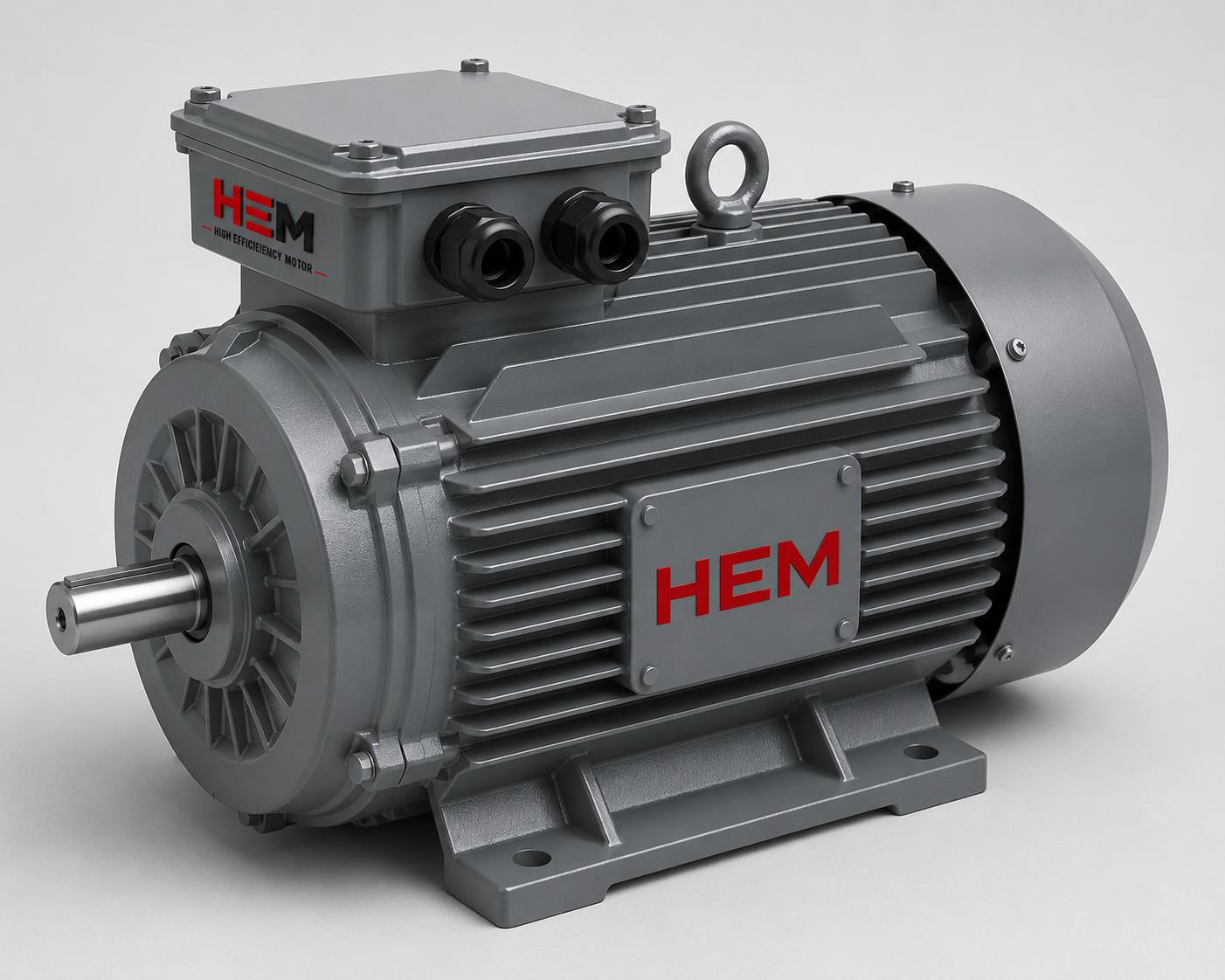

Selecting an asynchronous motor by looking at a single torque figure in a catalogue can lead to a serious starting problem when the load has high inertia. Many engineers only check the starting torque (locked-rotor) and the pull-out torque (breakdown); yet there is an often-ignored valley between these two peaks: the pull-up torque. With high inertia loads such as fans, centrifuges, large-flywheel crushers and long conveyors, the motor frequently gets stuck precisely in this valley, fails to reach speed, overheats and trips. In this guide we walk through the entire starting curve, explain why pull-up torque is critical, how to avoid stall risk, and how to choose the right motor from stock for your application. At HEM Motor we manufacture and supply IE3 and IE4 efficiency-class motors from 0.55 kW up to 355 kW, with 100% copper windings and cast-iron bodies, all backed by manufacturer assurance — this guide is here to help you pick the correct torque-speed characteristic from the start.
The Three Critical Points of the Torque-Speed Curve
The healthiest way to understand an asynchronous motor's behaviour is to read its starting curve, which shows the torque produced versus speed (slip). This curve spans the whole range from a stationary rotor to synchronous speed and is read through three characteristic points. These three values are what really determine whether a motor can accelerate a load.
- Starting torque (locked-rotor / Ta): The torque produced while the rotor is still at zero speed. If it does not exceed the load's breakaway torque, the motor never moves.
- Pull-up torque (Tu): The minimum torque value between the starting point and the breakdown peak. It is the valley of the curve, usually occurring around one third of full speed. This is where acceleration struggles the most.
- Pull-out / breakdown torque (Tb): The maximum torque the motor can produce. If this peak is exceeded, the motor breaks down, speed collapses and it stalls.
Many selection mistakes come from trusting only the starting and breakdown values while ignoring the acceleration dip in between — the pull-up valley. If the load torque curve crosses this valley, the motor gets stuck at that speed.
Why Pull-Up Torque Is Decisive
While accelerating a load, at every speed the motor uses the difference between the motor torque available at that speed and the load's resisting torque at that speed. This difference is the accelerating torque. The larger it is, the faster the motor reaches speed. Here is the problem: at the pull-up torque point the motor torque is at its lowest. If the load's resisting torque at that speed exceeds the motor's pull-up torque, the accelerating torque turns negative and the motor jams at that speed. Unable to reach speed, it keeps drawing a current close to locked-rotor current, the winding heats rapidly, and within a few seconds it enters a stall condition and is tripped by thermal protection.
This is especially insidious in applications with low load torque but high inertia. Because the load's own friction/work torque is small, the motor looks "more than adequate" on paper; but since accelerating a large rotating mass takes a long time, the motor lingers in the pull-up valley and is thermally stressed. To select the right motor you must evaluate not just the kW but the entire torque-speed curve together with the load's inertia (GD² or J). To see how rated torque is calculated and the kW-speed relationship in detail, review our guide on IE3 motor rated torque calculation from kW and rpm.
High Inertia (GD² / J) and Its Relation to Stalling
A load's inertia expresses the resistance a rotating mass shows against acceleration. It is often written as GD² (flywheel effect) in field practice and as J in international standards. The higher the inertia, the longer it takes the motor to reach a given speed. Typical high-inertia loads include:
- Large-diameter centrifugal and axial fans (the blades form a heavy rotating mass)
- Centrifugal separators and decanters
- Flywheel crushers, jaw crushers and mills
- Long conveyor belts and large drums
- Pumps with large impellers started against a filled line
With these loads the run-up time grows. Throughout the extended start, the rotor bars and winding heat up under high current. Every motor has a maximum locked-rotor time (tE or permitted starting time); if the start exceeds it, the motor is thermally damaged. So selecting the right motor under high inertia requires accounting for thermal endurance, not just torque. Our article on motor selection under impact load, flywheel and inertia complements this topic for crusher drives.
Run-Up Time and the Thermal Limit
Run-up time is found approximately by dividing the load's total inertia by the motor's average accelerating torque. If the average accelerating torque is low (i.e. the pull-up valley is deep), this time gets longer. The practical rule is this: if you will drive a high-inertia load, choose a design class with high pull-up torque or step up one kW size to increase accelerating torque. Because HEM Motor stocks options with different poles and torque characteristics for the same kW, we help you choose the right curve for your load at the quotation stage.
Design Classes and the Effect of Pole Selection on the Curve
Asynchronous motors are grouped into design classes by the shape of their torque-speed curves. Known internationally as NEMA A/B/C/D, these classes have IEC equivalents (N, NY, H, HY). The class determines the starting and pull-up torque levels depending on rotor bar geometry and winding design.
- Standard class (general purpose): Medium starting and pull-up torque; suitable for pumps, fans and general industrial loads.
- High starting torque class: Deeper / double-cage rotor; preferred for conveyors, crushers and loaded starts with high resisting torque.
- High-slip class: Smooths speed fluctuation in impact loads and flywheel energy-storage applications.
The number of poles also affects the curve. For the same kW, a 2-pole motor (about 3000 rpm) has lower rated torque than a 4-pole one (about 1500 rpm); therefore a lower-speed, higher-torque motor often gives a safer start under high inertia. You can find the relationship between starting torque and rated torque, and selection by load on direct-on-line starting, in our article on IE3 motor starting torque and rated torque (DOL).
The Effect of Reduced-Voltage Starting on Pull-Up Torque
Star-delta and soft starters, commonly used to limit inrush current, reduce the voltage applied to the motor. Since torque in an asynchronous motor is proportional to the square of voltage, when the star step applies about 58% of rated voltage, torque drops to roughly one third (1/3). This has a very critical consequence in practice: in the star position both the starting and the pull-up torque fall to one third. With a high-inertia load the motor cannot clear the pull-up valley in star, fails to reach speed, and stays jammed until transfer to delta. Transferring to delta too early then creates a high current surge.
Therefore, with high-inertia loads:
- Prefer direct-on-line (DOL) where possible, or start at full voltage if the supply permits the inrush.
- If a soft starter is used, set the initial voltage (pedestal) high enough to clear the load's pull-up valley.
- If started with a frequency converter (VFD), the high-inertia problem largely disappears, since high torque can be produced at low speed.
- If genuinely high inertia and high torque are required, choose a larger kW size or a high-torque design.
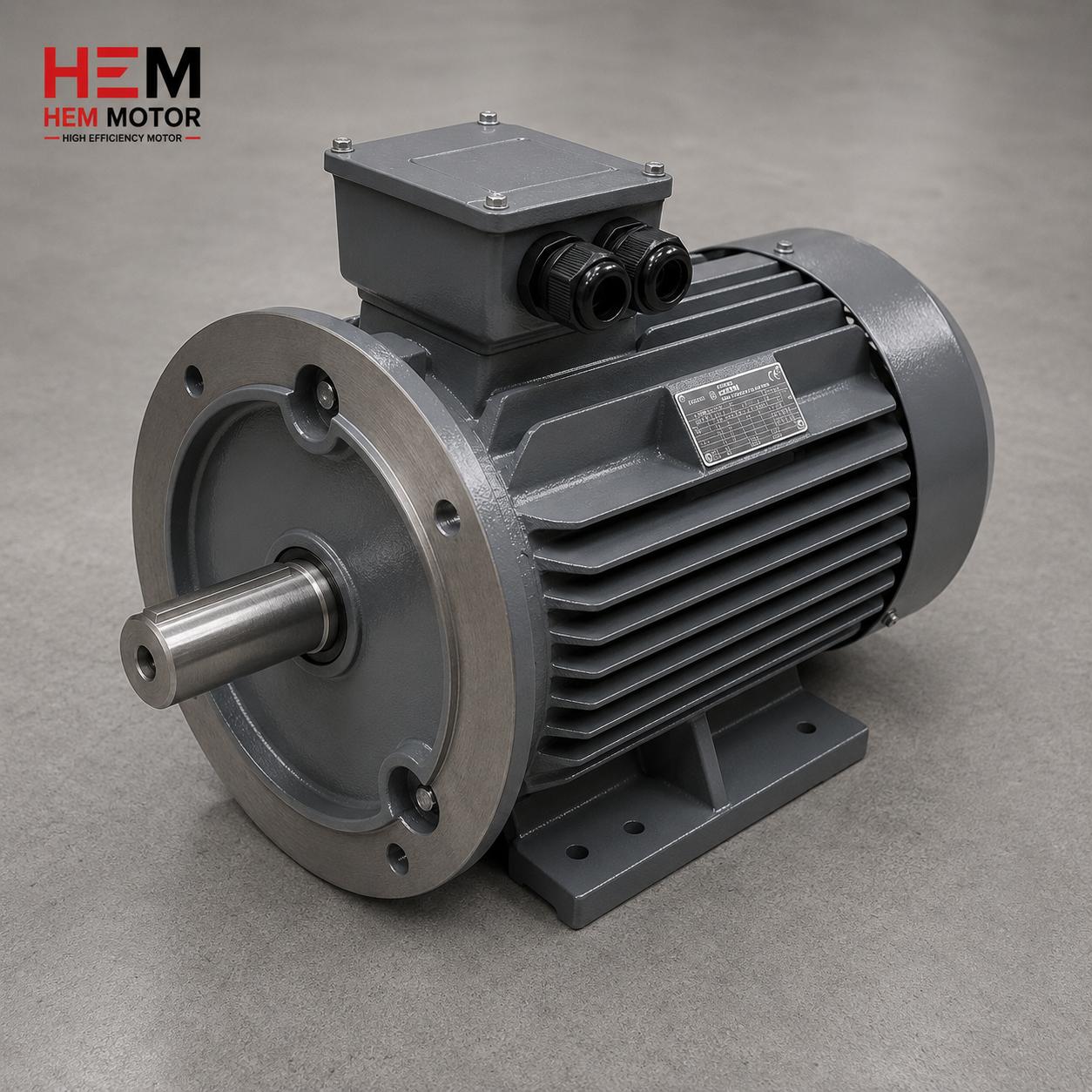
At HEM Motor, if we know which starting method you will use, we recommend a motor with adequate pull-up torque from the outset, so you do not wrestle with surprise stalls on the panel side. Browse our wide IE3 electric motor product family to see the right power, pole and mounting type for your application.
A Checklist for Choosing the Right Motor From Stock
When buying a motor for a high-inertia application, following these steps prevents stalling and thermal-trip problems in the field:
- Determine the load's resisting torque curve (speed-torque) and its total inertia (GD²/J).
- Make sure the motor's pull-up torque on the torque-speed curve is clearly above the load's resisting torque at the same speed.
- Verify that the run-up time does not exceed the motor's permitted starting time.
- State up front which starting method you will use (DOL, star-delta, soft starter, VFD).
- Choose the pole count and speed according to the application; a lower speed is usually safer under high inertia.
- Prefer thermally robust features such as cast-iron body, class F insulation and 100% copper winding.
If you share this checklist with us before ordering, we quickly supply a motor with the right torque characteristic from stock and clarify your delivery schedule. You can request a quote for current electric motor prices and stock availability; with manufacturer assurance we deliver the correct motor, with the correct curve.
Frequently Asked Questions
Are pull-up torque and starting torque the same thing?
No. Starting torque is the torque produced while the rotor is stationary (at zero speed). Pull-up torque is the minimum torque value between the start and the breakdown peak — the valley of the curve. With high-inertia loads the motor usually clears the starting torque but jams in the pull-up valley, so both values must be evaluated together when selecting.
If my motor trips before reaching speed, could pull-up torque be the cause?
Yes, this is a very typical symptom. If the load inertia is high or it starts at reduced voltage with star-delta, the motor cannot clear the pull-up torque valley, draws high current without reaching speed, and the thermal protection trips due to stall. The fix is to raise the starting voltage, use a VFD, or select a motor/size with higher pull-up torque.
Which motor do you recommend for a high-inertia load?
We select based on the load's GD²/J value, its resisting torque curve and the starting method. We usually recommend a high-torque design, a suitable pole count and, if necessary, a larger kW size. As HEM Motor stocks a wide range of IE3 and IE4 motors from 0.55 to 355 kW, we supply a motor with the right starting curve for your application with manufacturer assurance and fast delivery.