English
 Türkçe

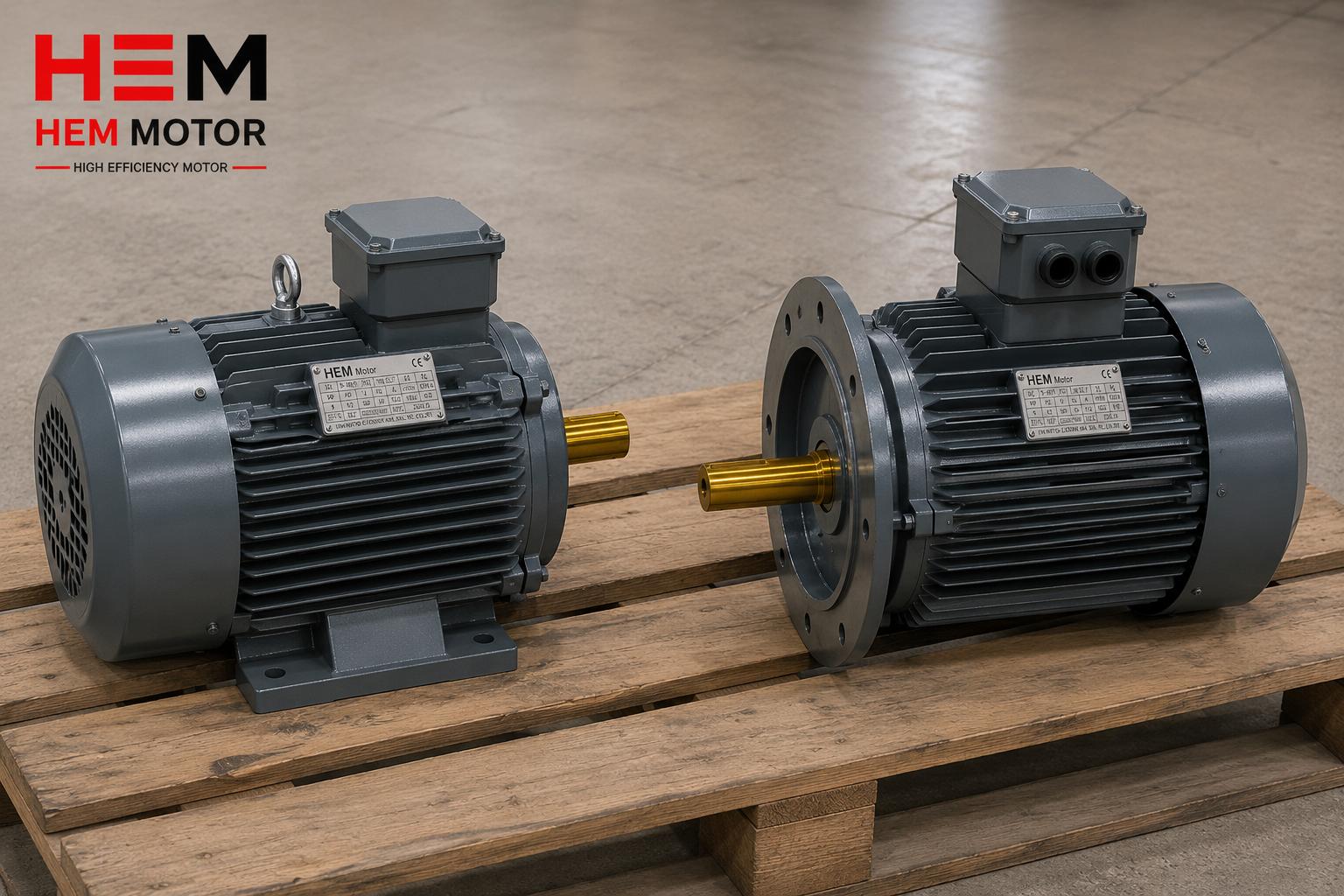

An electric motor's mounting position determines not only how it connects to the machine but also how the motor's bearings are loaded. When a motor is mounted vertically and receives an axial force from its shaft, the axial thrust load comes into play. While in horizontal mounting the bearings mostly carry the weight of the shaft, in vertical mounting the thrust forces acting along the shaft load the bearings differently. For this reason, selecting a vertically mounted asynchronous motor requires determining the correct bearing arrangement and the correct mounting code.
As HEM Motor, when we supply motors for vertically mounted pump, mixer and special drive applications, we focus on three points: the direction and magnitude of the axial thrust load, the correct mounting code (such as V1/V5), and a bearing arrangement that carries this load. In this article we explain the challenges of vertical mounting, thrust bearing selection and correct motor supply. You can review our general-purpose and pump motor range and current electric motor prices on our product pages.
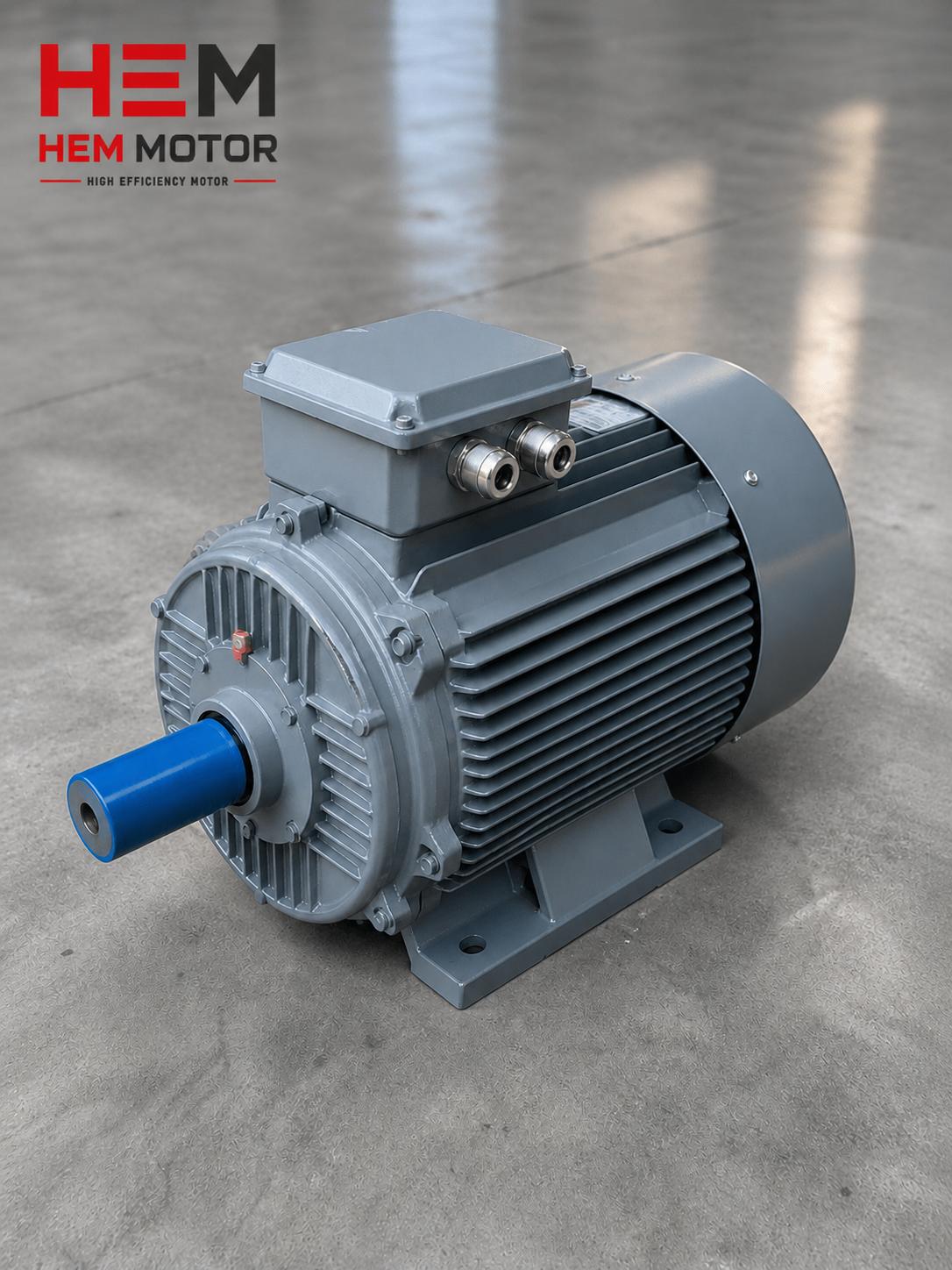
Vertical Mounting Codes: V1, V5, V3, V6
The mounting positions of electric motors are coded according to the IEC standard. In vertical mounting the shaft is positioned facing up or down; this changes the bearing load and the sealing requirement.
- V1: A flange-mounted motor installed vertically with the shaft facing down; common in vertical pumps.
- V5: A foot-mounted motor installed vertically on a wall/bracket with the shaft facing down.
- V3: A flange-mounted motor installed vertically with the shaft facing up.
- V6: A foot-mounted motor installed vertically with the shaft facing up.
We address oil-seal and order details in shaft-down V1/V5 mounting in our vertically mounted electric motor selection: oil seal in shaft-down V1/V5 position article, and shaft-up V3/V6 mounting in our electric motor V3 and V6 mounting: shaft-up and wall mounting article.
What Is the Axial Thrust Load?
The axial thrust load is the force acting along the shaft axis. In a horizontally mounted motor the load is mostly radial (perpendicular to the shaft); in vertical mounting the driven load (for example a pump impeller or the weight of a rotor) creates a downward or upward thrust along the shaft. This thrust can be a load that a standard motor's bearings are not designed to carry.
- Radial load: Acts perpendicular to the shaft; belt-pulley tension and shaft weight are typical sources.
- Axial (thrust) load: Acts along the shaft; in vertical pumps, impeller thrust and the weight of the rotating mass are the main sources.
- Direction: The thrust can be downward or upward; bearing selection is made according to this direction.
We detail the shaft's radial and axial load limit, together with belt tension and coupling thrust, in our electric motor shaft radial and axial load limit article.
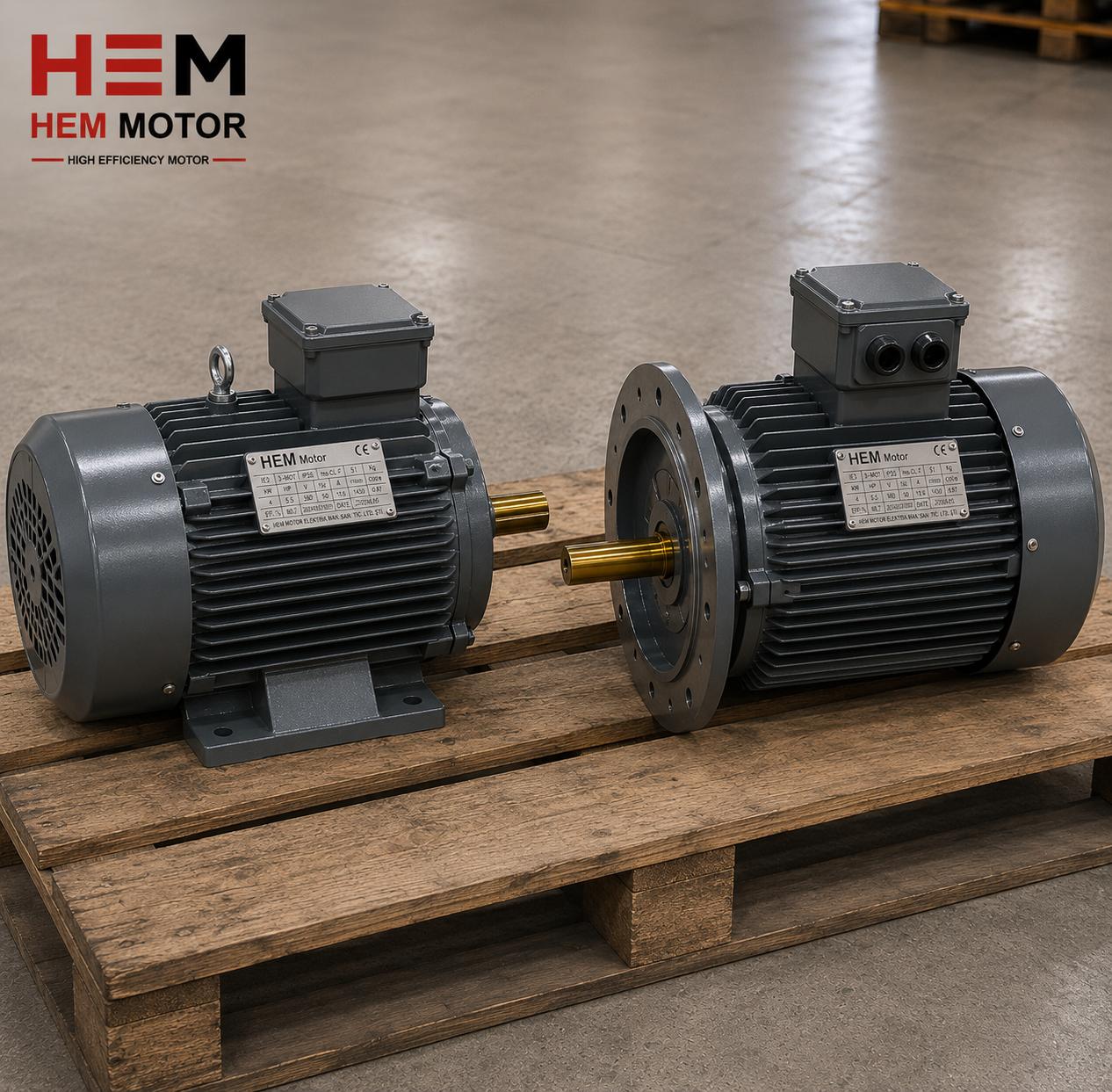
Thrust Bearing and Bearing Selection
In vertical applications with an axial thrust load, a standard deep-groove ball bearing is often insufficient. In this case, special bearing arrangements come into play. Correct bearing selection directly determines the motor's life.
- Angular contact bearing: Designed to carry a one-directional axial load; common in vertical pumps.
- Tapered roller/thrust bearing: Specially placed at high axial loads to carry the thrust.
- Bearing preload: Bearings can be mounted with a certain preload to balance the axial load.
- Lubrication: Lubrication behavior changes in the vertical position; grease distribution and seal selection are made accordingly.
We explain axial thrust and angular contact bearing selection in vertical hollow-shaft deep-well pump motors in our vertical hollow-shaft (VHS) deep-well pump motor: axial thrust load and angular contact bearing article, and bearing type selection in asynchronous motors in our bearing type and life in asynchronous motors article.
Sealing in Shaft-Down Mounting
In shaft-down (V1/V5) mounting, because the shaft outlet faces down, water, condensation or dripping from above carries the risk of seeping directly into the motor. For this reason, oil-seal and sealing measures are more critical in shaft-down vertical mounting.
- Oil seal: The seal at the shaft outlet prevents liquid and dust from reaching the bearing; correct seal selection is essential in the vertical position.
- Drip cover: In shaft-up mounting, a protective drip cover is used against water ingress from above.
- Drainage: Drain holes must be correctly positioned so that condensed water does not accumulate inside the motor.
We detail oil-seal and sealing measures in cast-iron motors in our oil seal and sealing in cast-iron motors article.
Selecting the Correct Power and Speed
In a vertically mounted application too, the motor power is determined by the requirement of the driven load. However, the axial load affects the bearing arrangement independently of the required power. That is, two motors of the same kW, one for horizontal and one for vertical axial load, can have different bearing arrangements.
- Power: Selected according to the kW the driven load (pump, mixer, etc.) requires.
- Speed/pole: Selected among 2/4/6 poles according to the speed the application requires.
- Duty type: S1 duty is preferred in continuously running applications.
We address correct pole and speed selection in our asynchronous motor buying guide: which pole count for which job article, and pump motor power matching in our pump motor selection guide: flow, head, speed and power article.
Supply and Order Information
A vertically mounted, axially loaded motor may require a special bearing arrangement unlike standard horizontal stock. Therefore, before ordering, the mounting code, the direction and magnitude of the axial load, and the bearing requirement must be clarified. As HEM Motor, we supply motors for vertically mounted applications with the correct mounting code and bearing arrangement according to the requirement of the existing motor or machine. You can review our mounting-types range on our B5 flange-mounted electric motors page, and pump motors on our pump electric motors page.
Replacing the Existing Motor Like-for-Like
When a vertically mounted motor fails, not only power and speed but also the mounting code and bearing arrangement must match exactly. The information to read from the nameplate and the installation is:
- Power (kW), speed (rpm) and mounting code (V1/V5/V3/V6).
- Frame size (IEC frame), flange type and shaft diameter.
- Axial load direction and, if present, thrust bearing information.
- Protection class (IP), insulation class and voltage/frequency.
We explain like-for-like equivalent selection from the nameplate step by step in our avoid the wrong motor delivery: like-for-like matching by nameplate before ordering article.
Frequently Asked Questions
Can a horizontal motor be used in the vertical position?
A motor's horizontal design cannot always safely carry vertical mounting and axial thrust load. In the shaft-down (V1/V5) position the sealing requirement changes, and under axial load the bearing arrangement differs. It must therefore be verified that the motor is suitable for the relevant mounting code (V1/V5/V3/V6) and has a bearing arrangement that carries the axial load.
What bearing is required for an axial thrust load?
Under an axial thrust load, a standard deep-groove ball bearing is often insufficient. For a one-directional axial load an angular contact bearing is preferred; for a high axial load a tapered roller/thrust bearing is preferred. Bearing selection is made according to the direction and magnitude of the thrust; therefore the axial load information must be conveyed before ordering.
Why should I specify the vertical mounting code when ordering?
The mounting code (V1/V5/V3/V6) determines the bearing arrangement, the sealing measures and the flange/foot connection. A motor with the wrong code cannot be connected to the machine, or even if connected, fails early by failing to carry the axial load. The mounting code is therefore one of the most critical pieces of information to clarify before ordering.