English
 Türkçe

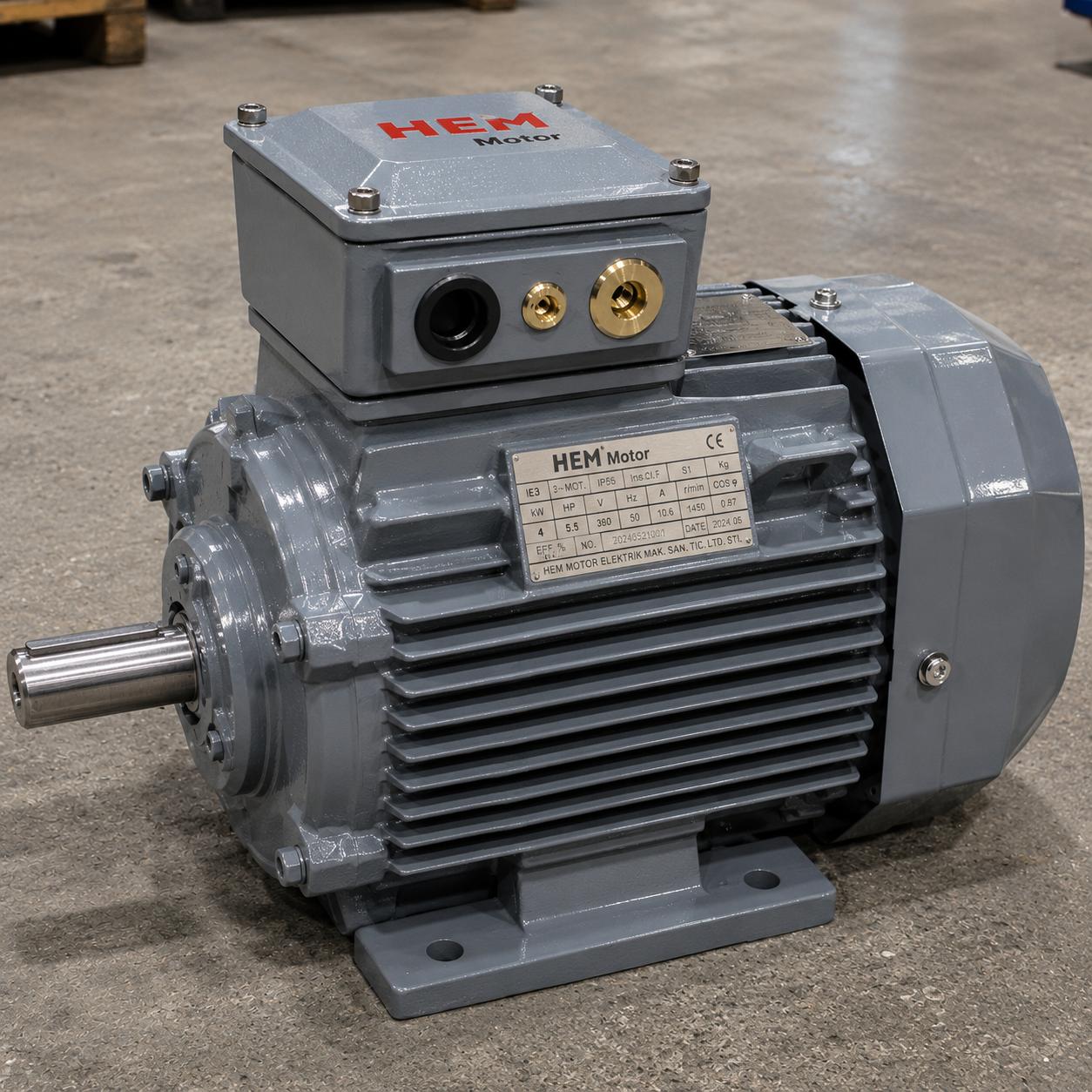

When you connect an asynchronous motor directly to the grid and start it (DOL — Direct On Line), the motor instantaneously draws a starting current several times higher than its rated current. This sudden current surge causes a voltage drop on the grid, jolts in the mechanical transmission and heating in the motor winding. To soften these problems, a soft starter is used, and the most critical setting of this device is the ramp time. The ramp time determines how long the motor takes to reach full speed from rest. As HEM Motor, with our identity as both manufacturer and seller, we guide facilities in selecting a motor suited to the starting method and setting the correct ramp. In this article we cover starting current, the effect of load type and how to set the ramp time correctly.
A soft start keeps the voltage applied to the motor low at first and raises it gradually, allowing the motor to accelerate smoothly. This both limits the starting current and reduces mechanical shock. But setting the ramp time correctly is a balancing act: too short a ramp cannot prevent the surge, while too long a ramp heats the motor unnecessarily.
The basic logic of soft starting is to raise the voltage along a controlled curve instead of suddenly switching the motor onto full voltage. A thyristor-based soft starter increases the effective voltage reaching the motor gradually by adjusting the conduction angle for each phase. The motor begins to move smoothly at a low initial voltage, then the voltage climbs to its full value over the ramp. When the motor reaches full speed, the soft starter usually switches out via a bypass contactor, and the motor is connected directly to the grid. This way there is no loss across the soft starter during operation.
This approach provides serious advantages both electrically and mechanically. Electrically, the sudden current surge drawn from the grid is reduced, which prevents voltage drop and avoids affecting other equipment. Mechanically, the jolt caused by sudden torque disappears; transmission elements such as belts, couplings, gears and bearings wear less. As a result, the life of both the motor and the driven machine is extended.
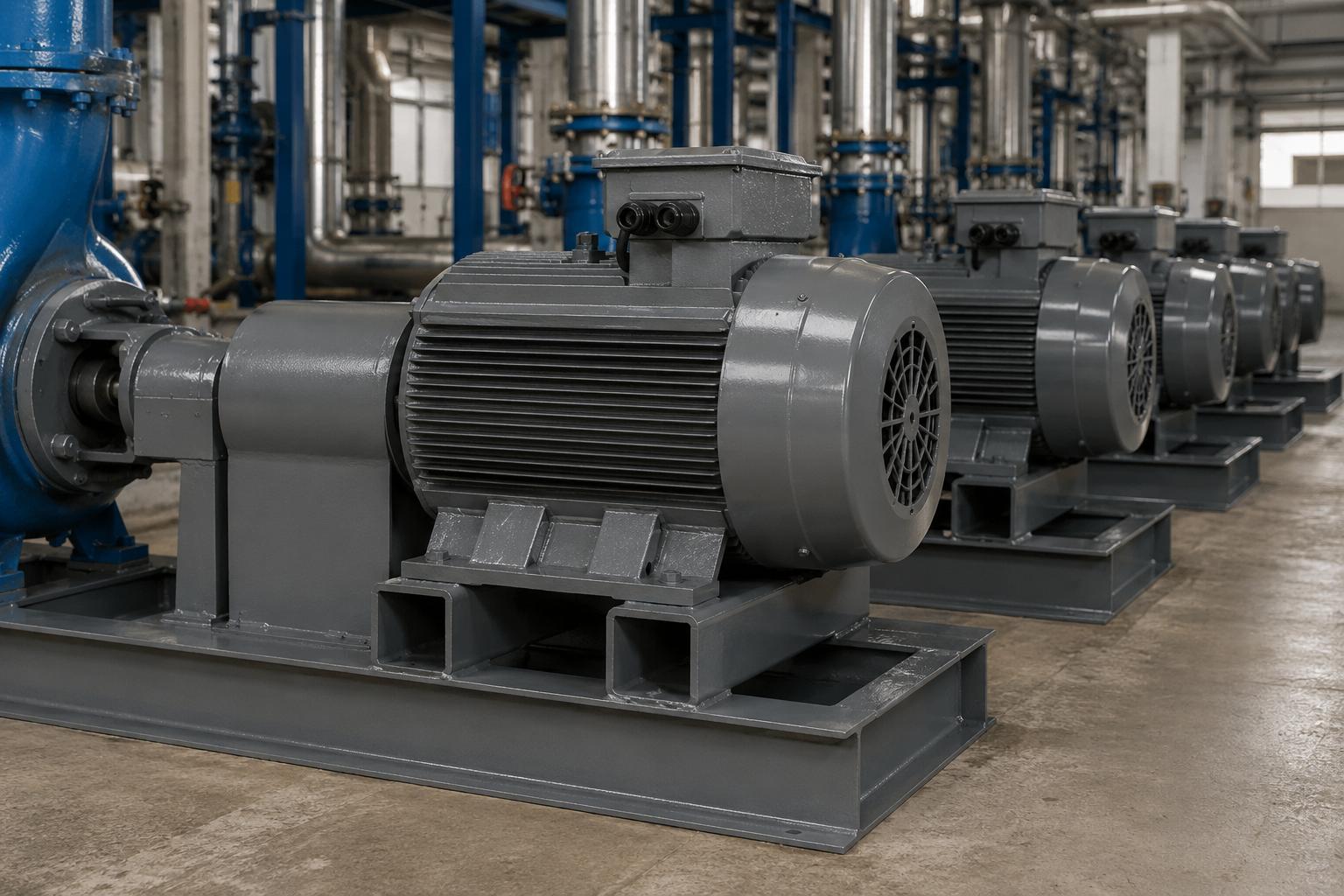
Why Is Starting Current High?
When the motor is at rest, the rotor is not turning, so the induced back-voltage (back-EMF) in the windings is zero. As a result the motor behaves almost like a short circuit and draws a high current. As the motor accelerates, the back-EMF rises and the current falls toward its rated value. In direct starting, this high current flows for a few seconds; in large motors it can cause a noticeable voltage drop on the grid and affect other equipment.
A soft starter keeps the starting current under control by limiting the initial voltage. This protects both the grid and the mechanical system from sudden torque. On sites fed by a generator this is especially important; we covered the topic in detail in our article on motor selection on generator-powered sites.
Load Type Determines the Ramp Time
The correct ramp time value depends on the character of the load the motor drives. Different loads exhibit different starting behavior.
Low-Inertia, Low Starting-Torque Loads
Loads such as centrifugal pumps and small fans demand low torque at startup and have low inertia. For these applications a short ramp time is sufficient; the motor reaches speed quickly and the winding does not overheat.
High Starting-Torque Loads
Some loads demand high torque at startup, before the motor even begins to turn. Loaded conveyors, mixers and some crushers fall into this class. Setting the initial voltage too low is dangerous in these applications, because the motor cannot break the load free, behaves as if turning in place and heats up with high current for a long time. For high starting-torque loads, the initial voltage must be kept high enough to set the load safely in motion. This is one of the fundamental differences between soft start and star-delta: soft start allows the starting torque to be set more precisely.
High-Inertia Loads
Large-diameter fans, flywheel presses, mills and wide conveyors carry high inertia. Accelerating these masses takes a long time, so the ramp time must be kept long. But the longer the ramp, the longer the motor draws high current under low voltage and heats up. For high-inertia loads, motor power and duty type must therefore be selected carefully. Our article on flywheel and inertia details this behavior.
The critical point with high-inertia loads is the balance between the starting time and the motor's heating limit. The ramp must be long enough for the load to accelerate, but this time must not exceed the starting time the motor can safely withstand. Very long and frequent starts gradually raise the winding temperature. In this case it may be necessary either to select a more powerful motor or to provide a much more controlled acceleration with a frequency drive.
How to Set the Ramp Time
On a soft starter, the initial voltage and the ramp time can be set. Correct adjustment follows this logic:
- Starting torque must be sufficient: The initial voltage must be set high enough to set the load in motion. At too low a voltage the motor will not begin turning and heats up in place.
- The ramp must match the load's acceleration time: The ramp time is chosen close to the time the load actually needs to accelerate. Too short a ramp brings the motor to full voltage while it is still at rest and cannot prevent the current surge.
- Avoid an excessively long ramp: An unnecessarily long ramp runs the motor at low speed with high current for a long time; the winding heats and thermal protection may trip.
- Thermal protection must be compatible: On long starts it is important to select the thermal relay to suit the starting current and duration.
Practical Approach
In practice the ramp is started from a medium value; if the motor reaches full speed without vibration or shock and without tripping thermally, the setting is correct. If the load struggles at startup, the initial voltage is raised; if the start is too harsh, the ramp is lengthened. This fine-tuning is done in field conditions during commissioning.
Effects of Starting Current on Operations
High starting current is not just a theoretical problem; it produces concrete consequences in operation. When a large motor is started directly, the sudden current it draws can cause a voltage drop in other equipment fed from the same panel or transformer. This can cause sensitive electronic devices to malfunction, lighting to flicker, and even some equipment to stop. In addition, the current surge at each start strains protection elements such as fuses and contactors and shortens their life.
On the mechanical side, the sudden torque created by direct starting shakes the system. The belt is suddenly tensioned, the coupling is strained and the gears take an impact. Over time these repeated shocks cause loosening, wear and early failure in transmission elements. A soft start eliminates this shock by raising the voltage gradually and protects both the electrical and mechanical systems. For high-power motors that start frequently in particular, soft starting is therefore not a luxury but an economic necessity.
Factors Affecting the Ramp Time
The correct ramp time is not found with a single formula; it is determined by the combination of many factors. Knowing these factors lets you make more informed adjustments during commissioning:
- Load inertia: The heavier the load and the wider its rotation diameter, the longer it takes to accelerate and the longer the ramp must be.
- Starting torque need: If the load demands high torque at startup, the initial voltage must be raised; otherwise the motor cannot break the load free.
- Motor power margin: A motor generously sized for the load completes the start faster and with less heating.
- Start frequency: If starts are frequent during the day, the heat of each start accumulates; ramp and motor selection must then be more careful.
- Grid capacity: On a weak grid or generator supply, the ramp may be kept slightly longer to limit the current surge.
All these factors interact with one another. A high-inertia but low starting-torque fan, for example, needs a long ramp but a medium initial voltage suffices. A loaded conveyor, by contrast, needs both a high initial voltage and a reasonable ramp. The ideal setting is therefore found by evaluating the application as a whole.
Soft Start, Star-Delta or VFD?
Soft starting is not the only option. Star-delta starting is more economical but stepped and harsh in transition; a variable frequency drive (VFD) both starts the motor and provides speed control but is more expensive. We compared which method suits your application in detail in our articles on the star-delta versus soft starter comparison and torque classes and starting torque. On the motor side, choosing a model with the correct starting torque makes the starter's job easier.
Choosing the Right Motor
A soft start cannot rescue a wrongly selected motor. When the power, pole count and starting-torque class suited to the load profile are correctly chosen, the soft starter does its job most efficiently. As HEM Motor, we evaluate the asynchronous motor selection and the starting method together for your load type. Contact us for current electric motor prices and stock availability. On the product side, IE3 Efficient Electric Motors are a suitable starting point depending on your need.
Frequently Asked Questions
How long should I set the ramp time?
The ramp time should be close to the load's acceleration time. For low-inertia loads such as centrifugal pumps a short ramp suffices, while for high-inertia loads such as flywheel presses or large fans the ramp is lengthened. Too short a ramp cannot prevent the current surge; too long a ramp heats the motor. Field fine-tuning is required during commissioning.
Does a soft start eliminate starting current completely?
No, it does not eliminate it completely but limits it significantly. The high surge current of direct starting is reduced by lowering the initial voltage. This both eases the grid voltage drop and protects the mechanical system from sudden torque. Full current reduction is achieved at a more advanced level only with a frequency drive.
Can a soft starter be fitted to every motor?
A soft starter can be used with most standard asynchronous motors. For the correct benefit, however, the motor's starting-torque class and power must be selected to suit the load. In some demanding applications requiring very high starting torque, star-delta or a VFD may be more suitable. If you send us your application, we will recommend the motor and starting method together.