English
 Türkçe

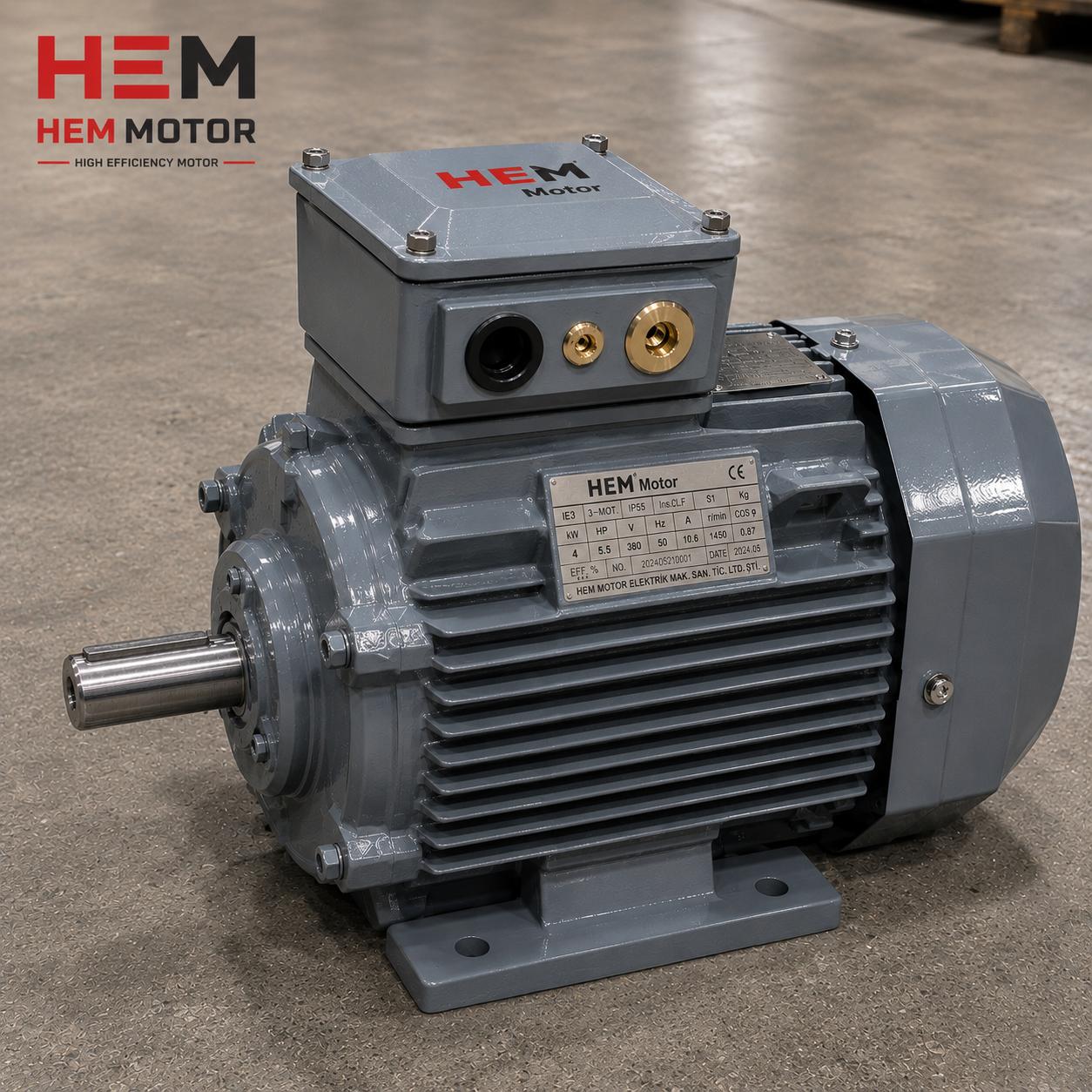

Woodworking plants are far riskier environments than they appear. The fine wood dust produced by band saws, planers, wide belt sanders and CNC machines creates a serious dust explosion hazard when it remains suspended in the air. For this reason, electric motor selection in woodworking and dust collection plants differs from ordinary industrial motor selection; ATEX (explosive atmosphere) zone classification, IP protection class and continuous duty capability must be evaluated together. In this article we address dust explosion zones, which motor is used where, the role of IP protection and correct motor supply from an engineering and purchasing perspective.
At HEM Motor we manufacture and supply motors suited to the woodworking sector. In this sector the principle of "the right motor" rather than "the cheap motor" is vital; because a wrongly chosen motor does not merely fail, it also magnifies the risk of fire and explosion.
What Is a Dust Explosion and Why Is Wood Dust Dangerous?
Fine organic dust can explode when it remains suspended in the air at a certain concentration and meets an ignition source. Because wood dust is a combustible organic material, it carries this risk. A motor's surface temperature, a spark or an internal arc can ignite suspended dust. Therefore, in areas where dust accumulates or a dust cloud may form, motor selection is made around the axis of explosion safety.
- Dust cloud (suspended dust): In extraction ducts, cyclones and filter units the dust is suspended in air; this is the most hazardous condition.
- Dust layer (accumulated dust): Dust that builds up on machines and the motor body acts like an insulating blanket and heats the motor, and can also be an ignition source.
- Ignition sources: Overheated surfaces, mechanical sparks, electrical arcs and static electricity.
ATEX Zone Classification (For Dust)
Explosive dust environments are divided into zones according to how frequently an explosive atmosphere occurs:
- Zone 20: Places where an explosive dust cloud is present continuously or for long periods (for example inside filters and cyclones).
- Zone 21: Places where an explosive dust cloud may occasionally form in normal operation.
- Zone 22: Places where an explosive dust cloud is not expected in normal operation and, if it forms, is short lived.
Each zone requires its own protected (Ex) equipment. We cover when an ATEX/explosion proof motor is mandatory and correct supply in an explosive atmosphere comprehensively in our article on when is an explosion proof (ATEX) motor essential? Correct motor supply in explosive atmospheres. We clarify the decision between a standard motor and an explosion proof motor in our article on explosion proof or standard asynchronous motor? Correct purchasing by environment.
Motor Selection by Plant Zone
Not every point of a woodworking plant has the same risk level. Smart motor selection sizes each piece of equipment according to the risk of its zone:
- Extraction/dust collection fan (high risk): On fans in direct contact with the dust cloud, an Ex protected motor suited to the zone class is evaluated. We detail dust collection fan motor selection in our article on fan motor selection in extraction and dust collection systems.
- Band saw, planer, sander (medium risk): On these motors where dust accumulates on the machine, high IP protection, a totally enclosed type and an easily cleaned body are priorities.
- General workshop and auxiliary equipment (low risk): In well ventilated areas away from the dust cloud, a high IP protection standard industrial motor is sufficient in most cases.
When planning the motor requirements of a woodworking workshop machine by machine, the full list from band saw to extraction must be drawn up. We lay out this planning from start to finish in our article on motor requirement list when setting up a woodworking workshop: band saw, planer and extraction.
The Role of the IP Protection Class
The IP protection class indicates how sealed the motor is against dust and water. Because wood dust is very fine it can easily enter the motor; the dust that gets inside coats the winding with an insulating blanket, blocks cooling and heats the motor. Therefore:
- High IP protection: In dusty environments at least IP55 is preferred, and under heavy dust higher protection such as IP65/IP66. We address IP class selection comparatively in our article on IP protection class selection in electric motors: IP55, IP65, IP66.
- Smooth and cleanable body: Surfaces on which dust does not accumulate and that are easy to clean are preferred; dust accumulated on cooling fins must be cleaned regularly.
- IP protection is not ATEX: High IP protection prevents dust entry but does not provide explosion safety on its own. In an explosion risk zone an Ex certified motor is also required.
Continuous Duty (S1) and Heating
Woodworking machines generally run uninterrupted through long shifts; therefore motors must have S1 continuous duty capability. The heating of a motor in a dusty environment is caused both by dust buildup on the cooling fins and by high ambient temperature. In continuous duty:
- Class F (and H if needed) insulation provides high temperature resistance.
- Regular dust cleaning preserves cooling efficiency.
- Correct power sizing lets the motor run at full load continuously without strain.
Correct Supply: Zone and Duty Information in the Order
When supplying a motor for a woodworking plant, the zone class (20/21/22), the required IP protection, the duty type and the machine connection type must be stated clearly. At HEM Motor we supply high IP protection industrial motors and special solutions required by the application, and help you choose suitably for dust intensive environments. For current electric motor prices and stock availability you can contact us.
Typical Motor Applications in a Woodworking Plant
To make motor selection in a woodworking plant concrete, it helps to review needs machine by machine. Each machine group carries different power, speed and protection requirements:
- Band saw and sliding circular saw: Require high starting torque and continuous duty; dust accumulates on the saw, so high IP protection is important.
- Planer and thicknesser: Run at high speed and produce large chips; the motor's cooling fins must be cleaned frequently.
- Calibrating and wide belt sander: Produce very fine dust; a high protection class is preferred to prevent this dust from entering the motor.
- Dust collection and extraction fan: The most critical motor of the plant; because it works directly with the dust cloud, an Ex protected solution suited to the zone class is evaluated.
- Conveyor and feed systems: Require high torque at low speed; usually used together with a gearbox.
In larger plants such as furniture factories, some of these applications combine with CNC and edge banding machines. We lay out the full motor supply list, including dust extraction and edge banding, from start to finish in our article on furniture factory electric motors: CNC, edge banding and dust extraction supply.
Managing Fire and Static Electricity Risk
Besides dust explosion, fire and static electricity are also serious hazards in wood dust environments. To manage these risks on the motor side:
- Surface temperature control: The motor surface must stay below the ignition temperature of accumulated dust; an overloaded or dust covered motor heats dangerously.
- Grounding: Proper grounding of the motor and machine is essential to prevent static electricity buildup.
- Regular cleaning: Dust accumulated on the cooling fins increases both heating and ignition risk; periodic cleaning is a safety procedure.
- Overload protection: Thermal relays and motor protection cut overheating early, protecting both the motor and the environment.
In special applications involving high temperature and dust, such as OSB, MDF and wood drying kilns, motor selection is even more critical; we address this special environment in our article on OSB, MDF and wood drying kiln asynchronous motors: fan, press and high temperature resistance.
Common Mistakes
- Fitting a standard motor everywhere: Fitting a standard motor in a high risk extraction zone is a serious safety gap.
- Fitting an ATEX motor everywhere: Placing an unnecessary explosion proof motor in a low risk area raises cost for nothing; zone classification must be done correctly.
- Neglecting dust cleaning: Even the highest quality motor overheats if its fins are covered with dust.
- Mistaking IP protection for ATEX: High IP does not replace explosion safety; the two concepts must be evaluated separately.
Motor selection in a woodworking plant is a safety decision. When correct zone classification, correct IP protection and continuous duty capability come together, production runs uninterrupted and the explosion risk stays under control. Evaluating your plant zone by zone and selecting each piece of equipment according to its risk is the best use of both safety and budget.
Motor Order Checklist for a Woodworking Plant
When supplying motors to a dust intensive, explosion risk woodworking plant, you must clearly determine the following information to make the right decision. This checklist offers a framework that protects both safety and budget:
- Zone classification: Is the area where the motor will be placed Zone 20, 21, 22, or a zone with no explosion risk? This determines whether an explosion proof motor is needed.
- Dust intensity: Does the area face a dust cloud or only accumulated dust? This determines the IP protection class.
- Required IP protection: Is at least IP55 needed, or IP65/IP66 for heavy dust?
- Duty type: Does the machine run continuously (S1) through long shifts?
- Power and speed: The kW and speed the machine requires; starting torque demand.
- Mounting type: Foot (B3), flange (B5/B14) or combined (B35) connection; will it run with a gearbox?
- Insulation class: Class F or H insulation if there is high ambient temperature.
- Grounding and protection: Grounding for static electricity risk, a thermal protection plan for overheating.
Clarifying this information upfront lets you choose the right motor without leaving a safety gap and without producing unnecessary cost. Rather than equipping the plant with a single motor type, evaluating each zone according to its own risk is both the safest and the most economical approach.
Frequently Asked Questions
Must every motor in a woodworking plant be ATEX?
No. An ATEX/explosion proof motor is only required in zones where an explosive dust cloud can form (Zone 20/21/22); especially around extraction, filters and cyclones. In well ventilated areas away from the dust cloud a high IP protection standard motor is often sufficient. The decision is made according to the zone classification of the area.
Does an IP65 motor provide explosion protection?
No. IP65 prevents dust and water from entering the motor, which is important in a dusty environment; but it does not provide explosion safety on its own. In an explosive atmosphere an ATEX/Ex certified motor is also required. IP protection and ATEX are complementary but different things.
Why does a motor heat up in a dusty environment?
Fine wood dust accumulates on the cooling fins and body surface, forming an insulating blanket that blocks heat dissipation. If dust that seeps inside coats the winding, heating increases. Therefore high IP protection, regular cleaning and an adequate insulation class are needed together.