English
 Türkçe

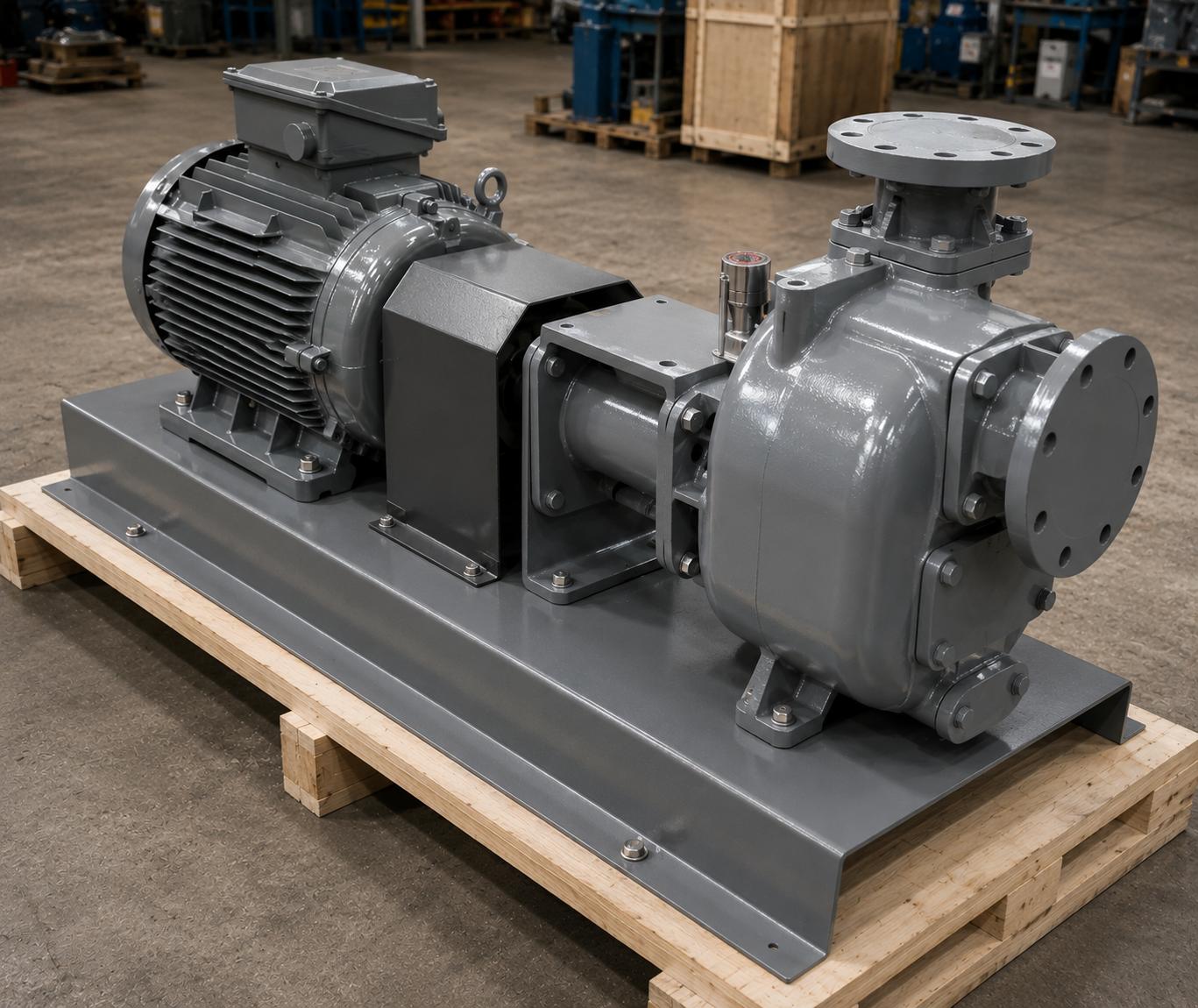

A self-priming jet pump is widely used in garden irrigation, booster (hydrophore), well and cistern applications where the water level sits below the pump axis. Unlike a classic centrifugal pump motor, the electric motor driving these pumps must withstand the special loads created by suction lift, air entrainment and the initial priming process. A wrongly chosen jet pump motor brings overheating, frequent on-off cycling and premature bearing failure. The correct motor, on the other hand, both preserves the self-priming capability of the pump and ensures a long-life, uninterrupted water supply. In this guide we examine suction lift, NPSH, air entrainment and correct power supply from a manufacturer and seller point of view.
How a Self-Priming Jet Pump Works and What It Loads onto the Motor
Self-priming jet pumps operate by retaining a quantity of water inside the casing. On the first start, the water in the pump casing is circulated through the venturi (jet) arrangement, mixing the air in the suction line with water and expelling it. This way the pump creates a vacuum and draws water upward. Until this priming process completes, the motor drives a system that pumps a partial air-water mixture. During the air-water mixture phase the hydraulic load is variable; the motor sometimes runs at full load and sometimes at partial load.
For the motor this means:
- During initial priming the motor runs continuously at high speed because the water is circulated repeatedly, so a motor suited to S1 continuous duty should be preferred.
- During air entrainment the pump efficiency drops while motor speed stays high, which can cause extra heating in the windings.
- Jet pumps usually run as 2-pole machines (about 2900-3000 rpm); high speed makes bearing and balancing quality critical.
- Frequent on-off cycling (booster mode) stresses the motor starting current and thermal capacity.
These loads show that the motor cannot be chosen at random. Our pump electric motor range, in IE3 and IE4 efficiency classes with 100% copper windings and IP55 protection, is designed for continuous duty, offering a safe choice in self-priming pumps.
Suction Lift and NPSH: They Directly Affect Motor Power
The most critical parameter of self-priming pumps is suction lift. Theoretically, atmospheric pressure can raise water roughly 10 meters; however, due to friction losses, water temperature and vapour pressure, practical suction lift is mostly limited to 7-8 meters. As suction lift increases, priming time gets longer, and during that period the motor runs unloaded/partially loaded for longer.
Why Is NPSH Important?
NPSH is the minimum pressure required on the suction side for the pump to operate without cavitation. If suction lift is large, pipe diameter is small and the number of elbows is high, the available NPSH drops and cavitation risk rises. Cavitation causes erosion and vibration in the impeller, while on the motor side it is felt as unbalanced load and noise. Therefore:
- The suction pipe should be as short and wide as possible, with the number of elbows reduced.
- If suction lift is high, bringing the pump closer to the water source or switching to a submersible solution should be evaluated.
- Motor power should be sized for the worst-case hydraulic power (maximum flow and head), never squeezed onto the nominal point.
For applications with large suction lift, deep well solutions come into play. In this case the flow-head calculation in our deep well pump motor selection guide helps with correct power sizing.
Air Entrainment: The Silent Enemy of Performance
Air entrainment results from leaks in the suction line, an excessively low water level or vortex formation. Air entering the pump destroys its self-priming capability and may cause the pump to lose its prime (flow drops to zero). For the motor, air entrainment creates these problems:
- The pump runs empty; even if the hydraulic load drops, motor speed stays high and the cooling fan does not run under sufficient load.
- Since water also helps cool the motor and the seal, dry running leads to seal damage.
- A pump that keeps attempting to prime runs the motor unnecessarily long; if thermal protection does not trip, the winding is damaged.
For this reason, dry-run protection, a level float or a pressure switch is essential in self-priming systems. On the motor side, a thermal overload relay and, where needed, a winding with PTC thermistor protection should be preferred. For detailed information on winding temperature monitoring, our content on motor protection with PT100 and PTC thermistor is a helpful reference.
Correct Power and Speed Selection
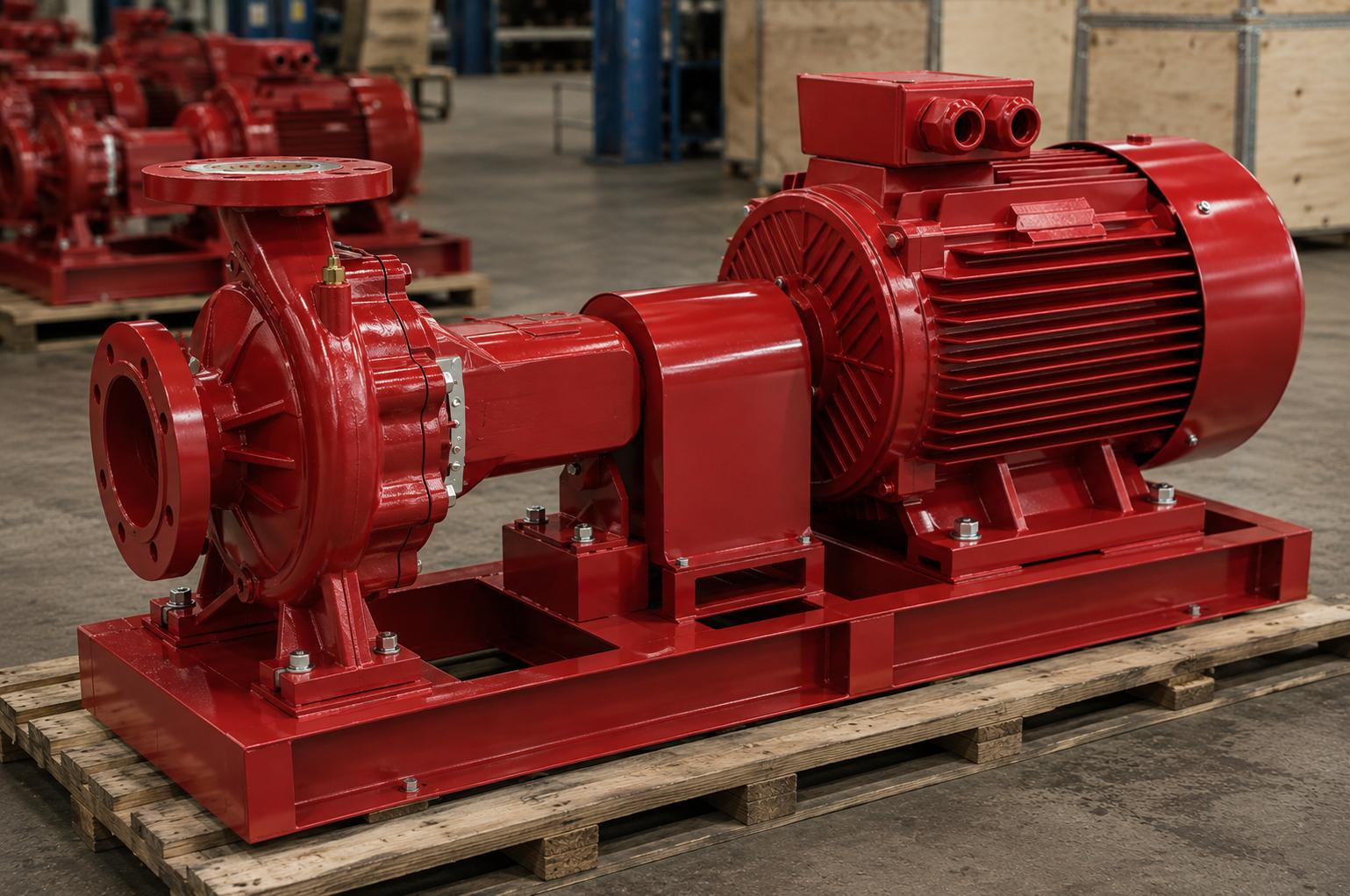
For jet pump motors, power selection must be based on the highest power consumption point on the pump curve. Many users base their choice on the nominal power on the nameplate; however, a pump draws different power at a closed valve or low head. The correct approach is:
- Speed: Jet pumps generally need high speed; 2-pole motors (about 3000 rpm) are standard. For quieter, low-pressure applications, the 4-pole (1500 rpm) option is evaluated.
- Mounting: Monobloc pumps use B14 or B5 flange motors, while coupled systems use B3 foot-mounted motors. Flange compatibility must be confirmed before ordering.
- Shaft and key: In a monobloc design where the impeller sits directly on the motor shaft, shaft diameter and length must exactly match the pump casing.
- Efficiency: In continuously running booster and irrigation systems, IE3/IE4 motors visibly reduce annual energy cost.
For power selection in 2-pole pump and fan applications, our content on correct power selection in an IE4 2-pole 3000 rpm motor details the selection logic in this class.
Stock, Supply and Manufacturer Assurance
In self-priming pump systems a motor failure means a direct water interruption, which causes crop loss in agricultural irrigation and loss of comfort in a building. That is why fast supply is critical. As a manufacturer and seller we keep the most demanded power-speed combinations in stock and provide motors with flange and shaft dimensions suited to monobloc pump manufacturers. For correct equivalent selection, when the existing motor nameplate, flange type and shaft dimension of the pump are sent to us, a fast and error-free quote can be issued.
- Fast delivery from stock minimizes downtime in emergency failures.
- IP55 protection and Class F insulation ensure safe operation in a humid pump room.
- 100% copper windings and quality bearings give long life in frequently cycling booster systems.
For current electric motor prices and stock status, you can contact us with your product nameplate. For motor selection according to the existing pump in booster applications, our guide on selecting a booster motor from the nameplate also offers a practical checklist.
Mounting, Terminal Connection and the Star-Delta Decision
In self-priming jet pumps, the mechanical and electrical mounting of the motor determines half of the performance. In a monobloc design the motor shaft carries the impeller directly; therefore shaft runout (TIR), bearing preload and flange flatness are the keys to vibration-free operation. In coupled systems, the axial and angular alignment between motor and pump directly affects bearing life. Misalignment is as insidious a failure source as air entrainment and usually shows itself as bearing noise within the first few months.
On the electrical side, small jet pump motors (usually below 3 kW) are started with direct-on-line (DOL). At larger powers, star-delta or soft starter is preferred to limit starting current. However, in frequently cycling booster systems, the number of starts must not exceed a certain hourly limit; otherwise the winding is repeatedly exposed to the starting current before it can cool down. At this point, correct pressure tank sizing and hysteresis setting prevent unnecessary motor cycling, providing gains both in energy savings and motor life.
- The terminal box bridge connection (star or delta) must be verified against the mains voltage; a wrong connection can burn the motor in the first seconds.
- Rotation direction is critical for the pump to deliver pressure correctly; a reverse-running pump delivers no water or very low flow.
- In humid pump rooms the terminal box sealing (gasket and gland) must be done carefully to preserve the IP rating.
For in-depth information on coupling selection and shaft alignment, our guide on flexible and rigid coupling selection with shaft alignment contains practical rules that also apply to self-priming pumps.
Efficiency, Energy Cost and Correct Class Selection
Self-priming pumps, especially in agricultural irrigation and continuously running building boosters, stay in service for thousands of hours per year. This operating time means that motor efficiency is directly reflected in operating cost. IE3 and IE4 class motors run with lower losses than old-stock IE2 and below motors; this difference creates savings that can pay back the purchase cost of the motor within a few years in a continuously running system.
In addition, high-efficiency motors run cooler, which extends the life of the winding insulation and bearing grease. For a continuous-duty self-priming pump motor, efficiency class selection is not only regulatory compliance but also an engineering decision that lowers total cost of ownership. Under current regulations, IE3 is already the minimum threshold for three-phase motors of 0.75 kW and above; in continuously running applications, stepping up to the IE4 class often amortizes itself quickly.
- In irrigation and booster systems with high annual operating hours, an IE4 motor recovers the extra investment quickly.
- Lower heating extends winding and bearing life, reducing maintenance frequency.
- The correct efficiency class also provides an advantage in future energy audits.
Frequently Asked Questions
Up to what suction lift can a self-priming jet pump motor work?
Although the theoretical limit is about 10 meters, in practice 7-8 meters of suction lift is considered safe. As suction lift increases, priming time gets longer and cavitation risk rises. Therefore, in high suction lift applications it becomes important to select a continuous-duty motor with correct power.
Why does a jet pump motor overheat?
The most common causes are air entrainment, dry running, insufficient power selection and frequent cycling. When the pump entrains air it loses the water cooling contribution and the winding heats up. Thermal protection and correct power selection largely prevent this issue.
Can I replace just the motor on a monobloc jet pump?
Yes, but the flange type (B14/B5), shaft diameter, shaft length and key dimension must exactly match the pump casing. By sending the existing motor nameplate and mechanical dimensions, you can quickly source a suitable equivalent motor from stock.