English
 Türkçe

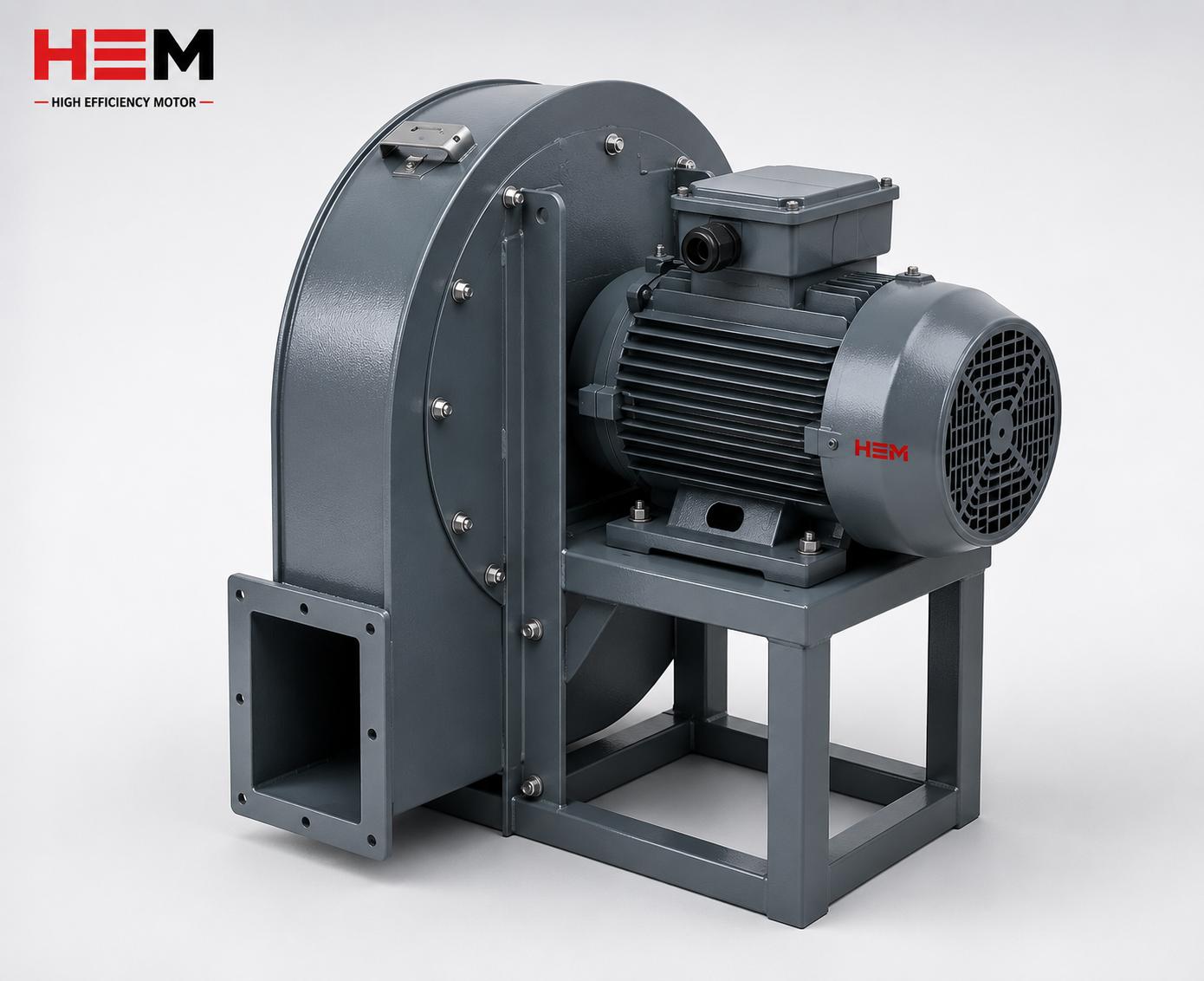

In greenhouse operations, yield is governed directly by climate. Temperature, humidity, carbon dioxide and air movement determine the plant's photosynthesis rate, disease pressure and ultimately harvest quality. At the heart of this balance sits the greenhouse climate control fan motor. Circulation fans, pad-fan (evaporative) systems, exhaust fans and recirculation fans run for most of the day, often without interruption. A wrongly specified fan motor not only inflates the energy bill; it disrupts humidity distribution, encourages mould and fungal disease, creates hot spots and reduces yield. This guide explains how to choose the right motor for greenhouse air circulation in terms of power, speed, protection class and frame material, and addresses stock, equivalent replacement and fast supply from a manufacturer and seller perspective.
Why Air Circulation Matters in a Greenhouse
When air stagnates inside an enclosed greenhouse, a humid micro-layer forms on the plant surface and transpiration slows down. This still air becomes an ideal environment for fungal spores. An air circulation fan solves this by distributing temperature and humidity evenly throughout the structure; it thins the boundary layer on the leaf surface, accelerates gas exchange and ensures supplemental CO2 reaches every plant. Exhaust and pad-fan systems, in turn, expel excess heat and moisture, keeping the interior temperature close to ambient during summer.
All of these functions depend on an electric motor that runs continuously and with low vibration. The greenhouse is a demanding environment for a motor: high humidity, water droplets, fertiliser and chemical vapours, dust and constant load. For this reason a greenhouse motor must be selected by different criteria than a motor in a dry workshop.
Selecting the Motor by Fan Type
Greenhouses use four basic fan groups, each requiring a different motor character:
- Horizontal airflow (HAF) circulation fans: Usually 0.12 kW to 0.55 kW, small, continuously running axial fans that move air volume at low pressure. Compact aluminium-body, 2 or 4 pole motors are preferred here.
- Exhaust fans: Large-diameter shutter fans that expel greenhouse air in bulk. Powers of 0.37 kW to 1.5 kW are common, generally with a 4 pole (1500 rpm) motor.
- Pad-fan (evaporative cooling) fans: Cool by drawing air through a wet pad under negative pressure. Because high airflow is required, motors of 0.75 kW and above are used; since they run under continuous load, heat endurance matters.
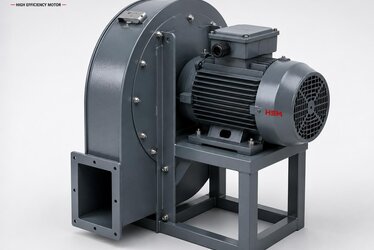
- Radial (scroll) fans: Used in heating/CO2 distribution ducts requiring in-duct pressure; due to high static pressure they call for a stronger, often cast-iron body motor.
Correctly identifying the fan type is the first step in determining motor speed and power. Axial fans are low pressure-high volume; radial fans are high pressure-medium volume. This difference directly affects the motor's pole count and power.
Speed and Pole Count
In fan motors, speed determines both air volume and noise level. 2 pole (about 3000 rpm) motors provide high air velocity but are noisy and consume more energy. The most frequent choice for greenhouse circulation is the 4 pole (about 1500 rpm) motor; quiet, balanced and energy efficient. For large exhaust fans, lower-speed 6 pole (1000 rpm) motors deliver quiet, high-volume operation. Our guide on fan power and speed selection by type is a complementary resource.
Protection Class and Insulation: Essential for the Greenhouse
For a motor, the greenhouse is a humid and corrosive environment. The protection (IP) class is therefore the most critical line of the catalogue. In our standard production, fan and ventilation motors are offered in IP55 protection class; this means full protection against dust and resistance to water jets from any direction. In applications constantly exposed to water droplets, such as pad-fans, or in washed-down greenhouses, higher protection classes such as IP56/IP65 can be supplied on request.
Insulation class is at least as important as protection. Our motors are produced with Class F insulation; this provides resistance to high winding temperatures, guaranteeing safe operation on hot summer days and under continuous load. Because the high humidity of the greenhouse stresses insulation, the combination of Class F insulation and 100% copper winding is decisive for long service life.
Frame Material: Aluminium or Cast Iron?
For small circulation fans, a lightweight aluminium frame with good heat dissipation is ideal. However, for large exhaust fans, in-duct radial fans and systems running under continuous heavy load, cast iron should be chosen for mechanical strength. Cast iron damps vibration better and extends bearing life. For the right material choice based on ambient conditions, see our cast iron versus aluminium frame comparison.
Greenhouse Climate Control with a Variable Frequency Drive (VFD)
In modern greenhouses, fans usually run at variable speed linked to climate sensors rather than at fixed speed. As temperature rises the fan speeds up; at night it slows down. This control is provided by a VFD and offers large energy savings, because fan power falls in proportion to the cube of the speed. In VFD-driven motors, insulation endurance and thermal protection become even more important. For the savings that a high-efficiency motor and drive combination delivers in pumps and fans, our article on high-efficiency motors with a frequency drive contains a detailed calculation.
- For VFD-driven motors, IE3/IE4 efficiency class maintains high efficiency even at partial load.
- Variable speed prevents fan overstress and unnecessary noise.
- Soft starting extends belt-pulley and bearing life.
Supply Advantage for Greenhouse and Livestock Facilities
Greenhouse projects typically require many identical fan motors at once. Working with a manufacturer's assurance provides a major advantage in both price and lead time. Thanks to standard power and speed combinations available from stock, you can build your project without delay at the start of the season. The ability to replace a failed fan motor the same day prevents crop loss during harvest. For high-efficiency motor supply tailored to greenhouse, livestock and agricultural facilities, we apply the approach described in our greenhouse and livestock facility motor supply article.
With a wide power range (0.12 kW to 355 kW) and B3 foot, B5/B14 flange and B35 combined mounting options, you can source the correct motor for every fan housing from a single supplier. For current electric motor prices and stock status, please contact us directly.
Selection Checklist
- Define the fan type (axial/radial) and required air volume.
- Determine the operating speed and pole count (usually 4 pole).
- Select the IP protection class (at least IP55, higher in humid environments).
- Decide the frame material (aluminium/cast iron) according to the environment.
- Match the mounting type (B3/B5/B14) to the existing fan housing.
- If a VFD is used, confirm the efficiency class and thermal protection.
Power Calculation and Spare Air Capacity
Correctly calculating fan power in a greenhouse directly affects both the initial investment and the operating cost. The required air volume is determined by how many times per hour the greenhouse volume must be renewed (air change rate). While 40-60 air changes per hour are targeted in vegetable greenhouses during summer, this value may be lower in flower greenhouses. Once the total volume is set, the required motor power is calculated by reference to the efficiency curve of the chosen fan type. A common mistake here is sizing the fan to run continuously at full capacity rather than leaving a slight reserve margin (service factor). A motor running constantly at full load heats up faster and its life is shortened. For a correct power calculation, you can use our guide on the required kW for pumps, fans and conveyors.
The service factor (SF) indicates how far above its rated power a motor can temporarily operate. In greenhouse fans, motors with a 1.15 service factor are preferred to meet increased load demand on hot days. This ensures the motor operates safely even under demanding conditions.
- Total air volume is set from the greenhouse volume and target air change rate.
- Motor power is calculated from the fan efficiency curve.
- A reserve margin is left via the service factor (usually 1.15).
- A higher power rating is considered for balanced load rather than constant full load.
Maintenance, Bearing Life and Vibration
Greenhouse fan motors are stressed at the bearings due to continuous operation and variable ambient conditions. High humidity accelerates the breakdown of bearing grease; therefore bearings lubricated with quality, high-temperature grease should be preferred. In large belt-driven exhaust fans, correctly setting the belt tension directly affects bearing life; an over-tight belt creates a side load and wears the bearing prematurely. Vibration measurement signals bearing deterioration before a failure occurs. The quality bearing structure and low-vibration operation of the motors reduce unplanned downtime.
Points to check during periodic maintenance include frame temperature, abnormal noise, vibration and moisture accumulation in the terminal box. In a humid greenhouse environment, sealing of the terminal box is critically important. When an emergency replacement need arises in conveyor and fan motors, our checklist on emergency replacement motors and direct swap is a useful guide. Thanks to standard motors available from stock, the risk of downtime during the harvest season is minimised.
Frequently Asked Questions
Which protection class motor does a greenhouse fan need?
For standard greenhouse ventilation, at least IP55 protection class is recommended; this provides adequate protection against dust and water jets. In applications exposed directly to water droplets such as pad-fans or misting, or in washed-down greenhouses, higher protection classes such as IP56/IP65 are offered on request. In humid environments, Class F insulation and 100% copper winding are decisive for long life.
How many poles should the circulation fan motor have?
The most common choice for greenhouse circulation and exhaust fans is the 4 pole (about 1500 rpm) motor; quiet, balanced and energy efficient. For large exhaust fans requiring quiet operation, a 6 pole (1000 rpm) motor is preferred. 2 pole motors are used in special applications needing high air velocity but are noisier.
Does it make sense to run fan motors with a frequency drive?
Yes. Variable-speed operation linked to climate sensors provides significant energy savings, since fan power falls in proportion to the cube of speed. For VFD-driven motors, IE3/IE4 efficiency class and suitable insulation endurance are recommended. For correct motor-drive matching, sharing your application details at the quotation stage is sufficient.