English
 Türkçe

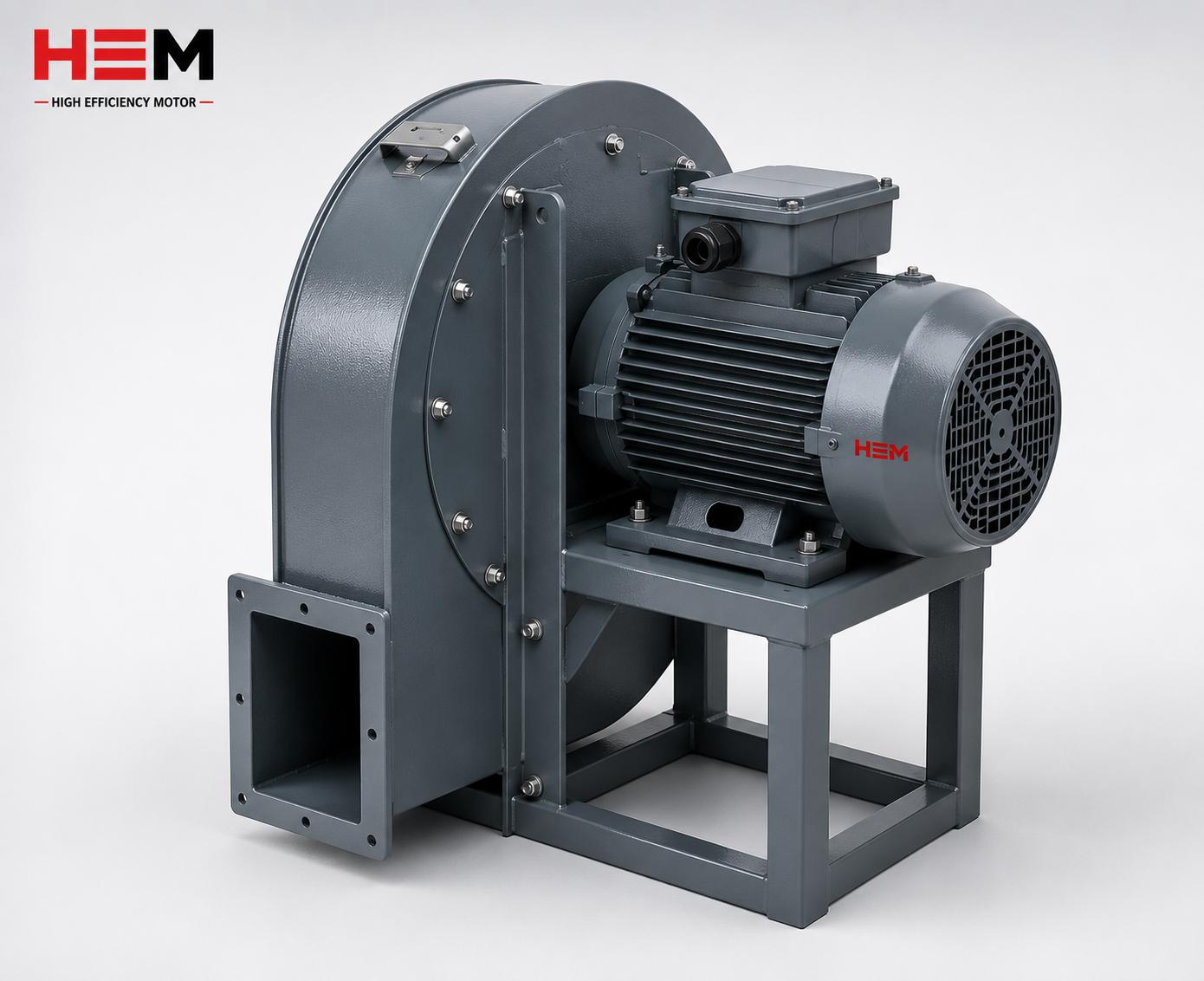

Summary (TL;DR)
- Blade type directly drives motor selection: Sirocco (forward-curved) fans have a power curve that keeps rising as flow increases; backward-curved and airfoil blades show a non-overloading (self-limiting) power characteristic that peaks and then falls.
- The sirocco danger: When a damper opens or system resistance drops, flow rises and the motor suddenly draws excess power and trips on overload. So motor power must be chosen for the highest-power operating point on the curve — the worst operating point — not just the duty point.
- Backward-curved advantage: Because the power curve peaks then drops, the motor is protected when the system shifts; this is the economical, safe choice for continuously running ventilation fans.
- The right motor: S1 continuous duty, IE3/IE4 efficiency, IP55 and Class F insulation; account for high impeller inertia and long start-up time on large wheels, and pick B3/B5/B35 mounting for belt-drive vs direct-drive fans.
- HEM Motor supplies 0.25–355 kW IE3/IE4 fan motors in cast iron and aluminum bodies from stock with fast delivery; get a manufacturer-backed quote for the right blade-type-to-power match.
When selecting a centrifugal fan motor, most engineers look at airflow and pressure first, run a power calculation, and order the nearest standard motor. Yet one of the most common field complaints — "the motor keeps tripping for no reason" — almost always traces back to a single overlooked detail: the blade type. A forward-curved (sirocco) impeller and a backward-curved impeller can deliver the same flow and pressure while demanding completely different behavior from the motor. This article explains step by step how blade type shapes the power curve, why a wrongly chosen motor draws overload current when a damper opens, and how to size the right power against the worst operating point.
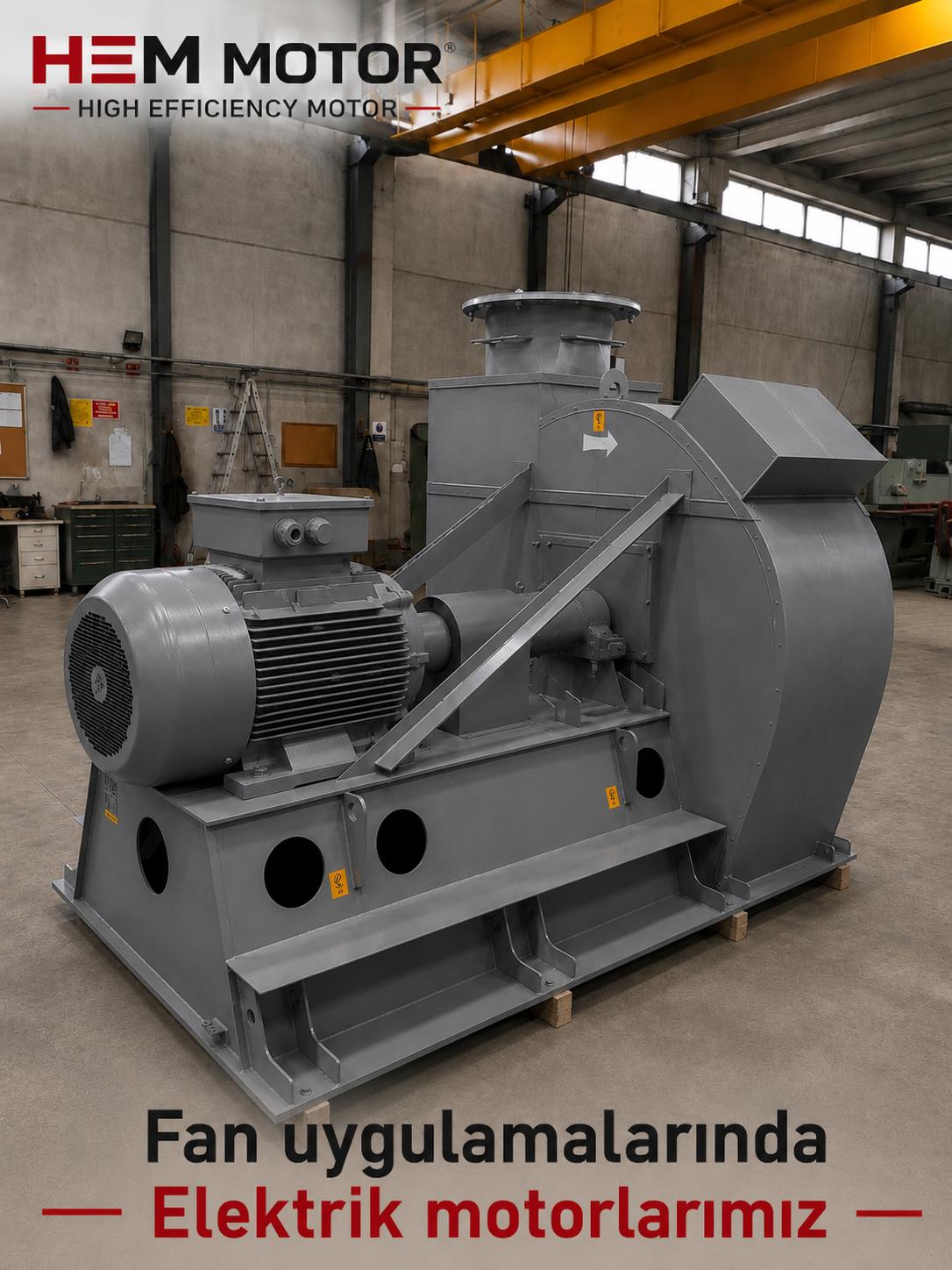
Why Does Blade Type Matter So Much in a Centrifugal Fan?
Centrifugal fans draw air into the center of the impeller and throw it outward, accelerating it inside the scroll (volute) housing. How the blades curve relative to the direction of rotation determines both the aerodynamic efficiency and, most critically, the power-versus-flow relationship. There are three main blade families, and each affects motor selection differently.
Forward-Curved (Sirocco) Blades
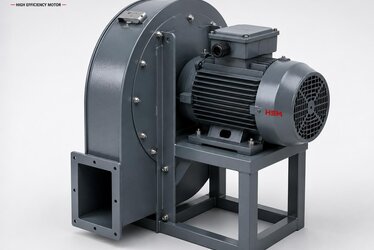
A sirocco fan uses an impeller with many short, wide blades curved toward the direction of rotation. At the same diameter and speed it produces more flow than other types, runs quietly, and is compact, which makes it very common in air-handling units, fan-coil units, and residential ventilation. However, the sirocco's power curve rises continuously: as flow increases, the power drawn keeps climbing and never peaks within the normal range. In engineering terms this is an "overloading" characteristic.
Backward-Curved and Airfoil Blades
In a backward-curved impeller the blades curve away from the direction of rotation. These wheels have fewer but longer blades, run at high efficiency, and most importantly offer a non-overloading (self-limiting) power curve: power peaks at a certain flow and then falls. The airfoil type is an aerodynamically optimized version of the backward-curved blade, delivering the highest efficiency and the most pronounced self-limiting power behavior. This protects the motor when system conditions change unexpectedly.
The Power Curve: The Critical Difference Between Sirocco and Backward-Curved
Here is the heart of the matter. A fan's power curve shows shaft power against flow. The two blade types behave in opposite ways:
- Sirocco (forward-curved): At zero flow (closed damper) power is low; as the damper opens, flow rises and power climbs continuously. If system resistance is lower than expected, the fan "rides to the right" on the curve, flow exceeds the design point, and the motor draws far more power than planned.
- Backward-curved / airfoil: The power curve reaches a maximum at mid-flow, then power falls even as flow keeps rising. Once the motor is sized for this peak, it will not be exceeded no matter how the system changes; the overload risk is structurally eliminated.
This difference dictates which point you size the motor against. On a backward-curved fan the peak of the curve is a known, fixed value. On a sirocco fan the "worst case" is the highest flow the system can reach — often well above the design flow.
Why Does an Undersized Motor Trip When the Damper Opens?
The most common field scenario goes like this: the fan is commissioned with the damper half closed, current looks normal, the system is handed over. Some time later the operator opens the damper fully (more air is wanted), system resistance drops, and flow surges. In this state the sirocco fan rides right on its power curve and draws much more power; the motor exceeds rated current and the thermal relay trips. The engineer thinks "why did it trip, nothing changed" — but the operating point changed.
The fix is to size the motor against the power demand at the fan's worst operating point. For a sirocco fan that means calculating power at the fully open (lowest-resistance) condition. In practice you add a safe overload margin (service factor) above the design power, or read the maximum open-position flow off the fan curve and size the motor for it. We explore this for VAV systems in our article on Pump, Fan & Blower Motors.
Duty Point or Worst Point? Correct Power Selection
The classic mistake is to size the motor against the duty point power alone. The duty point is the design condition where the fan curve meets the system resistance curve. But real systems never stay at one point: filters clog (resistance rises, flow drops), dampers open (resistance falls, flow rises), and duct balancing changes. The correct approach is:
- Backward-curved / airfoil fan: Size the motor for the peak (maximum) power of the fan's power curve. Then no matter where the system shifts, the motor stays safe.
- Sirocco (forward-curved) fan: Base sizing on the power at the highest flow the system can reach. Include scenarios where dampers might be opened fully by mistake or where more air may be demanded in the future.
- In both cases add a reasonable overload margin; thanks to high efficiency, HEM Motor IE3/IE4 motors run cooler in the same frame and offer a wider operating window.
Large Impeller, High Inertia and Long Start-Up Time
Centrifugal fan impellers, especially large-diameter backward-curved wheels, carry significant rotational inertia (GD² / WR²). When the motor energizes, bringing this mass from rest to full speed takes a long start-up time, during which the motor draws high starting current and heats up. A wrongly chosen motor can struggle on start-up purely because of impeller inertia — not the working load itself. So on large-impeller fans the starting torque, the permitted number of consecutive starts, and the thermal capacity must all be evaluated carefully. We cover inertia and start-up calculations in our article on inertia and starting in large-impeller fans.
If the impeller is mounted directly on the motor shaft (direct drive), the wheel's weight and aerodynamic thrust create an overhung (cantilever) load on the shaft and bearings. The effect of this load on shaft bending and bearing life calls for the correct mounting and bearing selection; for details see our article on overhung impeller load and bearing selection.
Motor Specifications: The Right Choice for Fans
Continuous Duty (S1) and Efficiency (IE3/IE4)
Ventilation and process fans mostly run around the clock, so the motor must be rated for S1 continuous duty. On a continuously running fan, energy cost far exceeds purchase cost, which makes IE3/IE4 efficiency classes practically mandatory in fan applications. High efficiency cuts the electricity bill and keeps the motor cooler, extending its life.
Protection (IP55) and Insulation (Class F)
Fan motors working on roofs, in flues, kitchen exhausts, or dusty environments must be protected against dust and splashing water with IP55 ingress protection. Class F insulation and 100% copper windings provide a safe temperature margin at high ambient temperature and continuous load. These features give the motor extra resilience during potential overload moments on sirocco fans.
Mounting Type: B3 / B5 / B35
Belt-and-pulley driven fans usually use foot-mounted B3; the motor sits on a separate base and turns the impeller via a belt. Compact fans requiring a direct (flanged) coupling use flange-mounted B5 or combined foot-and-flange B35. If the mounting type is wrong, the motor will be mechanically incompatible with the fan housing, so the drive arrangement must be confirmed before ordering.
Pole Count and Speed (2/4/6 Pole)
Fan flow and pressure are directly tied to speed. 2-pole (about 3000 rpm) motors suit high-pressure, small-diameter sirocco fans; 4-pole (1500 rpm) motors suit general ventilation; 6-pole (1000 rpm) and lower-speed motors suit large-diameter, quiet, low-pressure fans. Because the fan laws make power vary with the cube of speed, speed choice directly affects motor power — making pole count as critical a decision as blade type.
Body Material: Cast Iron or Aluminum?
Body material is also chosen by application. A cast iron body offers high mechanical strength, better vibration damping, and suitability for heavy industrial or outdoor conditions; it is preferred on large-impeller, overhung-load fans. An aluminum body is lighter, dissipates heat better, and is advantageous at smaller/medium powers and on portable or roof-type fans. The right choice depends on impeller mass, mounting arrangement, and ambient conditions.
Which Motor for Which Fan? Practical Summary
- Sirocco (forward-curved) fan: Size the motor for power at the highest flow, leave a generous overload margin, and set thermal protection carefully. Usually 2/4 pole, compact aluminum or cast iron body.
- Backward-curved / airfoil fan: Size the motor for the peak of the power curve; the self-limiting characteristic provides the safety margin by design. On large wheels use cast iron body, 4/6 pole, S1, IE3/IE4.
- For both types, IP55, Class F insulation, and high efficiency are essential for continuous duty.
For more fan and blower motor guidance, browse our ventilation electric motors options and the broader Pump, Fan & Blower Motors category.
Sourcing the Right Fan Motor with HEM Motor
HEM Motor manufactures IE3/IE4 efficient fan motors across a wide power range from 0.25 kW to 355 kW, with 1000/1500/3000 rpm options (plus 6/8 pole low-speed versions). With cast iron and aluminum bodies, IP55 protection, Class F insulation, 100% copper windings, B3/B5/B35 mounting, and IEC 56–355 frame sizes, there is a solution for every blade type. Matching blade type to power correctly ensures the motor is neither oversized (wasted cost) nor undersized (overload failure). If you are unsure whether your fan is sirocco or backward-curved, share the fan curve and your system condition and, with manufacturer assurance plus stock and fast delivery, we will pin down the right motor together. Contact us for current electric motor prices and a quote.
Frequently Asked Questions
Is a sirocco fan or a backward-curved fan safer for the motor?
For motor safety the backward-curved blade is safer because its power curve peaks at a certain flow and then falls; once the motor is sized for that peak, the overload risk is structurally limited even if system conditions change. On sirocco (forward-curved) fans power rises continuously with flow, so the motor must be sized more carefully for the worst case.
Is it enough to size the motor for the fan's duty point power?
No. Especially on sirocco fans, sizing the motor for the duty point power alone is dangerous. When a damper opens or resistance drops, flow increases and the motor draws far more power than at the duty point. You must size the motor for the power at the highest flow the system can reach (the worst operating point) and leave a reasonable overload margin.
What efficiency and protection class should a fan motor have?
For continuously running fans the motor should be S1 continuous duty and IE3 or IE4 efficiency; high efficiency lowers energy cost and keeps the motor cool. In dusty or damp environments, IP55 protection and Class F insulation are recommended. Choose B3 (belt drive) or B5/B35 (direct coupled) mounting according to the drive arrangement.