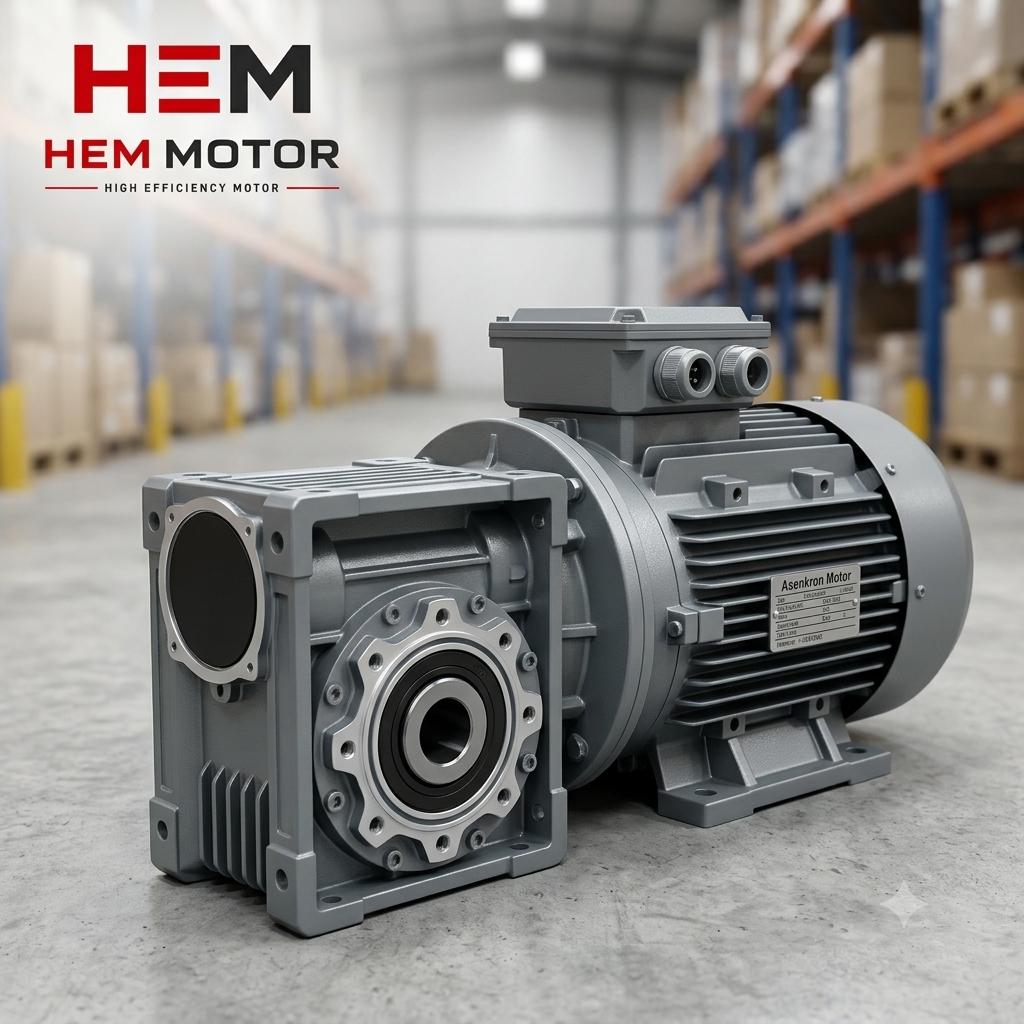
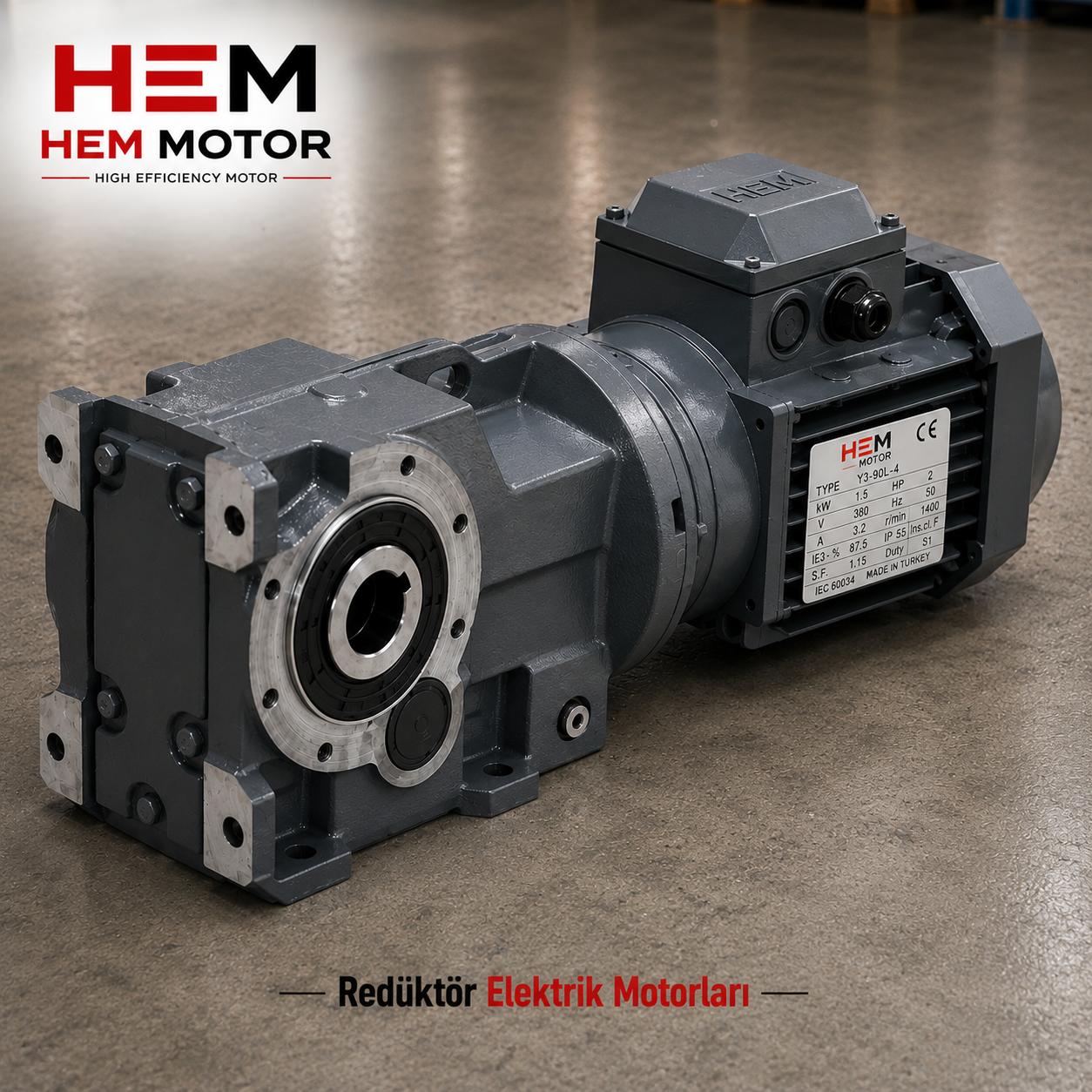
Selecting a small-power geared motor that runs on a 220V single-phase supply may look simple at first, but it is in fact an engineering decision where output speed, reduction ratio and torque expectations must be considered together. When sourcing a motor for a conveyor, mixer, dosing pump or a small packaging unit, the first question most businesses ask is "how many kW do I need"; yet with geared motors the real determinant is the speed (rpm) you expect at the output shaft of your machine and the torque required at that speed. In this guide we explain step by step how single-phase motors between 0.18 kW and 1.5 kW are matched with worm gear reducers, how the reduction ratio affects output speed and torque, and what to watch for when selecting the right combination from stock.
What Is a 220V Single-Phase Geared Motor and Where Is It Used?
A single-phase motor is the type powered from the 220V mains found in homes and small workshops, requiring no separate three-phase line. In small powers, typically in the 0.18 kW (about 0.25 HP) to 1.5 kW (about 2 HP) band, single-phase motors are a practical and economical solution. On their own, these motors rotate at high speed (generally around 2800 rpm on 2 poles or about 1400 rpm on 4 poles). However, most applications such as conveyor belts, mixing vessels, dosing systems or rotary tables do not want such a high speed but rather low speed and high torque. This is where the worm gear reducer comes in: it lowers the high motor speed and in return significantly increases the torque at the output shaft.
Typical applications for 220V single-phase geared motors include: small belt conveyors, mixers on food and chemical lines, liquid and powder dosing units, packaging machines, rotating displays, small screw (auger) conveyors and workshop-type feeding systems. What these applications share is that they can run on single-phase electricity, rotate continuously or semi-continuously at low speed, and require a compact drive unit. When you need higher power or a three-phase system, you should revisit the single-phase vs three-phase decision.
Reduction Ratio and Output Speed Calculation
The heart of geared motor selection is the reduction ratio calculation. Worm gear reducers are offered in standard values such as 1/7, 1/10, 1/15, 1/20, 1/30, 1/50, 1/80 and 1/100. To find the output speed we use a simple formula:
Basic Formula: Output Speed = Motor Speed / Ratio
Suppose you have a 4-pole single-phase motor turning at about 1400 rpm and your reducer ratio is 1/30. In this case the output speed is about 1400 / 30 = 46 rpm. If you want a lower output speed at your shaft, for example around 14-15 rpm, you move toward a 1/100 ratio; for a higher speed, for example around 97-100 rpm, you look at a ratio in the 1/14 to 1/15 band. Another example: with a 1400 rpm motor and a 1/14.5 ratio, the output speed is about 97 rpm, which is one of the most sought-after output speeds in the market.
Which Ratio Should I Choose?
The order of ratio selection is as follows: first determine the speed (rpm) your machine needs at the output shaft, then divide the speed of your motor (usually 1400 rpm) by this target and round to the nearest standard ratio. For example, if the target output is 70 rpm, then 1400 / 70 = 20 and you choose the 1/20 ratio directly. If the target is 28 rpm, then 1400 / 28 = 50, i.e. 1/50. Therefore, when ordering a geared motor, the priority is not "how many rpm motor" but "how many rpm do I want at the output shaft". Our monoblock geared motor purchasing guide, which considers output speed and reducer frame together, contains complementary information on this topic.
Why Does Torque Increase? The Speed-Torque Relationship
The most valuable feature of the reducer is that it increases torque while lowering speed. Physically, when power (kW) stays constant, as output speed drops the output torque rises inversely. So a reducer with a 1/30 ratio increases the output torque by roughly 30 times under ideal conditions (slightly less after efficiency losses). That is why even a small 0.37 kW single-phase motor, matched with the right ratio, can produce enough torque to comfortably turn a mixer or a loaded belt.
One point to watch in worm gear reducers is efficiency: at high reduction ratios (for example 1/80, 1/100), friction between the worm and the bronze gear increases, so efficiency drops somewhat and the system approaches self-locking. This can be an advantage in elevator-like applications because it prevents the load from running back; but it also means an efficiency loss. We covered the self-locking topic in a separate article. To define your torque requirement clearly, you can also look at the required kW calculation for pumps, fans and conveyors.
Matching Small-Power Motor and Reducer Frame
In 220V single-phase applications, the most used powers are 0.18 kW, 0.25 kW, 0.37 kW, 0.55 kW, 0.75 kW, 1.1 kW and 1.5 kW. On the worm gear reducer side, the frame size is selected according to both the motor power and the IEC connection flange. The practical matching is as follows:
Frame-Power Matching Logic
For 0.06-0.18 kW motors the HEM30 frame, for 0.12-0.37 kW the HEM40, for 0.18-0.75 kW the HEM50, and for 0.37-1.5 kW the HEM63 frame are typical choices. So a 1.1 kW single-phase motor usually pairs with a HEM63 frame worm gear reducer. When making this match, the motor's flange type (B5 large flange or B14 small flange) and IEC frame number (e.g. 63, 71, 80) must match the reducer input flange exactly. Our article on matching a motor to worm and NMRV reducers contains these IEC flange tables.
B5 or B14?
In small powers, the reducer connection is mostly made through a B14 small flange or a B5 large flange. Which one is needed depends on the reducer input frame; the wrong flange choice means the motor cannot be mounted to the reducer. Therefore always clarify the B5 vs B14 connection type decision in your order. Aluminium-frame motors are widely used in small and medium power reducer applications, from 0.12 kW up to 2.2 kW; for heavier duty, cast iron frames are preferred.
Guide to Selecting the Right Geared Motor From Stock
If you want fast delivery from stock, knowing the most sought-after combinations is an advantage. In the Turkish market, the profile most frequently demanded in small-power single-phase geared motors is 0.37-1.1 kW power, ratios between 1/10 and 1/100, and the corresponding output speeds. For example, the 1.1 kW, about 97 rpm output speed, single-phase (220V) combination is a classic for small mixer and conveyor applications. When making your stock selection, specifying the output speed, the power and the flange type together ensures the right product is reserved quickly.
If you plan to install several similar drive units on the same line in the future, building redundancy with a critical spare motor list and stock planning reduces downtime risk. Also, when deciding whether to buy the geared motor separately or as a monoblock, our geared motor vs separate motor + reducer comparison provides guidance. For a wider product range you can review our worm gear reducers and efficient electric motors categories, and reach all product groups from our home page.
Common Mistakes and Maintenance Tips
The most common mistake in small-power geared motors is ordering directly on "power" without calculating the output speed. The second common mistake is flange mismatch. The third is neglecting lubrication according to the reducer mounting position; in worm gear reducers the mounting position (M1-M6) affects oil level and life. Our article on reducer mounting positions and lubrication explains this topic. Before commissioning, verify the direction of rotation and the first start-up steps with the commissioning checklist.
Typical Application Matches by Output Speed
When choosing the right ratio, matching the output speed to the application makes the job easier. Applications requiring very low speed, such as heavy mixers, rotary tables and slow feeding augers, usually run in the 10-30 rpm range, which corresponds to ratios between 1/50 and 1/100. Medium-speed applications, such as standard belt conveyors and dosing systems, mostly rotate in the 40-100 rpm band, where ratios between 1/14 and 1/30 are suitable. Small machines needing a higher output speed are fed with ratios between 1/7 and 1/10. When making this match you should also consider the mechanical load and the continuity requirement of your machine; the heating behaviour of the motor and reducer on a continuously running line differs from that of a part-time unit.
If you are considering fine-tuning the output speed with a pulley-belt system, a pulley ratio added at the reducer output changes the total speed once more. In that case you need to calculate both the reducer ratio and the pulley ratio together. Our article on motor speed and pulley-belt speed adjustment explains this two-stage speed adjustment with examples. For those seeking very low speed and direct drive without a reducer, the article on low-speed motors, which evaluates the high-pole motor alternative, will be useful.
Starting and Start-Up on a Single-Phase Motor
Unlike three-phase motors, single-phase motors do not start rotating on their own; they produce starting torque with the help of an auxiliary winding and usually a capacitor. Therefore, in applications requiring a loaded start (for example a mixer that starts full), it is important that the start capacitor is adequate. Because the reducer also increases torque at start-up, it improves the loaded-start capacity of small single-phase motors; however, for very heavy starting loads, switching to a three-phase solution may be healthier. For a general overview of starting behaviour, our star-delta and soft starter article also explains the logic on the three-phase side.
Another point to watch in single-phase systems is fluctuation in the mains voltage. Low voltage on the 220V line can affect the motor's starting torque and heating behaviour. In facilities that constantly experience low voltage, motor selection should be made accordingly. Requesting motor protection devices together at the order stage is also good practice; our article on purchasing protection devices summarizes this topic.
Frequently Asked Questions
If I use a 1/30 reducer with a 1400 rpm motor, what is the output speed?
The output speed is about 1400 / 30 = 46 rpm. Due to reducer efficiency and the motor's actual speed under load (slip), this value may in practice be a few rpm lower. If you want a precise output speed, set the target rpm and divide the motor speed by it to choose the nearest standard ratio.
Can a 0.37 kW single-phase motor turn a small mixer?
Yes, when matched with the right reduction ratio. Because the reducer increases torque by the ratio, high torque is achieved even at low power. The key is to correctly calculate the output speed and torque the mixer requires; for very viscous products it is safer to step up one power level.
How is the direction reversed on a single-phase geared motor?
On single-phase motors the direction of rotation is reversed by changing the auxiliary winding connection, not by swapping two phases as on three-phase motors. Therefore, specifying your direction requirement before ordering is important so the terminal connection is made correctly.
Get a Quote
For your 220V single-phase geared motor needs, contact us by specifying the output speed, power and flange type; we will reserve the most suitable combination for you based on stock availability. For a fast quote and technical support, reach us at +90 (532) 345 49 86 or send your request through our contact page.
Purchase and Selection Checklist
- Have you determined the speed (rpm) you need at the output shaft?
- Have you divided the motor speed (usually 1400 rpm) by the target to choose the nearest standard ratio?
- Have you calculated the required output torque, and is the power sufficient for it?
- Have you matched the reducer frame (HEM30-HEM63) to the motor power?
- Are the flange type (B5/B14) and IEC frame number compatible with the reducer input?
- Have you specified the direction of rotation and commissioning steps?
- Have you checked the lubrication requirement according to the mounting position?
- Have you made a spare/stock plan for continuous use?