English
 Türkçe

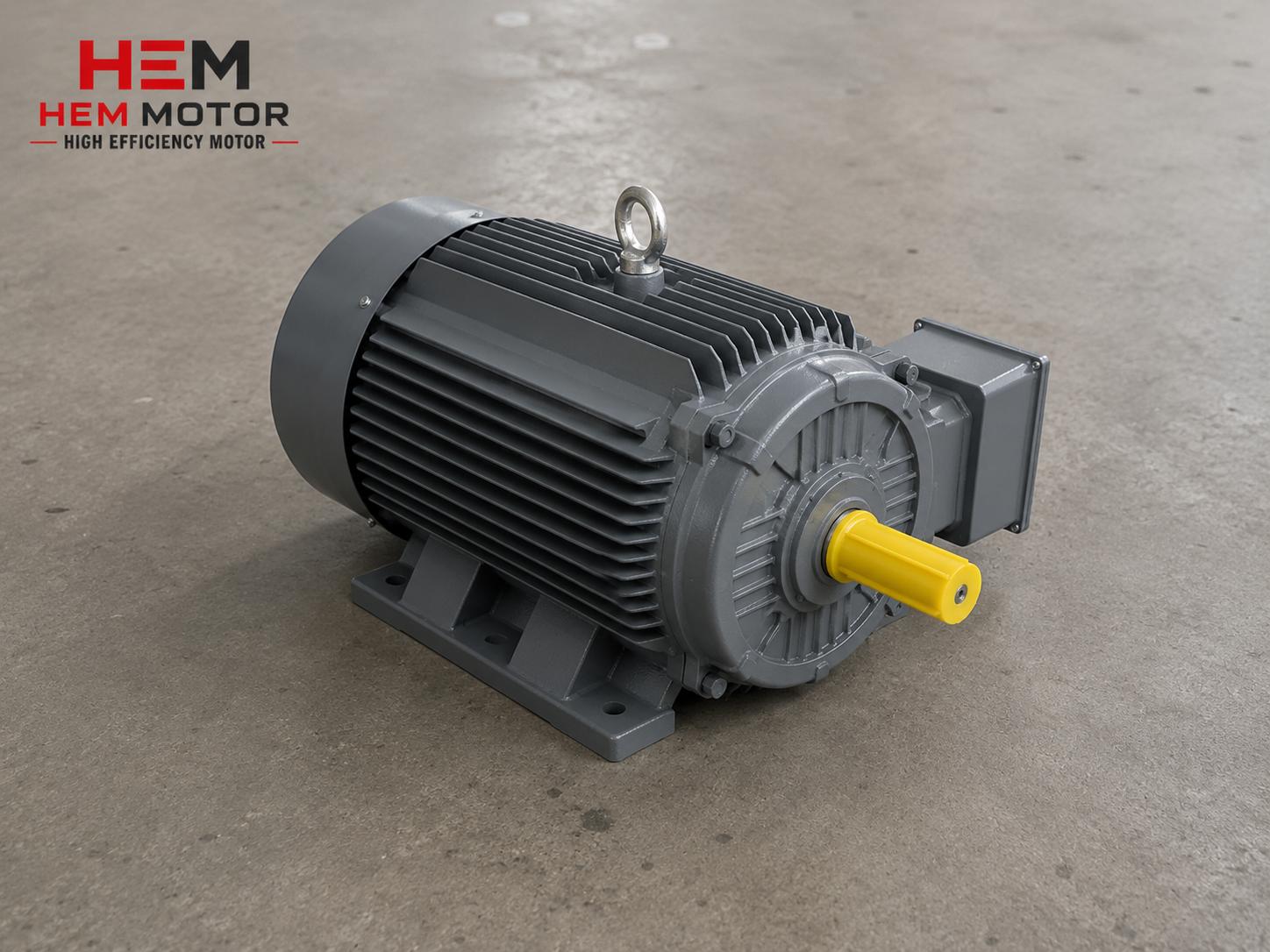

The small-power band, comprising 0.55 kW, 0.75 kW and 1.1 kW electric motors, represents the most frequently demanded range across industrial, agricultural and commercial applications in Turkey. These three power values appear everywhere, from small pumps and fan units to conveyor systems and compact machine drives. For exactly this reason, small-power electric motor selection, when done correctly, both reduces investment cost and balances a facility's energy expenditure over the long term. A wrong choice, on the other hand, brings problems such as an unnecessarily large frame, excessive current draw and mounting incompatibility.
The greatest advantage of this power band is that these are the most commonly requested values on the market, which means they are usually available from fast stock. When supplied directly from a manufacturer, 0.55 / 0.75 / 1.1 kW motors typically ship from shelf inventory, minimizing delivery time. In this article, we examine the pole-to-speed relationship of these three power values, frame sizes, mounting options, the brand-substitution ease enabled by IEC standardization, the difference between single-phase and three-phase supply, efficiency classes, and the information you need to provide to receive an accurate quote, all in technical depth.
Our goal is to clarify, whether you are an installation technician, a machine builder or a procurement officer, what each value on a motor nameplate means and why you should select it. This way, you can make decisions in your electric motor supply process that are strong both technically and commercially.
The 0.55 / 0.75 / 1.1 kW Power Band: Where Is It Used?
These three power values form the "entry and lower-mid" segment of the asynchronous motor world. The 0.55 kW electric motor corresponds to roughly 0.75 horsepower and is preferred in low-torque applications such as small dosing pumps, small ventilation fans, mixers and light conveyors. Because its energy consumption is low, it significantly limits operating cost in continuously running installations.
The 0.75 kW electric motor (approximately 1 HP) is perhaps the most universal value of this band. It is used as a standard drive source in countless applications, from water pumps to small compressors, from packaging machines to kitchen equipment. Many machine builders design directly around the 0.75 kW motor because this value is a balanced middle point in terms of both power and physical size.
The 1.1 kW electric motor (approximately 1.5 HP) represents the upper limit of the small-power band. It comes into play in centrifugal pumps, medium fans, geared drives and heavier conveyor lines that require slightly higher torque and power. This power value is a transition point that can handle somewhat more demanding loads while preserving small-power economy.
The common characteristic of all three values is that they are the most sought-after motors in the field. This means that finding a spare in case of a breakdown, sourcing an additional motor during a capacity increase, or quickly obtaining material for a prototype is relatively easy. Stock availability is the strongest commercial advantage of this band.
Pole Count and Speed Relationship: 2, 4 and 6 Poles
The fundamental parameter that determines the rotational speed of an asynchronous motor is the pole count. Since the grid frequency in Turkey is 50 Hz, the synchronous speed is calculated by the formula: synchronous speed = (120 × frequency) / pole count. This formula is the most critical technical foundation in motor selection, and the correct motor cannot be chosen without understanding the pole-speed relationship.
- 2-pole motor: 3000 rpm synchronous speed. Ideal for pumps, compressors and certain fan applications requiring high speed.
- 4-pole motor: 1500 rpm synchronous speed. The most widely used speed range in industry; standard in pump, fan, conveyor and general machine drives.
- 6-pole motor: 1000 rpm synchronous speed. Preferred in mixers, geared drives and heavy-start applications requiring lower speed and higher torque.
There is a critical detail here: the synchronous speed is the theoretical speed of the motor. The actual (loaded) speed is always slightly below this value. This difference is called slip. For example, although the synchronous speed of a 4-pole motor is 1500 rpm, its actual speed under load is typically between 1400 and 1460 rpm. Slip is a natural consequence of the operating principle of the asynchronous motor; the rotor lagging slightly behind the rotating magnetic field is the basis of torque production. The speed value written on the nameplate (for example 1430 rpm) is the actual rated speed including slip.
When making a selection, you must look not only at power but also at the speed the application requires. The same 0.75 kW power can be supplied as 2, 4 or 6 poles; however, these motors offer completely different speed and torque characteristics. A centrifugal pump may want high speed, while a mixer may demand low speed and high torque. Therefore, it is essential to clarify the pole count as well as the power at the quotation stage.
Speed and Torque Balance
At constant power, as speed decreases, torque increases. This physical fact is often overlooked in motor selection. A 6-pole 1.1 kW motor produces far higher torque than a 2-pole 1.1 kW motor because the same power is transmitted at a much lower speed. In applications requiring high torque, this allows the motor to pull slower but stronger. The correct speed-torque balance is decisive for both energy efficiency and mechanical lifespan.
Frame Sizes: 71, 80 and 90 Dimensions
According to the IEC standard, motors receive a frame number based on shaft center height. In the small-power band, the three most commonly encountered frames are the 71, 80 and 90 frame sizes. The number here expresses the height from the foot base to the shaft center in millimeters; that is, an 80 frame means a motor whose shaft center is 80 mm above the ground.
An important point is this: the same power value moves to a larger frame as the pole count decreases (i.e., as speed decreases). Because producing the same power at lower speed requires higher torque, and therefore a larger magnetic cross-section and more copper. For example:
- 0.55 kW 2-pole is usually a 71 frame, while 0.55 kW 6-pole may move to a larger frame.
- 0.75 kW 2-pole is typically in the 71-80 frame range, while 0.75 kW 4-pole is around the 80 frame.
- 1.1 kW 2-pole is an 80 frame, 1.1 kW 4-pole is a 90 frame, and 1.1 kW 6-pole moves to an even larger frame.
For this reason, saying only "I want a 1.1 kW motor" is not sufficient for mounting purposes. The pole count directly affects the frame size, and the frame size determines everything from the bolt holes to the shaft diameter. When looking for a replacement motor for an existing machine, providing the old motor's frame number and pole count together guarantees mounting compatibility. Frame size compatibility is one of the most frequent replacement problems in the field.
Shaft Diameter and Connection Dimensions
Each frame size comes with a standard shaft diameter and keyway dimension. On the 71 frame, the shaft diameter is typically 14 mm, on the 80 frame 19 mm, and on the 90 frame around 24 mm. Thanks to this standardization, coupling, pulley and gearbox connections remain compatible regardless of brand. Verifying the shaft diameter at the quotation stage is critically important, especially in applications with gearbox or coupling connections.
Mounting Types: B3 Foot, B5 and B14 Flange
The way electric motors connect to a machine is another decisive factor in selection. In the small-power band, three basic mounting types stand out:
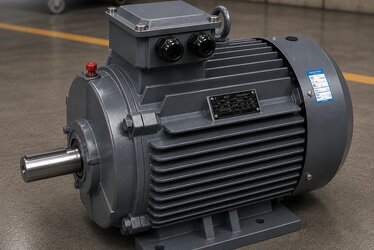
- B3 foot mounting: The motor is bolted to a base via the feet on its frame. It is the most common and economical mounting form; standard in conveyor, fan and general drive applications.
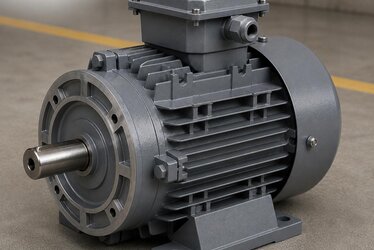
- B5 flange mounting: The motor is connected directly to the machine or gearbox via a large-diameter flange on the shaft side. Preferred in pump and gearbox connections.
- B14 flange mounting: Similar to B5 but uses a smaller, threaded face flange. Common in compact applications and especially in gearbox mountings.
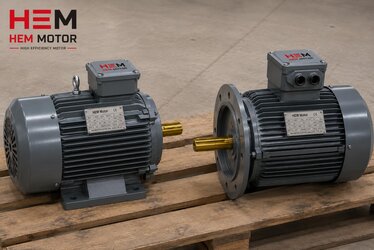
Some motors come in combined mounting options such as B34 or B35, providing both foot and flange, which offers mounting flexibility. Choosing the correct mounting type means an exact fit to the machine design. Mounting type selection, when done incorrectly, can render a motor impossible to install on site even if it has the correct power. Therefore, when requesting a quote, the B3, B5 or B14 distinction must always be specified.
IEC Standardization and Brand Substitution
Perhaps the greatest commercial advantage of this power band is that brand substitution is extremely easy thanks to IEC standardization. IEC 60034 and the related dimensional standards fix the frame size, shaft diameter, connection holes and flange dimensions for a given power-pole combination. This means that a 90 frame, 4-pole, 1.1 kW motor has the same mounting dimensions regardless of which manufacturer it comes from.
In practice, this means: you can replace a failed motor on an existing machine with another motor having the same IEC dimensions without any problem. Because the connection holes, shaft diameter and flange dimensions are compatible, no modification is required on the machine. This brand-substitution ease both speeds up spare-part supply and reduces dependence on a single supplier. For businesses, this is an important flexibility that minimizes downtime on critical production lines.
Another benefit of standardization is that it simplifies stock management. A company supplying directly from a manufacturer can keep IEC-standard motors in shelf inventory and offer a fast solution independent of the customer's brand preference. Standard frame stock is the most valuable card in urgent needs.
Single-Phase (220V) and Three-Phase (380V) Supply
An important feature of the small-power band is that it can be supplied as both single-phase 220V and three-phase 380V. This is a critical decision point depending on the place of use.
Single-phase motors connect to single-phase domestic or small commercial electrical grids. They are ideal for workshops without three-phase supply, agricultural irrigation points, small businesses and home use. However, single-phase motors require an auxiliary winding and capacitor for starting, which makes them slightly larger and more costly than their three-phase counterpart of the same power. Still, in places with infrastructure constraints, this is the only practical solution. For detailed information you can review the single-phase electric motor options.
Three-phase motors connect to the three-phase 380V grid and, at the same power, are more compact, more efficient and have higher starting torque. In industrial facilities, three-phase is preferred wherever three-phase infrastructure exists. When used together with a frequency inverter (variable speed drive), speed control also becomes possible. For three-phase options in this power band you can look at the three-phase electric motor product group.
When making a selection, the first question is always: is single-phase or three-phase available on site? The answer to this question directly determines the motor's supply type. Supply type selection, when done incorrectly, prevents the motor from working at all; therefore it must be clarified at the quotation stage.
Efficiency Classes: IE Standards
Modern electric motors are divided into IE (International Efficiency) classes based on energy efficiency. These classes, ranked as IE1 (standard efficiency), IE2 (high efficiency), IE3 (premium efficiency) and IE4 (super premium efficiency), express how much electrical energy the motor consumes while producing the same mechanical power. The IE efficiency class directly affects the total cost of ownership, especially in continuously running applications.
Efficiency class is important even in the small-power band. In a pump or fan motor running long hours per day, choosing IE3 instead of IE2 provides considerable energy savings over the motor's lifetime. Although the initial investment cost is slightly higher, the payback period is usually short. To choose the correct efficiency class, you should evaluate the daily operating time of the application and the electricity tariff. You can benefit from our electric motor selection guide when determining which power suits which application.
The Advantage of Stocked Supply from a Manufacturer
Sourcing the most sought-after values such as 0.55 / 0.75 / 1.1 kW from a manufacturer that keeps them in shelf inventory provides the buyer several concrete advantages. The first is speed: a motor in stock can be dispatched shortly after order confirmation; there is no need to wait for import or custom production. The second is continuity: being able to obtain the same product repeatedly from the same supplier makes it easier to keep a uniform stock across the machine park.
The third advantage is technical support. A manufacturer working with stock knows which power-pole-frame combination is suitable for which application and can guide you to the correct product together with fast supply. This is invaluable, especially when production is halted due to a breakdown, for finding the correct motor and restarting the line as quickly as possible. To check the current electric motor prices and stock status, requesting a quote directly is the most reliable method.
What Information Should You Provide for a Quote?
To receive an accurate and fast quote, providing a few key pieces of information that define your need from the outset speeds up the process. When requesting an electric motor quote, it is recommended to have the following information ready:
- Required power (such as 0.55 / 0.75 / 1.1 kW) or its horsepower equivalent
- Pole count or desired speed (3000 / 1500 / 1000 rpm)
- Mounting type: B3 foot, B5 flange or B14 flange
- Supply type: single-phase 220V or three-phase 380V
- Frame size (if known) and shaft diameter
- Preferred efficiency class (IE2, IE3, etc.)
- Quantity and delivery time expectation
The clearer this information, the more accurate and fast the quote will be prepared. If you are replacing an existing motor, sharing a photo of the old motor's nameplate is the most practical method; thanks to the power, pole, frame and supply information on the label, an exact equivalent can be determined. In the stock and quote process, this clarity saves time for both buyer and seller.
Frequently Asked Questions
How many horsepower does a 0.75 kW motor correspond to?
0.75 kW corresponds to approximately 1 horsepower (HP). The general conversion ratio is 1 kW = approximately 1.36 HP; therefore 0.55 kW is roughly 0.75 HP and 1.1 kW is roughly 1.5 HP. However, the official nameplate value is in kilowatts, and it is more accurate to base the selection on the kW value. The horsepower equivalent is used only as a practical reference.
What changes if I choose a 4-pole motor instead of a 2-pole at the same power?
At the same power, a 4-pole motor runs at half the speed (1500 rpm versus 3000 rpm) compared to a 2-pole motor and produces higher torque. In return, because it transmits the same power at a lower speed, it usually moves to a larger frame. So a 4-pole motor may be physically slightly larger and heavier. If your application wants low speed and high torque, choose 4 or 6 poles; if you want high speed, choose 2 poles.
How do I choose between a single-phase and a three-phase motor?
The main factor determining the choice is the electrical infrastructure at the installation site. If three-phase 380V supply is available on site, a three-phase motor should be preferred because it is more efficient, compact and has higher starting torque. If only single-phase 220V supply is available, a single-phase motor becomes mandatory. Three-phase motors are also suitable for speed control with a frequency inverter, which makes them more flexible in industrial applications.