English
 Türkçe

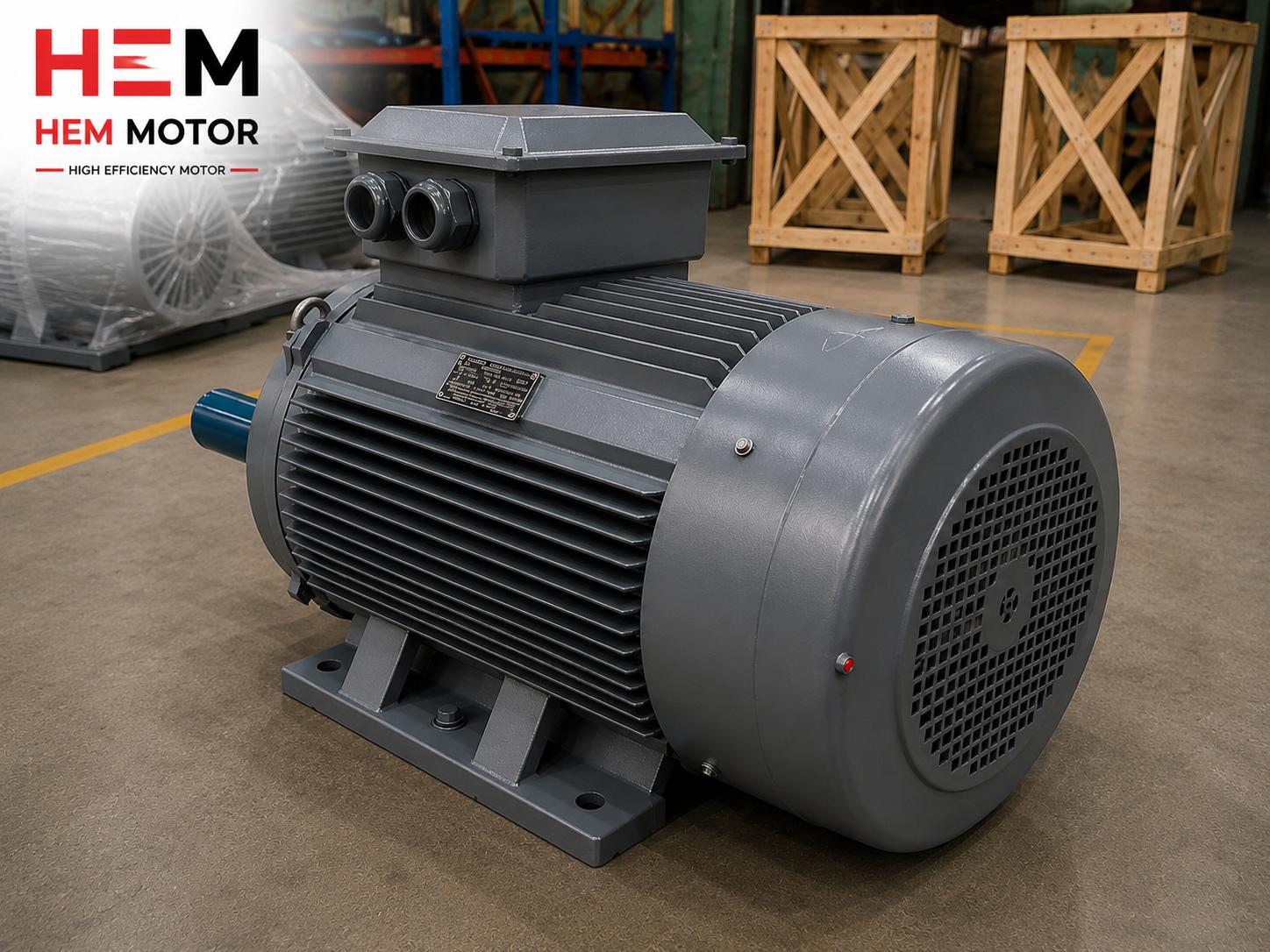

When selecting an electric motor, most businesses look only at the rated power (kW) and the speed (RPM). Yet in fans, mills, flywheel machines, centrifuges and large pulley drives, alongside power there is also the inertia of the load, and this inertia determines the motor's starting behaviour as much as power itself. With high-inertia loads, the motor draws high current and heats up for a long time until it brings the large stationary mass up to rated speed. If this process is not calculated correctly, the motor may burn out during start-up, the protection relay may keep tripping, or the motor may never reach rated speed at all. In this guide we define high inertia (WR² or GD²), explain how start-up time is determined, how the motor's thermal limit relates to this time, and how to select the correct power and motor starting method for fans, mills and flywheel machines.
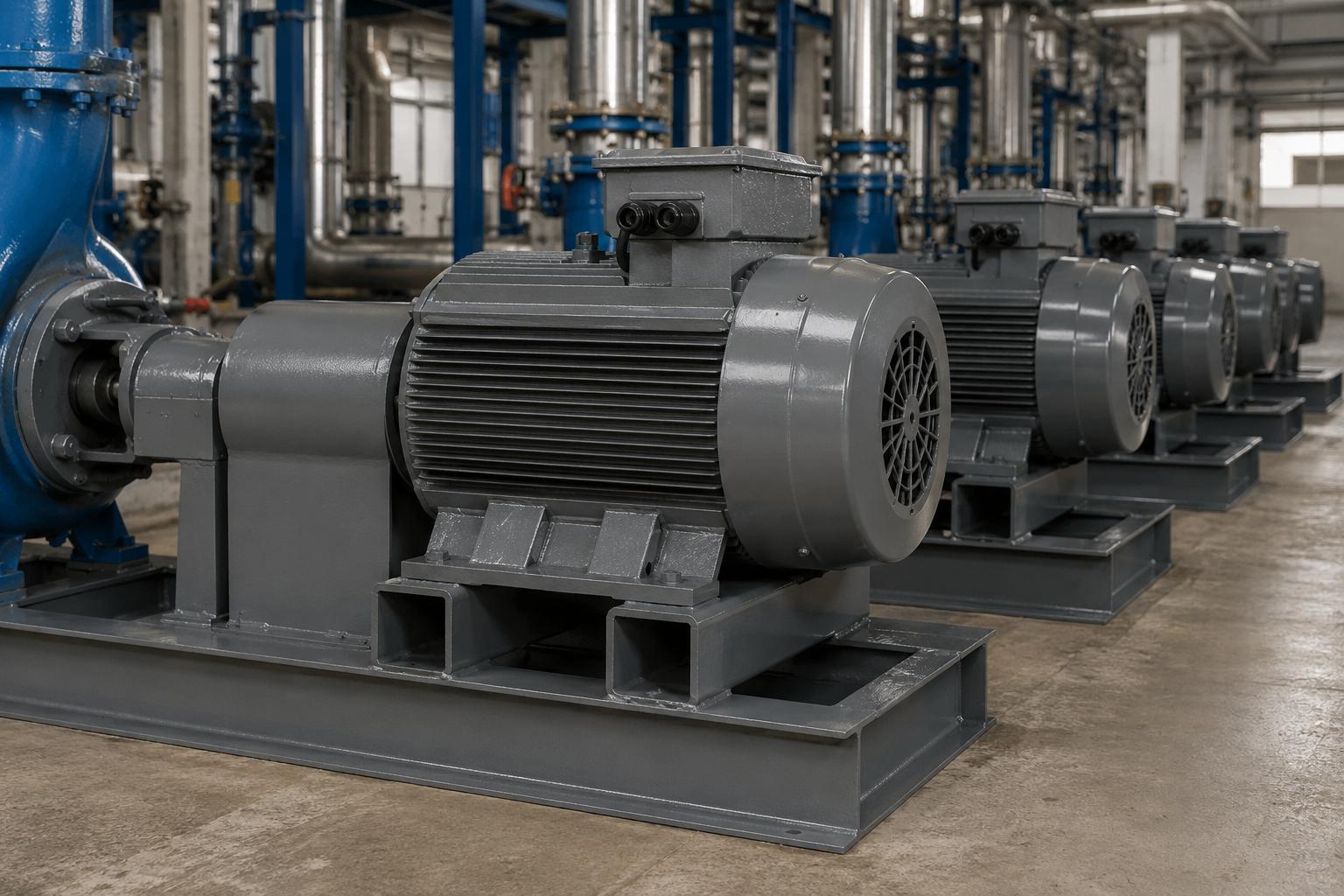
What Is Moment of Inertia? The WR² and GD² Concept
Moment of inertia is a measure of the resistance a rotating mass shows to a change in its speed. The heavier a flywheel or a large fan rotor is, and the farther its mass is from the axis of rotation, the higher its inertia. In industry this quantity is usually expressed as WR² (weight times radius squared) or equivalently as GD² (diameter squared). Both expressions describe the same physical reality: the energy and time required to accelerate the load.
The motor's rotor has its own inertia, and there is also the reflected inertia of the machine it drives. During start-up, the motor must accelerate both its own rotor and the connected load. If the load inertia is much greater than the motor inertia, the start-up time lengthens and the motor is loaded with starting current throughout this period. At this point, motor selection concerns not just its power but its acceleration capacity.
Typical High-Inertia Loads
Which machines are considered high-inertia? The most typical examples are:
- Large-diameter fans and blowers: Industrial forced-draught fans, flue gas fans, large ventilation fans.
- Mills: Large rotating masses such as hammer mills, ball mills and roller mills.
- Flywheel machines: Presses, shears, crushers that balance impact load with a flywheel.
- Centrifuges and separators: Large-drum machines rotating at high speed.
- Large pulley-belt drives: Conveyor and machine groups driven by heavy pulleys.
What all these machines have in common is that bringing the stationary mass up to operating speed can take seconds, sometimes tens of seconds. To examine the role of flywheel and inertia effects in impact loads in more detail, see our content on motor selection under impact load: flywheel, inertia and crusher drive.
The Relationship Between Start-Up Time and the Thermal Limit
A motor's start-up time arises from the balance between the total moment of inertia of the load and the accelerating torque the motor produces during loading. Accelerating torque is the difference between the motor's starting torque and the counter-torque of the load. The greater this difference, the faster the start-up. As load inertia grows, start-up time lengthens, and during this time the motor is loaded with a current several times its rated value.
The critical concept here is the motor's "locked rotor time" or "permissible hot/cold start time". The motor manufacturer specifies the maximum start-up time the winding can withstand without damage. If the calculated start-up time approaches or exceeds this limit, either a motor with higher starting torque must be selected or the starting current must be managed with a starting method. Otherwise, repeated starts shorten the winding's life.
The Difference Between Cold Start and Hot Start
A cold motor can withstand a longer start-up time than a motor whose winding is already heated. Therefore, successive starts within a shift are risky in terms of the motor's thermal accumulation. If a high-inertia load is to be started many times a day, motor selection must account not for a single start but for the start frequency as well. In this case a motor with high thermal capacity, F-class insulation and good cooling should be preferred.
Correct Power (kW) Selection: Not Just the Running Load
For high-inertia loads, power selection must meet two separate requirements at once. The first is the continuous running load, that is, the power drawn after the machine reaches rated speed. The second is the acceleration requirement during start-up. In some applications, even though the continuous running load is low, the start is demanding because of high inertia, requiring the motor to be selected according to its starting capacity rather than its running load.
It is therefore not enough to say "my machine draws 30 kW"; the question "with how many times the inertia and in how many seconds will I bring this machine up to speed" must also be answered. If you want to calculate motor power correctly for different load types such as pump, fan and conveyor, our guide on motor power calculation: required kW for pump, fan and conveyor is a good start. For a motor that suits your needs and current electric motor prices, you can contact our product team.
Choosing the Starting Method: The Right Strategy by Inertia
For high-inertia loads, the starting method directly affects both the starting current and the start-up time. The wrong starting method either burns out the motor or fails to bring the machine up to speed at all. Let us briefly summarize the main methods and their evaluation in terms of inertia.
Direct-On-Line Starting (DOL)
This is the simplest and cheapest method; the motor is energized directly at full voltage. Because it provides full starting torque, it is the method that accelerates a high-inertia load fastest, but the starting current is at its highest level. It is suitable for small powers and where the grid can handle the starting current.
Star-Delta Starting
This reduces the starting current to about one third but also reduces the starting torque by the same proportion. With high-inertia loads this reduced torque can create a problem; the load cannot reach speed in star position, and there is a current surge at the transition to delta. Star-delta is therefore not always suitable for high-inertia machines. We address the limits of the method comparatively in our article on starting AC asynchronous motors: star-delta or soft starter.
Soft Starter and Variable Frequency Drive (VFD)
A soft starter limits current by gradually raising the starting voltage and reduces mechanical shock. A VFD controls both frequency and voltage, bringing the motor up to speed at the lowest current and the desired ramp time; it is the most flexible solution for high-inertia loads. You can find when a VFD is necessary and how to select one in our content on variable frequency drive (VFD) with asynchronous motor.
The Inertia Problem When Running on a Generator
In a facility far from the grid running on a generator, the starting current of a high-inertia motor can strain the generator's instantaneous power capacity. In this case both correct generator sizing and soft starting must be considered together. We address the topic in detail in our article on motor selection and starting current on generator-powered sites.
The Effect of Speed Selection on Inertia and Start-Up
For a high-inertia load, speed selection directly affects the starting behaviour and the required motor power. When the same machine is driven by motors of different pole counts, the reflected moment of inertia and the starting torque requirement change. As a general rule, low-speed (6-pole, 1000 RPM) motors produce higher torque and make starting easier in some high-inertia, high-torque applications. 1500 RPM (4-pole) motors offer a balanced choice in terms of torque and efficiency and are the most commonly used speed.
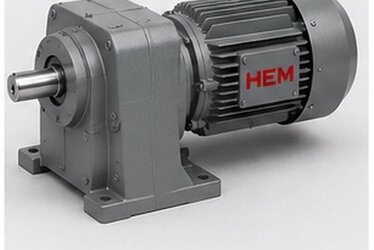
When selecting the speed, not only the machine's operating speed but also the torque that can be produced during start-up must be considered. In some applications, instead of driving the machine directly at the desired speed, the speed is reduced with a reducer or belt-pulley so that the motor works in a more comfortable torque region. In this case, the inertia reflected by the reducer and transmission elements must also be included in the total starting load. Correct speed and transmission selection ensures that the motor works at its most efficient point both during start-up and in continuous operation.
Inertia Reflected by Transmission Elements
The total inertia seen by the motor includes not only that of the driven machine but also the inertia of all the rotating elements in between (coupling, pulley, reducer, shaft). If there is a speed reducer between the machine and the motor, the machine's inertia is scaled by the square of the reduction ratio as it is reflected to the motor. This shows that an inertia that sometimes looks very large on the machine side drops to a more manageable value on the motor side. Calculating this reflection effect correctly is important so as not to select the motor's starting capacity larger or smaller than necessary.
Pre-Purchase Checklist
Before buying a motor for a high-inertia load, clarify the following:
- The machine's reflected moment of inertia (WR² / GD²) and continuous running load.
- Target start-up time and daily start frequency.
- The motor's permissible hot/cold start time and starting torque curve.
- The starting method to be used (DOL, star-delta, soft starter, VFD).
- Speed selection: 1500 RPM general, 1000 RPM high torque, 3000 RPM compact.
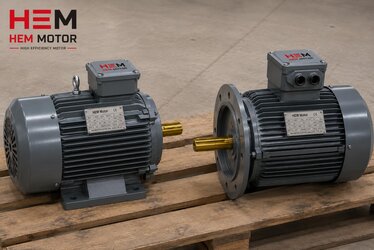
- Mounting type (B3/B5/B35), body material and IP protection class.
With this information, the motor is selected to safely carry both the running load and the starting load. In IE3 and IE4 efficiency class, over a wide range from 0.55 kW to 355 kW, with a cast iron body and robust bearing design, you can quickly supply motors suited to high-inertia applications.
Frequently Asked Questions
For a high-inertia load, should I select the motor by its power or by its starting?
You must evaluate both together. The continuous running load determines the motor's rated power; but if the load inertia is very high, the starting capacity becomes decisive. In some cases, even when the running load is low, high inertia requires a stronger motor, a motor with higher starting torque, or soft starting. The correct approach is to make the selection so that the start-up time stays below the motor's permissible thermal limit.
Are WR² and GD² the same thing?
Both express the rotational inertia of the load and can be converted into one another. WR² is based on weight times radius squared, while GD² is based on diameter squared. In practice motor and machine manufacturers provide these values as catalogue data; what matters is comparing the load's reflected moment of inertia with the value the motor can accept.
Why does star-delta cause problems on a high-inertia fan motor?
In star position the starting torque drops to about one third. If the fan's inertia is high, the motor cannot bring the load up to full speed in star position; and when switching to delta too early, a high current surge occurs. For this reason, a soft starter or variable frequency drive usually provides a safer and more controlled start for high-inertia loads.